
Edible
Date Palm
Phoenix dactylifera
Also known as Date, Nakhl, Tamr
How to grow date palm, Phoenix dactylifera. Sprouting a stone from a packet of dates, the male and female trees that have been hand-pollinated for five thousand years, and the desert heat a temperate summer cannot supply.
At a glance
- Difficulty
- Moderate
- Water
- Weekly in growth, sparingly in winter
- Light
- Full sun, and as much as can be given
- Temperature
- Survives a few degrees of frost. Needs sustained heat above 30 deg C to fruit
- Humidity
- Low. It wants dry air, which is unusual here
- Hardiness
- USDA 9-11, RHS H2, hardy to -6 C
- Type
- Tender to half-hardy evergreen palm, dioecious
- Height
- 20-30 m in the open, 2 m in a pot over many years
- Native to
- Mesopotamia, the Arabian peninsula
- Best month
- April, May and June in the Northern Hemisphere, October, November and December in the Southern Hemisphere
Desert oases of north Africa and the Middle East, and the old growers' rule states it exactly: feet in water and head in fire. The palm survives to about -6 deg C, and ripening the fruit needs extreme dry heat with a long rainless late summer, so it fruits in Arizona and the Coachella Valley and stands ornamental and barren on any humid coast.
Hardiness zones describe winter cold alone. Summer heat, humidity, rainfall and the length of the growing season decide as much, so treat the range as the outer limit rather than as a recommendation.
Every month named in this guide is for the temperate Northern Hemisphere. If you garden in the Southern Hemisphere, shift each one by six months, so April becomes October. Closer to the equator the wet and dry seasons matter more than the calendar, and the shift stops being a useful guide.
Not known to be toxic
- Safe to eat
- The fruit, and the growing point as a vegetable
Date palm is not toxic and the ASPCA does not list Phoenix dactylifera as harmful to cats or dogs. Dates are very high in sugar, which is worth knowing for anyone managing blood glucose and for dogs, where a large quantity causes stomach upset. The stone is hard, indigestible and a choking and obstruction hazard, so stoned dates are the safer thing to have in a house with small children or a dog. Note that the ornamental *Phoenix* species grown in pots, particularly *Phoenix roebelenii*, carry long needle-sharp spines at the base of the leaf stalk that cause painful puncture wounds and occasional infections, and the date palm has the same armament. Handle the leaf bases with care.
Sources: ASPCA toxic and non-toxic plants, RHS potentially harmful garden plants
About
Date stones from a packet of dates sprout readily, which makes this one of the easiest tropical plants to start from a kitchen. What follows is slow. A date palm takes five to eight years to look like anything and twenty to reach full size.
Fruiting is out of reach in a humid climate because the limiting factor is heat rather than cold. Date palms tolerate frost and need months above 30 deg C with low humidity to ripen a crop, which is why they grow in desert oases rather than in the humid tropics.
A hardiness zone would clear a date palm for any mild region above its winter minimum, most of which could never ripen the fruit. Why two gardens in one zone grow different plants takes up the heat and the humidity a cold map cannot show.
The species is dioecious, and human hands have been solving that for a very long time. Assyrian reliefs from the ninth century BC show figures pollinating date palms by hand, and the practice continues unchanged in every commercial grove today.
Appearance and character
A single trunk to 20 or 30 m, covered for much of its height in the persistent woody bases of old leaves, which give it a rough diamond-patterned surface.
Suckers appear around the base of a young palm, and these offshoots are how named cultivars are propagated, since seedlings are variable and half of them are male.
The crown carries 20 to 40 stiff, arching, grey-green pinnate leaves, each 3 to 5 m long.
The lower leaflets on each leaf are modified into long sharp spines, which are dangerous to handle.
Flowers come in a large branched spadix from a leaf axil, enclosed at first in a tough spathe. Male and female flowers are on separate trees, males cream and heavily scented, females small and yellow-green.
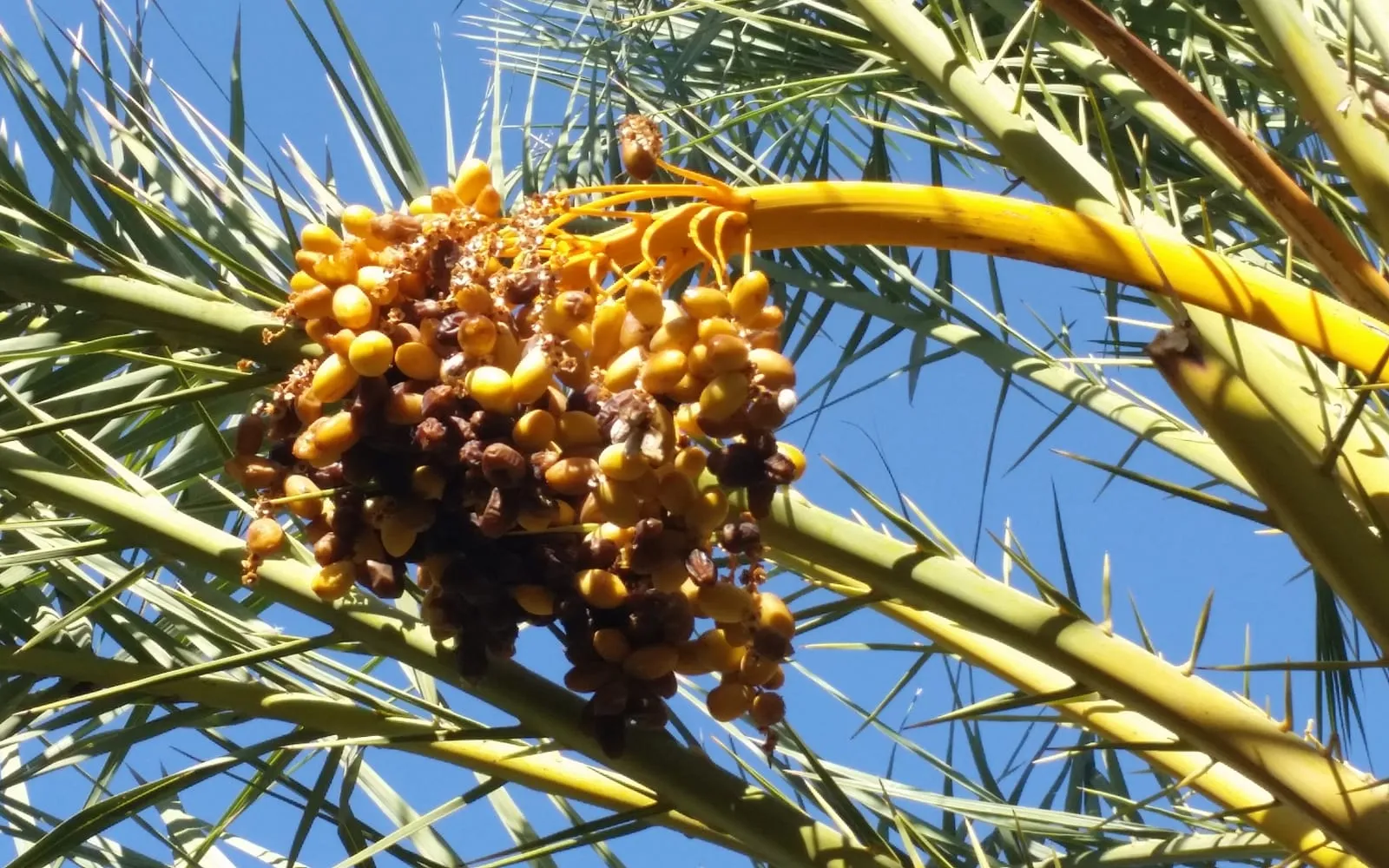
Fruit hangs in enormous bunches, each oval, 3 to 7 cm, ripening through yellow or red to brown as it dries and sweetens.
The three ripening stages have Arabic names still used in trade. Khalal is crisp and astringent, rutab is soft and partly browned, and tamr is the fully dried date sold in Europe.
The stone is hard, grooved along one side, and germinates readily.
Where it is from
Date palm was domesticated in the region running from Mesopotamia through the Arabian peninsula, and the archaeological record puts cultivation at six to seven thousand years ago.
No certain wild population survives, which is common for a crop this old and this thoroughly managed.
The palm made settled life possible in oases. It gave food that stored for a year without processing, shade for crops beneath it, timber, leaves for thatch and baskets, and sap for sugar.
Hand pollination is as old as the cultivation. Assyrian palace reliefs show winged figures holding what are usually read as male flower clusters against female palms, and the practice has been continuous ever since.
Egypt, Saudi Arabia, Iran, Algeria and Iraq are the largest producers. Medjool and Deglet Nour are the two cultivars a supermarket is most likely to sell.
Bayoud disease, a soil fusarium, has destroyed a large part of the Moroccan and Algerian groves over the last century and there is no cure.
Red palm weevil is the other defining threat to date palms grown outdoors. Native to South and Southeast Asia, it reached the Middle East in the 1980s and has since spread across North Africa and the Mediterranean, hollowing out the trunk from within until the crown collapses with little warning. There is no cure once a palm is heavily infested, so prevention through certified stock and pheromone trapping matters more than treatment. It has never established in most of North America, Australia or New Zealand, and a find in any of those is treated as a biosecurity emergency.
Desert locust swarms strip the fronds of young palms and can take the developing fruit off a mature grove during an upsurge, across an invasion area spanning North and West Africa, the Middle East and south-west Asia that overlaps most of the world’s commercial date-growing regions. A hopper band or swarm within that range should be reported to the national locust control authority immediately.
How it grows
Take stones from fresh soft dates rather than heavily dried ones, since some commercial dates are heat-treated and the stones are dead.
Clean the stones and soak them for two or three days, changing the water daily.
Sow at 25 to 35 deg C in sandy free-draining compost, 2 cm deep. Germination takes one to three months and is uneven.
Expect a strange first leaf. Date palms germinate remotely, sending a tube down from the seed before the first leaf appears at the surface some distance away, so plant them in a deep pot.
Grow in full sun in a very free-draining sandy mix.
Water weekly in growth and let the compost dry well down between waterings. This is a desert plant and overwatering is the commonest way to kill one.
Keep humidity low. Date palm is one of the few plants here that prefers dry air.
Feed monthly from April to September with a palm feed.
Overwinter cool and dry, above freezing. It tolerates a few degrees of frost once established, though a pot plant is more vulnerable.
Accept that fruit is not possible outside a desert climate. Months above 30 deg C with dry air are needed to ripen a crop.
Through the seasons
Winter is a cool dry rest above freezing. Water rarely and feed nothing.
Spring brings new growth as light and warmth return. Repot if needed and start feeding.
Early summer is the main growing period, and a healthy plant makes two or three new leaves a year.
Midsummer is peak growth. Stand it outdoors in full sun in a warm summer.
Late summer is when growth slows as the light drops.
Autumn is when to stop feeding, reduce watering and bring the plant back under cover.
Care difficulty
Moderate as a foliage plant, and impossible as a fruit crop outside the tropics.
Overwatering is the main fault. This is a desert palm and it wants to dry out between waterings.
Cold tolerance is good for a palm. It survives a few degrees of frost in the ground, though a pot plant needs protection.
Dry air suits it, which makes it a better indoor plant than almost anything else in this collection.
Growth is slow. Five to eight years to look substantial, and twenty to reach size.
The spines at the leaf bases are dangerous and need respect when repotting.
Fruit needs sustained desert heat, and no arrangement outside a desert climate supplies it.
Watering
Water weekly in growth, giving a deep soak.
Allow the compost to dry well down between waterings. A date palm tolerates drought and does not tolerate a permanently damp pot.
Reduce to occasional watering through winter, keeping the compost nearly dry.
Drain fully every time.
Tap water is fine, including hard water, since this species tolerates alkalinity and salt.
Keep humidity low. Misting is unnecessary and unhelpful.
Water outdoor pots less than you would expect, even in a temperate summer.
Warning signs, diseases and pests
Yellowing and browning of the lower leaves is normal ageing. Palms shed their oldest leaves continuously.
Orange or yellow mottling on older leaves is potassium or magnesium shortage, which pot-grown palms show routinely.
Brown crisp leaf tips usually mean salt build-up from feed rather than dry air, since this species likes dry air.
Fine webbing on the leaflets is spider mite.
Brown limpets along the leaf stalks are scale.
A soft rotting crown means the single growing point has gone, and the palm cannot recover.
Wilting with damp compost is root rot from overwatering.
New leaves smaller than the last means the plant is short of light, food or root space.
Growing environment
A conservatory, greenhouse or a bright room, standing outdoors in a warm summer.
Minimum a little above freezing for an established plant, though frost free is safer in a pot.
Full sun, and as much as can be given.
Low humidity, which is unusual for this collection.
Sandy very free-draining compost, around half sharp sand or grit.
pH from 6.0 to 8.0, tolerating alkaline ground.
A deep pot, because of the remote germination habit and the deep root system.
Care around the spines at the leaf bases.
Feeding
Feed monthly from April to September with a palm feed.
Choose one containing magnesium and potassium, which pot palms run short of.
Stop feeding at the end of September.
Give nothing through winter.
Repot every second or third spring into a deeper pot.
Correct orange mottling on older leaves promptly, since a palm cannot repair a leaf once it has formed.
Avoid heavy nitrogen, which produces soft growth on a plant built for hard conditions.
Troubleshooting
Will a stone from a packet of dates grow? Usually. Take stones from fresh soft dates rather than heavily dried ones, since some are heat-treated and the stones are dead. Soak for two or three days and sow warm.
Why has nothing appeared at the surface? Date palms germinate remotely, pushing a tube down from the seed before the first leaf emerges some distance away. Use a deep pot and be patient. It can take three months.
Will it fruit outside the tropics? No. Date palms need months above 30 deg C with dry air to ripen fruit, which is why they grow in desert oases. Cold is not the obstacle; heat is.
Do I need two plants? For fruit, yes. The species is dioecious and commercial groves are almost all female, hand-pollinated from a few males, exactly as Assyrian reliefs show being done three thousand years ago.
How often should I water it? Less than you think. Water weekly in growth, let the compost dry well down, and water rarely in winter. Overwatering kills more pot-grown date palms than anything else.
The lower leaves keep going brown. Normal. Palms shed their oldest leaves as they grow. Orange mottling on older leaves is different and means potassium shortage.
Something spiked me when I repotted it. The lower leaflets are modified into long sharp spines. They cause painful puncture wounds and need real care.
How hardy is it? An established plant in the ground takes a few degrees of frost. A plant in a pot has exposed roots and needs to be kept frost free.
Date Palm problem guides
Not sure what is wrong? See the common vegetable pests guide.
- Scale insects on the leaf stalks
- Spider mite in dry indoor air
- Root rot from overwatering, which is the commonest fault
- Potassium and magnesium shortage in pots
- Bayoud disease, the fusarium wilt that has destroyed North African groves
- Red palm weevil, which has killed date and canary palms across the Mediterranean
- Desert locust, which strips young palms and fruit during a swarm year