
Edible
Coconut
Cocos nucifera
Also known as Coconut palm, Coco, Nariyal
How to grow coconut, Cocos nucifera. Sprouting one on a windowsill, the three eyes, coconut water, coconut milk and the limits of an indoor palm.
At a glance
- Difficulty
- Difficult
- Water
- Two or three times a week year round
- Light
- Full sun
- Temperature
- Minimum 18 deg C. It suffers below 15 deg C and dies below about 7 deg C
- Humidity
- High
- Hardiness
- USDA 10-12, RHS H1b, hardy to 13 C
- Type
- Tender evergreen palm
- Height
- 20-30 m in the open, 1.5-2 m in a pot before it declines
- Native to
- the western Pacific, South East Asia
- Best month
- May and June in the Northern Hemisphere, November and December in the Southern Hemisphere
Tropical coasts, and the requirement is a mean temperature near 27 deg C with no cool season at all. It fruits poorly wherever the annual mean drops below about 21 deg C, which is why the palms of subtropical seafronts stand green and barren. Salt spray suits it.
Hardiness zones describe winter cold alone. Summer heat, humidity, rainfall and the length of the growing season decide as much, so treat the range as the outer limit rather than as a recommendation.
Every month named in this guide is for the temperate Northern Hemisphere. If you garden in the Southern Hemisphere, shift each one by six months, so May becomes November. Closer to the equator the wet and dry seasons matter more than the calendar, and the shift stops being a useful guide.
Not known to be toxic
- Safe to eat
- The flesh, the water, and the growing point of the palm
Coconut is not toxic and the ASPCA does not list it as harmful to cats or dogs, though it notes that the oil and flesh can cause loose stools in pets because of the fat content. Coconut water is high in potassium, which matters for anyone with kidney disease or on potassium-sparing medication, and there are case reports of dangerous potassium levels after drinking large volumes. Coconut allergy exists and is uncommon; it is a tree nut for labelling purposes in the United States and is treated separately from tree nut allergy in most clinical practice. The real hazard associated with the plant is mechanical. A falling coconut weighs one to two kilograms and drops from twenty metres, and injuries and deaths from them are recorded often enough that resorts remove the nuts from palms over paths.
Sources: ASPCA toxic and non-toxic plants, RHS potentially harmful garden plants
About
A coconut will sprout on a windowsill and it will not become a coconut palm. The nut has enough food inside to push out a shoot and a few leaves, and the seedling then needs a level of heat, light and humidity that no ordinary house supplies, so it declines over a year or two.
The three dark eyes at one end are the giveaway for how it germinates. Two are sealed and one is soft, and the shoot comes through that single soft eye, which is also the one to pierce when opening a fresh nut for the water.
Coconut water and coconut milk are different things and shops muddle them. Water is the clear liquid inside a young green nut. Milk is made by grating the white flesh of a mature nut and pressing it with hot water, and no coconut contains it.
Appearance and character
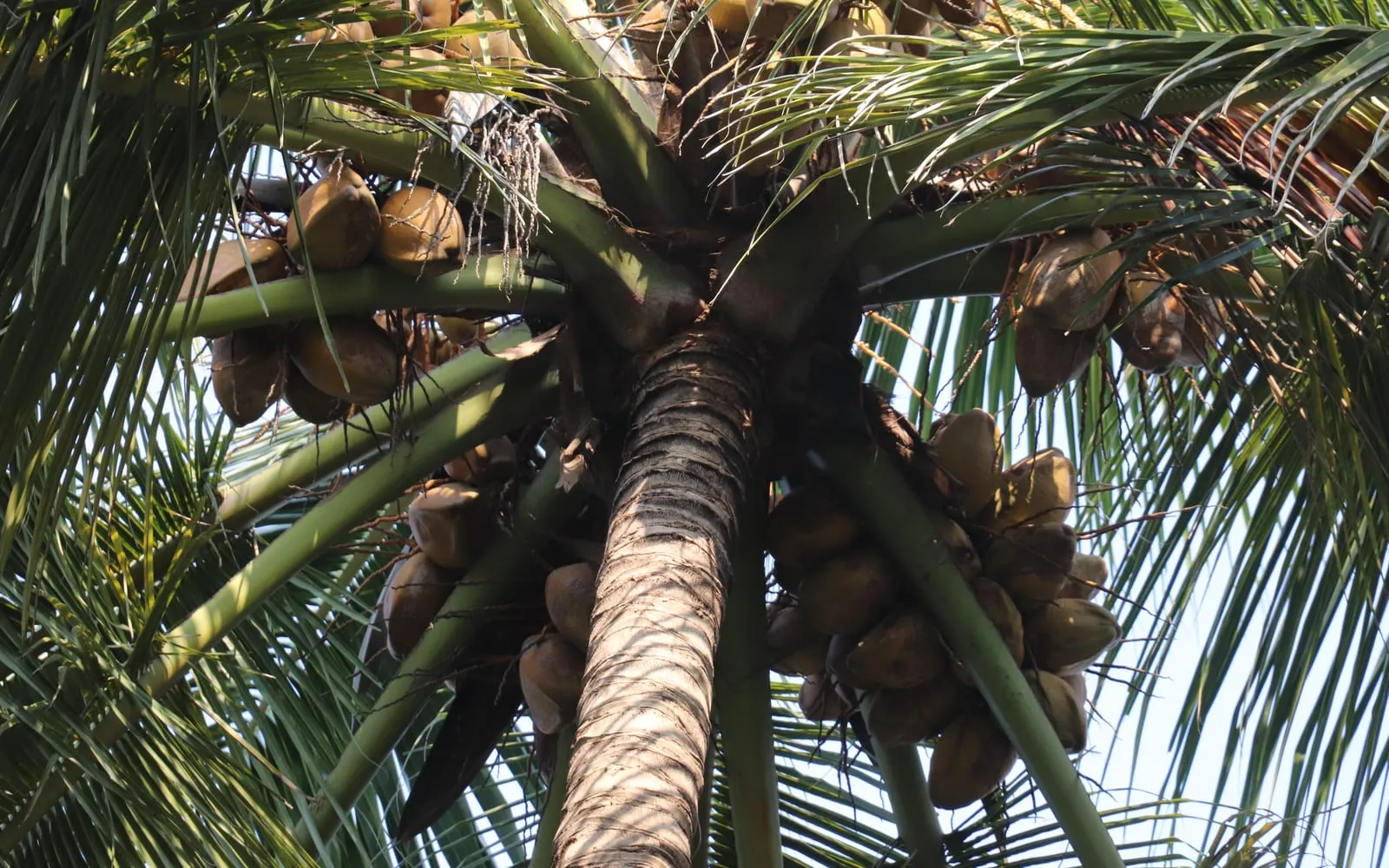
A single unbranched trunk, grey and ringed with old leaf scars, usually curved rather than straight, to 20 or 30 m.
The trunk has no growth rings and no bark in the usual sense, and it does not thicken once formed. A palm’s diameter is set at the base early in life.
The crown carries 25 to 30 pinnate leaves, each 4 to 6 m long, arching, with leaflets ranged along both sides of a stout midrib.
Flowers come in a large branched spadix from a leaf axil, with small female flowers at the base of each branch and many more male flowers above.
Fruit is a drupe rather than a nut. The green or yellow outer skin covers a thick fibrous husk, which is coir, and inside that is the hard shell with three germination pores at one end.
Inside the shell, a young nut holds mostly water with a soft jelly lining. As it matures the jelly thickens into the firm white flesh, and the water reduces.
Roots are fibrous and numerous, emerging continuously from the base of the trunk rather than thickening with age.
Where it is from
The coconut’s origin is contested, and genetic work has narrowed it to two separate domestications, one in the western Pacific around island South East Asia and one in the Indian Ocean around southern India and Sri Lanka.
The nut floats and stays viable in seawater for months, so the species colonised tropical coastlines on its own long before people moved it, and separating natural from human-assisted spread is difficult.
Austronesian voyagers carried the Pacific type east across the ocean, and traders carried the Indian Ocean type west to East Africa. The two lineages met in the Caribbean when European ships brought both.
Every part of the plant has a use, which is why it is called the tree of life across the tropics. Flesh, water, oil, coir, timber, thatch, sap for sugar and toddy.
Indonesia, the Philippines and India are the largest producers. Lethal yellowing, a phytoplasma disease spread by a planthopper, has killed millions of palms across the Caribbean and Florida since the 1970s and remains untreatable.
How it grows
Buy a fresh unhusked or partly husked nut if you can. A supermarket coconut has had the husk removed and the flesh may be old, and those sprout poorly.
Soak the nut in water for two or three days.
Lay it on its side, half buried, in a large pot of sandy free-draining compost, with the three eyes at one end sitting at compost level.
Keep it at 27 to 30 deg C, in high humidity and full light. Germination takes three to six months and needs sustained warmth throughout.
Keep the compost damp but never waterlogged.
Leave the nut attached once the shoot appears. The seedling feeds off it for its first year and removing it kills the plant.
Feed monthly from April to September with a palm feed containing magnesium, potassium and manganese.
Keep the temperature above 18 deg C and the humidity high year round.
Understand the ceiling. A pot-grown coconut outside the tropics is a two to three year plant. It will not fruit, will not reach any size, and declines when the nut’s reserves are gone and conditions are short of what it needs.
Through the seasons
Winter is the season that ends most coconuts grown indoors. Hold above 18 deg C with high humidity and reduced watering.
Spring brings renewed growth as light returns. Start feeding.
Early summer is the main growing period, and a healthy plant produces a new leaf every couple of months.
Midsummer is peak growth, with the highest light and warmth of the year.
Late summer is when to make sure the plant goes into autumn in good condition, since a weak plant will not survive winter.
Autumn is when to stop feeding and raise the humidity as the heating comes on.
Care difficulty
Difficult, and one of the few plants in this collection where the honest advice is that it cannot be done properly outside the tropics.
Constant heat is the first requirement. Minimum 18 deg C, ideally 27 to 30 deg C, with no cool period at all.
High humidity is the second, and a heated house in winter is far too dry.
Full sun is the third, and cool winter light is a fraction of what a coconut palm evolved under.
The nut carries the seedling for about a year, which is why a windowsill coconut looks healthy for its first months and then stops.
Fruiting needs six to ten years, twenty metres of space and a tropical climate.
Sprouting one in a warm bright bathroom is a satisfying thing to do, and a short-term novelty is what it should be attempted as.
Watering
Water two or three times a week year round, keeping the compost evenly damp.
Drain fully. Coconut grows in sand and will not tolerate a saturated pot.
Never let it dry out. The roots die back quickly and do not recover.
Keep humidity high with misting, damp gravel and grouping.
Use tepid water.
Reduce watering slightly in winter without letting the compost dry.
A little salt is tolerated and none is required, despite the plant’s reputation. Coconuts grow on beaches because the nuts float there rather than because they need salt.
Warning signs, diseases and pests
Brown crisp leaf tips are the standard indoor complaint and mean dry air.
Orange or yellow mottling on older leaves is potassium or magnesium shortage, which palms in pots suffer from routinely.
Fine webbing and stippling on the leaflets is spider mite, which coconut collects faster than almost any other plant indoors.
Brown limpets along the leaf stalks are scale.
New leaves emerging smaller than the last is decline, and it usually means light or heat is insufficient.
A soft rotting shoot at the crown means the growing point has gone, and a palm with one growing point cannot recover.
Wilting in damp compost is root rot.
The nut shrivelling and detaching after a year is normal, provided the plant has established roots by then.
Red palm weevil is a serious outdoor threat rather than an indoor one, hollowing out the trunk from within until the crown collapses. It is native to Asia and has since spread across North Africa and the Mediterranean. There is no cure once heavily infested, so certified stock and pheromone trapping matter more than treatment. It has never established in most of North America, Australia or New Zealand.
Coconut rhinoceros beetle leaves clean, V-shaped cuts across unfurled fronds, damage done weeks earlier while the leaf was still folded in the crown. Native to Africa and tropical Asia, it has spread through much of the Pacific and continues gaining ground, having reached Guam in 2007 and Hawaii in 2013. Clear rotting logs and compost near palms, since that is where it breeds.
Growing environment
A heated humid glasshouse, or a very warm bright bathroom for a short-term plant.
Minimum 18 deg C, ideally 27 to 30 deg C, with no cool rest.
High humidity year round.
Full sun.
Sandy very free-draining compost, around half sharp sand or grit.
pH from 5.5 to 7.0.
A deep pot, since the root system is extensive even on a young plant.
Realistic expectations, which matter more with this species than with any other here.
Feeding
Feed monthly from April to September with a palm feed.
Choose one containing magnesium, potassium and manganese, which are the three palms run short of in pots.
Stop feeding at the end of September.
Give nothing through winter.
Do not feed a newly sprouted nut for its first few months, since it is living on its own reserves.
Repot into a deeper pot each spring while the plant is growing.
Watch for orange mottling on older leaves, which signals potassium shortage and needs correcting before the next leaf forms.
Troubleshooting
Will a supermarket coconut sprout? Sometimes. The husk has been removed and the nut may be months old, both of which reduce the odds. A fresh nut with some husk still on is far more reliable.
How long does germination take? Three to six months at 27 to 30 deg C. It needs sustained warmth, not a warm week.
Which end goes up? Lay the nut on its side, half buried, with the three eyes at one end at compost level. The shoot emerges through the single soft eye.
Should I take the nut off once it sprouts? No. The seedling feeds off it for about a year, and removing it kills the plant.
What is the difference between coconut water and coconut milk? Water is the clear liquid inside a young green nut. Milk is made by grating the white flesh of a mature nut and pressing it with hot water. No coconut contains milk.
The leaf tips have gone brown. Dry air. Coconut needs high humidity and a heated room in winter is far too dry.
Will it ever fruit? No, not outside the tropics. Fruiting takes six to ten years, a tropical climate and twenty metres of space.
My plant looked fine for a year and then stopped. The nut’s reserves ran out. From that point the plant depends entirely on light, heat and humidity, and a cool temperate climate do not supply enough of any of them.
Coconut problem guides
Not sure what is wrong? See the common vegetable pests guide.
- Spider mite in dry heated air, which coconut collects readily
- Scale insects on the leaf stalks
- Root rot in cold wet compost
- Potassium and magnesium shortage, showing as orange leaf tips
- Red palm weevil, established across Asia, North Africa and the Mediterranean
- Coconut rhinoceros beetle, an established and still-spreading Pacific invader