
Edible
Bay laurel
Laurus nobilis
Also known as Bay tree, Sweet bay, True laurel
How to grow bay, Laurus nobilis. Clipping a standard, overwintering it in a pot, treating bay sucker and scale, and telling true bay from poisonous cherry laurel.
At a glance
- Difficulty
- Easy
- Water
- Weekly in summer for a potted plant, rarely once established in soil
- Light
- Full sun to partial shade
- Temperature
- Hardy to about -5 deg C in a pot and lower in the ground
- Hardiness
- USDA 8-10, RHS H4, hardy to -10 C
- Type
- Evergreen shrub or small tree, long-lived
- Height
- 1-2 m clipped, and 8-12 m left alone
- Native to
- The Mediterranean basin
- Best month
- November in the Northern Hemisphere, May in the Southern Hemisphere
A bay in the open ground is a good deal hardier than the same plant in a pot, because a container root ball freezes right through while soil does not, and most losses are pots rather than plants. Cold drying wind scorches the leaves without killing the tree. It regrows from the base after a hard winter cuts it down.
Hardiness zones describe winter cold alone. Summer heat, humidity, rainfall and the length of the growing season decide as much, so treat the range as the outer limit rather than as a recommendation.
Every month named in this guide is for the temperate Northern Hemisphere. If you garden in the Southern Hemisphere, shift each one by six months, so November becomes May. Closer to the equator the wet and dry seasons matter more than the calendar, and the shift stops being a useful guide.
Edible, with limits
- Safe to eat
- The leaves, used whole as a flavouring and lifted out before serving
- Do not eat
- The leaves in quantity, and the whole leaf itself as a physical hazard
- Harm from
- Eating it
- Affects
- People, cats, dogs and horses
Bay is a culinary herb with two separate cautions, and neither is a reason to avoid growing it. The first is physical. A bay leaf stays stiff and leathery through hours of cooking and its edges remain sharp, so a whole leaf that is swallowed can lodge in the throat or scratch the gut wall. Cases requiring endoscopy are documented. Add the leaf whole and remove it before serving, which is the reason recipes have always said so. The second concerns quantity. The ASPCA lists Laurus nobilis as toxic to cats, dogs and horses because the essential oils, chiefly eugenol and cineole, cause vomiting and diarrhoea when eaten in bulk, and a browsing animal can strip a great deal more than a cook uses. A far more important point is one of identification. Cherry laurel, Prunus laurocerasus, is the common hedging shrub of temperate gardens, it is not related to bay, and its leaves contain cyanogenic glycosides that release hydrogen cyanide. Cherry laurel leaves are broader, glossier and smell of marzipan when crushed, whereas bay is narrower, matt and smells of the kitchen. Never cook with a leaf picked from a hedge unless you are certain which plant it came from.
Sources: ASPCA (Bay Laurel, Laurus nobilis), RHS potentially harmful garden plants
About
Bay is the only evergreen in a temperate herb garden that earns its place twice over. It supplies leaves every month of the year, including January when the rest of the herb bed is bare ground, and clipped into a cone or a standard it holds a doorway together through the winter.
It also asks for almost nothing. A bay in free-draining soil in a sheltered corner will outlive the person who planted it, growing slowly enough that a single annual clip keeps it in shape.
The two things that kill bay are both about water and cold rather than neglect. A pot standing in winter wet rots at the root, and an exposed position in a hard frost browns the foliage.
Appearance and character
An evergreen shrub or small tree, dense and upright, growing 8 to 12 m if left alone and kept anywhere between 1 and 2 m by clipping.
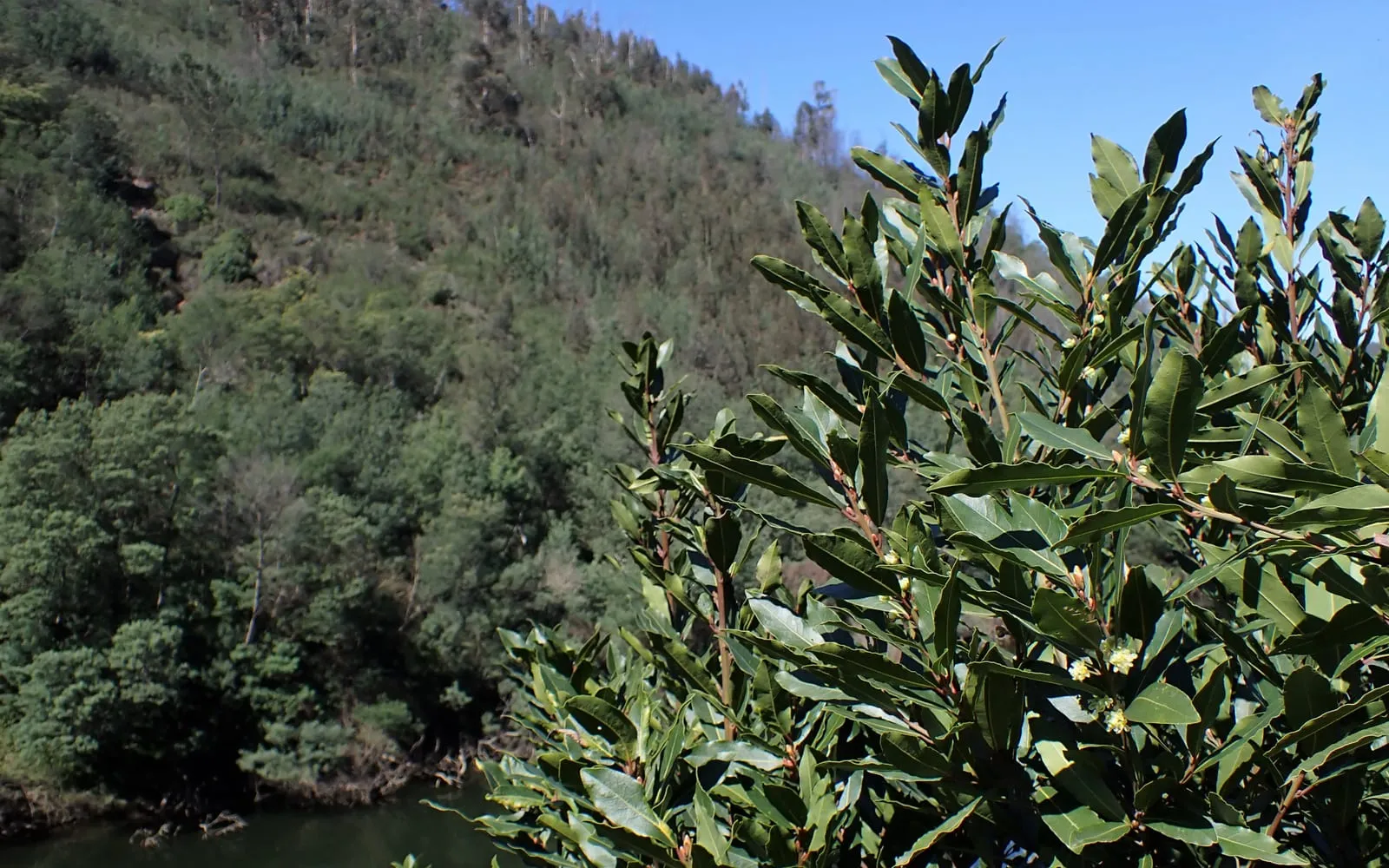
Leaves are 6 to 10 cm long, narrow and oval with a pointed tip, dark green, matt rather than glossy, with a slightly wavy edge and a leathery feel. Crushing one releases the familiar warm savoury smell.
Bark is smooth and grey-green on young wood, darkening and roughening with age.
Flowers are small, pale yellow-green and clustered in the leaf axils in April, pleasant rather than showy.
The species is dioecious, meaning male and female flowers grow on separate plants. Only a female bay produces the small black berries, and only where a male is nearby.
Growth is slow. A bay standard in a pot puts on perhaps 20 to 30 cm a year, which is part of why a well-shaped specimen costs what it does.
Where it is from
The Mediterranean basin, where it grows in scrub and open woodland on dry rocky hillsides with hot summers and mild wet winters.
Free-draining ground and summer drought are what it is built for, which is the whole explanation for the two rules about not overwatering and not letting a pot sit wet through the winter.
Its classical history is written into the English language. The laurel wreath crowned victors, poets and emperors, giving us “poet laureate” and, by way of the berries, “baccalaureate” from bacca laureus.
The Greek myth of Daphne, transformed into a laurel to escape Apollo, made the tree sacred to him, and laurel branches were burned at Delphi.
Bay has been grown in Britain since at least the sixteenth century, and the limit on where it thrives here is winter wet rather than winter cold.
How it grows
Plant in spring so the roots establish before winter, into free-draining soil or into a container of loam-based compost with added grit.
Choose a sheltered position out of cold drying wind, ideally with the shelter of a wall.
Clip in early summer, around June, and again lightly in late summer if needed. Use secateurs rather than shears, cutting each shoot individually just above a leaf, because shears slice through the large leaves and leave brown-edged halves all over the plant.
Do not clip after early September. Late growth pushed out by pruning has no time to harden and is the first thing damaged by frost.
For a standard, select one strong upright stem, remove the side shoots from the lower two thirds, and clip the head into shape each summer.
Repot container plants every two or three years in spring, or top-dress if the plant has reached its final pot.
Pick leaves at any time of year. Older, darker leaves carry more flavour than the soft new ones, and drying concentrates it further.
Take semi-ripe cuttings in late summer, which root slowly and unevenly.
Through the seasons
Winter is the season that tests it. Move containers to a sheltered spot against a wall, raise them on pot feet so they drain, wrap the pot rather than the plant in a hard frost, and cut watering right back.
Spring brings new growth and the small yellow flowers. Repot or top-dress, begin feeding, and cut out any winter-damaged shoots once the risk of frost has passed.
Summer is the clipping season. Shape in June, water containers regularly, and watch for bay sucker on the new growth.
Autumn is for tidying and moving. Stop feeding, reduce watering, and get containers into their winter position before the first hard frost.
Care difficulty
Easy, provided the drainage is right.
Overwatering kills more bay trees than anything else, especially in containers left standing in saucers over winter.
Winter cold and wind cause the browning that alarms people every February. The plant usually recovers from the base, and cutting the damage out in spring is the whole treatment.
Bay sucker disfigures the leaves without killing the plant.
Growth is slow enough that a shape, once achieved, is easy to keep.
Watering
Water container plants thoroughly and then wait until the top few centimetres of compost have dried before watering again. Constant damp is what rots the roots.
Cut watering back sharply from October, giving only enough to stop the compost drying out completely through the winter.
Never leave a pot standing in a saucer of water, and raise containers on feet so they drain freely.
Plants in the ground need watering only through their first two summers. After that they cope with drought without help.
Yellowing lower leaves on a container plant are more often a sign of waterlogging than of thirst, so check the compost before reaching for the can.
Warning signs, diseases and pests
Bay sucker is the pest you will meet. Adults and nymphs feed under the leaf edges in spring and summer, causing the margins to thicken, curl downward and turn yellow then brown, often with a white waxy fluff underneath. It is disfiguring rather than fatal. Pick off affected leaves and destroy them, and encourage predators rather than spraying.
Scale insects appear as flat brown discs along the stems and leaf undersides, and they excrete honeydew that grows black sooty mould over the foliage. Wipe them off with a damp cloth on a small plant, and treat a heavy infestation in late spring when the young are moving.
Brown scorched leaves in late winter are cold and wind damage rather than disease. Wait until spring, cut back to live wood, and the plant reshoots.
Yellow leaves overall usually mean waterlogging, cold roots or a hungry container plant that needs repotting.
Sudden wilting of a potted bay in summer often means vine weevil grubs have eaten the roots. Check the rootball.
Sooty mould washes off with soapy water once the scale causing it is dealt with.
Laurel wilt kills a tree fast outdoors, wilting the foliage to reddish-brown while it stays attached rather than dropping, with dark staining inside the wood. Spread by an ambrosia beetle native to Asia, it has established across the southeastern United States since the early 2000s and bay laurel is a confirmed host. There is no cure; never move firewood from an affected area.
Growing environment
Full sun gives the densest growth, and bay tolerates partial shade with a looser habit.
Free-draining soil is the single non-negotiable requirement. Add grit to heavy ground, or grow in a container where you control the drainage entirely.
Shelter from cold easterly wind, which does more damage than frost alone.
A container suits it well and has the advantage of restraining the roots, which keeps a standard in proportion. Use loam-based compost with added grit rather than a peat-free multipurpose on its own.
In cold gardens, a porch, unheated greenhouse or the lee of a house wall gets a potted bay through winter reliably.
Bay makes a good informal hedge in mild coastal areas and dislikes inland frost pockets.
Feeding
Feed container plants monthly from April to August with a balanced liquid fertiliser, or apply slow-release granules once in spring.
Stop feeding by the end of August so growth hardens before winter.
Plants in the ground need little. A mulch of compost in spring is usually enough.
Yellowing leaves on a pot-bound plant respond better to repotting than to feeding.
Avoid high-nitrogen feeds, which produce soft growth that bay sucker and frost both find easy.
Troubleshooting
The leaf edges have gone thick, curled and yellow. Bay sucker. Remove the affected leaves and destroy them. The plant is not in danger.
The whole tree browned over winter. Cold and wind scorch. Leave it until spring, cut back to live wood, and it will reshoot from the base if the roots survived.
Brown patches in the middle of every leaf after clipping. Shears cut through the large leaves. Use secateurs and cut each shoot above a leaf instead.
Sticky leaves with black sooty deposit. Scale insects. Wipe the stems and leaf undersides, then wash off the mould with soapy water.
Is bay the same as the laurel in hedges? No, and the difference matters. Hedging laurel is usually cherry laurel, Prunus laurocerasus, whose leaves release cyanide. Bay leaves are narrower and matt and smell savoury, while cherry laurel is broad and glossy and smells of marzipan.
Can I leave it outside all winter? In the ground down to about -10 deg C, yes. In a pot, move it somewhere sheltered, keep it on the dry side, and wrap the container in a hard frost.
Should I use fresh or dried leaves? Either. Dried leaves have a stronger flavour, and picking fresh from your own plant gives you a milder, greener taste that many people prefer.
Why is it growing so slowly? Bay is slow by nature, and a container plant is slower still. Repotting every two or three years and feeding through summer is as fast as it gets.