
Edible
Grape vine
Vitis vinifera
Also known as Grapevine, Common grape vine
How to grow grapes, Vitis vinifera. Choosing outdoor or greenhouse varieties, the rod and spur system, thinning the bunches, and why powdery mildew decides the crop.
At a glance
- Difficulty
- Moderate
- Water
- Regularly while the fruit swells, then reduce
- Light
- Full sun against a south or west-facing wall
- Temperature
- Hardy in wood to -15 deg C. The new growth is frost-tender
- Hardiness
- USDA 6-10, RHS H5, hardy to -18 C
- Type
- Deciduous climber, productive for fifty years and more
- Height
- 3-10 m depending on training
- Native to
- The Caucasus and the eastern Mediterranean
- Best month
- September in the Northern Hemisphere, March in the Southern Hemisphere
Accumulated summer heat decides where wine grapes ripen, and the usual measure is growing degree days rather than a zone. Pierce's disease sets the other boundary. The bacterium spread by sharpshooter insects kills Vitis vinifera outright across the warm humid southeastern United States, which is why that region grows muscadines instead.
Hardiness zones describe winter cold alone. Summer heat, humidity, rainfall and the length of the growing season decide as much, so treat the range as the outer limit rather than as a recommendation.
Every month named in this guide is for the temperate Northern Hemisphere. If you garden in the Southern Hemisphere, shift each one by six months, so September becomes March. Closer to the equator the wet and dry seasons matter more than the calendar, and the shift stops being a useful guide.
Edible, with limits
- Safe to eat
- The fruit, and the leaves for stuffing
- Harm from
- Eating it
- Affects
- Dogs and cats
The fruit is food for people and a genuine danger to dogs. Grapes and raisins cause acute kidney failure in dogs, and the mechanism was unknown for decades until tartaric acid was identified as the likely cause. What makes it alarming is that the response is idiosyncratic. Some dogs eat grapes with no effect and others go into renal failure after a small handful, and there is no reliable safe dose. The ASPCA treats any grape or raisin ingestion by a dog as an emergency. Signs begin with vomiting within a few hours, then lethargy, loss of appetite and reduced urination over the following days. Contact a vet immediately rather than waiting, since treatment is effective when started early. Cats appear less susceptible and are also less inclined to eat fruit, and the same caution applies. This matters in a garden because a fruiting vine drops grapes, and a dog that patrols underneath will find them. Pick up windfalls, and site a vine away from a run if you can. For people the fruit is entirely safe, and vine leaves are eaten across the eastern Mediterranean. The severity rating here reflects the risk to dogs rather than any hazard to humans.
Sources: ASPCA (Grapes and Raisins), RHS potentially harmful garden plants
About
Britain grows more grapes than at any time since the Romans, and a garden vine is a reasonable proposition in a way it was not thirty years ago. Warmer autumns and better varieties have done most of that work.
The first decision settles everything else. An outdoor vine on a warm wall, grown on a variety bred for a cool climate, will ripen dessert grapes in a good year and wine grapes most years. A greenhouse vine ripens larger, sweeter dessert fruit reliably and takes up the whole greenhouse.
The second thing to understand is that mildew, rather than sunshine, is what usually costs a crop in a damp climate. Airflow, careful pruning and keeping the leaves dry matter more than any amount of feeding.
Appearance and character
A deciduous woody climber, climbing by tendrils, and long-lived. Vines of over a century are still productive, and the Great Vine at Hampton Court was planted in 1768 and still crops.
Stems become thick, gnarled and shaggy with peeling bark, and the permanent trunk is called the rod.
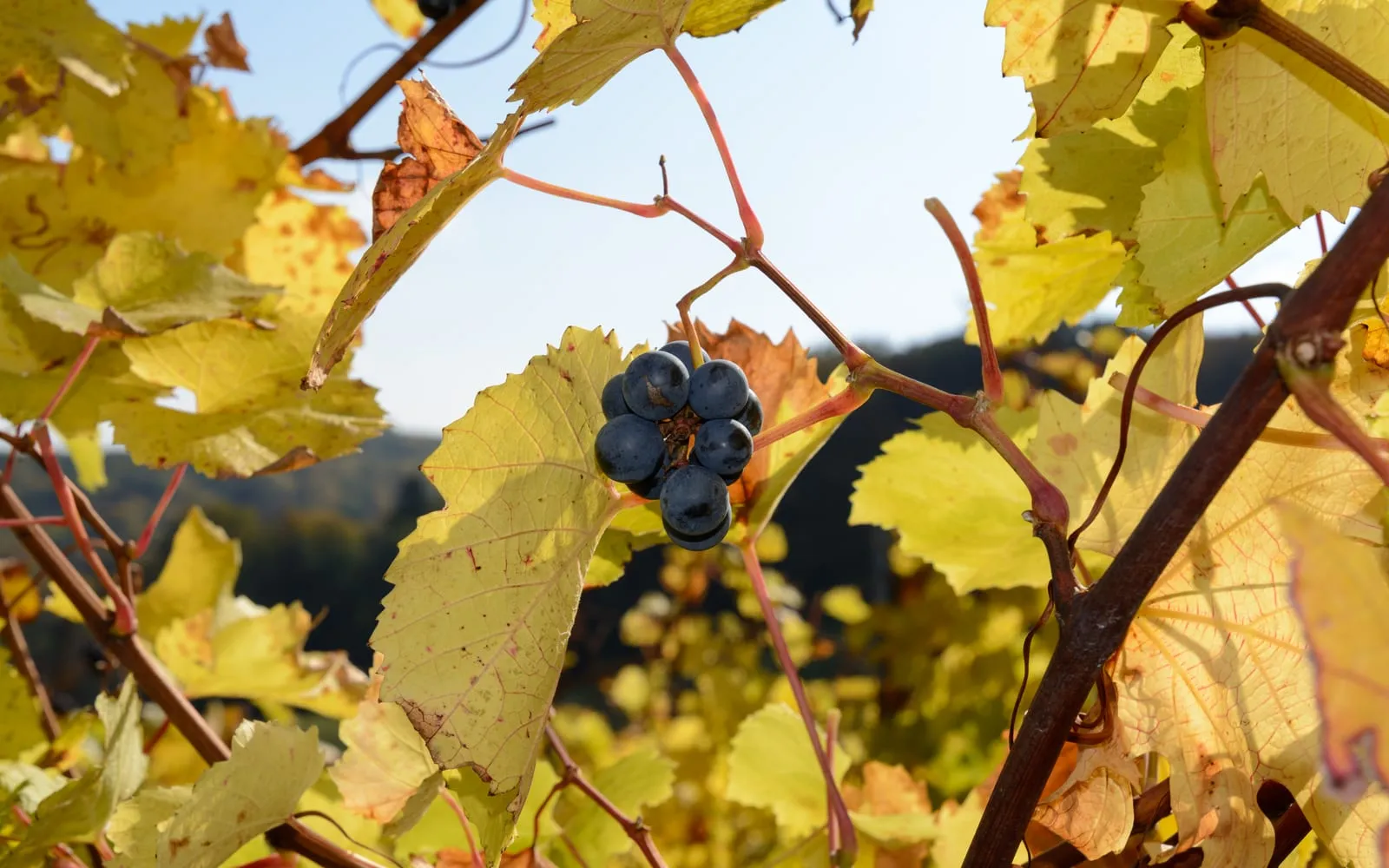
Leaves are large, 10 to 20 cm across, roughly heart-shaped in outline with three or five lobes and a toothed edge, turning yellow, orange or crimson in autumn.
Tendrils are modified flower clusters and grip anything they touch.
Flowers open in June in small green clusters, without petals, and they are barely noticeable. Most cultivated varieties are self-fertile.
Fruit ripens from late August into October in bunches, from green through amber to red, blue and near-black, with a waxy bloom on the skin.
Varieties divide by purpose and place. For outdoors, ‘Phoenix’, ‘Solaris’ and ‘Rondo’ are reliable, and ‘Boskoop Glory’ is a good black dessert grape. Under glass, ‘Black Hamburgh’ is the classic and ‘Muscat of Alexandria’ the best flavoured.
Where it is from
The Caucasus and the eastern Mediterranean, where wild grape grows through riverside trees, and where domestication began around 6000 BC in what is now Georgia and Armenia.
The Romans brought vines to Britain, and Domesday records dozens of vineyards. Cultivation collapsed after the medieval warm period and the dissolution of the monasteries, and revived from the 1950s onward.
Its natural habitat is a climber in warm dry country on poor stony ground, which explains three things at once. It wants heat, it wants sharp drainage, and rich soil produces leaf rather than fruit.
The tendril habit means a vine wants something to grip, and the training systems used in gardens replace what a tree would provide.
The vine’s greatest crisis shaped modern viticulture. Phylloxera, an American root aphid, destroyed most European vineyards from the 1860s, and almost every Vitis vinifera vine now grows on American rootstock as a result.
How it grows
Decide first between outdoors and under glass, and choose the variety accordingly.
Plant a bare-root vine between November and March into free-draining soil. Do not enrich it heavily.
For a greenhouse vine, the traditional method is to plant the root outside and lead the stem in through a hole low in the wall, so the roots get natural rain and the top gets the heat.
Train on the rod and spur system, which is what nearly every garden vine uses. Establish one permanent vertical rod, and let short fruiting spurs develop along it at 25 to 30 cm intervals on horizontal wires.
Prune in midwinter, and only in midwinter. Cut every side shoot back to one or two buds from the rod, between late November and Christmas. Vines bleed sap heavily if cut after the New Year and pruning in spring can weaken them seriously.
In summer, pinch each fruiting shoot back to two leaves beyond the developing bunch, and pinch the non-fruiting shoots to five or six leaves. Tie the shoots to the wires as they grow.
Allow one bunch per fruiting spur, and remove the rest. A vine that ripens a modest crop well is worth more than one carrying twice as much that never sweetens.
Thin the berries within each dessert bunch with long-pointed scissors when they are pea-sized, removing perhaps a third so the rest have room to swell. Wine grapes are not thinned.
Pick by cutting the bunch with a piece of stem, and taste rather than trusting the colour. Grapes do not sweeten after picking.
Through the seasons
Winter is the pruning. Cut spurs back to one or two buds before Christmas, and plant new vines. Do no cutting after the New Year.
Spring brings the growth. Rub out unwanted buds, tie in shoots, and protect from late frost, which damages the new growth badly.
Summer is training, thinning and mildew watch. Pinch the shoots, thin the bunches, feed fortnightly, and keep the air moving.
Autumn is harvest, from late August into October, followed by the leaf colour. Pick when the fruit tastes ripe rather than when it looks ripe.
Care difficulty
Moderate. The plant grows easily and getting fruit worth eating takes attention.
Powdery mildew is the main obstacle in a damp climate. It thrives in the warm humid conditions of a greenhouse and in still air outdoors.
The pruning system takes a season to understand and is straightforward once the rod and spurs are established.
Timing the winter prune matters. After the New Year a vine bleeds sap from every cut.
Ripening depends on the season outdoors, and a poor summer produces sharp grapes that are still worth juicing.
Watering
Water regularly while the fruit is swelling, from flowering until the berries begin to colour.
Reduce watering as the fruit ripens. Too much water at that stage dilutes the flavour and splits the skins.
Water evenly. A dry spell followed by heavy rain or a heavy watering is what splits the fruit.
Greenhouse vines need considerably more water than outdoor ones and benefit from a mulch.
Avoid wetting the foliage, and ventilate a greenhouse hard, since humid still air is what mildew wants.
Warning signs, diseases and pests
Powdery mildew is the disease that decides most crops in humid summers. A white powdery coating appears on leaves, shoots and young berries, the fruit stops swelling, splits and fails to ripen. It is worst in warm humid still conditions. Ventilate greenhouses hard, thin the foliage so air moves through, avoid overhead watering, and choose resistant varieties such as ‘Phoenix’ or ‘Regent’ outdoors.
Grey mould rots the bunches in a wet autumn, spreading from berry to berry once one splits. Thin the bunches so the berries do not press together, remove damaged fruit promptly, and pick as soon as the grapes are ready.
Split fruit follows uneven watering or heavy rain at ripening.
Wasps hollow out ripening grapes and are difficult to exclude. Bagging individual bunches in fine netting or perforated bags works on a small vine.
Bleeding sap from cuts made after Christmas is a sign of pruning too late. It looks alarming, weakens the vine, and is entirely avoidable.
Red spider mite and scale insects both build up on greenhouse vines in dry heat.
Leaves that scorch at the margins in high summer under glass usually mean the greenhouse needs shading and more ventilation.
Japanese beetle skeletonises leaves between the veins and eats irregular holes into ripening grapes, feeding in visible groups on the sunniest foliage. It is well established across most of the United States, reached northern Italy in 2014 and has since spread into southern Switzerland, and the rest of Europe treats a sighting as notifiable. Net the vine or shake beetles into soapy water in the morning where it occurs.
Spotted lanternfly is the pest this crop has most to fear. It mobs the trunk and canes in large numbers, weeping sap and coating the vine in sticky honeydew, and a sustained heavy infestation can kill a vineyard within a few years. It has spread across nineteen US states since 2014 and has not established outside North America and its native Asia; destroy any mud-coloured egg mass found and report a sighting elsewhere.
Grape phylloxera is why almost every vine sold today is grafted rather than grown on its own roots. This microscopic root aphid, native to North America, destroyed most of Europe’s original vineyards after arriving there around 1860 and is now present in nearly every wine region on Earth. Buy grafted vines rather than own-rooted ones unless you are in one of the rare areas that remains free of it, chiefly Chile, New Zealand and parts of Australia, where strict quarantine on plant material and soil is what keeps it out.
Marginal leaf scorch that does not improve with watering, followed by scattered dieback and vine collapse over one to a few years, is Pierce’s disease, caused by a bacterium spread by sap-feeding insects including glassy-winged sharpshooter. It is established across the Americas and has caused severe losses in California vineyards; it is not the same as ordinary scorch from heat and poor ventilation under glass, and it has no cure once a vine is infected.
Growing environment
Full sun and as much warmth as possible. A south or west-facing wall is the standard outdoor position at the cool edge of the range.
Free-draining soil that is not too rich. Poor stony ground gives better fruit than a well-manured border.
Good air movement matters as much as sun, because of mildew. Avoid an enclosed stagnant corner.
Allow 2 to 3 m of wall for a garden vine on the rod and spur system, or the length of a greenhouse for an indoor one.
Wires spaced 25 to 30 cm apart, fixed 10 to 15 cm clear of the wall so air moves behind the plant.
A greenhouse vine takes over the whole roof space, so plan for that before planting.
Site it away from where a dog patrols, since fallen grapes are dangerous to dogs.
Feeding
Feed fortnightly with a high-potassium fertiliser, such as a tomato feed, from flowering until the fruit begins to colour.
Stop feeding once the grapes start to ripen.
Avoid nitrogen and rich manures, which produce vigorous leafy growth, poor fruit and more mildew.
Mulch in spring with compost, keeping it off the stem.
Greenhouse vines benefit from a top-dressing of fresh soil over the root area each spring.
Troubleshooting
When do I prune it? Between late November and Christmas, cutting the side shoots back to one or two buds. Never after the New Year, since the vine bleeds sap heavily from late cuts.
White powder on the leaves and fruit. Powdery mildew, which is the main reason garden crops fail in a damp summer. Ventilate hard, thin the foliage for airflow, keep water off the leaves, and choose a resistant variety.
The grapes are small and sour. Usually too heavy a crop, too little sun, or mildew. Allow one bunch per spur and remove the rest.
Should I thin the berries? For dessert grapes, yes. Remove about a third of the berries in each bunch with long scissors when they are pea-sized. Wine grapes are left alone.
The fruit split and then rotted. Uneven watering or rain at ripening, followed by grey mould. Water steadily, thin the bunches so the berries do not press together, and pick promptly.
Sap is pouring out of the cuts. The vine was pruned too late. It happens after the New Year and weakens the plant. Prune before Christmas next time.
Outdoors or in a greenhouse? A greenhouse gives reliable sweet dessert grapes and takes the whole roof. Outdoors on a warm wall gives a good crop in a good year from a variety bred for cool climates.
Are grapes dangerous to dogs? Yes, seriously. Grapes and raisins cause kidney failure in dogs, the sensitivity varies unpredictably between individuals, and any ingestion should be treated as an emergency. Pick up windfalls.
Grape vine problem guides
Not sure what is wrong? See the common vegetable pests guide.
- Powdery mildew, which decides most crops in a damp climate
- Grey mould in a wet autumn
- Fruit splitting after rain
- Red spider mite and scale under glass
- Japanese beetle across the US, newly arrived in northern Italy and Switzerland
- Spotted lanternfly, which can kill a vine and is spreading fast across the eastern and midwestern US
- Grape phylloxera, present in nearly every wine region except Chile, New Zealand and parts of Australia
- Pierce's disease, a fatal bacterial disease established across the Americas
- Glassy-winged sharpshooter, the main vector across California