
Edible
Yellow Gentian
Gentiana lutea
Also known as Great yellow gentian, Bitterwort
How to grow yellow gentian, Gentiana lutea. The bitter root behind gentian bitters, the decade it takes to flower, and the deadly plant it is confused with.
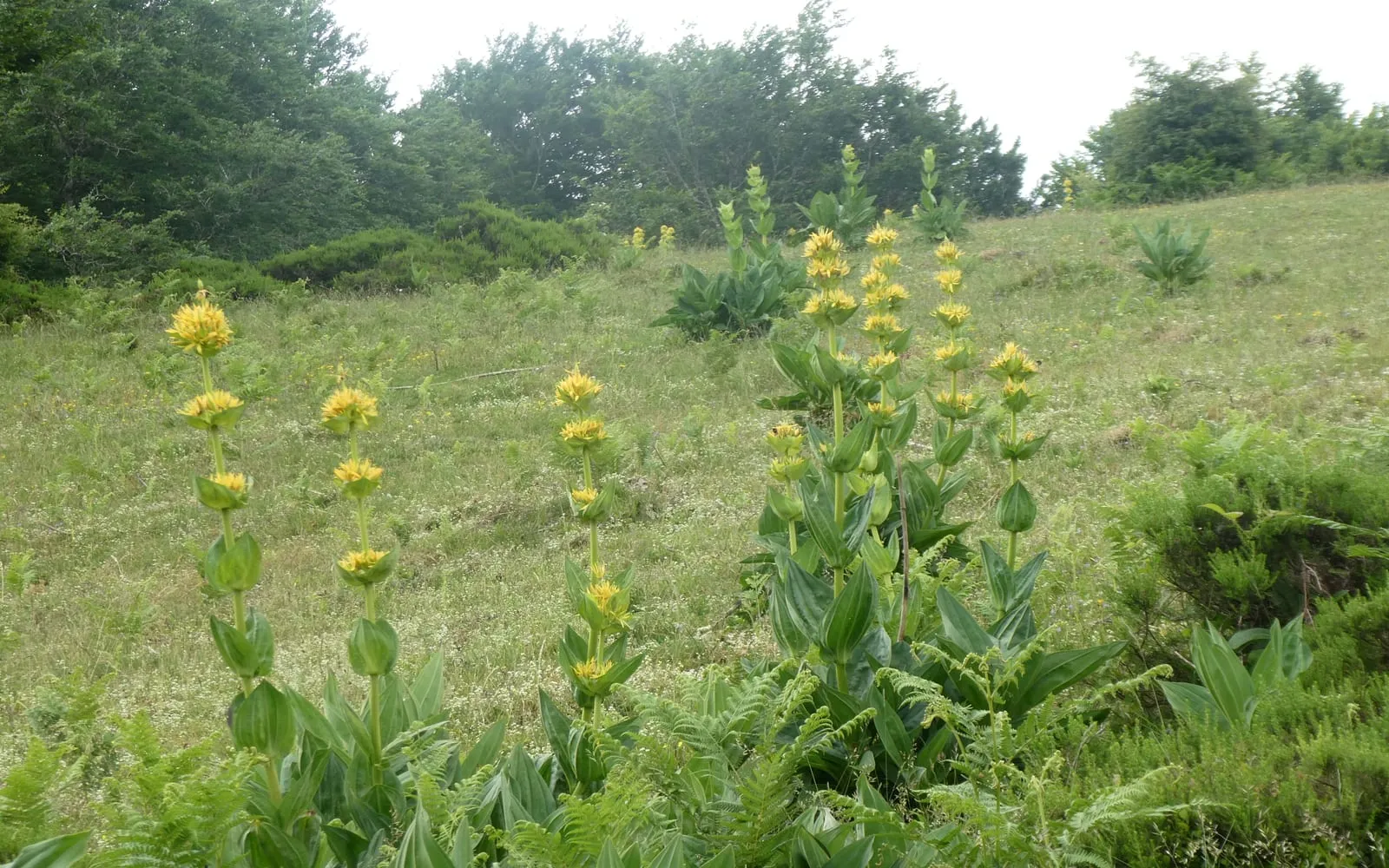
At a glance
- Difficulty
- Difficult
- Water
- Regularly in dry weather. It dislikes drying out
- Light
- Full sun to light shade
- Temperature
- Fully hardy. It is an alpine pasture plant
- Hardiness
- USDA 4-8, RHS H7, hardy to -25 C
- Type
- Hardy herbaceous perennial, very long-lived
- Height
- 60-120 cm, occasionally 180 cm
- Native to
- the mountains of central and southern Europe
- Best month
- July and August in the Northern Hemisphere, January and February in the Southern Hemisphere
Seed needs several months of cold before it will germinate, and the plant then takes seven to ten years to flower, which is why nobody grows it casually. Alpine pasture conditions suit it, meaning deep moist soil, full sun and cool summers. Wild digging is regulated across the Alps because the root harvest kills the plant.
Hardiness zones describe winter cold alone. Summer heat, humidity, rainfall and the length of the growing season decide as much, so treat the range as the outer limit rather than as a recommendation.
Every month named in this guide is for the temperate Northern Hemisphere. If you garden in the Southern Hemisphere, shift each one by six months, so July becomes January. Closer to the equator the wet and dry seasons matter more than the calendar, and the shift stops being a useful guide.
Edible, with limits
- Safe to eat
- The root, in the small quantities used for bitters
- Do not eat
- Large quantities of root, which cause nausea
- Harm from
- Eating it
- Affects
- People
Yellow gentian root is used in bitters, aperitifs and herbal tonics and it is safe in those quantities. The European Medicines Agency has assessed it as a traditional herbal medicine for digestive complaints. Large doses cause nausea and vomiting, which the intensity of the bitterness tends to prevent. The serious danger attached to this plant is confusion rather than toxicity. Gentiana lutea grows in the same alpine meadows as white hellebore, Veratrum album, which is lethal, and the two look very similar before flowering. The reliable difference is the leaf arrangement: gentian leaves are opposite, in pairs facing each other, and hellebore leaves are alternate and spiral up the stem. Hellebore leaves are also pleated and hairy beneath. People die most years in the Alps after digging the wrong root for home-made spirits. Do not collect gentian in the wild.
Sources: European Medicines Agency, Gentiana lutea, RHS potentially harmful garden plants
About
Yellow gentian is the bitterest plant most people will ever taste, and it is the bitter principle behind gentian bitters, Suze, Aveze and a long list of alpine aperitifs. A dilution of one part root extract in fifty thousand parts water is still detectably bitter.
It is nothing like the small blue alpine gentians in a rockery. This is a substantial mountain perennial with ribbed blue-green leaves and stems over a metre tall carrying whorls of yellow star flowers.
Growing it takes patience of an unusual order. The seed needs months of cold and often does not germinate until its second spring, and a plant takes anywhere from five to ten years to flower. That is the whole difficulty, and once established the plant lives for decades.
Appearance and character
A stout clump of large basal leaves, each up to 30 cm long, oval, blue-green and marked with three to seven strong parallel ribs running the length of the leaf.
The ribs are the family character and they make the plant recognisable long before it flowers.
Flowering stems are hollow, stout and unbranched, 60 cm to 1.2 m and sometimes 1.8 m on an old plant.
Leaves on the stem are in opposite pairs, clasping the stem, which is the single most important character on this plant. White hellebore, which grows alongside it and is lethal, has alternate leaves.
Flowers are bright yellow, star-shaped with five to seven narrow petals, carried in dense whorls in the upper leaf axils from July to August.
The root is thick, fleshy, branched and yellow-brown, and it goes down a long way on an old plant.
Where it is from
Yellow gentian is native to the mountains of central and southern Europe, from the Pyrenees through the Alps and Apennines to the Balkans and Carpathians, growing in alpine meadow and pasture between about 800 and 2,500 metres.
Its root has been harvested for bitters and medicine since antiquity. The genus name comes from Gentius, an Illyrian king who classical writers credit with discovering its medicinal value.
Alpine distilling is what built the trade. Gentian spirit, gentian bitters and aperitifs such as Suze and Aveze are made from the root, and Angostura bitters and several vermouths use it as a bittering agent.
Wild collection has been the traditional source and it has been heavy enough to cause concern. The plant is protected in several countries, harvest is licensed in France and Spain, and cultivated crops in France and Germany now supply a growing share.
Britain has no native population. It is a mountain plant of continental Europe and it turns up here only in gardens.
How it grows
Sow fresh seed in autumn in pots left outdoors. The seed needs a long period of cold and germination usually comes in spring, sometimes not until the second spring.
Do not throw the pot away after one blank year. That is the commonest reason people fail with it.
Sow on the surface, since it needs light, and cover the pot with grit to keep it in place.
Prick out carefully when the seedlings have two true leaves and grow them on for a year before planting out.
Plant into deep, moist, well-drained alkaline soil in sun or light shade, spacing at 60 cm.
Do not move an established plant. The root goes deep and disturbance sets it back by years.
Expect the first flowers between five and ten years after sowing. There is no shortcut.
Mulch lightly each spring with compost.
Roots are lifted commercially at around seven to ten years old, and lifting a garden plant ends it.
Through the seasons
Winter is bare ground. The whole plant retreats to the root.
Spring brings new leaves in April, and they are a magnet for slugs, which find them before anything else in the border.
Early summer is when the flowering stem extends on a mature plant.
Midsummer is flowering, in July and August, in whorls that open from the bottom upwards.
Late summer ripens seed in upright capsules. Collect it fresh and sow it straight away, since it keeps poorly.
Autumn is when the top growth dies back. Cut it away and mulch.
Care difficulty
Difficult, and the difficulty is time rather than technique.
Germination needs months of cold and frequently two winters. A pot sown in autumn that shows nothing the following spring should be kept, watered and left outside for another year.
Flowering takes five to ten years from seed. Anyone wanting a quick result should plant something else.
The root resents disturbance permanently. Choose the position once, because a moved plant sulks for years and often dies.
Slugs are the practical pest and they concentrate on the emerging spring growth, which on a young plant is the whole plant.
Wet winter ground rots the crown. Deep, moist and well-drained is the combination, which usually means adding grit while keeping the depth.
Once established it is long-lived, hardy and untroubled by anything.
Watering
Water young plants regularly through their first three summers while the root goes down.
Water an established plant in dry weather. This is an alpine meadow plant used to snowmelt and summer rain, and it does not tolerate baking dry soil.
Water thoroughly rather than lightly, so the moisture reaches the deep root.
Keep the crown from sitting wet in winter, which means good drainage rather than less water.
Mulch each spring to hold summer moisture.
Containers are unsuitable long term. The root wants depth that no reasonable pot provides.
Warning signs, diseases and pests
Slugs graze the emerging spring shoots and can kill a young plant outright. Protect it for the first several years.
Root and crown rot in wet winter ground kills established plants. Improve drainage without reducing the moisture the plant needs in summer.
Aphids gather on flowering stems and rarely need action.
A plant that has not flowered after five years is behaving normally. Wait.
Seed that shows nothing after one winter is behaving normally. Keep the pot for another year.
Leaves that scorch at the edges in July mean the ground dried out.
A plant that goes backwards after being moved is responding to root disturbance and may take several years to recover.
Growing environment
Full sun to light shade. In an alpine meadow it grows in open pasture, and in a temperate garden it takes some afternoon shade without complaint.
Deep soil above all. The root wants depth, and a shallow bed over rock or hardpan is the wrong place.
Moist but well-drained. Alpine meadow soil is both, and reproducing that usually means organic matter for moisture plus grit for drainage.
Alkaline to neutral, around pH 6.5 to 8. It grows on limestone in the wild.
A deep border, a large raised bed or a meadow planting all suit it. A rockery does not, because the small blue gentians want a rockery and this one wants depth.
It is fully hardy anywhere in its range and it does better in the north and in Scotland than in a hot dry southern garden.
Feeding
Little is needed. Alpine pasture is not rich, and the plant is adapted to getting by.
Mulch lightly with compost each spring, kept off the crown.
Avoid high-nitrogen feeds, which produce soft growth on a plant that has no use for it.
A balanced feed once in late spring helps a young plant build root, and is unnecessary on an established one.
Ground preparation matters more than feeding. Dig deep, add grit and organic matter, and then leave the plant alone for a decade.
Troubleshooting
Nothing germinated. Normal. The seed needs months of cold and often two winters. Keep the pot outside, watered, for a second year before giving up.
It has not flowered. Also normal. Yellow gentian takes five to ten years from seed to first flower.
Is this the same as the blue gentians? Same genus, different scale. The small blue alpine gentians are rockery plants. This one is a metre-tall meadow perennial with yellow flowers.
How do I tell it from white hellebore? Leaf arrangement. Gentian leaves are in opposite pairs; white hellebore leaves are alternate and spiral up the stem, pleated, and hairy underneath. White hellebore is lethal and people die most years in the Alps after confusing the two. Never dig a wild root.
Can I move it? Not without setting it back by years. Choose the position once.
Something ate the new shoots. Slugs. They find gentian first every spring. Protect young plants.
Can I use the root? Traditionally yes, dug from a plant of seven years or more, which ends the plant. Grow it for the flowers and buy the bitters.