
Edible
Rhubarb
Rheum rhabarbarum
Also known as Garden rhubarb, Pie plant
How to grow rhubarb, Rheum rhabarbarum. Forcing for early pink stems, why you pull rather than cut, when to stop picking, and why the leaves must never be eaten.
At a glance
- Difficulty
- Easy
- Water
- Weekly in dry summer weather
- Light
- Full sun to partial shade
- Temperature
- Very hardy. It needs winter cold to break dormancy
- Hardiness
- USDA 3-8, RHS H7, hardy to -35 C
- Type
- Long-lived herbaceous perennial
- Height
- 60-100 cm, and up to 2 m when it flowers
- Native to
- Siberia and the mountains of western China
- Best month
- January in the Northern Hemisphere, July in the Southern Hemisphere
Winter cold is a requirement rather than a hazard, since the crown needs several weeks below about 5 deg C to break dormancy and produce thick stalks. In a warm climate it never rests, throws thin stems and rots off in the summer heat, which is why it is grown as an annual in the subtropics and not at all in the tropics.
Hardiness zones describe winter cold alone. Summer heat, humidity, rainfall and the length of the growing season decide as much, so treat the range as the outer limit rather than as a recommendation.
Every month named in this guide is for the temperate Northern Hemisphere. If you garden in the Southern Hemisphere, shift each one by six months, so January becomes July. Closer to the equator the wet and dry seasons matter more than the calendar, and the shift stops being a useful guide.
Poisonous if eaten
- Safe to eat
- The leaf stalks, cooked or raw
- Do not eat
- The leaf blades, at any time of year and cooked or raw
- Harm from
- Eating it
- Affects
- People, cats and dogs
The stalks are food and the leaf blades are poison, and the line between them is where the green blade meets the stalk. Rhubarb leaves are listed by the RHS as harmful if eaten. They contain oxalic acid and, more importantly, anthraquinone glycosides, and eating them causes burning of the mouth and throat, vomiting, abdominal pain and diarrhoea, with kidney damage in serious cases. Deaths are recorded but rare, and the quantity needed is large because the taste is repellent. The advice given during the First World War to eat rhubarb leaves as a vegetable caused a number of poisonings and was withdrawn. Cooking does not make them safe. Cut the blades off as soon as you pull a stalk and compost them, which is perfectly safe to do since the compounds break down and are not taken up by other plants. The ASPCA lists rhubarb as toxic to cats, dogs and horses, again through soluble oxalates in the leaves. A frosted stalk should also be discarded, because oxalic acid can migrate from the leaf into the stalk after a hard freeze.
Sources: ASPCA (Rhubarb, Rheum rhaponticum), RHS potentially harmful garden plants
About
Rhubarb is the least demanding thing in a kitchen garden. Plant a crown once, mulch it every winter, and it produces for twenty years with no further thought.
It is also the first crop of the year. Forced rhubarb, grown under a cover in the dark, gives tender pink stalks in February when nothing else is ready, and the technique costs nothing beyond an upturned bin.
Botanically it is a vegetable and a New York court ruled it a fruit in 1947 for tariff purposes, which is the sort of fact that settles arguments.
Appearance and character
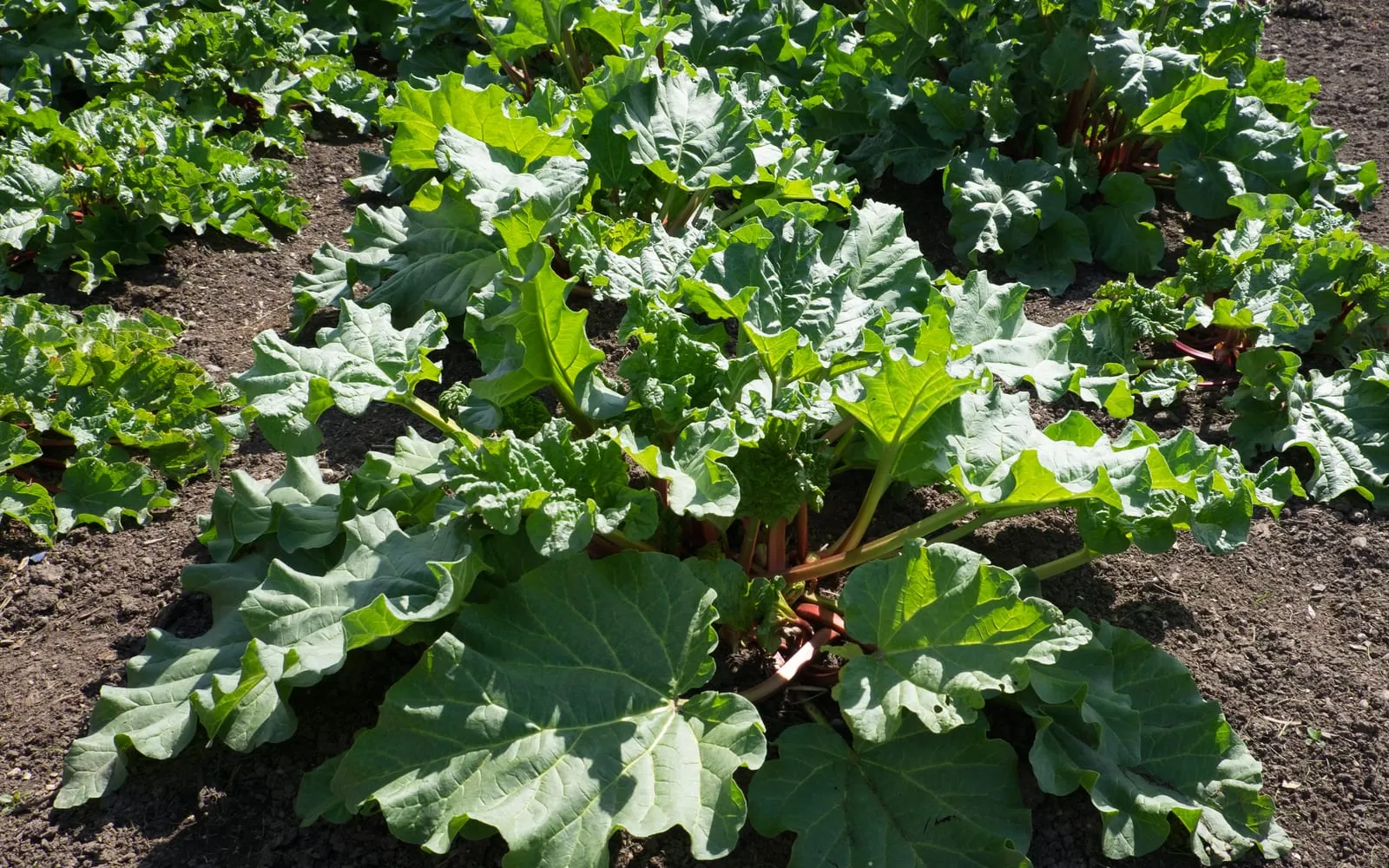
A clump of very large leaves, heart-shaped to triangular with crinkled surfaces and wavy margins, reaching 60 cm across on a mature plant.
Stalks are thick, ribbed and juicy, from deep red through pink to green depending on variety and on how much light they have had. Green does not mean unripe.
The crown is a woody mass of buds and thick storage roots sitting at soil level. It expands outward each year and benefits from division every five to six years.
Flowering stems rise dramatically in early summer, up to two metres, topped with plumes of small creamy-white flowers. They look impressive and drain the crown, so cut them out at the base as soon as they appear.
Forced stalks are pale pink, slender and much more tender than open-grown ones, with small yellow leaves.
Where it is from
Siberia and the mountains of western China, where it grows in cold continental conditions with hard winters and short intense summers.
The related Rheum officinale and Rheum palmatum were traded along the Silk Road as a purgative medicine for centuries before anyone ate the stalks. Medicinal rhubarb was among the most valuable imports into Europe.
Eating it required cheap sugar. Rhubarb only became a food plant in Britain in the late eighteenth and early nineteenth centuries, once sugar prices fell far enough to make something that sour worth cooking.
The cold origin explains the one hard requirement. Rhubarb needs a period below about 3 deg C to break dormancy, which is why it grows well in cool temperate regions and badly in warm ones.
The Yorkshire Rhubarb Triangle, between Wakefield, Leeds and Bradford, forced rhubarb in heated sheds by candlelight from the 1870s and still holds protected status for it.
How it grows
Plant a dormant crown from November to March, with the buds just at or slightly above soil level. Burying the crown causes it to rot.
Space plants 90 cm apart. A mature clump is large.
Do not pick anything in the first year. The plant needs that season to build the crown, and stripping it sets it back permanently.
In the second year, take a few stalks. From the third year onward, pick freely from April to June.
Pull rather than cut. Grasp the stalk low down, twist and pull sideways so it comes away cleanly from the crown. A cut stump rots and lets disease into the crown.
Never take more than half the stalks at once, and stop picking by the end of June so the plant can rebuild for next year.
Divide every five or six years in winter, chopping the crown into pieces each with at least one fat bud, and replant those.
Through the seasons
Winter is planting, dividing and forcing. Cover a crown with a bin or forcing pot in January to crop in February and March.
Spring is the main harvest. Pick freely from April, remove any flower stems at the base, and mulch around the plant.
Summer ends the picking. Stop by the end of June and let the leaves feed the crown. Water in dry spells.
Autumn is dormancy. The leaves collapse and yellow. Clear them away, and put a thick layer of well-rotted manure around the crown without burying the buds.
Care difficulty
Easy, and among the few crops that thrive on neglect.
The mistakes are all about restraint. Picking in the first year, picking too much, and picking past midsummer all weaken the crown.
Drainage is the one soil requirement. Rhubarb wants moisture and rots in standing water.
Forcing must be rotated. A crown forced two years running is exhausted, so force a different plant each year, or force one every third year.
Frost, wet, cold and shade are all tolerated without complaint.
Watering
Water generously in dry summer weather. That vast leaf area transpires hard and a dry plant produces thin stalks.
A thick mulch does most of the work and is better than frequent watering.
Newly planted crowns need watering through their first summer while they establish.
Do not water in winter, and never let the crown sit in waterlogged ground.
Container-grown rhubarb needs a very large pot and daily watering in summer, and it is rarely as good as a plant in the ground.
Warning signs, diseases and pests
Crown rot is the disease that kills rhubarb. The buds and crown turn soft and brown, stalks emerge thin and discoloured, and the plant collapses. It follows waterlogging or a crown planted too deep. There is no cure. Dig out and destroy the plant, and do not replant rhubarb in the same spot.
Honey fungus attacks the crown, producing white fungal sheets under the bark of the roots and black bootlace strands in the soil. It is fatal and spreads.
Flowering stems in early summer drain the crown. Cut them out at the base as soon as they appear. Frequent flowering suggests the plant is stressed, old, or needs dividing.
Thin weak stalks mean an overpicked, congested or starved crown. Stop picking, feed, mulch, and divide it the following winter.
Slugs graze the emerging buds in early spring.
Mottled, stunted, distorted growth points to virus, for which there is no treatment. Replace the plant with certified stock.
Stalks that have been hard frosted should be discarded rather than eaten.
Growing environment
Full sun gives the heaviest crop, and rhubarb tolerates partial shade better than almost any other edible.
Deep, rich, moisture-retentive soil with plenty of well-rotted manure dug in before planting. This is a hungry, long-lived plant and the preparation lasts for years.
Good drainage is essential. On heavy wet ground, plant on a raised mound.
Give it space and a permanent position. A mature clump occupies a square metre and resents being moved.
Cold is a requirement rather than a risk. Rhubarb needs winter chilling.
A forcing pot, upturned dustbin or large bucket over a crown in January excludes light and produces tender pink stalks four to six weeks later.
Feeding
Mulch thickly with well-rotted manure or compost every winter, spread around the crown but not over the buds. This is the main feed and it matters more than anything else.
Apply a nitrogen-rich fertiliser in early spring as growth starts.
Avoid feeding during the picking season, and resume with the autumn mulch.
Forced crowns are exhausted by the process and want a generous feed and a full year off afterwards.
Divide every five or six years, which renews the plant as effectively as feeding.
Troubleshooting
Can I eat the leaves? No. Rhubarb leaves contain oxalic acid and anthraquinone glycosides and cause serious poisoning. Cut them off and compost them.
The stalks are thin and spindly. The crown is overpicked, congested or starved. Stop picking, mulch heavily, and divide it in winter.
A huge flower stem has appeared. Normal in early summer, and it drains the plant. Cut it out at the base straight away.
The crown has gone soft and brown. Crown rot, usually from waterlogging or planting too deep. Dig it out and start again elsewhere.
My stalks are green rather than red. Variety and light, rather than ripeness. Green-stalked rhubarb is fully ripe and often better flavoured.
When should I stop picking? By the end of June. After that the plant needs its leaves to rebuild the crown for next year.
Should I cut or pull the stalks? Pull. Twist and pull sideways at the base so the stalk comes away cleanly. A cut stump rots into the crown.
How do I force it? Cover a dormant crown with an upturned bin or forcing pot in January to exclude all light. Pick the pale pink stalks in February and March, then leave that plant unpicked and unforced for the rest of the year.