
Edible
Peach
Prunus persica
Also known as Nectarine
How to grow peach, Prunus persica. Keeping peach leaf curl off with a rain shelter, hand pollinating in February, and thinning the fruit for size.
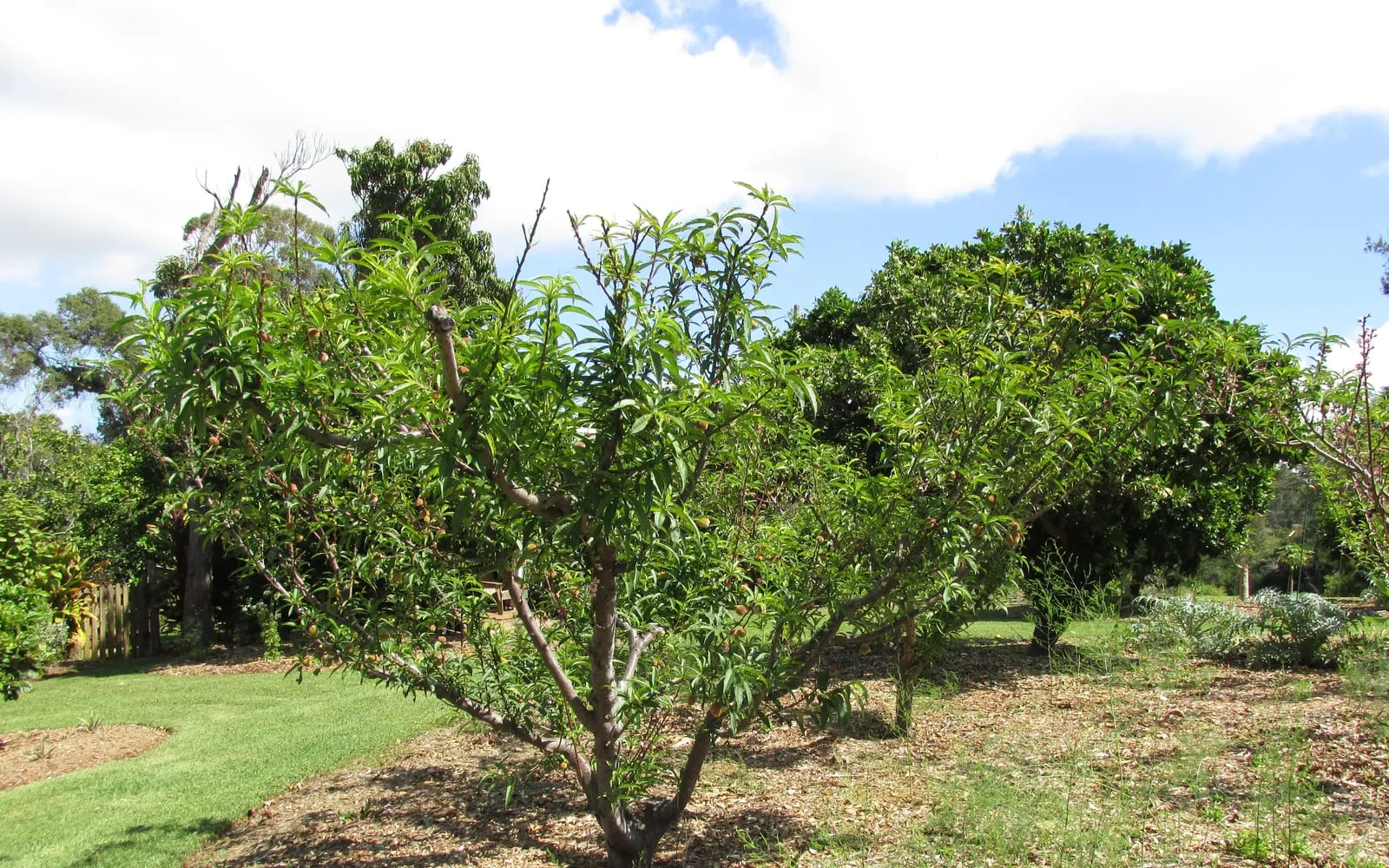
At a glance
- Difficulty
- Difficult
- Water
- Regular through the growing season, and essential against a wall
- Light
- Full sun against a sheltered south or south-west facing wall
- Temperature
- Hardy as a tree, and the February blossom is destroyed by frost
- Hardiness
- USDA 5-9, RHS H5, hardy to -20 C
- Type
- Deciduous tree, cropping for around fifteen to twenty years
- Height
- 3-5 m as a bush, and any size as a trained fan
- Native to
- North-west China, and cultivated there for at least four thousand years
- Best month
- February in the Northern Hemisphere, August in the Southern Hemisphere
Chill requirements run from 100 hours in Florida cultivars to 1000 in northern ones, and choosing the wrong end of that range is the usual reason a healthy tree gives no fruit. Wet springs bring leaf curl, which is why peaches do well in dry-summer Mediterranean and continental climates and struggle in maritime ones.
Hardiness zones describe winter cold alone. Summer heat, humidity, rainfall and the length of the growing season decide as much, so treat the range as the outer limit rather than as a recommendation.
Every month named in this guide is for the temperate Northern Hemisphere. If you garden in the Southern Hemisphere, shift each one by six months, so February becomes August. Closer to the equator the wet and dry seasons matter more than the calendar, and the shift stops being a useful guide.
Toxic if eaten
- Safe to eat
- The flesh of the ripe fruit
- Do not eat
- The stone, the leaves and the twigs
- Harm from
- Eating it
- Affects
- People, cats, dogs and horses
Peach carries the standard cautions of the genus Prunus. The flesh of the fruit is entirely safe. The stone contains amygdalin, a cyanogenic glycoside, which releases cyanide when the kernel is crushed and chewed, so stones should never be eaten or cracked open for the kernel. Swallowing a stone whole is a choking and obstruction risk rather than a poisoning one, and it matters most for dogs, where a peach stone can lodge in the gut and needs a vet. The ASPCA lists Prunus persica as toxic to cats, dogs and horses on the basis of the stone and the foliage. Leaves and twigs also contain cyanogenic compounds, and wilted foliage releases more cyanide than fresh, which matters for horses and livestock browsing prunings. Never throw peach prunings into a paddock. The RHS lists Prunus as harmful if eaten, referring to the stones and foliage. A child who has swallowed a stone whole is a matter for watching, and a child who has cracked one open and eaten the kernel is a matter for a doctor.
Sources: RHS potentially harmful garden plants, ASPCA toxic and non-toxic plants
About
A peach tree in a temperate garden will get peach leaf curl every spring unless you keep the rain off it in late winter.
The fungus, Taphrina deformans, is spread by spores in rain splash from January to May, and it infects the buds as they open. The leaves emerge red, blistered, thickened and puckered, then yellow and drop, and a tree that defoliates twice in a row is badly weakened and crops nothing.
Copper fungicides were the traditional answer and are no longer approved for amateur use in Britain or the EU, though they remain on sale in some countries. The dependable control is physical. Build a polythene shelter over a wall-trained tree from January to late May, open at the sides for air movement, so the rain never reaches the buds. That single measure is the difference between a healthy tree and an annual disaster.
The second problem is the flowering time. Peaches blossom in February, weeks before any pollinating insect is reliably flying and squarely inside the frost season. That means hand pollinating with a soft brush on warm days, and fleecing the tree whenever frost is forecast.
Given a warm south-facing wall, a rain shelter and a paintbrush, peaches crop well in a mild maritime climate and the fruit is worth every bit of the trouble.
Nectarines are the same species with a recessive gene for smooth skin, they are slightly less hardy, and everything here applies to them.
Appearance and character
A deciduous tree reaching 3 to 5 m as a bush, and trained flat as a fan against a wall in most temperate gardens.
Leaves are narrow and lance-shaped, 8 to 15 cm long, glossy mid-green, finely toothed and often folded along the midrib.
Blossom opens in February and March, before the leaves, 2.5 to 3.5 cm across, deep pink to rose, borne singly or in pairs along the previous year’s wood.
Fruit ripens from July to September depending on cultivar, round, 5 to 8 cm across, with velvety skin in yellow flushed red, and yellow or white flesh around a deeply pitted stone.
Nectarines have smooth skin and are otherwise identical.
Freestone cultivars release the stone cleanly and clingstone cultivars do not.
Peaches fruit on wood made the previous summer, which governs the whole pruning approach.
Rootstocks control size. St Julien A gives a tree of 3 to 4 m, and Pixy is more dwarfing and suits a container.
‘Peregrine’ and ‘Rochester’ are the standard outdoor cultivars for cool climates, and ‘Avalon Pride’ carries useful resistance to peach leaf curl.
Where it is from
North-west China, where it has been cultivated for at least four thousand years and where the wild relatives grow.
The species name records a mistaken belief that it came from Persia, which was a staging post on its westward journey rather than its origin.
It reached the Mediterranean by Roman times and Britain by the sixteenth century, where it was grown against heated walls in the great kitchen gardens of the eighteenth and nineteenth centuries.
The Victorian walled garden is the context in which peaches were grown well in Britain, with south-facing brick walls, glass lean-tos and heating flues doing what the climate does not.
Peach has deep cultural weight in China, where the fruit symbolises longevity and immortality and appears throughout art and mythology.
Peach leaf curl has been recognised as a disease of the crop since the eighteenth century, and the copper-based sprays that once controlled it have been withdrawn from amateur use across Britain and the EU.
‘Avalon Pride’ was found as a chance seedling in Washington State in the 1970s and carries genuine partial resistance to leaf curl, which makes it the sensible choice for anyone unwilling to build a shelter.
How it grows
Choose a warm sheltered south or south-west facing wall. This is not a tree for an open position in a cool damp climate.
Plant a fan-trained tree in autumn or early spring, 20 to 25 cm out from the wall, leaning slightly towards it.
Fix horizontal wires 15 cm apart on the wall and tie the fan ribs in.
Improve the soil at planting with compost and grit, and aim for a deep free-draining slightly acid to neutral soil.
Build a rain shelter over the tree from January to late May. A polythene sheet on a simple timber frame, projecting 45 cm from the wall and open at both ends, keeps the rain off the buds and prevents peach leaf curl. Take it down at the end of May.
Hand pollinate. Peaches flower in February when almost no insects are flying. Go over the open flowers with a soft artist’s brush or a rabbit’s tail every day or two on a warm dry afternoon, transferring pollen from flower to flower.
Fleece the tree whenever frost is forecast during flowering, and remove the fleece by day so insects can reach it.
Thin the fruit in two stages. Thin first when the fruitlets are the size of a hazelnut, to 10 cm apart, and again when they are walnut sized, to 20 to 25 cm apart. This is what produces fruit worth eating rather than a heavy crop of small ones.
Water regularly and generously, since the soil at the foot of a wall is in permanent rain shadow.
Mulch every spring with compost or well-rotted manure.
Prune in spring and summer, never in winter. Prunus is susceptible to silver leaf and bacterial canker, both of which enter winter pruning wounds.
Prune on the replacement system. Peaches fruit on last summer’s wood, so each spring select a replacement shoot at the base of every fruiting shoot, remove competing shoots, and after harvest cut the shoot that has fruited back to the replacement.
Tie in the new growth as it extends.
Harvest when the fruit gives slightly to gentle pressure at the stalk end and comes away with a gentle lift and twist.
Expect a tree to crop for fifteen to twenty years.
Through the seasons
Winter is when the rain shelter goes up in January, and the tree is dormant and should not be pruned.
Spring flowers in February and March under the shelter, is hand pollinated and fleeced against frost, and pruning starts once growth begins.
Summer swells and ripens the fruit from July, and the shelter comes down at the end of May. Thinning and tying in happen now.
Autumn finishes the harvest, and the leaves fall. This is planting season.
Care difficulty
Difficult. Peaches are among the more demanding fruit in a temperate garden, and none of the difficulty is in the growing.
Peach leaf curl needs a physical rain shelter for five months of the year, or a resistant cultivar.
February blossom needs hand pollination and frost protection.
Pruning has to be done in the growing season on the replacement system, which is more involved than most fruit.
Watering a wall-trained tree in rain shadow is a real commitment.
The reward is fruit that is nothing like anything you can buy, from a tree that occupies a wall rather than a plot.
Watering
The ground within half a metre of a house wall is the driest in the garden. Rain comes off the brickwork rather than onto the border, and a fan-trained peach sits in that strip all year, so it wants water in a wet August as much as a dry one.
A rain shelter doubles the problem while it is up, since nothing at all reaches the roots between January and the end of May.
Two moments in the season decide the crop. Stone hardening comes about six weeks after the fruit sets, when the tree diverts everything into building the shell around the kernel, and a check then is what leaves you with split stones at harvest. The final swell is the last three weeks before picking, when the fruit puts on most of its weight and a dry spell costs you size you cannot get back.
Soak deeply once a week rather than sprinkling daily. Water at the surface evaporates off the wall foot before it reaches anything.
Mulch each spring and keep the material a hand’s width clear of the trunk, since peach bark rots where it stays damp and that is where canker starts.
Warning signs, diseases and pests
Leaves emerging red, thickened, blistered and puckered in spring, then yellowing and dropping, is peach leaf curl. Pick off and burn affected leaves, feed and water the tree to help it produce a second flush, and put a rain shelter up from January next year. Copper fungicides are withdrawn from amateur use in Britain and the EU, and ‘Avalon Pride’ is partially resistant.
No fruit set despite good blossom is a lack of pollination, frost, or both. Hand pollinate with a soft brush and fleece the tree when frost is forecast.
Buff pustules in rings on a rotting fruit are brown rot. A rotted peach dries to a hard black mummy, hangs on all winter and fires spores at the blossom in February, so take them off the tree and out of the garden rather than dropping them at the foot of the wall.
A silvery sheen across the leaves, with a dark stain in the middle of a cut branch, is silver leaf. It comes in through pruning wounds, which is the reason nothing on this tree is cut between leaf fall and bud burst.
Sunken bark weeping amber, with buds above it that never open, is bacterial canker. Cut back into clean wood in summer and burn what you take off.
A fruit split at the stalk end with a stone in two halves inside is split stone. Early thinning and a heavy crop both encourage it, and a dry fortnight while the stone was hardening is usually what triggered it.
Gum running from the trunk without any sunken bark around it is gummosis, which is a response rather than a disease. Look for the injury, the waterlogging or the canker behind it.
Fine pale mottling and webbing on leaves under the shelter is red spider mite, which the still dry air beneath polythene suits. Open both ends and damp the wall down.
Japanese beetle skeletonises the leaves and brown marmorated stink bug leaves dimpled, corky patches on the fruit. The beetle is well established across the United States and newly arrived in northern Italy and Switzerland; the stink bug is already established across North America and a growing list of European countries. Neither occurs in Australia or New Zealand, where a find is reportable.
Spotted lanternfly, spreading across the eastern and midwestern US since 2014, mobs the trunk and weeps sap where it feeds, and has not established outside North America and its native Asia.
Plum curculio cuts a crescent-shaped scar into young green fruit and is confined to North America east of the Rocky Mountains. Jar branches over a sheet in the cool morning after petal fall to catch adults, which play dead and drop when disturbed.
Mediterranean fruit fly stings ripening fruit to lay eggs, leaving a pinprick mark that develops into a soft rotting patch with small maggots inside. It is established across the Mediterranean, the Middle East and much of Central and South America. Pick up and destroy fallen fruit, and net or bag fruit as it ripens where the pest is present.
Growing environment
Full sun on a wall facing south or south-west, with shelter from wind. In all but the mildest districts an open position gives you a tree rather than a crop.
Deep, fertile, free-draining ground, slightly acid to neutral.
Winter cold is not the limitation. The wood takes minus 20 deg C without complaint, and the flowers open in February into whatever the weather is doing, so what decides the crop is how much frost falls while they are open.
Reckon on 3.5 to 4.5 m of wall for a fan on St Julien A.
It suits a south-facing house wall, a walled garden, a lean-to greenhouse, a conservatory or a large container on a dwarfing rootstock.
Grow it in a greenhouse or a large container moved under cover for the winter in a cold garden, which solves the leaf curl and the frost together.
Choose ‘Peregrine’ for flavour and ‘Rochester’ for reliability, and ‘Avalon Pride’ if you want partial leaf curl resistance without building a shelter.
Nectarines want a warmer position still and are best under glass wherever summers are cool.
Feeding
A balanced granular fertiliser as the buds swell, worked into the surface and watered in.
Sulphate of potash in early summer, which the tree spends on sugar in the fruit and on ripening the wood behind it.
This summer’s shoots are next summer’s fruiting wood, so a peach is feeding two crops at once. Anything that leaves those shoots soft and unripened at leaf fall costs you the following year as well as inviting canker into the bark.
Nothing high in nitrogen after midsummer, for the same reason. Sappy late growth is what bacterial canker enters.
A generous feed after a bad spring of leaf curl, since the tree has to build a second set of leaves out of reserves and will not manage it hungry.
Compost or rotted manure as a spring mulch, kept off the trunk.
A tree in a pot lives on liquid feed from bud burst to harvest and wants repotting every second or third winter, because there is no reservoir under it to draw on.
Troubleshooting
The leaves came out red, blistered and puckered. Peach leaf curl, spread by rain splash onto the opening buds. Pick off and burn the affected leaves, feed and water the tree, and put a polythene rain shelter over it from January to late May next year.
Is there a spray for leaf curl? No effective one is available to gardeners in most countries. The control is keeping the rain off the buds from January to May, or growing the partially resistant ‘Avalon Pride’.
It flowered well and set no fruit. No pollinating insects are flying in February, and frost may have destroyed the flowers. Hand pollinate daily with a soft brush on warm afternoons, and fleece the tree when frost is forecast.
When do I prune it? In spring and summer, never in winter. Winter cuts let in silver leaf and bacterial canker. Prune on the replacement system, cutting each fruited shoot back to a new shoot after harvest.
Should I thin the fruit? Yes, in two stages. Thin to 10 cm apart at hazelnut size and to 20 to 25 cm at walnut size. Unthinned trees produce a lot of small poor fruit.
The fruit split at the stone. Irregular watering. Keep the soil evenly moist, which is harder than it sounds at the foot of a wall under a rain shelter.
Can I grow one in a pot? Yes, on Pixy rootstock in a large container, which lets you move it under cover in winter and solves the leaf curl and frost problems together.
Are nectarines different? They are the same species with smooth skin, slightly less hardy, and best under glass wherever summers are cool. Everything else applies equally.
Can I eat the kernel inside the stone? No. It contains amygdalin, which releases cyanide when crushed and chewed. Never crack peach stones for the kernel.
Peach problem guides
Not sure what is wrong? See the common vegetable pests guide.
- Peach leaf curl, which defoliates the tree every spring unless it is sheltered
- Frost destroying the flowers
- Silver leaf entering winter pruning cuts
- Split stone and brown rot on the fruit
- Japanese beetle across the US, newly arrived in northern Italy and Switzerland
- Brown marmorated stink bug, established across North America and Europe
- Spotted lanternfly, spreading across the eastern and midwestern US
- Plum curculio, a North America-only weevil that scars young fruit
- Mediterranean fruit fly, established across the Mediterranean, the Middle East and parts of the Americas