
Edible
Common Thyme
Thymus vulgaris
Also known as Garden thyme, English thyme, Thyme
How to grow common thyme, Thymus vulgaris. Drainage, the trim that stops it going woody, harvesting when the oils peak, and why it belongs in gravel rather than good soil.
At a glance
- Difficulty
- Moderate
- Water
- Rarely once established
- Light
- Full sun. Six hours minimum
- Temperature
- Hardy to about -15 deg C when the soil is dry
- Hardiness
- USDA 5-9, RHS H5, hardy to -15 C
- Type
- Evergreen sub-shrub, woody at the base
- Height
- 15-30 cm
- Native to
- The western Mediterranean
- Best month
- August in the Northern Hemisphere, February in the Southern Hemisphere
Winter wet kills far more thyme than winter cold. On sharp drainage it takes -15 deg C without trouble, and in heavy ground that stays wet it rots at -5. Oil content peaks just as the flower buds open, so that is the moment to cut for drying, and a plant on poor stony soil is stronger than one on good.
Hardiness zones describe winter cold alone. Summer heat, humidity, rainfall and the length of the growing season decide as much, so treat the range as the outer limit rather than as a recommendation.
Every month named in this guide is for the temperate Northern Hemisphere. If you garden in the Southern Hemisphere, shift each one by six months, so August becomes February. Closer to the equator the wet and dry seasons matter more than the calendar, and the shift stops being a useful guide.
Not known to be toxic
- Safe to eat
- Leaves and flowers
Non-toxic. The ASPCA lists Thymus vulgaris as non-toxic to dogs, cats and horses, and thyme does not appear on the RHS list of potentially harmful garden plants. It is a culinary herb eaten freely and one of the safest plants in these guides. Thyme is also the source of thymol, a genuinely powerful antiseptic that was used to sterilise surgical dressings before modern antibiotics and which still appears in mouthwash. That potency belongs to the concentrated essential oil rather than the herb, and thyme oil is an irritant that should not be applied undiluted to skin or given to pets. Sprigs in a stew are food. The distinction between a plant and its distilled oil holds across the whole mint family, and it is the same one drawn in the lavender and rosemary guides.
Sources: ASPCA (Thyme, Thymus vulgaris), RHS potentially harmful garden plants
About
Thyme is the herb that punishes kindness. Plant it in improved soil, water it regularly and feed it, and you get a soft sprawling plant with weak flavour that dies in its second winter. Plant it in gravel on a sunny bank and forget about it, and it thrives.
The flavour lives in thymol and carvacrol, oils the plant produces as a defence, and it concentrates them most under stress. A thyme grown hard on poor stony ground tastes considerably stronger than the same variety grown soft.
It flowers in June and July and the bees are on it constantly. Thyme honey from the Mediterranean is a distinct and prized thing.
Appearance and character
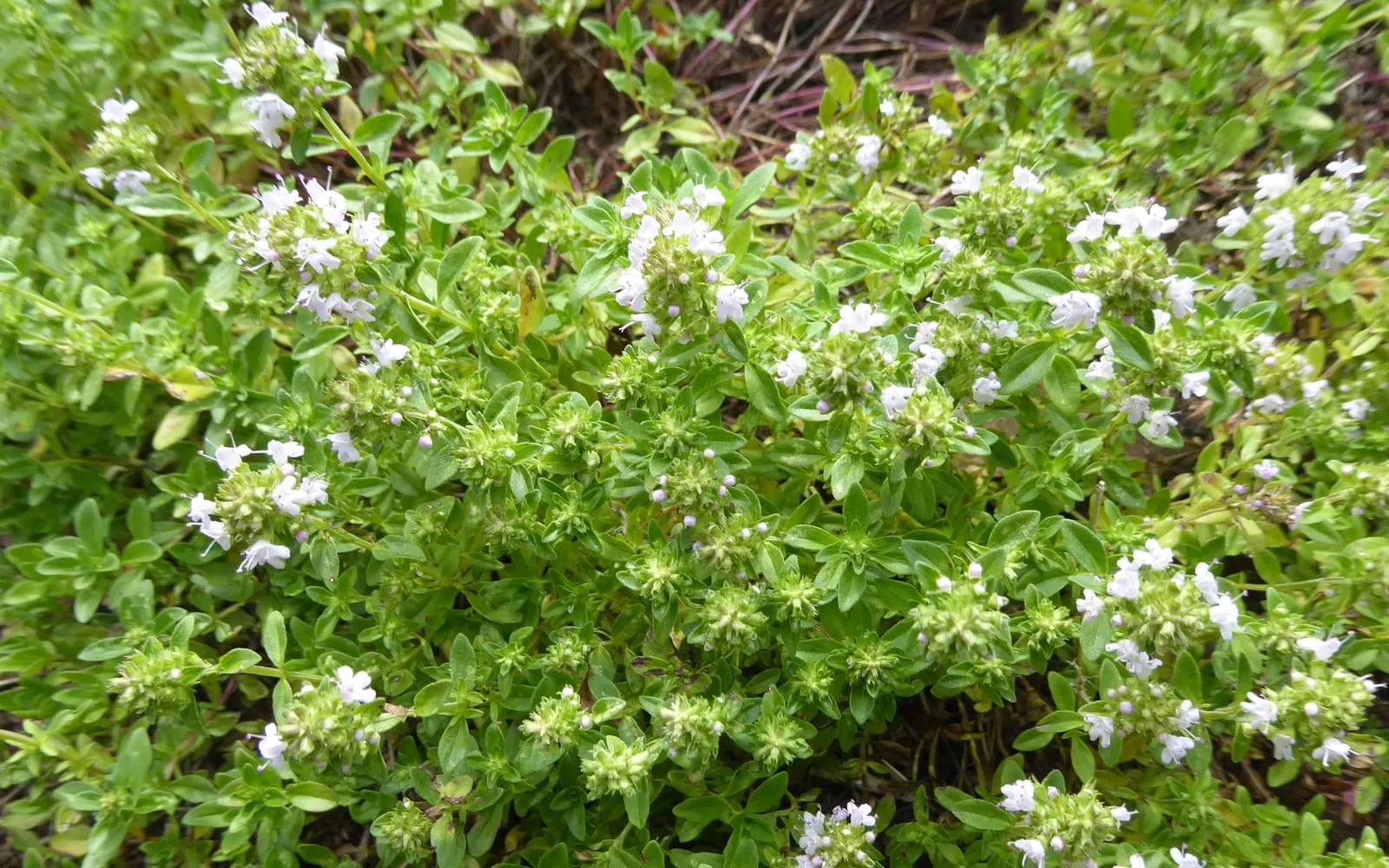
A low woody-based sub-shrub with tiny narrow grey-green leaves, only 4 to 9 mm long, packed along thin wiry stems. Common thyme forms an upright bushy mound 15 to 30 cm high.
Flowers appear in early summer as small clusters of white to pale lilac blooms at the shoot tips, so numerous that a plant in flower looks like a haze.
The scent is warm, sharp and slightly medicinal, released by brushing past or by walking on the creeping species.
Several thymes are sold and they differ in use. Thymus vulgaris is the upright culinary thyme with the strongest flavour. Lemon thyme, Thymus citriodorus, is milder and citrus-scented. Creeping thyme, Thymus serpyllum, forms flat mats for paving cracks and lawns and is better as ground cover than in the kitchen.
Where it is from
The western Mediterranean, on dry rocky limestone hillsides and open garrigue scrub in Spain, southern France and Italy.
The soil there is thin, stony, alkaline and poor. Rain falls in winter and drains away through fissured rock within hours. Summer is hot and dry, and the plant is grazed by goats, which is one reason it tastes of antiseptic.
Reproducing that in a damp climate means gravel, grit, full sun and neglect. Everything that would help a vegetable harms a thyme.
How it grows
An evergreen sub-shrub that builds permanent woody stems and makes soft green growth from them each year. Flowers form on the current season’s growth.
The wood is the constraint on pruning, as it is with lavender and rosemary. Thyme rarely regenerates from bare brown stems, so every cut must leave green growth below it.
Trim after flowering, taking the plant back by about a third and shaping it into a dome. Doing this every year keeps it dense. Skipping it for two or three years gives a woody plant with a bare middle and green only at the tips, and there is no way back from that.
Lifespan is four or five years even with good pruning, after which the plant is best replaced. Layering happens naturally where stems touch the ground, and those rooted pieces can be detached in spring.
Semi-ripe cuttings taken in early summer root within a few weeks.
Through the seasons
Spring is for planting and for a light tidy, removing any winter-damaged tips. Divide or replant rooted layers now.
Summer is flowering and harvest. Cut sprigs freely. The oils peak just as the flowers open, so that is the moment to harvest for drying.
Late summer is the annual trim. Once flowering finishes, cut the plant back by a third, always leaving green growth below the cut.
Autumn and winter need nothing. Thyme stays evergreen and can be picked through the winter. Wet is the danger rather than cold, so keep mulch off the crown and make sure containers drain.
Care difficulty
Moderate, and the same two issues as rosemary and lavender.
Drainage decides survival. Thyme in heavy wet soil rots over winter. Plant it in a raised bed, a gravel bed, a crack in paving or a gritty pot.
Annual trimming decides longevity. An untrimmed thyme goes woody within three years and cannot be cut back into that wood to recover.
Given both, it is one of the easiest plants in the garden, and it will grow in places nothing else tolerates.
Watering
Water new plants through their first summer, then almost never.
Established thyme in the ground needs no watering in an ordinary year, and watering it does harm.
Containers dry out completely and do need occasional attention. Let the compost dry properly between waterings, and choose terracotta over plastic.
Winter wet kills far more thyme than winter cold. Stand pots on feet, use free- draining compost, and site plants where water runs away rather than pooling.
Use gravel rather than bark or compost as a mulch, keeping the crown dry and reflecting heat back into the plant.
Warning signs, diseases and pests
Root rot from waterlogging is the main cause of death. The plant goes grey and dull, branches die back, and it collapses. There is no treatment, so the answer is drainage from the start.
Rosemary beetle eats thyme as readily as rosemary. It is metallic green with purple stripes, active from late summer through spring, and hand picking is the practical control. Shake the plant over a sheet of paper.
Grey mould rots the congested centre of an unpruned plant in a damp summer. Trim annually and space plants for airflow.
Leggy growth with bare woody stems and leaves only at the tips is age plus missed trimming rather than disease.
Yellowing and dieback in a container usually means the compost has become waterlogged or exhausted. Repot into fresh gritty mix.
Slugs occasionally graze new growth in a wet spring, though thyme is largely left alone by pests, which is one advantage of tasting of antiseptic.
Growing environment
Full sun, six hours minimum. Shade gives leggy soft growth with little flavour and few flowers.
Hardy to about -15 deg C when the soil is dry. The combination of cold and wet is what kills, and a thyme on a gravel bank survives conditions that would kill one on clay.
Soil should be poor, stony, sharply drained and neutral to alkaline. Do not add compost or manure. Do add grit, and lime on an acid site.
Thyme is ideal for the awkward dry places in a garden. Put it in a gravel bed, along the top of a wall, into cracks between paving slabs, or at the front of a hot south-facing border. Creeping varieties tolerate light foot traffic and release scent when walked on.
Containers work well in a soil-based compost with a third added grit.
Spacing at 30 cm apart gives the air movement that keeps mould away.
Feeding
None in open ground. Thyme evolved on nutrient-poor limestone, and feeding it produces soft growth, weak flavour and a plant that rots in winter.
Container plants can take one light feed in spring at half strength, since a pot is a closed system. Nothing more.
Avoid manure and rich mulches around the base entirely.
Repot container thyme every couple of years into fresh gritty compost instead of increasing the feeding.
Troubleshooting
Woody with bare stems and green only at the tips. Years without trimming. Thyme will not regrow from old wood. Take cuttings and replace the plant.
Died over winter. Waterlogging rather than cold. Replant in gravel or a raised bed.
Sprawling, soft and almost tasteless. Too much water, too much feed, or too little sun. Thyme wants hard conditions.
Grey dull foliage with branches dying back. Root rot. Check the drainage.
Metallic beetles with purple stripes on the plant. Rosemary beetle. Pick them off by hand.
When should I harvest for drying? Just as the flowers open, on a dry morning after the dew has gone. That is when the oil content peaks.
Bought thyme in a supermarket pot and it collapsed. Those pots hold many seedlings crammed together in wet compost. Split it into two or three clumps and pot them separately in gritty compost.