
Edible
Papaya
Carica papaya
Also known as Pawpaw, Papaw, Melon tree
How to grow papaya, Carica papaya. The fastest fruit tree there is, why most seedlings turn out male, green papaya salad, and the latex that tenderises meat.
At a glance
- Difficulty
- Moderate
- Water
- Two or three times a week in growth
- Light
- Full sun
- Temperature
- Minimum 15 deg C. Damaged below 10 deg C and killed by frost
- Humidity
- Moderate to high
- Hardiness
- USDA 10-11, RHS H1c, hardy to 2 C
- Type
- Tender short-lived evergreen, usually dioecious
- Height
- 3-10 m, and 1.5-2 m in a large pot
- Native to
- southern Mexico, Central America
- Best month
- April, May and June in the Northern Hemisphere, October, November and December in the Southern Hemisphere
Tropical America, and short-lived rather than hardy, cropping heavily from year one and declining by year four. Plants are male, female or hermaphrodite, so a single seedling may never fruit. Cold below about 10 deg C stalls it and frost kills it outright.
Hardiness zones describe winter cold alone. Summer heat, humidity, rainfall and the length of the growing season decide as much, so treat the range as the outer limit rather than as a recommendation.
Every month named in this guide is for the temperate Northern Hemisphere. If you garden in the Southern Hemisphere, shift each one by six months, so April becomes October. Closer to the equator the wet and dry seasons matter more than the calendar, and the shift stops being a useful guide.
Skin irritant
- Safe to eat
- Ripe flesh, green fruit cooked, young leaves cooked, and the seeds in small amounts
- Do not eat
- The white latex from unripe fruit and stems, and the seeds in quantity
- Harm from
- Eating it and handling it
- Affects
- People
Ripe papaya is food and the ASPCA lists it as non-toxic to cats and dogs. The caution attaches to the white latex that runs from unripe fruit, stems and leaves. It contains papain, a protein-digesting enzyme strong enough to be sold as a meat tenderiser, and it irritates skin and eyes on contact and can trigger asthma in people who handle it daily. Papain is also a recognised occupational allergen. Unripe papaya and its latex have a long folk reputation as an abortifacient, and though the evidence in humans is thin, most obstetric advice in papaya-growing countries is to avoid unripe fruit in pregnancy while treating ripe fruit as safe. The seeds are eaten in small quantities and are peppery; large amounts carry benzyl isothiocyanate and are not worth the risk. Latex-sensitive people can react to the fruit, since papaya is part of the latex-fruit cross-reaction group.
Sources: ASPCA toxic and non-toxic plants, RHS potentially harmful garden plants
About
Papaya is the fastest fruit tree in cultivation. A seed sown in spring can be a two-metre plant carrying fruit within twelve months, which no other tree in this collection comes close to.
Speed comes at a price. The trunk is hollow and soft, the plant is a giant herb rather than a woody tree, and it is worn out in three or four years. Commercial growers replant continually.
Sex is the recurring frustration. Papaya is usually dioecious, so a seedling is male or female with roughly even odds, and males never fruit. Hermaphrodite lines exist and are what serious growers buy, because a single hermaphrodite plant crops on its own.
Appearance and character
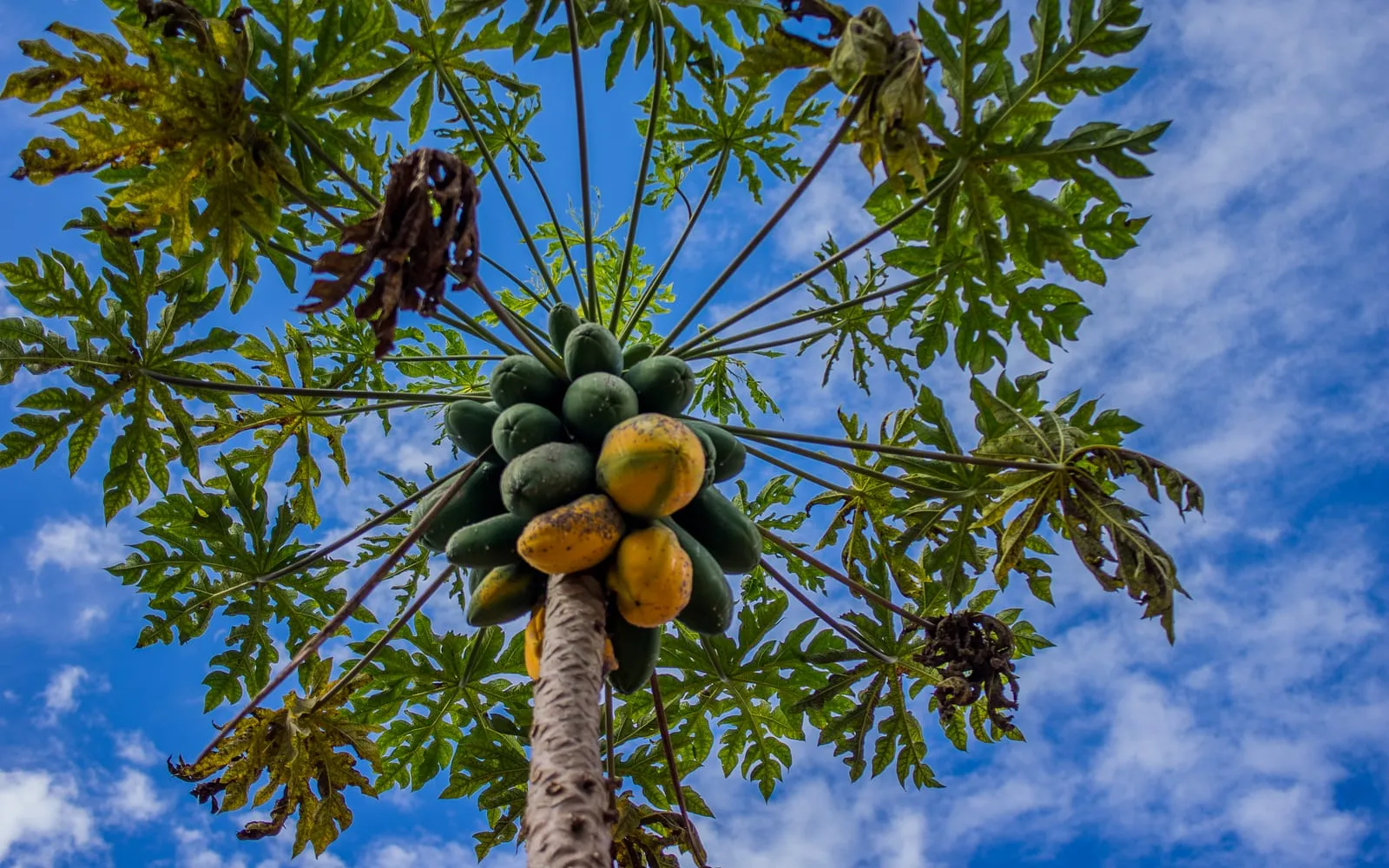
A single straight unbranched trunk, hollow, soft, green when young and grey and corky with age, marked all over with the diamond-shaped scars of fallen leaves.
The crown is a rosette of very large leaves on long hollow stalks, each blade 50 to 70 cm across and deeply cut into seven or more lobes, themselves lobed again.
Leaves last a few months and fall, so the crown climbs and the trunk lengthens below it.
Flowers sit in the leaf axils and differ by sex. Male plants carry long hanging sprays of small cream flowers on thin stalks. Female plants carry larger waxy flowers close against the trunk, singly or in small groups. Hermaphrodites carry elongated flowers with both parts.
Fruit hangs directly against the trunk in a ring beneath the crown, pear-shaped to nearly round, green ripening to yellow or orange, from 15 cm to a monster of several kilograms.
Flesh is orange to red-pink, soft and musky, with a central cavity packed full of round black seeds in a gelatinous coat.
Every part cut when green bleeds white latex.
Where it is from
Papaya is native to the lowlands of southern Mexico and Central America, and it has never been found convincingly wild outside that region.
Mesoamerican peoples grew it before European contact, and the Spanish carried it to the Caribbean, then to the Philippines by way of the Manila galleons, and from there into Asia within a century.
The name travelled with it from the Carib word, though “pawpaw” in Britain and Australia means this plant while “pawpaw” in North America means Asimina triloba, an unrelated temperate tree. That collision catches people out.
India is now the largest producer by a wide margin, followed by Brazil, Indonesia and Nigeria, and the trade in fresh fruit runs mainly out of Mexico and Central America.
Hawaii’s crop was nearly destroyed by papaya ringspot virus in the 1990s and was saved by a virus-resistant transgenic line, which makes papaya one of the few genetically modified fruit crops in ordinary commerce.
How it grows
Sow fresh seed from a ripe fruit. Wash the gelatinous coat off, which contains germination inhibitors, and sow at once.
Germinate at 25 to 30 deg C in free-draining compost, a few seeds to a pot. Emergence takes two to four weeks.
Sow more than you need. Half will be male and you cannot tell until they flower at six to nine months.
Pot on quickly and keep them moving. A checked papaya seedling rarely catches up.
Grow at a minimum of 15 deg C in full sun, in a very free-draining rich compost.
Water regularly and drain fast. The stem rots at the collar in wet compost with alarming speed.
Feed fortnightly from April.
Thin the seedlings once they flower. Keep one hermaphrodite, or one female and a male in the corner for pollen.
Expect fruit within a year of sowing under good conditions, and expect the plant to be exhausted by its fourth year.
Through the seasons
Winter is the hard season under glass. Hold above 15 deg C, water sparingly, and feed nothing. Many potted papayas die in January.
Spring is the sowing season and the point at which established plants resume growth. Repot and start feeding.
Early summer is rapid growth, a new leaf every week or so.
Midsummer brings flowering on plants sown the previous spring.
Late summer is fruit swell. Feed with high potash.
Autumn is when fruit colours and the plant slows. Stop feeding and reduce water as the temperature falls.
Care difficulty
Moderate, with three specific traps.
Wet compost is the first and worst. Papaya collapses at the collar within days of standing wet, particularly in cool weather.
Cold is the second. Below 10 deg C the plant suffers and below freezing it dies. A cool winter under glass at 15 deg C is the minimum viable arrangement.
Sex is the third. Roughly half of seedlings are male and never fruit, and there is no way to tell before flowering. Sow six, flower them, and keep what you need.
Short life is a fact rather than a fault. Three or four productive years and then replace it.
Given heat, light, food and sharp drainage, it is one of the quickest and most satisfying tropical fruits to bring to a crop under glass.
Watering
Water two or three times a week in growth, letting the surface dry between.
Drain completely every time. Never let the pot stand in water for even a day in cool weather.
Keep water off the collar where the stem meets the compost, which is where rot starts.
Reduce sharply below 18 deg C and water very little through winter.
Use tepid water, since cold water on warm roots checks growth.
Keep humidity moderate to high, which suits the large soft leaves.
Water more in fruit, since a swelling crop is demanding.
Warning signs, diseases and pests
A water-soaked dark patch at the base of the stem, spreading upward, is collar rot. It is usually fatal and it comes from wet compost.
Wilting despite damp compost means the roots have gone.
Yellow mottling and distortion of the young leaves, with dark rings on the fruit, is papaya ringspot virus. There is no cure. Destroy the plant and control aphids on the others.
Pale mottling with fine webbing on the leaf undersides is spider mite.
White powdery patches on the leaves are mildew, worse in still humid air.
Lower leaves yellowing and falling is normal, since papaya sheds its oldest leaves continuously.
Flower drop without fruit set usually means the plant is male, or is female with no pollen source.
Blackened growing point after a cold night is chill damage, and the plant rarely recovers.
Growing environment
A heated greenhouse or conservatory. No outdoor option outside the tropics.
Minimum 15 deg C, ideally 25 to 30 deg C.
Full sun with no shading.
Moderate to high humidity.
Rich free-draining compost with a third grit or perlite, in a deep pot.
pH from 6.0 to 6.5.
Shelter from draughts. The soft trunk and large leaves are easily damaged.
Room above. Even a pot-grown papaya reaches two metres in its first year.
Feeding
Feed fortnightly from April to September with a balanced liquid feed.
Switch to a high-potash feed as flowering begins.
Papaya grows so fast that it runs short quickly in a pot. Underfeeding shows as small pale leaves.
Stop feeding at the end of September.
Give nothing through winter.
Repot annually while the plant is young, into a larger pot each time.
Add magnesium if the older leaves yellow between the veins.
Troubleshooting
How fast will it fruit? Under glass with heat, twelve to fifteen months from sowing. It is the quickest fruit tree in this collection by a wide margin.
Why has mine never fruited? It may be male. Papaya is usually dioecious and about half of seedlings are male, carrying long hanging sprays of small flowers on thin stalks and never setting fruit. Sow several and keep the females or a hermaphrodite.
How do I tell the sexes apart? At flowering. Males carry flowers on long dangling stalks, females carry larger waxy flowers tight against the trunk, and hermaphrodites carry elongated flowers with both parts.
The stem went soft and brown at the base. Collar rot from wet compost. It is almost always fatal. Grow the next one in a grittier mix, water less, and keep water off the stem base.
Is green papaya safe? Cooked, yes, and it is the basis of som tam salad in Thailand. The white latex from unripe fruit irritates skin and eyes, and standard advice in growing countries is to avoid unripe fruit during pregnancy.
Can I eat the seeds? In small amounts. They are peppery and are used as a condiment. Large quantities are not advisable.
Why does papaya tenderise meat? Papain, the enzyme in the latex, digests protein. It is sold commercially as a tenderiser for exactly that reason.
My plant looks worn out after three years. That is its life span. Papaya is short-lived and commercial growers replant continually. Sow a replacement.
Papaya problem guides
Not sure what is wrong? See the common vegetable pests guide.