
Outdoor plant
Century Plant
Agave americana
Also known as Agave, American aloe, Maguey
How to grow the century plant. Flowering, sap irritation, overwintering in wet climates and propagating the offsets.
At a glance
- Difficulty
- Easy
- Water
- Every 2-3 weeks in summer for pots, none in winter
- Light
- Full sun, as much as it can get
- Temperature
- Hardy to about -7 deg C if kept dry. Wet cold kills it
- Hardiness
- USDA 8-11, RHS H3, hardy to -5 C
- Type
- Monocarpic perennial. Flowers once after decades, then dies
- Height
- 1.5-2 m tall and up to 4 m across, with a flower spike to 8 m
- Native to
- Dry scrub and rocky slopes of eastern Mexico
- Best month
- October in the Northern Hemisphere, April in the Southern Hemisphere
Winter wet kills it and winter cold usually does not. A dry agave survives several degrees of frost while a plant with water standing in the crown rots the growing point at temperatures it would otherwise shrug off, so a pane of glass over the top through winter buys more than a fleece. It flowers once after ten to thirty years and then dies, leaving offsets. Agave americana is a declared weed across parts of Australia, South Africa and the Mediterranean.
Hardiness zones describe winter cold alone. Summer heat, humidity, rainfall and the length of the growing season decide as much, so treat the range as the outer limit rather than as a recommendation.
Every month named in this guide is for the temperate Northern Hemisphere. If you garden in the Southern Hemisphere, shift each one by six months, so October becomes April. Closer to the equator the wet and dry seasons matter more than the calendar, and the shift stops being a useful guide.
Toxic if eaten
- Do not eat
- The sap in every leaf, and the spines
- Harm from
- Handling it, sap in the eyes and eating it
- Affects
- People, cats and dogs
The sap is the problem, and it is a worse one than most gardeners expect. It contains calcium oxalate needles alongside saponins, and contact produces a burning contact dermatitis that can blister and can take weeks to settle. Some people develop a delayed reaction appearing a day or two after handling. In the eye the sap causes severe pain and needs immediate irrigation and medical attention. The RHS lists Agave americana as a severe skin and eye irritant, and the ASPCA lists Agave americana as toxic to cats and dogs, with vomiting and drooling after ingestion. The spines are a separate hazard. The terminal spine at each leaf tip is stiff, needle-sharp and set at eye height on a mature plant, and puncture wounds from it are slow to heal because the sap enters the wound. Wear gloves, long sleeves and eye protection when cutting leaves, and consider pushing wine corks or purpose-made caps onto the terminal spines of a plant sited near a path. Never site one where children play.
Sources: RHS potentially harmful garden plants, ASPCA (Agave, Agave americana)
About
An agave spends decades building a rosette, then spends all of it at once. The flower spike rises from the centre at extraordinary speed, sometimes 20 cm in a day, reaching six to eight metres and branching into candelabra arms of yellow flowers. Then the plant dies.
Monocarpic is the botanical term for it, meaning fruiting once. The English name suggests a century of waiting, and the real figure in cultivation is closer to ten to thirty years, less in a hot climate.
The plant is not gambling. By the time it flowers it has produced a ring of offsets around its base, and those carry on. What dies is one rosette, and the colony continues.
This is the plant that gives us pulque and mezcal. Tequila comes from a different species, Agave tequilana, and no agave produces agave nectar without industrial processing.
Appearance and character
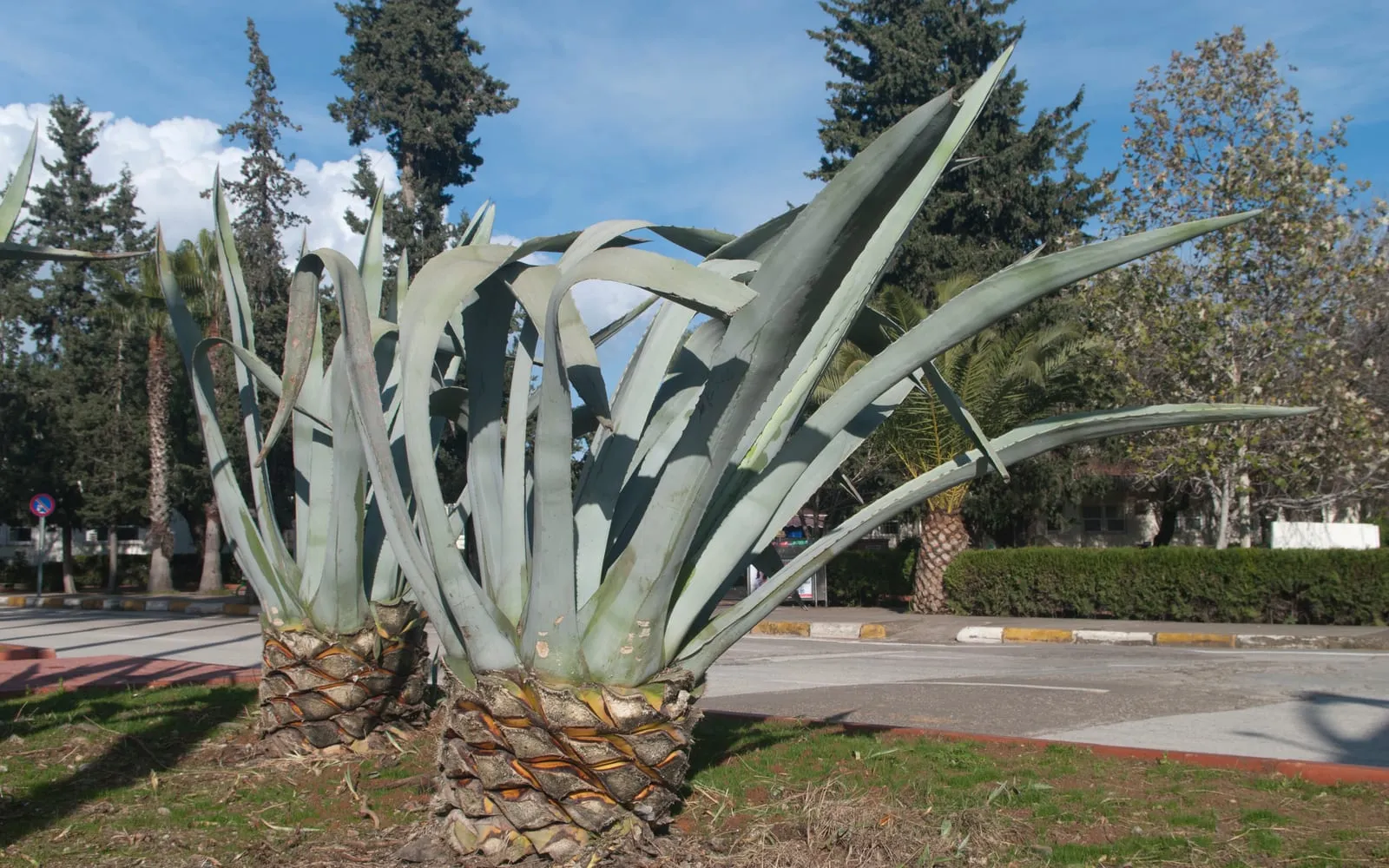
A rosette of thick, stiff, grey-green leaves, each one 1 to 2 metres long, tapering to a hard brown spine and edged with hooked teeth along both margins.
A mature plant reaches 1.5 to 2 metres tall and up to 4 metres across, which is larger than most people picture when they buy a 20 cm specimen in a pot.
New leaves emerge tightly furled from the centre and press against their neighbours as they harden, leaving a permanent pattern of imprinted lines across each leaf surface.
‘Variegata’ carries a yellow leaf margin and ‘Mediopicta Alba’ has a broad cream central stripe. Both are somewhat smaller and rather less hardy than the plain species.
The flower spike appears once. It is a genuine spectacle and it is the end of that rosette.
Where it is from
The dry scrub and rocky slopes of eastern Mexico, in thin stony soil with fierce sun and long rainless periods.
Everything about the plant follows from drought. The thick leaves are water stores, the waxy grey bloom reflects heat, and the roots are shallow and wide to catch what little rain falls before it drains away.
It has naturalised widely around the Mediterranean, along the Atlantic coasts of Portugal and Spain, and in South Africa and Australia, where it is now an invasive weed in several regions.
A wet winter climate differs from its home in one respect that matters more than temperature. The plant tolerates cold reasonably well, down to about -7 deg C, and it has almost no tolerance for cold combined with wet. Water sitting in the crown through a wet winter rots the growing point.
How it grows
A monocarpic perennial that builds a single rosette over many years, flowers once, and dies.
Growth is steady rather than fast, adding perhaps six to ten leaves a year in a good position. A plant in a pot grows more slowly and stays proportionately smaller.
Offsets, called pups, appear around the base from underground stems, at first as small spikes pushing through the gravel. A mature plant produces them freely, and they are the way the plant persists.
Detach pups in spring or summer once they are 10 to 15 cm tall. Dig down, cut the connecting stem with a spade or knife, and leave the pup somewhere dry and shaded for a few days so the wound calluses before potting it into gritty compost.
Seed is possible after flowering and takes many years to produce anything of size.
Through the seasons
Spring is when growth restarts and when to repot, detach pups, or move a container plant back outside once the frosts have finished.
Summer brings the main growth. Water potted plants every two or three weeks and give as much sun as possible.
Autumn is when to prepare for wet rather than cold. Move containers under cover, and for plants in the ground, clear the crown of fallen leaves and consider a cloche or an open-sided rain shelter.
Winter means keeping it dry. Stop watering entirely. A plant kept dry survives frost that would kill the same plant sitting in wet soil.
Care difficulty
Easy in a pot, moderate in the ground, and the difficulty is entirely about winter wet rather than about frost.
Rot starts in the crown, where water collects between the tightly packed young leaves and cannot evaporate in cold still weather. The centre goes soft and brown and the plant collapses from the middle.
Sharp drainage prevents most of it. Plant on a slope or a raised bed, work plenty of grit into the soil, and mulch with gravel rather than bark.
The other difficulty is size and armament. A mature specimen is a serious obstacle with spines at face height. Choose the position before you plant, since moving one later is a substantial and hazardous job.
Watering
For plants in containers, water every two to three weeks through summer, soaking thoroughly and letting the compost dry out completely before the next one.
Stop watering from October to March. A dormant agave needs none, and winter watering is a common cause of loss.
Plants in the ground need no watering once established, beyond the first summer after planting.
Never let a pot stand in a saucer of water. Drainage holes are essential.
Water at the base rather than over the plant, so that nothing collects in the crown.
Warning signs, diseases and pests
Soft brown collapse starting in the centre is crown rot from water sitting in the rosette. It is usually fatal by the time it shows. Prevention is drainage and overhead shelter in winter.
Leaves shrivelling and wrinkling lengthwise mean drought, which takes a long time to reach in a temperate climate.
Black spots and mushy patches on lower leaves after a cold spell are frost damage. Leave them until spring, then cut them off.
Agave snout weevil is the serious pest. It is endemic across Mexico and the American south-west and has followed imported plants into Europe. The adult bores into the base to lay eggs, the grubs eat out the core, and the plant collapses suddenly with leaves folding down like a closing flower. There is no practical cure once the core has gone. Remove and destroy affected plants along with the surrounding soil, since the grubs pupate there.
Mealybugs gather deep between the leaf bases as white fluff, hard to reach on a spiny plant.
Scale insects show as brown discs on older leaves.
A flower spike emerging from the centre means the rosette is ending its life. Nothing can be done, and the pups around the base are the succession.
Growing environment
Full sun, all day. Shade produces a floppy, dark, misshapen plant that rots easily.
Sharp drainage is the single most important factor. In a container use a gritty cactus compost, or ordinary compost cut with at least a third of coarse grit. In the ground, dig in plenty of grit and plant on a mound if the soil is heavy.
Hardy to about -7 deg C when dry, and considerably less when wet. Below zone 9 a container plant overwintered in a cold greenhouse, porch or unheated conservatory is the safest approach, and mild coastal gardens can grow it outdoors year-round with sharp drainage.
Mulch with gravel or grit rather than bark or compost. Organic mulches hold moisture against the base.
Shelter from cold wet winds helps, though the plant tolerates salt spray well and does much better in coastal gardens than inland ones.
Site it well away from paths, doorways and anywhere children play. The terminal spines cause serious puncture wounds, and capping them with corks is a sensible precaution on a mature plant near a walkway.
Feeding
An agave needs very little. Once or twice through the summer with a low-nitrogen cactus feed is enough for a container plant, and plants in the ground need nothing.
Avoid high-nitrogen fertilisers, which produce soft, dark, floppy growth that rots in winter and loses the grey bloom that makes the plant handsome.
Feed nothing from autumn to spring.
Repot container plants every three or four years into fresh gritty compost. Choose a heavy pot, since a large agave in a light plastic container blows over in the first autumn gale.
Troubleshooting
It has sent up an enormous spike. The plant is flowering and will die afterwards. Enjoy it, and look after the pups around the base, which are the next generation.
How long until it flowers? Ten to thirty years in cultivation, sooner in hot climates and later in cool ones. The name promising a century overstates it.
The centre has gone soft and brown. Crown rot from winter wet. It is rarely recoverable. Improve the drainage and keep rain off the crown next winter.
The leaves are dark green and floppy. Too little sun, too much nitrogen or both. Move it into full sun and stop feeding.
Small spiky shoots are coming up around the base. Pups. Detach them in spring or summer, let the cut callus for a few days, and pot them in gritty compost.
Can it stay outside all winter? In a well-drained coastal garden in the south or west, usually yes. Inland, on clay, or in a container, bring it under cover or build it a rain shelter. Cold is survivable and wet is not.
The sap got on my skin. Wash it off at once with soap and water. Expect burning and possibly blistering, and be aware the reaction sometimes appears a day or two later. Get medical attention if it reaches your eyes.
It has collapsed suddenly with the leaves folding down. Suspect agave snout weevil. Cut into the base to check for grubs. Destroy the plant and the soil around it rather than composting it.