
Edible
Olive
Olea europaea
Also known as Common olive, European olive
How to grow olive, Olea europaea. The winter chill it needs to flower and the summer heat it needs to ripen, growing it in a container outside its zone, and why wet roots kill more olives than frost.
At a glance
- Difficulty
- Moderate
- Water
- Sparingly, and it needs far less than most people give it
- Light
- Full sun, in the warmest and most sheltered position available
- Temperature
- Hardy to around -10 deg C in shelter, and cold wet is what kills it
- Hardiness
- USDA 8-11, RHS H4-H5, hardy to -10 C
- Type
- Evergreen tree, extremely long lived and slow growing
- Height
- 8-15 m in the ground, and 2-3 m held in a container
- Native to
- The Mediterranean basin, domesticated in the Levant several thousand years ago
- Best month
- August in the Northern Hemisphere, February in the Southern Hemisphere
Mediterranean, meaning hot dry summers and mild wet winters. Olive fails to crop at both ends of its range and for opposite reasons. It needs roughly two months below 10 deg C to initiate flower buds, so it stays barren in the frost-free tropics and in USDA 11, and it needs a long hot summer to ripen what it sets, so it flowers sparsely and ripens nothing in a cool maritime summer. Wet cold kills it at temperatures that dry cold does not.
Hardiness zones describe winter cold alone. Summer heat, humidity, rainfall and the length of the growing season decide as much, so treat the range as the outer limit rather than as a recommendation.
Every month named in this guide is for the temperate Northern Hemisphere. If you garden in the Southern Hemisphere, shift each one by six months, so August becomes February. Closer to the equator the wet and dry seasons matter more than the calendar, and the shift stops being a useful guide.
Not known to be toxic
Olive is not listed by the RHS as a potentially harmful garden plant and is not recorded by the ASPCA as toxic to cats, dogs or horses. No part of it is a recognised poisoning hazard, and the fruit and the oil have been food across the Mediterranean for thousands of years. Raw olives straight off the tree are inedibly bitter because of oleuropein, and they are not toxic, and curing in brine or with salt or lye is what removes the bitterness. Olive leaf extract is sold as a supplement and is a concentrated preparation rather than the garden plant. The stones are a choking and obstruction risk for a dog, and jarred olives are heavily salted, which is a reason to keep them away from pets. Olive pollen is a major hay fever allergen wherever the tree flowers heavily, and it is one of the principal spring allergens in Spain, Italy, Greece, Turkey and inland California. It does not arise in cool maritime climates, where the trees flower too sparsely to matter. Where a plant is unlisted by both sources rather than positively assessed, read that as no hazard recorded rather than a hazard ruled out.
Sources: RHS potentially harmful garden plants, ASPCA toxic and non-toxic plants, NC State Extension, Olea europaea
About
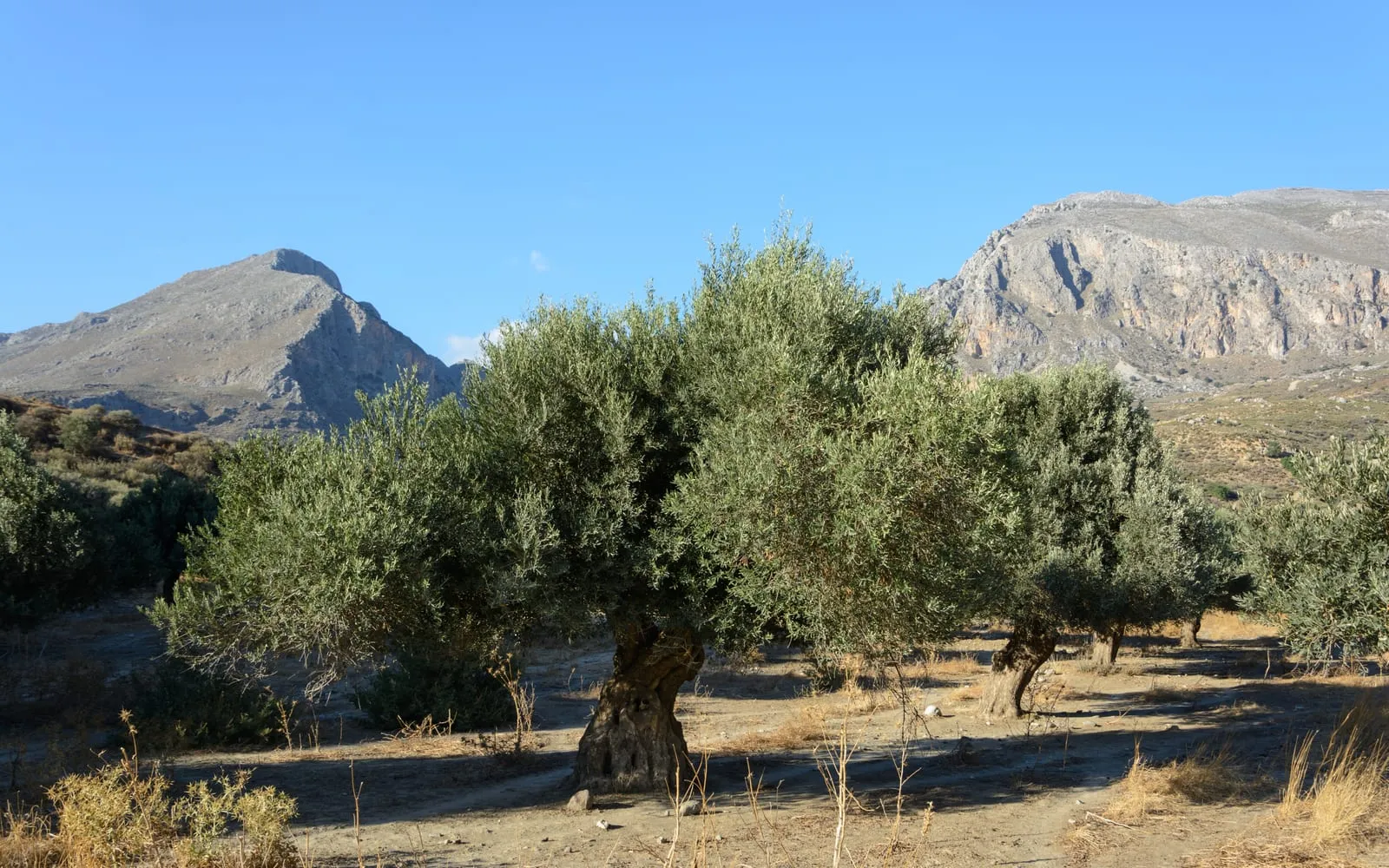
An olive does two different jobs depending on where you garden. In a Mediterranean climate, which includes coastal California, central Chile, the Western Cape and much of southern Australia, it is an orchard tree that lives for centuries, crops heavily and asks almost nothing of you. In USDA 8 and colder it becomes a container plant grown for its trunk and its foliage, and any fruit is a bonus that usually does not arrive.
That split is why a hardiness zone alone cannot tell you whether an olive will fruit, since winter cold decides survival while summer heat decides the crop. For how the two scales work together, see what a hardiness zone leaves out.
The tree is hardier than most people expect, taking around -10 deg C in a sheltered position once established. Cold combined with wet is what kills it. Roots sitting in saturated compost through a wet winter rot at temperatures that the same tree would shrug off in dry cold, which is why olives survive continental Spain more easily than maritime Britain at the same minimum.
Fruiting asks for a sequence rather than a temperature. The tree needs roughly two months below 10 deg C to initiate flower buds, then a long hot summer to set and ripen what it initiated. Miss either half and you get no crop. Cool maritime regions supply the cold and not the heat, so trees flower sparsely and ripen almost nothing. The frost-free tropics and the warmest parts of USDA 11 supply the heat and never the cold, so the tree grows well and barely flowers at all.
Where it does crop, expect alternate bearing. A heavy year is normally followed by a light one, and commercial growers thin the fruit to even it out.
Outside its zone, grow it for what it is. The trunk gnarls beautifully with age, the narrow grey-green leaves with silver undersides catch the light, it is evergreen, and it needs almost no water. Buy a tree with a good trunk if you can, since the character is in the wood.
Appearance and character
An evergreen tree reaching 8 to 15 m in the ground in its own climate, held to 2 or 3 m in a container, growing very slowly and living for centuries.
The trunk is the plant’s great asset. Smooth and grey when young, becoming deeply gnarled, twisted, hollowed and fissured with age, and an old olive trunk is one of the most sculptural things in the plant world.
Leaves are narrow and lance-shaped, 4 to 8 cm long, leathery, held in opposite pairs, dull grey-green above and silvery-white beneath with fine scales.
Flowers open in June and July, small, creamy-white and fragrant, in loose sprays from the leaf axils of the previous year’s wood.
Fruit is a drupe, 1 to 2.5 cm long, ripening from green through purple to black over several months, with a hard stone inside.
Growth is slow everywhere and slower still outside the tree’s climate, which is part of why mature specimens are expensive.
Trees with substantial trunks on sale are usually field-grown imports from Spain or Italy rather than anything raised where they are sold.
Where it is from
The Mediterranean basin, with domestication traced to the Levant several thousand years ago, and the wild ancestor is the oleaster, Olea europaea subsp. sylvestris.
The tree is central to Mediterranean civilisation. Olive oil was food, fuel, medicine, cosmetic and ritual across the classical world, and the olive branch as a symbol of peace reaches back to Greek and Hebrew tradition.
Olives are among the longest-lived trees in cultivation, and specimens in Crete, Portugal and Israel have been claimed at over two thousand years, with the trunk hollowing and regenerating repeatedly.
The plant is adapted to hot dry summers and mild wet winters, and it succeeds wherever that combination repeats. Spain grows the largest share of the world crop, followed by Italy, Greece, Turkey, Morocco and Tunisia, all of them on the same climate.
Spanish and Portuguese colonists carried it out of the Mediterranean from the sixteenth century onwards, into Peru, Chile, Argentina and Mexico, and Franciscan missionaries took it into California, where the old Mission cultivar still carries their name. It reached Australia and South Africa in the nineteenth century.
It naturalises readily on that kind of climate, and in parts of South Australia, New South Wales and the Western Cape the feral olive is an established environmental weed that displaces native vegetation. Check local advice before planting one in a Mediterranean-climate region outside its native range.
Olives arrived in cool northern European gardens as conservatory plants in the nineteenth century and became a mass-market patio plant in the 1990s, largely through imports of mature trees from Spain and Italy.
Xylella fastidiosa, the bacterial disease that has devastated the ancient groves of Puglia since 2013, is why the movement of olive trees is regulated across the EU, the UK and elsewhere. Buy from a nursery that can show the plant passport rather than carrying a tree home from holiday.
How it grows
In USDA 9 to 11, plant it in the ground. Give it full sun, sharply drained alkaline soil and room to reach its full size. It wants no shelter, no protection and no coddling, and a raised position or a slope suits it better than a hollow where water collects. Space trees 5 to 8 m apart for a grove, or closer for a hedge.
In USDA 8, plant in the ground only where drainage is sharp. A gravelly slope, a raised bed or a warm urban site all work. Choose a cold-hardier cultivar such as Arbequina, Leccino or Mission, and accept that a severe winter will take some wood.
In USDA 7 and colder, grow it in a container, which lets you control the drainage and move it under cover for the winter.
Use a loam-based compost with at least a third added grit, in a pot with generous drainage holes and crocks, and stand it on pot feet so water runs away.
Keep a container tree dry in winter. Move it under the eaves, into a porch or against a house wall for the coldest and wettest months, so it is not sitting in saturated compost. This matters more than any frost protection.
Wrap the pot with fleece or bubble wrap in a cold spell to protect the roots, which are the vulnerable part, and fleece the top growth below about -8 deg C.
Plant two cultivars if you want a reliable crop. Many olives are partly self-fertile and almost all of them set more fruit with a second variety flowering alongside.
Water sparingly. Olives are drought adapted and far more olives are killed by overwatering than by drought. Let the compost dry out between waterings.
Feed a container-grown tree monthly from April to August with a balanced or high-potash feed.
Prune in spring, once the worst frosts have passed and before growth starts. That is April in cool temperate regions and as early as February where winters are mild.
Prune for shape and to open the centre. Olives fruit on the previous year’s wood, so light annual thinning rather than hard cutting is the approach where fruit is hoped for.
Remove crossing branches, thin the interior so light and air move through, and shorten over-long shoots.
Cut a neglected tree back hard if necessary. Olives regrow readily from old wood, which is one of their virtues.
Repot every three or four years into fresh gritty compost, or top-dress annually.
Outside USDA 9, do not expect fruit. Treat any olives you get as a bonus rather than a crop.
Through the seasons
Winter is the critical season, and the job is keeping the roots dry rather than warm. Move containers under cover from November to March.
Spring is pruning season in April, and growth starts once the weather warms.
Summer is the growing period, flowering in June and July, and this is when watering and feeding matter.
Autumn slows down, and this is the point to stop feeding and reduce watering before winter.
Care difficulty
Moderate, and the difficulty is winter management rather than anything in the growing season.
An olive in a well-drained pot in a sunny sheltered spot needs very little. Sparing watering, monthly feeding in summer, a spring prune and a repot every few years.
The winter is where they are lost, and almost always to wet rather than cold. A pot standing in a saucer of rain through January kills an olive that would have survived the frost.
Fruiting outside a Mediterranean climate is unreliable to the point that it should not be the reason for growing one.
Leaf drop after a move, a cold snap or a change of position is common and usually recoverable.
Watering
Water sparingly. This is the single most important adjustment for anyone used to other container plants.
Let the compost dry out substantially between waterings, and check by pushing a finger into it rather than by a schedule.
Water more often through hot dry summer weather, and considerably less from October to March.
Never let it stand in water. Remove saucers in winter and stand the pot on feet so drainage is free.
A tree in the ground in a suitable position needs no watering once established.
Overwatering shows as yellowing leaves that drop, which is often mistaken for drought and watered further.
Warning signs, diseases and pests
Leaves yellowing and dropping in winter is most often waterlogging at the roots. Check the drainage, move the pot under cover, and reduce watering.
Sudden leaf drop after a move, a repot or a cold spell is shock. Keep it in a stable position, water sparingly, and it usually recovers.
Whole branches wilting and dying with dark staining in the wood is verticillium wilt, a soil fungus. Cut affected branches out well into clean wood, disinfect tools, and do not replant an olive in the same soil.
Marginal leaf scorch that does not improve with watering, spreading to scattered branch dieback and decline over a season or more, is olive quick decline syndrome, caused by a bacterium spread by sap-feeding insects. It has devastated commercial groves across parts of Apulia in southern Italy since around 2013 and has since been found in Corsica, Provence and parts of Spain, with no cure once a tree is infected. It is not a risk outside those confirmed outbreak areas, and a suspected case anywhere else should be reported rather than treated as routine dieback.
Brown limpet-like bumps on the stems and leaf undersides, with sticky leaves and black sooty mould, is scale insect, which is the commonest pest of container olives and worst under cover. Wipe off small infestations and treat in midsummer when the crawlers are moving.
Grey-white cottony masses in the leaf axils is mealybug.
Small holes in ripening fruit, with brown tunnelling in the flesh and premature fruit drop, is olive fruit fly. It is the defining pest of every olive-growing region, established across the Mediterranean and through California since the late 1990s, and it does not arise where trees never carry fruit. Bait traps from the point the fruit starts to colour, and pick up and destroy fallen fruit rather than leaving it to complete the life cycle in the soil.
Sooty round spots with a pale halo on the upper leaf surface, followed by yellowing and heavy leaf fall, is peacock spot. It is a fungal disease of wet mild winters, worst on crowded interiors, and thinning the canopy so air moves through it does most of the work.
Rough woody galls at pruning cuts and branch junctions is olive knot, a bacterium that enters through wounds. Prune in dry weather, disinfect tools between trees, and cut affected wood out well below the gall.
Blackened crisp leaves after a hard winter is frost damage. Wait until late spring before cutting back, since olives often reshoot from apparently dead wood.
No flowers at all has two opposite causes, and which one applies depends on your winter. In a cool maritime climate the tree gets its chill and never the summer heat to follow. In a frost-free subtropical or tropical garden it never gets the two months below 10 deg C that initiate the buds in the first place. The second case has no remedy short of moving the plant.
Flowers that set fruit which never ripens is a lack of summer heat.
Grey-green lichen on the trunk is harmless and is part of the character.
Olive fruit fly stings ripening fruit and tunnels through the flesh from inside, and is established across virtually the whole Mediterranean and Middle Eastern growing range as well as California since 1998. Harvest promptly and clear fallen fruit. Australia’s olive industry remains free of it and treats a sighting as a biosecurity priority.
Growing environment
Full sun in the warmest, most sheltered position available.
Poor, gritty, sharply drained alkaline soil or a loam-based compost with a third added grit. Fertility is not what it wants and drainage is.
Hardy to around -10 deg C in a sheltered dry position, and far less so with wet roots. Dry cold is survivable and wet cold is not, so a continental winter at a given minimum treats an olive better than a maritime one at the same figure.
Allow a large container, at least 45 cm across, or 3 to 4 m of space in the ground.
It suits a large terracotta pot on a terrace, a courtyard, a sheltered south wall, a gravel garden in a mild area, or a conservatory.
Grow it with other Mediterranean plants that want the same treatment. Rosemary, lavender, cistus, phormium and bay all share the drainage and sun requirements.
Buy a tree with a good gnarled trunk if you can afford it, since that is the plant’s real asset and it takes decades to develop.
Its wildlife value is limited wherever it flowers sparsely, which is anywhere it is grown outside its climate. In a Mediterranean garden the flowers are wind-pollinated and still of modest value, and the fruit feeds birds heavily, which is how it naturalises.
Feeding
Feed a container-grown tree monthly from April to August with a balanced or high-potash liquid feed.
Stop feeding from September, so the growth hardens before winter.
Top-dress the pot with fresh compost each spring and repot fully every three or four years.
A tree in the ground on suitable soil needs no feeding.
Avoid high-nitrogen feeds, which give soft growth that suffers in winter.
Do not enrich the soil. Olives grow on poor stony ground in the wild and rich conditions produce soft growth without improving the plant.
Troubleshooting
Will it survive my winter? Down to about -10 deg C in a sheltered position, so USDA 8 and warmer in the ground. What kills olives is cold plus wet roots rather than cold alone, so keeping a pot dry and off the ground through the wet months matters more than fleece.
The leaves have gone yellow and are dropping. Most often waterlogging rather than drought, which is the opposite of what people assume. Check the drainage, move it under cover, and water less.
Why does my olive never fruit? The tree needs about two months below 10 deg C to set flower buds and then a long hot summer to ripen what it sets. In a cool maritime climate the second half is missing, and fruit is rare enough that it is not worth planning on. In a frost-free garden the first half is missing and the tree will not flower at all.
How often should I water it? Far less than you think. Let the compost dry out substantially between waterings, and reduce it sharply from October to March.
When do I prune it? In spring, after the worst frosts and before growth starts. Thin the centre to let light and air through, and olives regrow readily from old wood if a hard cut is needed.
It dropped all its leaves after I moved it. Shock, which is common and usually recoverable. Put it somewhere stable and sunny, water sparingly, and wait.
Can I plant it in the ground? In USDA 9 and warmer, yes, and it is the better way to grow one. In USDA 8 it works where drainage is sharp and the site is warm. Colder than that a container is safer, because you can control the winter wet.
There are brown bumps on the stems and the leaves are sticky. Scale insect, the commonest pest of container olives. Wipe small infestations off and treat in midsummer when the crawlers are active.
Can I eat the olives if I get any? They are inedibly bitter raw because of oleuropein, and they need curing in brine, salt or lye. They are not toxic. A handful of half-ripe fruit off a patio tree is unlikely to be worth the process, and a proper crop off a tree in its own climate certainly is.
Olive problem guides
Not sure what is wrong? See the common vegetable pests guide.
- Winter wet, which kills far more container olives than cold does
- Olive fruit fly, the defining pest anywhere the tree crops commercially
- Leaf drop after a shock, which alarms people unnecessarily
- Scale insect and sooty mould, especially under cover
- Verticillium wilt, which kills whole branches
- Olive quick decline syndrome, a fatal bacterial disease established in southern Italy