
Outdoor plant
Star jasmine
Trachelospermum jasminoides
Also known as Confederate jasmine, Trachelospermum
How to grow star jasmine, Trachelospermum jasminoides. Evergreen scent for a sheltered wall, why it bronzes in winter, and whether it is hardy where you live.
At a glance
- Difficulty
- Moderate
- Water
- Regular in dry spells, and never let a container dry out
- Light
- Full sun to light shade, in a sheltered position out of cold wind
- Temperature
- Hardy to around -10 deg C in shelter, and cold drying wind does the damage
- Hardiness
- USDA 8-11, RHS H4, hardy to -10 C
- Type
- Evergreen twining climber, long lived and slow to establish
- Height
- 4-6 m
- Native to
- Eastern and southern China, Japan, Korea and Vietnam
- Best month
- July in the Northern Hemisphere, January in the Southern Hemisphere
Cold drying wind does more damage than still frost, which is why an exposed east-facing wall kills plants that would survive the same temperature in shelter. It needs summer heat to flower well and a plant in shade makes glossy leaves and few flowers. Through the American south and California it is a standard evergreen ground cover and needs no protection at all.
Hardiness zones describe winter cold alone. Summer heat, humidity, rainfall and the length of the growing season decide as much, so treat the range as the outer limit rather than as a recommendation.
Every month named in this guide is for the temperate Northern Hemisphere. If you garden in the Southern Hemisphere, shift each one by six months, so July becomes January. Closer to the equator the wet and dry seasons matter more than the calendar, and the shift stops being a useful guide.
Harmful if eaten
- Do not eat
- The milky sap in all parts
- Harm from
- Handling it and eating it
- Affects
- People, cats and dogs
Star jasmine is in Apocynaceae, the family that includes oleander, periwinkle and frangipani, and every member of it bleeds a milky latex when cut. In Trachelospermum that sap contains cardiac glycosides at low concentration. The practical hazard is skin contact rather than poisoning, since the latex irritates skin and causes a rash in sensitive people, and it is worth taking seriously around the eyes, so wear gloves and wash your hands after pruning. Eating the plant causes vomiting and abdominal pain, and the sap is bitter enough that nobody eats much. The ASPCA does not list Trachelospermum, so no hazard is recorded for cats and dogs rather than one being ruled out, and the family it belongs to is a reason for caution rather than reassurance. This is a different plant from true jasmine, which is Jasminum and belongs to the olive family and carries none of these compounds, and the shared common name causes real confusion.
Sources: RHS potentially harmful garden plants, ASPCA toxic and non-toxic plants
About
Star jasmine is the evergreen climber that smells of jasmine, and it is not a jasmine.
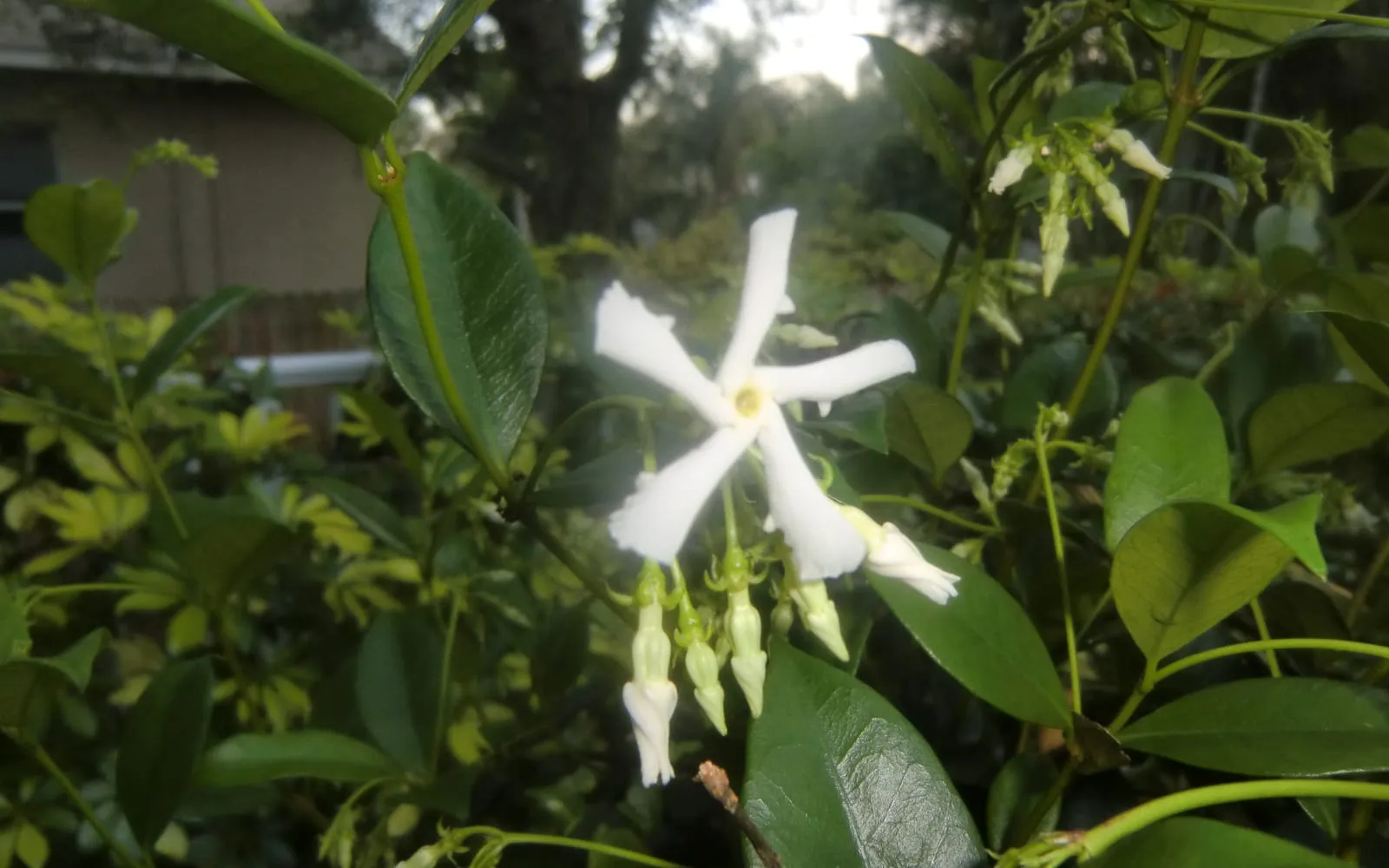
The flowers are small white pinwheels, five petals each twisted like a propeller, in loose clusters from June to September. The scent is heavy, sweet and closest to true jasmine, and it carries across a courtyard on a warm evening.
What sets it apart from the plants it competes with is the foliage. It is evergreen, glossy, dark and neat, it lies flat against a wall, and it looks presentable in February when a honeysuckle or a clematis is a mess of bare stems.
The catch is hardiness, and the risk is misunderstood. It survives around -10 deg C in a sheltered spot, and what kills it is cold drying east wind rather than the thermometer. A plant against a south or west wall in a courtyard comes through winters that flatten the same plant on an exposed east-facing fence.
It is also slow. The first two or three years produce almost nothing while the roots go down, and gardeners give up on it during that period. From year four onwards it grows steadily and flowers heavily.
Appearance and character
An evergreen twining climber reaching 4 to 6 m in time, dense and flat against a support.
Leaves are oval to lance-shaped, 3 to 8 cm long, thick, leathery and glossy dark green, held in opposite pairs.
Winter foliage often bronzes to a deep red-purple in cold weather, particularly in an exposed position, and greens again in spring. This is normal rather than damage.
Flowers open from June to September in loose clusters at the ends of the shoots. Each is about 2.5 cm across, pure white, with five petals twisted into a pinwheel around a narrow tube.
Scent is strong, sweet and jasmine-like, and it is at its best on warm still evenings.
Stems twine rather than clinging, and they need wires or trellis.
Every part bleeds a milky white latex when cut.
Trachelospermum asiaticum is the related species, slightly hardier, with smaller leaves and cream-yellow flowers.
‘Variegatum’ carries cream-edged leaves flushed pink in winter and is less vigorous.
Where it is from
Eastern and southern China, Japan, Korea and Vietnam, growing in woodland, on rocky slopes and scrambling over shrubs and walls.
That range explains the hardiness, which sits at the edge of what a temperate winter delivers and depends heavily on shelter.
It reached Britain in 1844 through Robert Fortune, the Scottish plant hunter who also brought back tea plants from China.
The name comes from Greek, trachelos for neck and sperma for seed, describing the narrow seed.
Confederate jasmine is the American name, referring to the Confederate States rather than to anything about the plant, and it is widely grown across the southern United States.
It belongs to Apocynaceae alongside oleander, periwinkle and frangipani, which accounts for the milky sap.
True jasmine is Jasminum, in the olive family, and the two are unrelated despite the shared name and the similar scent.
How it grows
Plant in late spring, once the soil has warmed and the risk of hard frost has passed.
Choose the most sheltered warm wall you have. South or west facing, out of cold east wind, and enclosed if possible. A courtyard, a corner, or a wall with buildings either side all improve its chances considerably.
Avoid an exposed east-facing position, which is where most star jasmines die.
Moist, free-draining, neutral to slightly acid soil suits it. It yellows on chalk, where a container of ericaceous compost is the better answer.
Provide wires or trellis. It twines and cannot cling to a bare wall.
Tie in the young growth until it takes hold, spreading the shoots sideways rather than letting everything race upwards.
Water regularly for the first three years, since the plant is establishing a root system during the period when it appears to be doing nothing.
Mulch every spring with compost or leaf mould, and mulch the root area in autumn for winter protection in a cold garden.
Be patient. Two or three years of little growth is normal and is not a sign of a problem.
Prune lightly after flowering in late summer, or in spring, cutting back stray shoots and thinning congested growth.
Cut a plant damaged by winter back to live wood in late spring, once you can see what has survived.
Grow it in a large container in a cold garden and move it into a porch or unheated greenhouse for the winter.
Propagate from semi-ripe cuttings in summer with bottom heat, which is slow but works.
Wear gloves when pruning. The milky sap irritates skin.
Through the seasons
Winter holds the evergreen foliage, often bronzed deep red-purple in cold weather, which is normal and reverses in spring.
Spring greens up and starts into growth in May, later than most climbers, and this is mulching and feeding time.
Summer flowers from June to September with the scent strongest on warm evenings, and this is the main growth period.
Autumn slows down, and this is the time to mulch the root area for winter protection.
Care difficulty
Moderate. In the right position it is easy and in the wrong one it dies.
Shelter is the main limit. Given a warm enclosed wall it is hardy, evergreen, long-lived and needs little more than a light prune and an annual mulch.
Given an exposed position, particularly one facing east, it browns, defoliates and often fails within a few winters.
The other difficulty is patience. The slow start convinces people that something is wrong. Water it, mulch it and wait.
Watering
Water regularly for the first three years while the root system establishes, particularly against a wall where the soil is in rain shadow.
Established plants in reasonable soil manage on rainfall and want water in a long drought.
Container plants need watering all year and must never dry out.
Use rainwater in a hard-water area, since it prefers neutral to slightly acid conditions.
Mulch every spring, which holds moisture at the foot of a wall better than watering does.
Warning signs, diseases and pests
Leaves bronzing to deep red-purple over winter is normal in cold weather and reverses in spring. It is not damage.
Brown, dry, crisp leaves after a cold spell is wind burn from cold drying east wind, which is the main killer of this plant in a cold climate. Cut back to live wood in late spring and improve the shelter, or move it.
Almost no growth in the first two or three years is normal establishment.
Yellow leaves with green veins is chlorosis on chalky soil. Move it to a container of ericaceous compost or use sequestered iron as a holding measure.
No flowers is usually a plant that is still too young, too much shade, or hard pruning in spring removing the flowering wood.
Scale insect on the stems with sticky leaves and sooty mould is the commonest pest. Treat in midsummer when the crawlers are active.
Red spider mite gives fine mottling and webbing in a hot dry position or under glass. Increase humidity.
Sudden collapse in wet heavy soil is root rot. Improve drainage.
Growing environment
Full sun to light shade, in the most sheltered position available. A warm enclosed courtyard is ideal.
Moist, free-draining, neutral to slightly acid soil enriched with organic matter. Avoid chalk and heavy wet clay.
Hardy to around -10 deg C in shelter, and far less hardy in cold drying wind. It is reliable in USDA zone 8 and warmer and marginal below that.
Allow 3 to 5 m of wall and provide wires or trellis at 45 cm spacing.
It suits a sheltered sunny wall, a courtyard, a warm fence, a pergola near a seating area, a doorway or a large container.
Plant it where you will be in the evening. The scent is the reason to grow it and it works best in an enclosed space that holds the air still.
Grow Trachelospermum asiaticum instead in a colder garden, since it is a little hardier with smaller leaves and cream flowers.
Its wildlife value is modest, and bees and moths do work the scented flowers.
Pair it with other plants that want a warm wall. Fig, ceanothus, abutilon and passion flower all suit the same aspect.
Feeding
Feed in spring with a balanced general fertiliser, and again in early summer with a high-potash feed to support flowering.
Mulch every spring with compost or leaf mould, kept clear of the stem.
Feed container plants with a liquid feed every two weeks from May to August, and repot every two or three years.
Avoid high-nitrogen feeds, which give soft growth that suffers most in winter wind.
Yellowing on chalk is a pH problem rather than a nutrient one.
Troubleshooting
How hardy is it? In a sheltered position, to around -10 deg C. Cold drying east wind kills it faster than low temperature does, so shelter matters more than the minimum on the thermometer. It is reliable in USDA zone 8 and warmer and marginal in cold inland gardens.
The leaves have gone deep red-purple over winter. Normal cold-weather bronzing. It greens again in spring and is not damage.
The leaves went brown and crisp. Wind burn from cold drying wind. Cut back to live wood in late spring and give it more shelter, or move it to a warmer wall.
It has barely grown in two years. Normal. Star jasmine spends its first two or three years establishing roots. Water it, mulch it, and it starts growing properly from year four.
Can it climb a bare wall? No. It twines and needs wires or trellis to hold onto.
Is it the same as jasmine? No. True jasmine is Jasminum, in the olive family. Star jasmine is Trachelospermum, related to oleander and periwinkle, and it bleeds a milky sap that true jasmine does not.
The leaves are yellow with green veins. Chlorosis on chalky soil. Grow it in a container of ericaceous compost, or use sequestered iron as a stopgap.
It has never flowered. Usually a plant that is still too young, or too much shade, or pruning in spring that removes the flowering wood. Prune lightly after flowering instead.
Is the sap dangerous? It irritates skin and causes a rash in sensitive people, and it should be kept away from eyes. Wear gloves when pruning and wash your hands afterwards.