
Outdoor plant
Norway spruce
Picea abies
Also known as Christmas tree, European spruce
How to grow Norway spruce, Picea abies. The traditional Christmas tree, why it drops its needles indoors, and how to keep a pot-grown one alive for another year.
At a glance
- Difficulty
- Moderate
- Water
- Regular in dry spells, and daily for a cut tree indoors
- Light
- Full sun to light shade
- Temperature
- Extremely hardy, and late frosts damage the new growth
- Hardiness
- USDA 3-7, RHS H7, hardy to -40 C
- Type
- Evergreen conifer, long lived and fast growing
- Height
- 25-40 m
- Native to
- Northern and central Europe, and introduced to Britain around 1500
- Best month
- December in the Northern Hemisphere, June in the Southern Hemisphere
It is a tree of cool moist northern summers and it suffers where summers are hot and dry, shedding needles from the inside out. Warm dry summers also invite the European spruce bark beetle, which has killed spruce across central Europe on a scale that has changed forestry policy in Germany, Austria and the Czech Republic. Anywhere with a hot summer, a fir or pine will do the job better.
Hardiness zones describe winter cold alone. Summer heat, humidity, rainfall and the length of the growing season decide as much, so treat the range as the outer limit rather than as a recommendation.
Every month named in this guide is for the temperate Northern Hemisphere. If you garden in the Southern Hemisphere, shift each one by six months, so December becomes June. Closer to the equator the wet and dry seasons matter more than the calendar, and the shift stops being a useful guide.
Not known to be toxic
Norway spruce is not listed by the RHS as a potentially harmful garden plant and is not recorded by the ASPCA as toxic to cats, dogs or horses. The shoots have been used to flavour spruce beer and the needles brewed as a vitamin C drink, and no part of the tree is a recognised poisoning hazard. The Christmas tree questions that reach vets are about mechanics rather than poison. Swallowed needles are sharp and can irritate a cat or dog's mouth and gut, the water in a tree stand goes stagnant and sometimes carries additives or fertiliser that should not be drunk, and a climbing cat brings the whole tree over. Cover the stand, keep the reservoir topped up with plain water, and sweep needles rather than leaving them to be eaten. Where a plant is unlisted by both sources rather than positively assessed, read that as no hazard recorded rather than a hazard ruled out.
Sources: RHS potentially harmful garden plants, ASPCA toxic and non-toxic plants
About
Norway spruce is the original Christmas tree and the one that ends up as a carpet of needles by Boxing Day.
Prince Albert is usually credited with bringing the German custom to Britain in the 1840s, though Queen Charlotte had a decorated tree at Windsor decades earlier. Either way, the tree in the picture was a Norway spruce, and it stayed the standard until Nordmann fir took over the market in the 1990s for the simple reason that Nordmann holds its needles.
Norway spruce is still worth buying. It has the best scent of any Christmas tree by a distance, the classic narrow spire shape, springy branches that hold decorations, and it costs less than the alternatives. It just needs handling properly, which mostly means buying late, cutting the base and never letting it run dry.
Outside the house it is a forestry tree rather than a garden one. It is fast, it reaches 40 m, and it wants cool moist acid ground. On chalk or in a dry southern garden it is a poor choice.
The oldest known clonal tree in the world is a Norway spruce in Sweden, where the root system has been dated at over 9,000 years while the trunk above it is modern.
Appearance and character
An evergreen conifer reaching 25 to 40 m, narrowly conical with branches in regular whorls, one whorl per year.
Needles are single rather than paired, about 1 to 2 cm long, four-sided in cross section so they roll between the fingers, and sharply pointed. They are dark glossy green all round rather than banded white beneath.
Each needle sits on a small woody peg on the twig. When the needles fall the pegs stay, so a bare spruce twig feels rough and knobbly. This separates spruce from fir, whose needles leave smooth round scars.
Cones hang downwards, which is the other spruce and fir difference. They are 10 to 18 cm long, cylindrical, pale brown, and they fall whole. Fir cones stand upright and disintegrate on the tree.
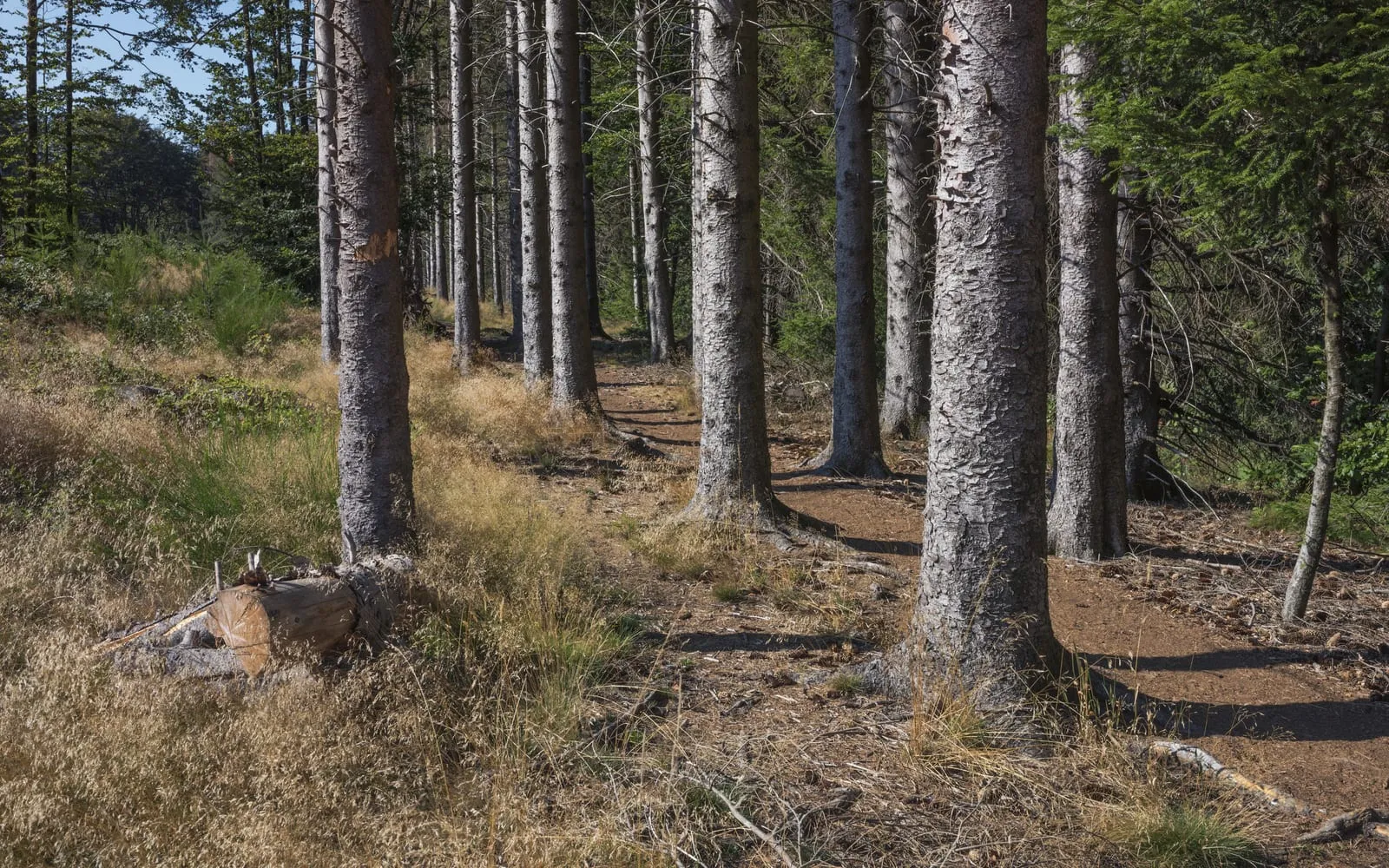
Bark is thin, coppery-brown and flaking in small round scales, becoming purplish-grey and platy with age.
New growth in May is a bright apple green against the dark old needles, and the shoot tips of older trees droop in a way that gives a mature spruce its weeping outline.
Where it is from
Northern and central Europe, from Scandinavia and the Alps east into Russia, and it is the dominant forest tree across much of that range.
It is not native to Britain, though pollen records show it grew here in earlier interglacials. The current population was introduced around 1500 and planted heavily for timber from the eighteenth century onwards.
It grows on moist acid soils, in cool climates, in mountain forest and on the northern plain, and it is shallow-rooted, which is why spruce plantations blow down in gales.
The timber is sold as whitewood and is the standard European construction softwood, used for framing, pallets and paper pulp.
Its finest use is musical. Slow-grown Alpine spruce with very narrow even rings is the soundboard wood for violins, guitars and pianos, and the trees selected for it are worth more standing than any plantation crop.
The Trafalgar Square Christmas tree given by Norway to London every year since 1947 is a Norway spruce.
How it grows
Plant a garden or shelterbelt tree between November and March, small rather than large, in moist acid to neutral soil.
Choose an open position with sun or light shade, sheltered from late spring frost if you can, since the young growth is frost-tender even though the tree is hardy.
Water it through the first two summers and keep watering in dry spells for several years afterwards. Spruce is shallow-rooted and drought is the commonest killer in a temperate garden.
Mulch generously. A thick bark or leaf mould mulch over the root plate imitates the forest floor it evolved on.
Prune nothing. Spruce does not regrow from old wood and a cut branch leaves a permanent hole.
For a cut Christmas tree, buy as late as you can, and take one from a grower rather than a forecourt where it may have been felled in November.
Saw 2 to 3 cm off the base before it goes into the stand. The cut end seals with resin within hours of felling and a tree that cannot draw water drops its needles within a week.
Use a stand with a water reservoir and keep it filled. A fresh tree drinks a litre or more a day at first and the reservoir must never go dry, because once it does the base seals again.
Keep it away from radiators, wood burners and sunny windows. Heat is what triggers the drop, and a cool hallway keeps a spruce presentable for three weeks where a hot living room gives you ten days.
For a pot-grown tree, check it is container-grown rather than a field tree dug and stuffed into a pot, which is what most cheap ones are and which rarely survives.
Bring a potted tree indoors for no more than ten to twelve days, keep it cool and watered, then move it back outside through a shaded sheltered spot for a few days rather than straight from a warm room into frost.
Pot it on into a larger container each spring, keep it outside in shade for the summer and never let the compost dry out.
Through the seasons
Winter is the Christmas tree season and the planting season. Outdoor trees need nothing.
Spring breaks bud in late April and May into bright green shoots that a late frost will burn.
Summer is when the tree is most vulnerable in a temperate garden. Water in dry spells and watch for spruce aphid.
Autumn ripens and drops the cones, and this is the point to move a potted Christmas tree somewhere sheltered ahead of December.
Care difficulty
Moderate, and the difficulty depends entirely on what you are doing with it.
In the ground on cool moist acid soil in the north or west it is easy and grows fast. In a dry southern garden on chalk it is a struggle and usually a failure.
As a cut Christmas tree it demands the water routine above and punishes neglect within days.
As a pot-grown tree kept from year to year it is difficult, and most of them die because they are field-lifted stock with no root system, or they are kept indoors too long, or they dry out in the pot in July when nobody is thinking about Christmas.
Watering
Water an established garden tree in dry spells for its first five years and in serious drought after that. The roots are shallow and spruce shows drought stress by browning from the inside out.
A cut tree indoors needs the reservoir checked daily and topped up with plain water. Skip the sugar, aspirin and proprietary additives, which have no reliable evidence behind them, and never let it run dry.
A potted tree needs watering all year including in winter, and the compost should stay damp rather than wet.
Rainwater is better than tap water on acid-loving conifers in a hard-water area.
Warning signs, diseases and pests
Needle drop indoors is the classic problem and it is nearly always the base sealing over. Saw the bottom off before the tree goes up and keep the reservoir full.
Needles browning from the inside of the tree outwards in the garden is drought stress. Water and mulch heavily.
Older needles yellowing and falling in late winter, leaving green new growth at the tips, is green spruce aphid. It builds through mild winters and can strip a tree bare. Look for small green aphids on the underside of the shoots between November and April.
Pineapple-shaped green galls at the base of new shoots are spruce adelgids. They are disfiguring on a small tree and harmless on a big one. Cut them off before they turn brown and open.
Yellowing across the whole tree on chalky soil is lime-induced chlorosis and there is no lasting fix.
Honey fungus attacks spruce and is fatal, showing as white fungal sheets under the bark at the base.
Windthrow is the risk on an exposed site. Spruce roots run wide and shallow, and a tall spruce in a gale on wet ground comes over root plate and all.
Growing environment
Full sun to light shade.
Moist, acid to neutral soil that does not dry out. It grows best where summers are cool and wet and struggles anywhere hot and dry.
Avoid chalk, avoid thin sand and avoid anywhere that bakes.
It is extremely cold-hardy, and the vulnerability is late spring frost on the new shoots rather than winter cold.
Allow 6 to 10 m of space for a forest-form tree and keep it well away from buildings and drains.
For a garden the dwarf cultivars are the sensible choice. ‘Nidiformis’ makes a flat cushion under a metre, ‘Little Gem’ is a tight bun, and ‘Inversa’ is a weeping form that stays narrow.
Its wildlife value outside its native range is moderate. Goldcrests, coal tits and crossbills use spruce, and red squirrels feed on the seed, so it earns its place in a shelterbelt even though it is not native.
Feeding
None needed for a tree in the ground.
Mulch a young tree with bark or leaf mould each spring, which matters more than fertiliser because it keeps the shallow roots cool and damp.
A potted tree needs a liquid feed every two weeks from May to August, using an ericaceous or general balanced feed, since container compost is exhausted within a season.
Never feed a cut tree. Additives in the stand water do nothing useful.
Yellowing on chalk is a pH problem rather than a nutrient one.
Troubleshooting
Why did my Christmas tree drop all its needles? Almost always because the cut base sealed with resin and the tree stopped drinking. Saw 2 to 3 cm off the bottom immediately before it goes into the stand, use a water reservoir, and top it up every day.
How long will a Norway spruce last indoors? Around two to three weeks kept cool and watered, and closer to ten days in a warm room. Nordmann fir lasts longer and smells of much less.
Can I plant my Christmas tree in the garden afterwards? Only if it was container-grown rather than field-lifted. A tree dug up and pushed into a pot has almost no roots and rarely survives. Check for roots emerging from the drainage holes when you buy it.
Should I put sugar or aspirin in the water? No. Plain water and a reservoir that never runs dry are what matter.
My potted tree died in the summer. It dried out. A spruce in a container needs watering all year and shade in July, and it needs potting on every spring.
The older needles went yellow and fell in February. Green spruce aphid. Check the undersides of the shoots for small green aphids and treat in autumn or early spring before the damage shows.
What are the pineapple-shaped lumps on the new shoots? Adelgid galls. Harmless. Cut them off while green if they bother you.
Is it safe for cats and dogs? It is not listed as toxic. The real risks are swallowed needles irritating the gut, stagnant or treated water in the stand, and the tree being pulled over. Cover the reservoir and secure the tree.
How do I tell spruce from fir? Roll a needle between your fingers. Spruce needles are four-sided and roll, fir needles are flat and do not. Spruce cones hang down, fir cones stand up.