
Edible
Garlic
Allium sativum
Also known as Common garlic
How to grow garlic, Allium sativum. Why it must go in before Christmas, hardneck against softneck, scapes, rust, and why garlic is dangerous to dogs and cats.
At a glance
- Difficulty
- Easy
- Water
- Rarely. Only in a dry spring, and stop entirely from June
- Light
- Full sun
- Temperature
- Very hardy. It needs a cold spell to form cloves at all
- Hardiness
- USDA 3-9, RHS H6, hardy to -25 C
- Type
- Perennial bulb grown as an annual
- Height
- 60-90 cm, taller when a hardneck sends up its scape
- Native to
- Central Asia, and no certainly wild population survives
- Best month
- October in the Northern Hemisphere, April in the Southern Hemisphere
Garlic needs four to eight weeks below about 10 deg C before it will divide into cloves at all, so a bulb planted in a frost-free garden gives one undivided round instead of a head. Hardneck cultivars want a hard winter and softnecks manage on much less, which is how the two sorts map onto cold and mild regions. Where winters are warm, growers chill the seed cloves in a fridge for six weeks before planting.
Hardiness zones describe winter cold alone. Summer heat, humidity, rainfall and the length of the growing season decide as much, so treat the range as the outer limit rather than as a recommendation.
Every month named in this guide is for the temperate Northern Hemisphere. If you garden in the Southern Hemisphere, shift each one by six months, so October becomes April. Closer to the equator the wet and dry seasons matter more than the calendar, and the shift stops being a useful guide.
Toxic to pets if eaten
- Safe to eat
- The bulb, the leaves, and the flower scapes
- Harm from
- Eating it
- Affects
- Cats, dogs and horses
Garlic is food for people and a genuine poison for pets. The ASPCA lists Allium sativum as toxic to cats, dogs and horses. The organosulfur compounds that give garlic its flavour damage red blood cells in these animals, causing oxidative haemolysis and the anaemia that follows, with vomiting, blood in the urine, weakness and a raised heart rate. Cats are more sensitive than dogs, and garlic is roughly five times as potent as onion by weight. Cooking does not reduce it, and concentrated forms such as garlic powder and garlic salt are the most dangerous because a small volume carries a large dose. Signs can be delayed by several days, which is why an owner often fails to connect the two. Garlic supplements marketed as flea remedies for dogs have no good evidence behind them and carry this risk. Keep bulbs, plaits and kitchen scraps away from pets, and do not feed leftovers containing garlic.
Sources: ASPCA (Garlic, Allium sativum), RHS potentially harmful garden plants
About
Garlic is planted in autumn and forgotten until summer, which makes it the lowest-effort crop in the vegetable garden by a wide margin. Push cloves into the ground in October, and lift bulbs the following July.
The autumn timing is a botanical requirement rather than a convention. A clove needs a spell below about 10 deg C for a month or more before it will divide into a new bulb. Plant in spring and you frequently get one large round onion-like bulb with no cloves at all.
Supermarket garlic is a poor bet. It is usually a warm-climate cultivar that will not vernalise in a cold garden, and it may carry white rot. Buy certified seed garlic once and save your own after that.
Which type suits you follows the climate rather than the zone, since hardneck needs a properly cold winter and softneck a mild one. How climate and day length decide a crop covers vernalisation and the onions and garlic that measure the seasons.
Appearance and character
An upright fan of flat strap-shaped leaves, grey-green and waxy, growing from a single point.
The bulb is a cluster of cloves wrapped in papery white or purple-streaked skins, each clove a complete plant in miniature.
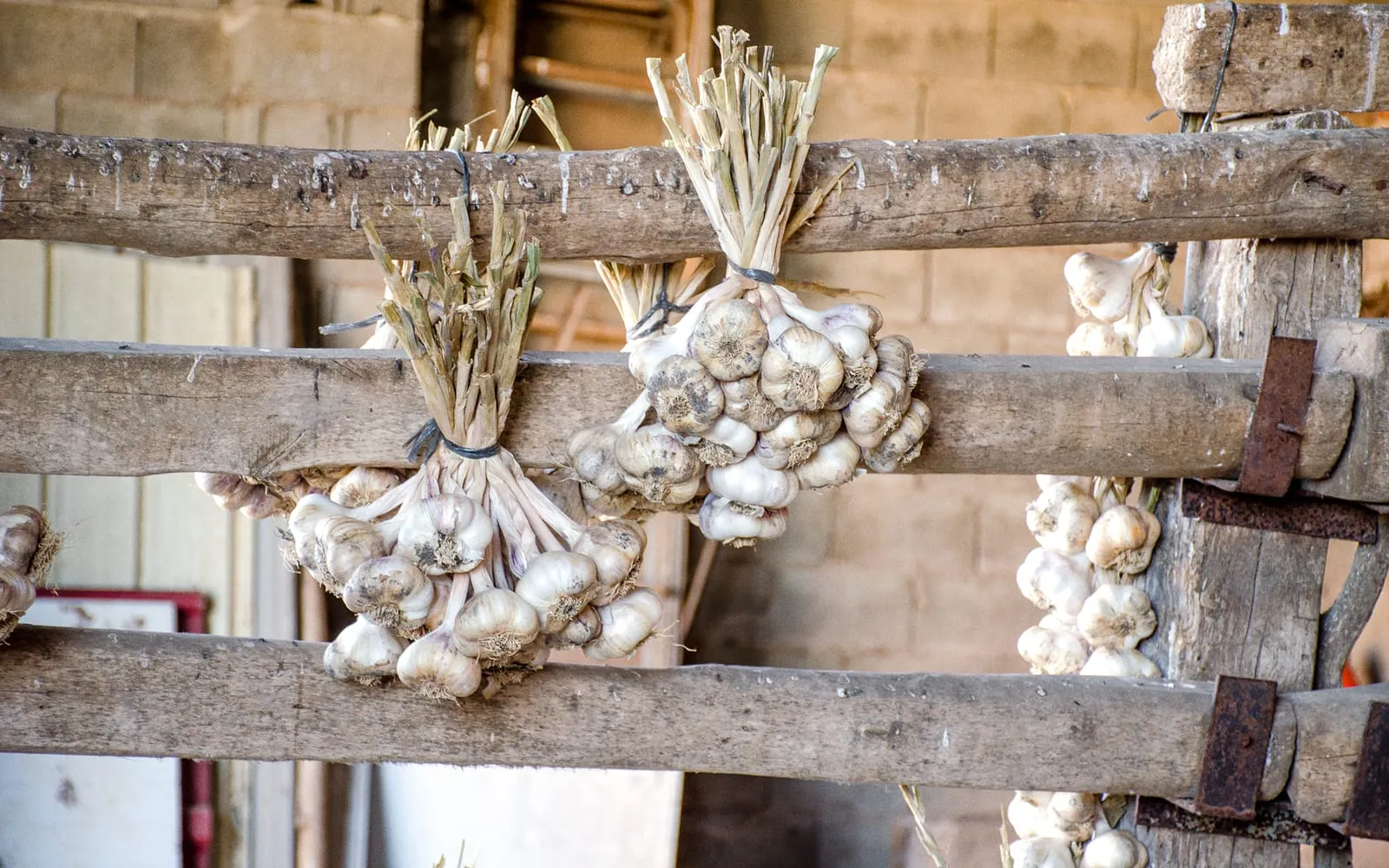
Two groups are sold and they behave differently. Hardnecks send up a stiff central flower stalk, produce fewer and larger cloves, have stronger flavour and keep for around six months. Softnecks make no flower stalk, produce more and smaller cloves in several layers, keep for up to a year and are the ones that can be plaited.
The hardneck flower stalk is called a scape. It curls into a loop as it grows and carries a pointed bud at the tip.
Flowers rarely open in cultivation. Where they do, the head usually carries small bulbils rather than seed.
Where it is from
Central Asia, most likely the mountains of Kyrgyzstan and Tajikistan, where the wild relative Allium longicuspis still grows. Cultivated garlic itself is sterile in most varieties and no wild population of it survives.
It has been grown for at least five thousand years and appears in Egyptian, Sumerian, Greek, Roman and Chinese records, as food, as medicine, and as pay for labourers building the pyramids.
Its native climate has a cold winter and a hot dry summer. Cold triggers the bulb to divide, and the dry summer ripens and cures it.
The problem in a maritime climate is wet rather than cold. Garlic tolerates hard frost easily and rots in waterlogged ground.
How it grows
Split a bulb into cloves just before planting, and keep the papery skin on each one. Plant only the fat outer cloves and cook the small inner ones.
Plant from October to early December, pointed end up, with the tip about 2.5 cm below the surface, spacing 15 cm apart in rows 30 cm apart.
Roots grow through the winter and a few leaves may show. Growth accelerates from February.
The clove divides into a new bulb in spring, driven by the cold it has already had and by lengthening days.
Cut the scapes off hardneck varieties in June when they curl. This puts the plant’s effort into the bulb and gives you a vegetable in its own right, good grilled or made into pesto.
Bulbs are ready when the lower third to half of the leaves have yellowed, usually in July. Lift them then rather than waiting for the tops to collapse, because an overripe bulb splits its wrapper and does not store.
Through the seasons
Autumn is planting. Get the cloves in from October to early December on free-draining ground.
Winter needs nothing. The plants sit through frost and snow without harm. Keep the bed weeded, since garlic competes badly.
Spring brings the growth surge. Feed with a high-nitrogen fertiliser in February and March, keep weeding, and water only in a dry spell.
Summer ends it. Cut the scapes in June, stop watering, and lift in July when the lower leaves yellow. Cure the bulbs in a dry airy place for two to four weeks before storing.
Care difficulty
Easy, with a long occupation of the ground as the price. Garlic holds a bed for nine months.
Timing is the one thing that matters. Plant before Christmas, and lift when the lower leaves yellow rather than when the tops fall over.
Weeding is the ongoing job. Garlic has thin upright leaves that cast no shade and it is easily smothered.
Drainage decides whether an autumn planting survives. On heavy wet ground, plant into a raised ridge or start the cloves in modules and plant out in February.
White rot is the one disease that ends garlic growing in a plot for years, and it arrives on infected stock.
Watering
Garlic needs very little water. Through a temperate winter and spring it needs none at all.
Water only during a dry spring, and only while the bulbs are swelling in April and May.
Stop watering entirely from June. The bulbs need to ripen dry, and late water produces soft bulbs that rot in store.
Never let the bed sit waterlogged. Winter wet is what kills autumn-planted garlic.
Containers dry out faster than open ground and need occasional watering in spring.
Warning signs, diseases and pests
Allium rust is the commonest problem in mild damp climates, showing as bright orange powdery pustules on the leaves from late spring. It thrives in mild damp weather and on plants that have had too much nitrogen. It rarely kills the crop but it reduces the bulb size, and lifting early is often the best response. Remove and bin affected foliage rather than composting it, space plants generously, and rotate.
White rot is the serious one. Leaves yellow and wilt, and the base of the bulb carries a fluffy white mould studded with small black resting bodies. Those survive in the soil for fifteen years or more and no treatment removes them. Never plant supermarket garlic, buy certified stock, and if it appears, stop growing any allium on that ground.
Leek moth larvae mine the leaves and tunnel into the bulb wherever the moth has established. Cover the crop with fine mesh.
Bulbs that never divided into cloves were planted too late and missed the cold period. They are perfectly edible.
Split bulbs with the wrapper burst were lifted too late.
Rotting bulbs in store were lifted wet or cured too briefly.
Growing environment
Full sun. Garlic in shade makes leaf and small bulbs.
Free-draining fertile soil with a neutral to slightly alkaline pH. Add compost the season before, and avoid fresh manure, which encourages rot.
Raised beds or ridges help enormously on clay.
Rotate on a four-year cycle with other alliums to limit rust and white rot.
Containers work. Use a deep pot with good drainage and space the cloves 10 cm apart.
Choose the variety for the job. Hardnecks such as ‘Lautrec Wight’ have the better flavour and the scapes, and softnecks such as ‘Solent Wight’ store far longer.
Feeding
Feed once or twice in early spring with a high-nitrogen fertiliser, such as sulphate of ammonia or a general-purpose feed, between February and April.
Stop feeding by May. Late nitrogen produces soft leafy growth, encourages rust, and gives bulbs that store poorly.
Do not use fresh manure. Work compost in during the previous season instead.
A dressing of sulphate of potash in spring improves storage quality.
Container plants need a liquid feed every fortnight through spring.
Troubleshooting
The bulb is one solid round lump with no cloves. It was planted too late and never got the cold spell it needed to divide. Plant before Christmas next time. The round bulb is perfectly good to eat.
Orange powdery spots all over the leaves. Allium rust. Remove the worst leaves, lift early if it is severe, and rotate the bed next year.
Yellowing plants with white fluffy mould at the base. White rot. Lift and bin every plant, and grow no alliums on that ground for many years.
The bulbs rotted in store. They were lifted too wet, cured too briefly, or watered too late in the season. Cure for two to four weeks somewhere dry and airy.
The wrapper has split and the cloves are loose. Lifted too late. Harvest when the lower third of the leaves yellow.
Can I plant garlic from the supermarket? It is a poor idea. It is usually a cultivar that will not vernalise in a cold garden, and it can carry white rot. Buy certified seed garlic.
What are the curly stalks and should I cut them? Scapes, on hardneck varieties. Cut them in June. The bulbs grow bigger and the scapes are excellent grilled or blitzed into pesto.
Is garlic safe for my dog? No. Garlic damages red blood cells in dogs and cats and causes anaemia. Keep bulbs and leftovers out of reach.
Garlic problem guides
Not sure what is wrong? See the common vegetable pests guide.