
Outdoor plant
Camellia
Camellia japonica
Also known as Japanese camellia, Rose of winter
How to grow camellias, Camellia japonica. Why an east-facing wall ruins the flowers, what causes bud drop, keeping the soil acid, and treating petal blight.
At a glance
- Difficulty
- Moderate
- Water
- Regularly through summer, and July and August matter most
- Light
- Dappled shade or a north or west-facing position, never east
- Temperature
- Hardy to about -10 deg C, though the flowers are frost-tender
- Hardiness
- USDA 7-9, RHS H5, hardy to -15 C
- Type
- Evergreen shrub or small tree, living well over a century
- Height
- 2-4 m in a garden, and up to 10 m in the wild
- Native to
- Japan, Korea and eastern China
- Best month
- March in the Northern Hemisphere, September in the Southern Hemisphere
The plant is hardier than its flowers and the buds form the summer before, so a dry August costs you the following spring. Morning sun after a frost turns open flowers brown, which is the single commonest cause of a ruined camellia, so face it west or north rather than east. It needs acid soil, and on chalk or limestone it will only ever be a container plant. Camellia petal blight, a fungus that browns flowers from the centre out, is established across the American south, New Zealand and parts of Europe.
Hardiness zones describe winter cold alone. Summer heat, humidity, rainfall and the length of the growing season decide as much, so treat the range as the outer limit rather than as a recommendation.
Every month named in this guide is for the temperate Northern Hemisphere. If you garden in the Southern Hemisphere, shift each one by six months, so March becomes September. Closer to the equator the wet and dry seasons matter more than the calendar, and the shift stops being a useful guide.
Not known to be toxic
Non-toxic. The ASPCA lists camellia among plants that are not harmful to cats, dogs or horses, and the RHS does not include Camellia japonica in its list of potentially harmful garden plants. Neither the leaves, the flowers nor the seeds present a poisoning risk, which makes camellia a good choice for a garden used by children or animals. The genus is better known in another form, since Camellia sinensis is the tea plant and its leaves have been drunk for several thousand years. Leaves of Camellia japonica are not used that way and are not worth trying, being tough and without flavour rather than dangerous. Camellia seeds are pressed for oil in Japan and are likewise harmless. The only caution worth naming is the fallen flowers, which drop whole and turn to a slippery brown mush on a path or a set of steps. Sweep them up rather than leaving them.
Sources: ASPCA toxic and non-toxic plants, RHS potentially harmful garden plants
About
Camellias flower in late winter, which is both their great virtue and the source of nearly every problem people have with them. Blooms opening in February and March are the only substantial colour in the garden, and they are also exposed to frost at the worst possible time.
Where you plant one decides whether that goes well. A camellia on an east-facing wall catches the early morning sun, which thaws frozen petals within minutes and turns them brown. The same plant twenty metres away facing west warms slowly and flowers unmarked.
Acidity is the other hard limit. Camellias will not grow in chalky or limy soil, so on chalk or limestone that means a large pot of ericaceous compost.
Appearance and character
A dense evergreen shrub, upright when young and broadening with age, typically 2 to 4 m in a garden and slowly reaching more.
Leaves are the plant’s other asset. Thick, leathery and glossy dark green, 5 to 10 cm long, oval with finely toothed edges, and holding their polish through winter.
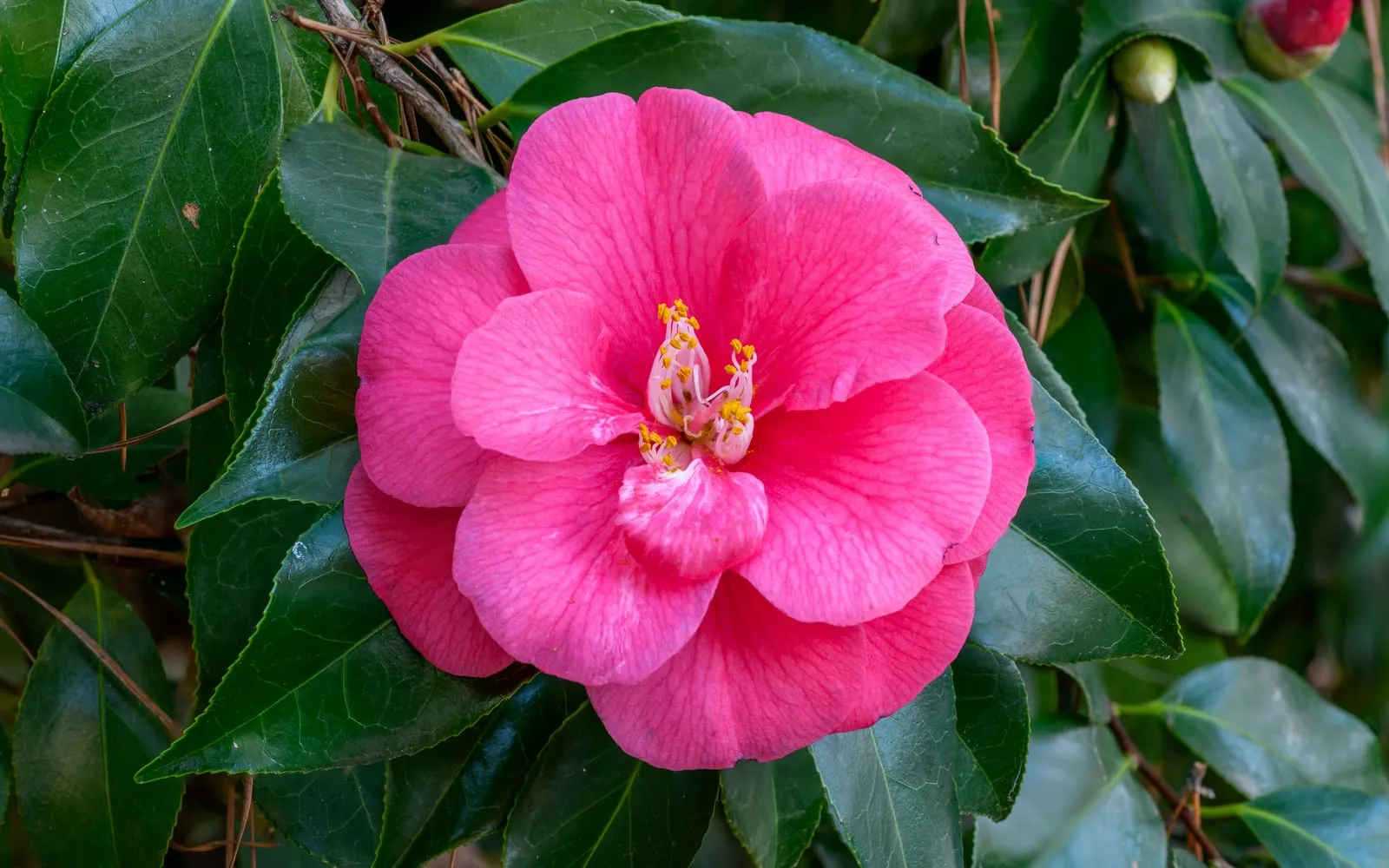
Flowers open from February to April, 7 to 12 cm across, in white, every shade of pink, and deep red. Forms range from single blooms with a boss of golden stamens through to formal doubles packed with overlapping petals and no visible centre.
Spent flowers of Camellia japonica drop whole rather than shedding petals, which leaves a circle of brown blooms under the bush.
Bark is smooth and pale grey, and the framework is attractive in its own right on an old specimen.
Growth is slow, around 10 to 20 cm a year, and plants live for well over a century. Some Japanese specimens are over five hundred years old.
Where it is from
Japan, Korea and eastern China, where it grows as an understorey shrub in mild damp forest with high rainfall and acid leaf-littered soil.
That understorey habit explains the shade tolerance. A camellia in the wild grows below a canopy and receives filtered light rather than full sun.
The genus takes its name from Georg Joseph Kamel, a Jesuit missionary and botanist who worked in the Philippines in the seventeenth century, though he never worked on the plant that carries his name.
Camellias reached Britain in the eighteenth century, arriving alongside the tea trade, and were grown under glass for decades before anyone realised they were hardy outdoors.
Their winter flowering follows the mild damp climate of the origin, where late winter is a reasonable time to bloom. In a colder climate the timing collides with frost, which is a problem of position rather than of hardiness.
How it grows
Plant in autumn or spring into acid soil enriched with leaf mould or composted bark, setting the rootball at the same depth it grew before. Planting too deep is a common cause of failure.
In alkaline soil, grow in a container of ericaceous compost. A pot of 45 to 50 cm suits a mature plant.
Choose the position for the morning sun rather than for the light. North-facing and west-facing walls both work well, and dappled shade under high trees is ideal. Avoid east-facing at all costs.
Water through July and August without fail. Flower buds for next spring form during those two months, and a plant that runs dry then will drop its buds the following February, months after the mistake was made.
Prune after flowering if you need to, cutting back to a leaf or a bud. Camellias tolerate hard pruning and respond by breaking from old wood, though a hard cut costs a season of flower.
Deadhead where you can reach, which tidies the plant and reduces petal blight.
Mulch each spring with composted bark, leaf mould or pine needles, keeping it clear of the stem.
Through the seasons
Winter brings the first buds and flowers, from January in mild years. Protect from early morning sun, and shelter containers from hard frost.
Spring is the main flowering season and the time to act. Prune after the last flower, feed with ericaceous fertiliser, mulch, and repot container plants.
Summer is when next year’s flowers are decided. Water thoroughly through July and August, feed once in early summer, and stop feeding by August.
Autumn is planting season and a good time to check the buds, which will be visible and fattening by October.
Care difficulty
Moderate, and almost all of it comes down to two decisions that are made once.
Position is the first. An east-facing wall produces brown flowers every year and no amount of subsequent care corrects it.
Soil acidity is the second. A camellia in limy soil yellows and declines regardless of feeding, and moving it into a pot of ericaceous compost is the only real answer.
Summer watering is the ongoing task, and it is the one people forget because the consequence arrives seven months later.
Beyond that the plant is hardy, long-lived, largely free of disease and needs very little pruning.
Watering
Water thoroughly through the growing season, and treat July and August as non-negotiable. Bud initiation happens then, and drought at that point causes the bud drop that appears the following winter.
Use rainwater wherever possible. Tap water in a hard water area raises the pH of ericaceous compost within a season or two and yellows the leaves.
Container plants need frequent watering in summer and checking even in winter, since an evergreen in a pot under the eaves of a house can dry out unnoticed.
Keep the compost damp rather than sodden. Camellias dislike waterlogging as much as drought.
Mulch to hold moisture, which does more good than an extra watering.
Warning signs, diseases and pests
Bud drop is the commonest complaint. Fat buds form in autumn, sit through winter, then yellow and fall without opening. The usual cause is drought the previous July and August, and other triggers are waterlogging, a sudden hard frost and extreme temperature swings. The treatment is watering next summer, which means the fix always comes a year after the disappointment.
Brown flowers on an east-facing wall are frost damage. Frozen petals thawed quickly by morning sun go brown and mushy within hours. Move the plant, or accept losing the early flowers.
Camellia petal blight is a fungal disease that browns the flowers from the centre outward, often with darker veining, and the affected blooms cling to the plant rather than dropping cleanly. Collect and destroy every fallen flower, replace the mulch, and avoid overhead watering. It persists in the soil.
Yellow leaves with green veins mean lime-induced chlorosis. Switch to rainwater, repot into ericaceous compost, and apply sequestered iron for a quick correction.
Scale insects sit as small brown or white discs along the leaf undersides and stems, producing honeydew and then black sooty mould over the foliage.
Leaves that are entirely pale yellow, rather than yellow between green veins, usually mean too much sun.
Vine weevil grubs eat the roots of container plants and cause sudden collapse.
Growing environment
Dappled shade, or a north or west-facing aspect. Filtered light under high deciduous trees suits camellias better than anything else.
Never plant against an east-facing wall. Slow thawing is what saves the flowers, and morning sun prevents it.
Acid soil at pH 5.5 to 6.5. Where the garden is alkaline, grow in a large container of ericaceous compost and water with rainwater.
Shelter from cold drying wind, which browns the leaf margins on an exposed plant.
Moisture-retentive soil rich in organic matter, and never waterlogged.
Containers work well and have the advantage that the plant can be moved into shelter while it flowers. Use a pot of at least 45 cm and top-dress each spring.
Avoid planting under the drip line of a house eave, where the plant sits dry in rain and exposed in frost.
Feeding
Feed with an ericaceous fertiliser twice a year, once after flowering in spring and again in early summer.
Stop feeding by the end of July. Late nitrogen produces soft growth that frost damages.
Top-dress container plants with fresh ericaceous compost each spring, removing the top few centimetres first.
Sequestered iron corrects yellowing leaves quickly while you deal with the underlying pH.
Avoid mushroom compost, bone meal and general fertilisers, all of which raise the pH.
Troubleshooting
The buds went brown and fell off without opening. Bud drop, usually caused by the plant drying out the previous July and August when the buds were forming. Water thoroughly through next summer and mulch.
The flowers turn brown as soon as they open. Frost, thawed too quickly by early morning sun. Move the plant off any east-facing position.
Brown flowers that cling to the bush with dark veining. Camellia petal blight. Collect and destroy every fallen bloom, renew the mulch, and stop overhead watering.
Yellow leaves with green veins. Lime-induced chlorosis. Use rainwater, repot into ericaceous compost, and apply sequestered iron.
Can I grow one on chalky soil? Only in a container of ericaceous compost. Attempts to acidify a chalky bed fail within a season or two.
When do I prune it? Straight after flowering in spring. Pruning later removes the buds forming for next year.
It flowers less every year. Check for too much shade, a pot that needs repotting, or a plant that has not been fed. Hard renovation pruning after flowering restores an old congested bush over two or three years.
Sticky leaves with a black coating. Scale insects and the sooty mould that grows on their honeydew. Treat the scale, then wash the mould off.