
Edible
Mango
Mangifera indica
Also known as Aam, Mangga, Mango tree
How to grow mango, Mangifera indica. Telling a ripe one by smell rather than colour, cutting the hedgehog, why the skin can raise a rash, and what a stone on a windowsill will and will not do.
At a glance
- Difficulty
- Difficult
- Water
- Twice a week in growth, much less from late autumn
- Light
- Full sun, and as much of it as you can give
- Temperature
- Growth stops below 15 deg C and frost kills young wood
- Humidity
- Moderate. It wants a dry spell before flowering rather than constant damp
- Hardiness
- USDA 10-11, RHS H1b, hardy to 4 C
- Type
- Tender evergreen tree
- Height
- Up to 30 m in the tropics, 2-3 m in a large pot
- Native to
- north-eastern India, Myanmar
- Best month
- April and May in the Northern Hemisphere, October and November in the Southern Hemisphere
Tropical and subtropical lowland. Frost kills young trees outright and a mature one loses wood below about -1 deg C, so USDA 10 is a hard floor for growing it outdoors. Cropping asks for more than survival. Mango needs a distinct dry period of two to three months to flower well, which is why it fruits so reliably in monsoon climates and in subtropical regions with a dry winter, and why it flowers erratically where rain falls evenly through the year. Outside USDA 10 it is a heated greenhouse plant that rarely fruits and a handsome foliage plant that always does.
Hardiness zones describe winter cold alone. Summer heat, humidity, rainfall and the length of the growing season decide as much, so treat the range as the outer limit rather than as a recommendation.
Every month named in this guide is for the temperate Northern Hemisphere. If you garden in the Southern Hemisphere, shift each one by six months, so April becomes October. Closer to the equator the wet and dry seasons matter more than the calendar, and the shift stops being a useful guide.
Skin irritant
- Safe to eat
- The ripe flesh
- Do not eat
- The skin, the sap and the leaves, which carry urushiol
- Harm from
- Handling it and eating it
- Affects
- People
Mango is in the Anacardiaceae, the family that also holds cashew, pistachio and poison ivy, and it shares their chemistry. The sap, the skin and the leaves contain urushiol, the compound behind poison ivy dermatitis. Anyone already sensitised to poison ivy or poison oak can react to a mango skin with an itching rash around the mouth a day or two after eating, and people who pick the fruit for a living get it on their hands and forearms. The flesh is free of it, so peeling the fruit rather than biting through the skin avoids the problem for almost everyone. Pruning a tree releases sap that raises blisters on contact, and gloves are worth wearing. The ripe flesh is safe for cats and dogs in small amounts, though the stone is a choking and obstruction hazard and should never be given to a dog.
Sources: RHS potentially harmful garden plants, ASPCA toxic and non-toxic plants
About
Mango is the fruit more people eat than any other, and any one country sees a fraction of what exists. Something over a thousand named cultivars are grown in India alone, ranging from fruit the size of a plum to one that needs both hands.
Ripeness is judged by nose and thumb rather than by eye. A ripe mango smells sweet and resinous at the stem end and gives slightly under a press. Colour tells you almost nothing, because a Kesar stays green when it is ready and an Alphonso goes gold, and the red blush on a supermarket Tommy Atkins is sunburn on the side that faced out.
Where you garden decides what the tree is for. In USDA 10 and 11 it is an orchard tree that crops heavily and lives for decades. Anywhere colder it is a foliage plant, and a good one. A stone from a shop-bought fruit germinates freely and grows into a handsome glossy-leaved plant that will never fruit. For a crop you need a grafted dwarf cultivar under glass, with heat through the winter.
Appearance and character
A dense domed evergreen tree, 10 to 30 m where it is happy, kept to 2 or 3 m in a pot by root restriction and pruning.
New growth is the thing to watch for. Mango flushes in bursts, and the young leaves hang limp and coppery red or purple for a week before hardening and turning green. A grower seeing that for the first time usually thinks the plant is dying.
Mature leaves are long and narrow, 15 to 35 cm, leathery, dark glossy green, and strongly aromatic when crushed. The smell is turpentine rather than fruit.
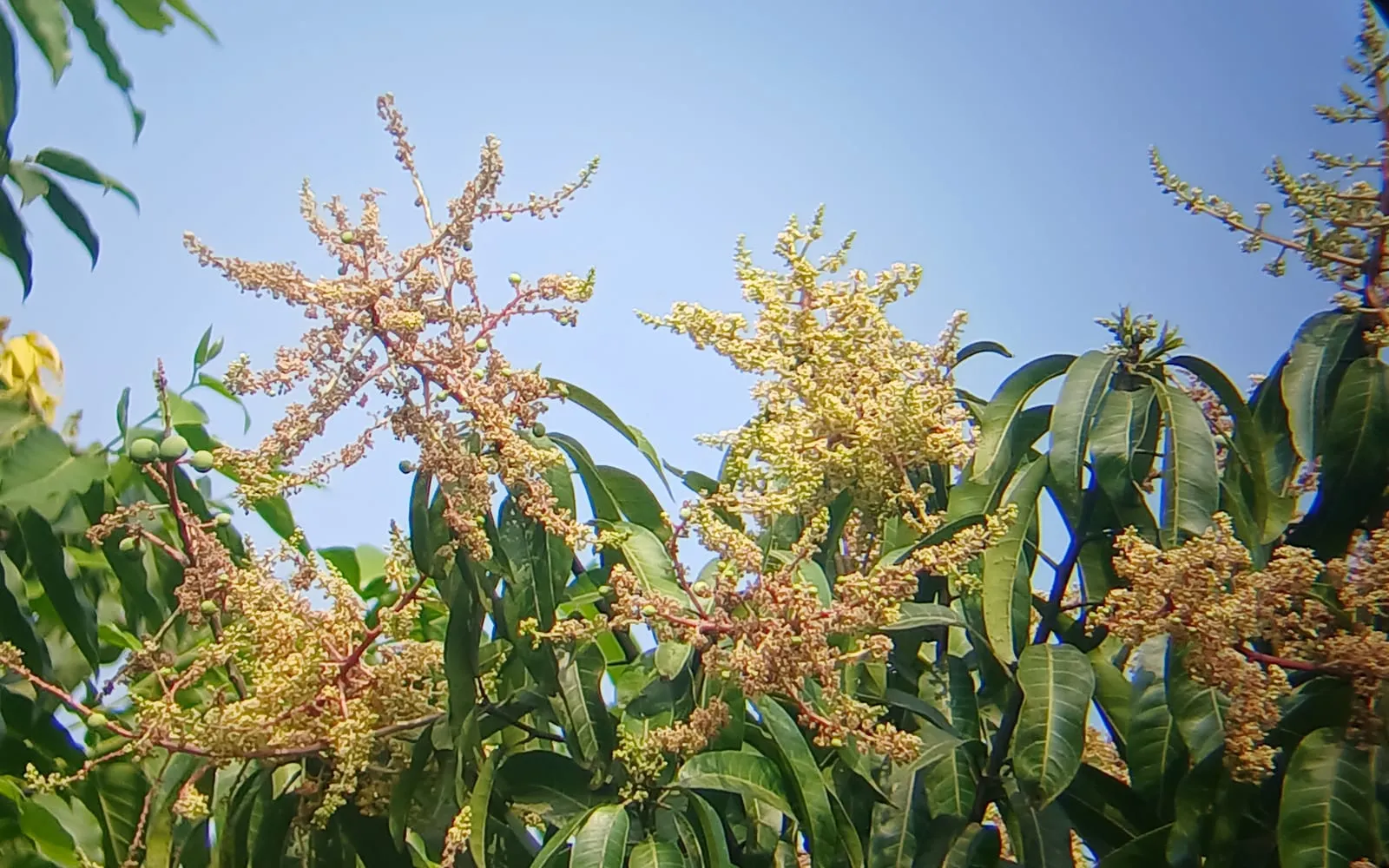
Flowers come in large branched panicles at the ends of the shoots, hundreds to a spray, small and yellowish pink. Most are male and only a small percentage carry a functional ovary, which is why a panicle of five hundred flowers sets two or three fruit.
The fruit is a drupe with a single large flat stone. Shape runs from round to long and beaked, and the flesh is orange to yellow, with a fibrous layer next to the stone in older cultivars that the modern ones have mostly bred out.
Cut it around the flat stone. Slice down each side of the flat stone, score the flesh of each cheek into squares without cutting the skin, then push the skin inside out so the squares stand proud.
Where it is from
Mango is native to the foothills of the eastern Himalaya, across north-eastern India, Bangladesh and Myanmar, where it still grows wild in monsoon forest.
Cultivation there is old enough to be measured in millennia. Mango appears in Sanskrit literature, in Buddhist texts where the Buddha is given a mango grove, and in the accounts of the Mughal emperors, who ran the first serious grafting programmes and produced several cultivars still grown.
Portuguese traders carried it out of India in the sixteenth century, to East Africa and then to Brazil, and the English word came with them from the Malayalam and Tamil name for the fruit.
India grows roughly half the world crop and exports very little of it, because the domestic market takes almost everything. The export trade runs instead from Mexico and Brazil into North America, and from Peru, Brazil, Pakistan and West Africa into Europe. A short Indian season in early summer is the one worth waiting for, and greengrocers serving South Asian communities make a great deal of it.
The species is now naturalised across the tropics and is a weed in parts of Australia and the Pacific.
How it grows
Start with a stone from a ripe fruit, or buy a grafted plant if you want fruit rather than foliage.
Clean the stone, let it dry for a day, then cut the tough husk open along its edge with secateurs and take out the kidney-shaped seed inside. Sowing the whole husk works and takes three times as long.
Sow the seed flat, half buried, in free-draining compost at 25 to 30 deg C. Germination takes two to four weeks.
Expect more than one shoot from some seeds. Many Indian and South East Asian cultivars are polyembryonic, meaning a single seed produces several seedlings, of which the strongest are clones of the mother tree and one is a true seedling. Keep the vigorous ones and discard the weakest.
Pot on into deep free-draining compost with grit, into a tall pot rather than a wide one, because the taproot goes straight down.
Grow at a minimum of 15 deg C with full light. Outdoors in USDA 10 and 11, and in a conservatory or a heated greenhouse anywhere colder.
Prune after each growth flush to build a branched plant rather than a single whip.
Withhold water for four to six weeks in late winter to trigger flowering on a mature grafted plant. A mango that never dries never sets flower buds.
Through the seasons
Winter is the resting period. Keep the plant above 15 deg C, cut watering right back, and give no feed.
Late winter is when a mature grafted plant is deliberately dried off to initiate flowers.
Spring brings the flower panicles on plants old enough, followed by the first growth flush. Start feeding as growth begins.
Early summer is fruit swell on a tree that has set, and the main flush of new leaves on one that has not.
Midsummer is peak growth. Feed fortnightly and keep the plant in as much light as possible.
Late summer is when to stop feeding and let the wood harden before the light goes.
Autumn is a slow taper. Reduce watering as growth stops.
Care difficulty
Easy in the tropics and subtropics, and difficult everywhere else, where the difficulty is climate rather than skill.
Minimum 15 deg C year round, with 25 to 30 deg C for real growth. A cold greenhouse will not do it.
Full sun is needed, and at high latitudes winter light is the limiting factor even in a heated house.
A seedling from a shop-bought stone will not fruit in any useful timescale. Seedling mangoes take eight to fifteen years to flower in the tropics and usually never do so in a pot.
Grafted dwarf cultivars such as Nam Doc Mai, Julie and Irwin will fruit in a large pot in three to four years given the heat.
Powdery mildew on the flower panicles is the commonest reason a plant that flowers sets nothing.
As a foliage plant it is easy, handsome and forgiving, and that is the sensible ambition anywhere outside its climate.
Watering
Water twice a week through the growing season, letting the top few centimetres dry between times.
Give a full soak that runs from the base rather than a daily splash, because the root system is deep.
Cut back hard from late autumn. A pot that stays wet through a cool winter is the commonest way to kill a mango.
Dry the plant off deliberately for four to six weeks in late winter if you want flowers, watering only enough to stop the leaves wilting.
Resume normal watering as the panicles extend.
Use rainwater in a hard water area, since mango prefers slightly acid conditions.
Never let a pot stand in a saucer of water.
Warning signs, diseases and pests
Limp coppery new leaves are normal. That is how a mango flushes, and they harden and green over about a week.
A white bloom on flower panicles, followed by the whole spray going brown and dropping, is powdery mildew. It costs more mango crops worldwide than anything else and it is worse in still humid air under glass.
Black sunken spots on fruit, with the flower stalks dying back, is anthracnose. Improve airflow and remove affected material.
Brown leaf tips and edges usually mean salt build-up from tap water or feed.
Yellowing between the veins is iron shortage, common in a pot watered with hard water.
Scale insects sit as flat brown discs along the stems and the midribs.
Mealybug gathers as white waxy fluff in the leaf axils.
Blackening at the base with a sour smell is root rot from cold wet compost.
Leaf drop through winter means the plant is too cold, too wet, or both.
A tree in flower that sets nothing may have had no pollinators. Mango is pollinated by flies rather than bees, and a closed greenhouse has neither, so brush the panicles with a soft brush.
Fruit flies puncture ripening fruit and can turn it into a collapsing, maggot-riddled mass within days, an outdoor risk rather than a greenhouse one. Across eastern Australia the species responsible is Queensland fruit fly; net outdoor trees and never move home-grown fruit out of a quarantine area.
Growing environment
Outdoors in USDA 10 and 11, in full sun with room for a large tree. Colder than that, a heated greenhouse or conservatory, with no outdoor option at all.
Minimum 15 deg C, ideally 24 to 30 deg C in growth.
Full sun, with no shading. Mango is one of the few plants under glass that wants every scrap of light the sky can offer.
Moderate humidity. Very damp still air encourages the mildew that ruins the flowers.
A deep pot with free-draining compost, around a third grit or perlite.
pH from 5.5 to 7.0.
Good air movement, which matters more for this species than for most because of the mildew.
Root restriction in a pot is useful rather than a compromise, since it keeps the tree small and brings flowering forward.
Feeding
Feed a balanced liquid feed fortnightly from April as growth starts.
Switch to a high-potash feed once flower buds are visible, and carry on through fruit swell.
Stop feeding in late August so the wood ripens before winter.
Give nothing at all from October to March.
Add sequestered iron if the young leaves yellow between the veins.
Top-dress or repot every second spring, using fresh compost with added grit.
Avoid heavy nitrogen on a mature plant, which produces leaf at the expense of flowers.
Troubleshooting
My stone sprouted three shoots. That is normal for many Asian cultivars. Polyembryonic seeds produce several seedlings, most of them clones of the parent tree. Keep the strongest two and pot them separately.
The new leaves are limp and red and I think it is dying. It is not. Mango flushes in bursts and the soft new growth hangs down for about a week before hardening and turning green.
How do I tell when a shop mango is ripe? Smell the stem end and press gently with a thumb. A ripe one smells sweet and resinous and gives a little. Skin colour depends on cultivar and tells you very little.
Will my windowsill seedling ever fruit? No. Seedlings take eight to fifteen years to flower even in the tropics, and a plant in a pot indoors will not get there at all. A grafted dwarf cultivar such as Nam Doc Mai or Julie fruits in three or four years, outdoors in USDA 10 or under glass with real heat.
It flowers every year and never sets fruit. Two likely causes. Powdery mildew browns the panicles before anything sets, and a sealed greenhouse has no pollinating flies. Improve the airflow and hand-pollinate with a soft brush.
Eating mango gives me an itchy rash round my mouth. The skin and sap carry urushiol, the poison ivy compound. Peel the fruit rather than biting through the skin, and wear gloves when pruning.
Can I give mango to my dog? A little ripe flesh is fine. Never give the stone, which is both a choking hazard and an obstruction risk.
Mango problem guides
Not sure what is wrong? See the common vegetable pests guide.
- Powdery mildew on the flower panicles, which is what costs most crops
- Anthracnose, showing as black sunken spots on fruit and flower stalks
- Scale insects along the stems and leaf veins
- Mealybug in the leaf axils under glass
- Root rot from a pot that never dries
- A seedling that grows for fifteen years and never flowers
- Fruit flies, including Queensland fruit fly across eastern Australia