
Outdoor plant
Snowdrop
Galanthus nivalis
Also known as Common snowdrop, Galanthus, Fair maids of February
How to grow snowdrops, Galanthus nivalis. Why to plant them in the green, how to divide a clump, and how poisonous the bulbs are.
At a glance
- Difficulty
- Easy
- Water
- Rain is enough in open ground
- Light
- Partial shade, ideally under deciduous trees
- Temperature
- Fully hardy, down to about -20 deg C
- Hardiness
- USDA 3-8, RHS H6, hardy to -30 C
- Type
- Bulbous perennial
- Height
- 10-15 cm
- Native to
- Mainland Europe, from the Pyrenees to Ukraine
- Best month
- January in the Northern Hemisphere, July in the Southern Hemisphere
Dry bulbs sold in autumn establish poorly, which is why snowdrops are traded in the green, lifted and replanted in leaf just after flowering. It needs cool moist summers and does badly anywhere summers are hot and dry. Flowers flatten in hard frost and stand up again when it lifts, so the display survives cold that would finish anything else in bloom.
Hardiness zones describe winter cold alone. Summer heat, humidity, rainfall and the length of the growing season decide as much, so treat the range as the outer limit rather than as a recommendation.
Every month named in this guide is for the temperate Northern Hemisphere. If you garden in the Southern Hemisphere, shift each one by six months, so January becomes July. Closer to the equator the wet and dry seasons matter more than the calendar, and the shift stops being a useful guide.
Harmful if eaten
- Do not eat
- Every part, and the bulbs most of all
- Harm from
- Eating it
- Affects
- People, cats and dogs
All parts are poisonous and the bulbs hold the most. They contain lycorine and galantamine, and the RHS lists Galanthus in category C, harmful if eaten. Nearly every serious human case on record involves someone digging up bulbs and cooking them in mistake for onions or shallots, which is worth knowing if you grow snowdrops near a vegetable patch. Eating a flower or a leaf causes vomiting and stomach pain rather than anything worse. The ASPCA has no entry for snowdrop, but it lists Narcissus, which sits in the same family and carries the same lycorine, as toxic to cats, dogs and horses, so treat snowdrops as one to keep pets away from. Label your bulbs, and ring a doctor or vet if any quantity has been eaten.
Sources: RHS potentially harmful garden plants, NC State Extension, Galanthus nivalis, ASPCA (Narcissus, same family)
About
Snowdrops flower in January, in cold soil, often through snow, and they do it without any help from you. Once a clump is settled it spreads slowly into a drift and outlives the gardener who planted it.
They are not native to Britain, which surprises people who find them carpeting an old churchyard. Galanthus nivalis is a mainland European plant, grown in British gardens since the sixteenth century and first recorded growing wild here in 1778. The sheets of them in woodland and along riverbanks are escapes from cultivation, usually near a house or an abbey that is long gone.
Buying and planting them at the right moment is the one job that decides whether they take. Get that right and the rest is mulch.
Appearance and character
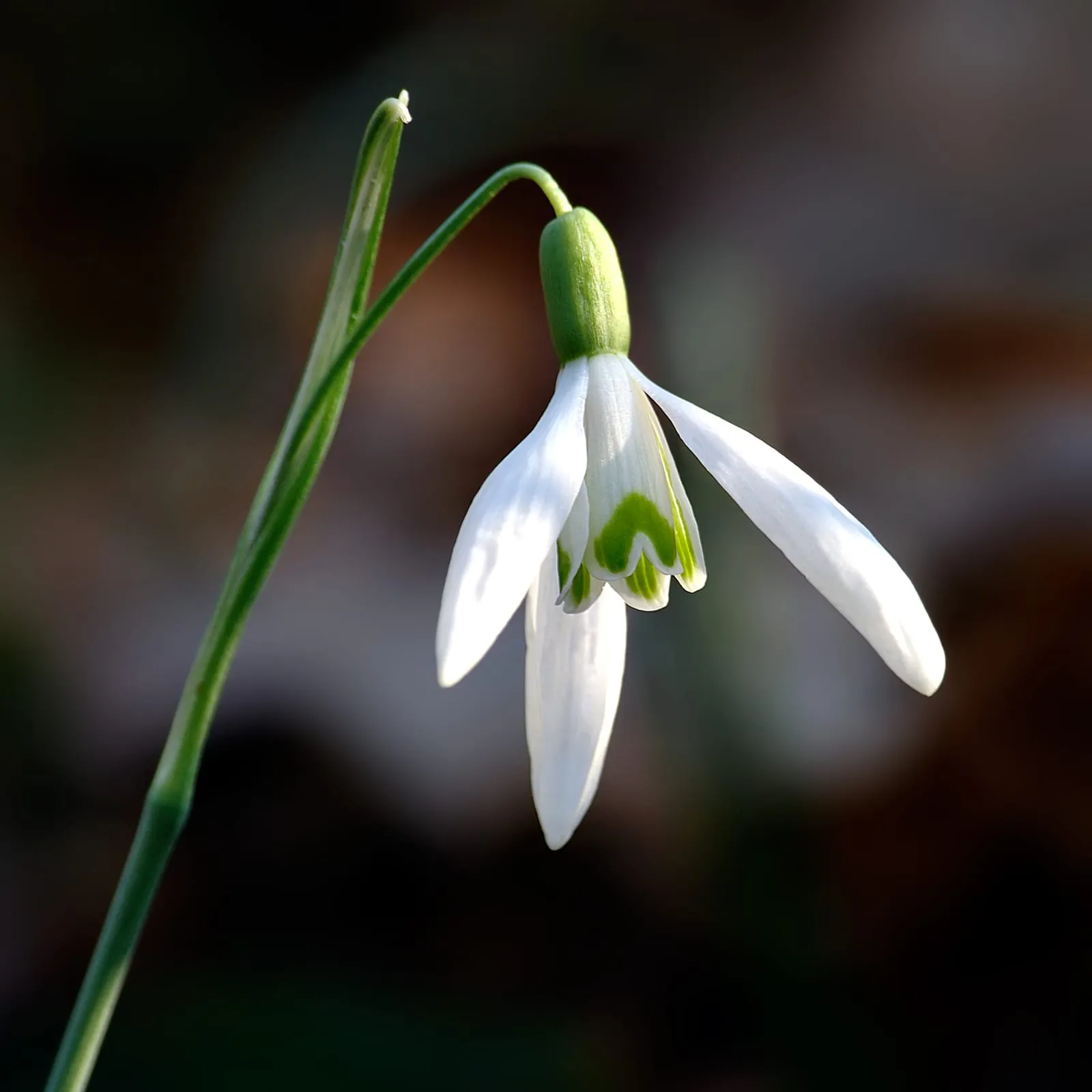
Each stem carries a single nodding flower over two narrow grey-green leaves. The flower has six white segments in two ranks. The three outer ones are long, plain and spreading. The three inner ones are short, notched, and marked with green, and they sit together in a little tube.
Those green marks are the whole basis of snowdrop collecting. The shape and extent of the mark on the inner segments, and whether it appears on the outer ones too, is how cultivars are told apart, and collectors, who call themselves galanthophiles without irony, pay hundreds of pounds for a single bulb of a distinctive one. You do not need to care, but it explains the price tags you will see in February catalogues.
The leaf tips are hardened and slightly thickened, which is how a soft shoot pushes up through frozen ground without being shredded. There is a faint honey scent on a mild day.
Where it is from
Mainland Europe, from the Pyrenees across to Ukraine, in damp deciduous woodland and on shaded stream banks.
That habitat sets the whole management. A snowdrop does its growing between midwinter and late spring, while the trees above it are bare and light reaches the floor, then dies back and rests through summer in the shade of the leaf canopy. It is adapted to soil that stays cool and slightly damp all year under a layer of leaf litter, and it resents a summer bake.
How it grows
A bulbous perennial that multiplies by splitting into offsets around the parent bulb, gradually building a congested clump, and also by seed. The seeds carry a fleshy appendage that ants collect and carry off, which is how colonies travel a few metres a year across a wood.
Growth runs opposite to the garden. Roots and shoots move in autumn and early winter, flowers open in January and February, the leaves feed the bulb through March and April, and the whole plant vanishes by June.
That timetable means the foliage is doing its most important work at the moment it starts to look untidy. Leave it entirely alone until it yellows and pulls away by itself.
Through the seasons
Winter is the flowering. Nothing to do but look at them.
Spring is when you divide, and it is the only easy window. As soon as flowering finishes, while the leaves are still green, lift a congested clump, tease it into groups of three to five bulbs, and replant at the same depth straight away. Water them in.
Summer is dormancy, and the season snowdrops are lost in. The soil above them should not bake dry. A planting under a hungry tree, or in a pot left on a sunny terrace, can cook the bulbs while you are not thinking about them.
Autumn is mulching, and the time to plant dry bulbs if that is what you have. Spread leaf mould or garden compost over the area.
Care difficulty
Easy once established, with a single decision that decides whether they establish at all.
Snowdrop bulbs have no protective tunic and a high water content, so they dry out badly in a paper sack in a garden centre. Dry bulbs bought in autumn often fail, and gardeners who lose a whole bag conclude they cannot grow snowdrops.
Buy them “in the green” instead. That means growing plants with leaves attached, sold in bundles in February and March, lifted and shipped straight from the field. Plant them at the depth of the pale mark on the stem, water them in, and they carry on as if nothing happened. If you do buy dry bulbs, buy early, pick plump firm ones, and get them in the ground the day they arrive.
Watering
In open ground with decent soil, rain does everything. Snowdrops are growing in the wettest months of the year.
Water new plantings in well, particularly ones divided in the green, whose roots have been disturbed while in full growth. Keep an eye on them through a dry spring.
The real risk is summer drought under trees or in containers. The bulbs must not bake. If you grow them in pots, keep the compost just moist through summer rather than letting it dry to dust, and plunge the pots somewhere shaded.
Waterlogging rots them, so heavy clay wants grit and leaf mould worked in.
Warning signs, diseases and pests
Grey mould, Botrytis galanthina, is the disease to watch for. It appears as a fuzzy grey growth on leaves and flower stems in mild damp weather, and it spreads through a congested clump. Pull out affected plants including the bulb, bin them rather than composting them, and thin the clump to move air through.
Narcissus bulb fly lays at the neck of the bulb in late spring, and the grub hollows it out over summer, so the clump fails to appear the following January. Firming the soil around the foliage as it dies back gives the fly fewer gaps to lay in.
Squirrels and mice dig up newly planted bulbs, mostly out of curiosity in the first autumn. Netting over the area until growth appears is enough.
A clump that flowered well for years and is now producing leaves and few flowers is not diseased. It is congested, and it needs dividing.
Growing environment
Partial shade under deciduous trees and shrubs is ideal, because it gives full winter light while the branches are bare and shade once the canopy closes. The north side of a wall, a hedge bottom or a shaded border all work. Full sun is tolerated if the soil stays moist through summer.
Fully hardy to about -30 deg C, and unbothered by frost. Flowers that collapse in a hard freeze stand up again as they thaw.
Soil should be humus-rich and moisture-retentive but not boggy. Snowdrops do well on clay, which holds summer moisture, provided it drains in winter. Plant about 10 cm deep.
Feeding
Snowdrops evolved on a woodland floor with no fertiliser and they do not need much. An annual autumn mulch of leaf mould or well-rotted garden compost is the best thing you can give them, because it feeds the soil and keeps summer moisture in.
If a clump is weak on poor soil, a low-nitrogen feed as the leaves come through helps. Avoid anything high in nitrogen, which produces soft foliage and no extra flowers.
Troubleshooting
The dry bulbs I planted in autumn never came up. The usual outcome. They desiccated before you bought them. Buy in the green in February or March instead.
Lots of leaves, hardly any flowers. The clump is congested. Lift and divide it in the green, straight after flowering, into groups of three to five.
The colony is shrinking year on year. Usually summer drought, often because a tree above has grown and is now taking all the moisture. Mulch heavily, and consider moving them.
Fuzzy grey growth on the leaves. Botrytis. Remove and destroy affected plants, bulb included, and thin the clump.
Can I cut the leaves off once flowering ends? No. That is the bulb feeding itself for next year. Wait until they yellow and detach on their own, usually late May.
They are not spreading. Snowdrops spread slowly, a few centimetres a year. Dividing every three or four years in the green speeds it up far more than waiting does.