
Outdoor plant
Common heather
Calluna vulgaris
Also known as Ling, Scots heather
How to grow heather, Calluna vulgaris. Why it needs acid soil and rainwater, when to shear it, and the difference between ling and the winter-flowering ericas.
At a glance
- Difficulty
- Difficult
- Water
- In dry spells for the first two years, and rainwater only in hard-water areas
- Light
- Full sun, and it goes leggy and stops flowering in shade
- Temperature
- Extremely hardy, and it survives exposed moorland winters
- Hardiness
- USDA 4-6, RHS H7, hardy to -30 C
- Type
- Evergreen dwarf shrub, long lived but going woody and bare without cutting
- Height
- 20-60 cm
- Native to
- Europe and Asia Minor, and native throughout Britain
- Best month
- August in the Northern Hemisphere, February in the Southern Hemisphere
Acid soil below pH 6 is not negotiable, and on chalk or in hard water the leaves yellow and the plant dies within a season or two. Cold is no obstacle at all and warm humid summers are, so it does poorly through the American south-east. It is one of the worst invasive plants in New Zealand, where it covers large parts of Tongariro National Park and is fought with an introduced beetle.
Hardiness zones describe winter cold alone. Summer heat, humidity, rainfall and the length of the growing season decide as much, so treat the range as the outer limit rather than as a recommendation.
Every month named in this guide is for the temperate Northern Hemisphere. If you garden in the Southern Hemisphere, shift each one by six months, so August becomes February. Closer to the equator the wet and dry seasons matter more than the calendar, and the shift stops being a useful guide.
Not known to be toxic
Common heather is not listed by the RHS as a potentially harmful garden plant and is not recorded by the ASPCA as toxic to cats, dogs or horses. No part of it is a recognised poisoning hazard. It has a long history of domestic use across Scotland and northern England, where the stems were made into brooms and thatch and rope, the flowers were used to flavour ale, and heather honey is a distinct and highly regarded product with a thick jelly texture. Sheep, deer and grouse all browse it as a staple. One point of confusion is worth clearing up, because the genuinely poisonous plants of the same family are the rhododendrons and the related Pieris and Kalmia, which contain grayanotoxins and which are dangerous to livestock and to people through honey. Calluna is not among them. Where a plant is unlisted by both sources rather than positively assessed, read that as no hazard recorded rather than a hazard ruled out.
Sources: RHS potentially harmful garden plants, ASPCA toxic and non-toxic plants
About
Heather is easy on a Scottish hillside and difficult in most temperate gardens, and the reason is the soil.
Calluna needs ground that is acid, poor, free-draining and short of nutrients. That combination is what an upland peat moor provides and what a fertile garden loam provides the opposite of. Planted into ordinary alkaline soil it yellows within a season and dies within two, and no amount of watering or feeding changes it.
Given the right conditions it is as tough as any garden plant, holding on through gales, frost, drought and grazing on ground with almost nothing in it.
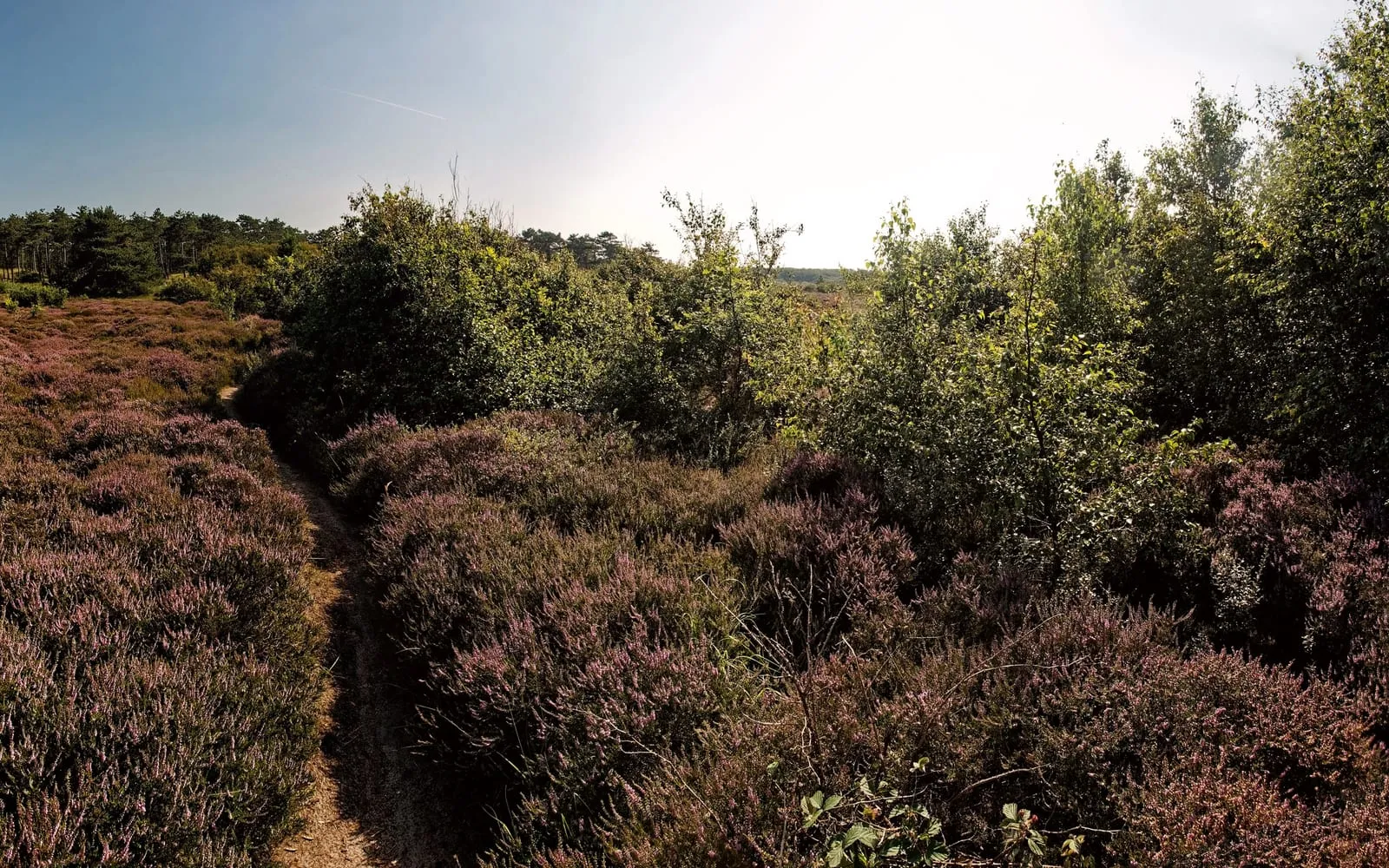
It is the purple that covers moorland in August, and the single species behind that whole landscape. Bell heather and cross-leaved heath flower alongside it, both in the genus Erica, and the mass of colour is Calluna.
Garden cultivars run far beyond wild purple. The foliage forms are the more useful half, with gold, orange, bronze and grey selections that hold colour through the winter and change tone with the cold, and those earn their place in a bed for twelve months rather than six weeks.
Appearance and character
An evergreen dwarf shrub reaching 20 to 60 cm, spreading into a low mound of fine wiry stems.
Leaves are the identification. They are minute, only 2 to 3 mm, scale-like, and pressed flat against the stem in four overlapping ranks so a shoot looks like a plaited cord. Erica, by contrast, has needle-like leaves that stand out from the stem in whorls.
Flowers open from July to September in slender one-sided spikes along the upper stems, each flower 3 to 4 mm, in pale purple-pink, deeper mauve or white.
The flower has four sepals as long as the four petals, both coloured, so the dead flowers keep their colour on the plant right through the winter and go russet rather than dropping.
Cultivar foliage runs through gold, lime, orange, bronze, red and silver-grey, and many selections deepen or change colour after the first frosts.
Stems go woody and bare from the base upwards as the plant ages, which is why cutting matters.
White heather is a genuine and rare wild variant, and the luck associated with it comes from that rarity.
Where it is from
Europe and Asia Minor, from Iceland and northern Scandinavia south to the Mediterranean, and native throughout Britain and Ireland.
It grows on acid heath, moorland, blanket bog margins, open pine and birch woodland, and coastal cliff, always on acid ground and usually on poor thin soil or peat.
British heather moorland is a managed habitat rather than a natural one. It was created by clearing woodland and maintained by grazing and burning, and much of it is now burned in rotation for red grouse, which keeps the heather young and productive.
Heather supports a distinct community. Red grouse eat little else, and merlin, curlew, golden plover, emperor moth and the heath potter wasp all depend on it.
The domestic uses were extensive. Heather thatch, heather rope, heather brooms and heather bedding all appear across the Highlands and Islands, and the word ling comes from Old Norse.
Heather honey is a separate product from ordinary honey. It is thixotropic, meaning it sets to a jelly and liquefies when stirred, and it has to be pressed rather than extracted by spinning.
How it grows
Test the soil pH before you buy anything. Heather needs pH 4.5 to 6, and above about 6.5 it will not survive.
On alkaline or neutral soil, grow it in a container or a raised bed of ericaceous compost rather than trying to acidify a border. Sulphur chips lower pH slowly and partially, and the surrounding ground pulls it back.
Plant in autumn or spring in full sun, into free-draining acid soil with leaf mould or composted bark worked in.
Plant slightly deeper than the pot, up to the lowest foliage, which encourages the stems to root along their length.
Space plants 30 to 45 cm apart for ground cover, or plant in drifts of odd numbers of the same cultivar rather than dotting single plants about.
Mulch with composted bark, pine needles or leaf mould rather than mushroom compost, which is alkaline.
Shear it every year. This is the one job that matters and the one most often skipped. Cut the whole plant back in March or April with shears, taking off all the dead flower spikes and cutting into the top of the previous year’s growth.
Never cut back into bare old wood. Calluna does not regrow from it, and a plant left unsheared for years cannot be recovered.
Water with rainwater in a hard-water area. Tap water drawn from chalk or limestone carries enough calcium to raise the pH of a container within a couple of seasons.
Propagate by layering, which happens on its own where stems touch soil, or from semi-ripe cuttings in midsummer.
Replace plants every ten to fifteen years. Even sheared annually, heather eventually goes woody and thin.
Through the seasons
Winter is when the foliage cultivars do their work, deepening to orange, red and bronze in the cold, with the russet dead flower spikes still on the plant.
Spring is shearing season, in March or April before the new growth extends.
Summer grows and sets the flower spikes, and this is when a young plant needs watering.
Autumn is the tail of the flowering, which runs from July to September, and it is a good planting season.
Care difficulty
Difficult, and specifically difficult in the wrong soil.
On acid ground in full sun it needs almost nothing but an annual shear. On chalk, limestone or ordinary alkaline garden loam it cannot be grown at all in the ground, and attempts to change the soil fail within a few years.
The other common failure is neglecting the shear. An unsheared heather goes bare and woody at the base, flowers thinly on the outer edges and cannot be cut back to recover, so it has to be replaced.
Watering with tap water in a hard-water area kills container-grown plants slowly, and the cause is rarely identified.
Watering
Water regularly through dry spells for the first two years while it roots in. The root system is shallow and fibrous and dries out fast.
Established heather in the ground on acid soil manages on rainfall in a temperate climate, and needs water in a long drought.
Use rainwater wherever the mains supply is hard. This matters more for heather than for almost any other garden plant, and it is the commonest cause of slow decline in a pot.
Never let it stand in water. Phytophthora root rot follows waterlogging and kills.
Warning signs, diseases and pests
Yellowing across the whole plant with green veins is lime-induced chlorosis. The soil or the water is too alkaline. Move it to a container of ericaceous compost and switch to rainwater.
A bare woody centre with a thin ring of green at the edges means it has not been sheared. There is no recovery, since Calluna does not regrow from old wood. Replace it and shear the new plant every March.
Whole patches turning fox-red or brown in summer is heather beetle, Lochmaea suturalis. The larvae strip the shoots. It is a serious problem on managed moorland and occasional in gardens, and cutting back hard often lets the plant recover.
Sudden wilting and death of a whole plant in wet ground is Phytophthora root rot. Improve drainage, remove the plant and do not replant heather in the same spot.
Grey mould on shoots after a wet winter is botrytis. Cut affected growth out and improve air movement.
Leggy growth and few flowers is shade. Heather needs full sun and there is no way around it.
Growth that looks lush, green and floppy with poor flowering is over-feeding. Heather is adapted to poverty and fertiliser makes it soft.
Growing environment
Full sun, without compromise.
Acid soil, pH 4.5 to 6, poor, free-draining and low in nutrients. Sandy or peaty ground suits it and rich loam does not.
It is extremely hardy and stands exposure, wind, coastal salt and hard frost.
Allow 45 to 60 cm of spread per plant, and plant in drifts rather than singly.
It suits a heather bed, a gravel garden, a bank, a large container, a rockery edge or a wild acid border. It does not suit a mixed herbaceous border on ordinary soil.
Grow it with the plants it lives with in the wild. Bell heather, cross-leaved heath, bilberry, dwarf gorse, birch and Scots pine all share its requirements and make a coherent planting.
Its wildlife value is high. Bees work it heavily in August when little else is out, solitary bees and wasps nest in the bare sandy ground between plants, and it supports a range of moths.
Choose winter-flowering Erica carnea instead if your soil is alkaline. That species tolerates neutral and mildly alkaline ground where Calluna will not, and it flowers from December to April.
Feeding
None. Fertiliser is actively harmful to heather.
The plant is adapted to nutrient-poor acid ground and responds to feeding with soft lush growth, fewer flowers and a shorter life.
Mulch with composted bark, pine needles or leaf mould instead, which conserves moisture and keeps the pH where it should be.
Avoid mushroom compost, spent lime and any general-purpose fertiliser near it.
Yellowing is a pH problem rather than a nutrient shortage. Sequestered iron treats the symptom for a season.
Troubleshooting
My heather has gone yellow. The soil or the water is too alkaline. Check the pH, move it into ericaceous compost, and water with rainwater rather than tap water.
Can I grow it on chalk? Not in the ground. Use a container or a raised bed of ericaceous compost, or grow Erica carnea, which tolerates alkaline soil and flowers in winter.
The middle has gone bare and woody. It was not sheared. Calluna does not regrow from old wood, so the plant cannot be recovered. Replace it and shear the new one every March or April.
When do I cut it back? March or April, with shears, taking off all the dead flower spikes and cutting into the top of last year’s growth. Never cut into bare wood.
Is this heather or an erica? Look at the leaves. Calluna has tiny scale leaves pressed flat against the stem. Erica has needle-like leaves standing out in whorls. Calluna flowers July to September and the winter-flowering ericas flower December to April.
Should I feed it? No. Feeding produces soft growth and fewer flowers. Mulch with bark or leaf mould instead.
Whole patches have gone brown in summer. Heather beetle. Cut the affected growth back hard and the plant often recovers.
Does it need rainwater? In a hard-water area, yes, particularly in a container. Tap water raises the pH of the compost within a couple of seasons and the plant declines without any obvious cause.
It has stopped flowering. Either shade or an unsheared woody centre. Move it into full sun and start shearing it annually.