
Edible
Apple
Malus domestica
Also known as Orchard apple, Eating apple, Cooking apple
How to grow apples, Malus domestica. Rootstocks and what they control, pollination groups explained plainly, winter pruning, and the cyanide in the pips.
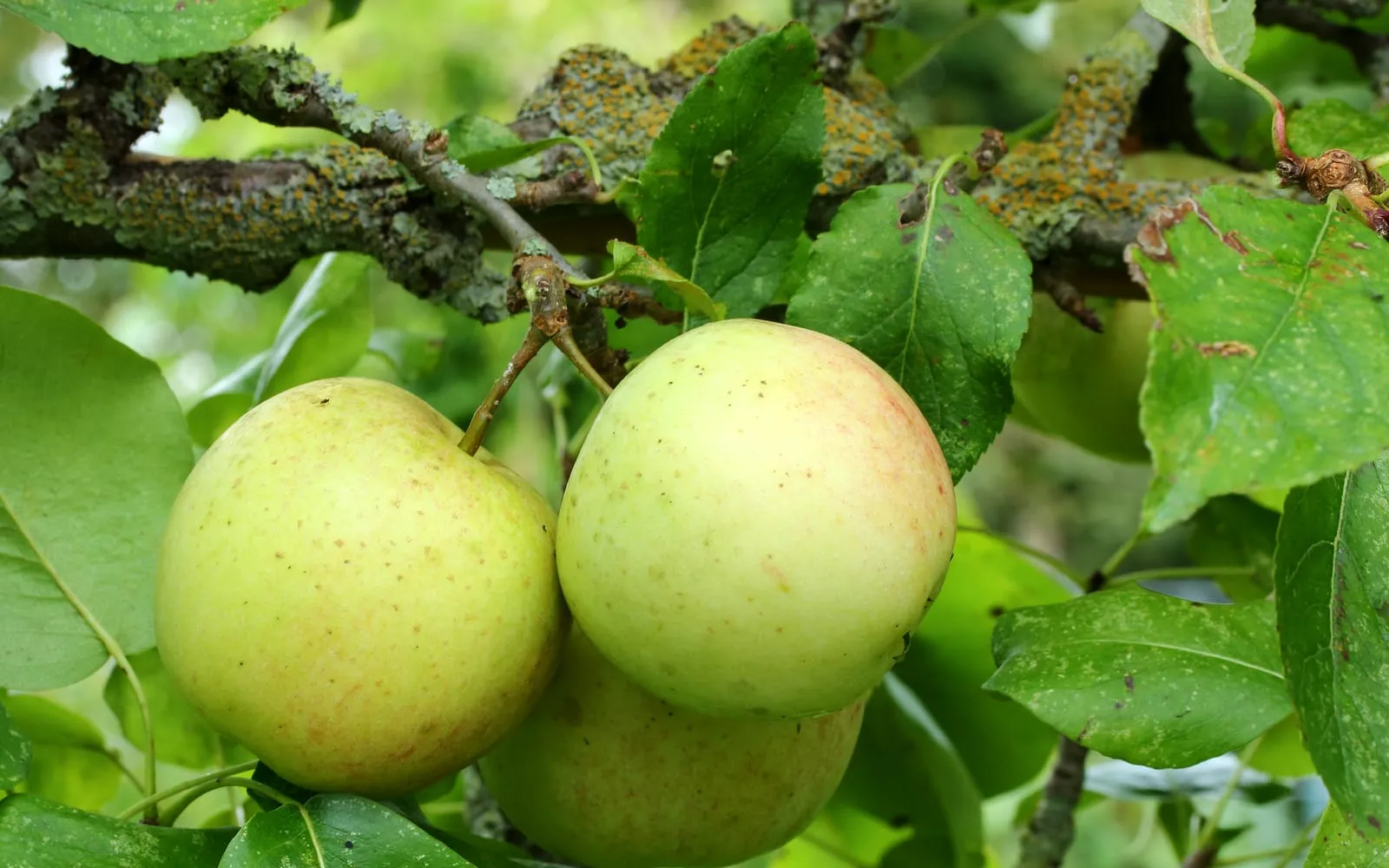
At a glance
- Difficulty
- Moderate
- Water
- Only in the first three years, and in droughts thereafter
- Light
- Full sun. Shade gives poor crops and worse flavour
- Temperature
- Hardy. It needs winter cold to flower properly
- Hardiness
- USDA 3-8, RHS H6, hardy to -30 C
- Type
- Deciduous tree, long-lived and productive for decades
- Height
- 1.8 m on M27 rootstock to 8 m on M25
- Native to
- The Tian Shan mountains of Kazakhstan
- Best month
- November in the Northern Hemisphere, May in the Southern Hemisphere
Most cultivars need 800 to 1200 hours below 7 deg C before the buds open evenly, so a mild winter gives straggling blossom and a light crop from a tree that looks perfectly healthy. Low-chill cultivars bred in Israel and Florida come into leaf on 200 to 300 hours and crop where the standard sorts will not. Almost every apple also needs a second tree flowering alongside it.
Hardiness zones describe winter cold alone. Summer heat, humidity, rainfall and the length of the growing season decide as much, so treat the range as the outer limit rather than as a recommendation.
Every month named in this guide is for the temperate Northern Hemisphere. If you garden in the Southern Hemisphere, shift each one by six months, so November becomes May. Closer to the equator the wet and dry seasons matter more than the calendar, and the shift stops being a useful guide.
Edible, with limits
- Safe to eat
- The flesh and skin of the fruit
- Do not eat
- The pips, and the leaves and bark
- Harm from
- Eating it
- Affects
- People, cats, dogs and horses
The fruit is food and the pips are not. Apple seeds contain amygdalin, a cyanogenic glycoside that releases hydrogen cyanide when the seed coat is crushed and the contents meet gut enzymes. The ASPCA lists the apple tree as toxic to cats, dogs and horses on this basis, naming the stems, leaves and seeds rather than the fruit. In practice the risk to a person is very small. Swallowing a few pips whole does nothing at all, because the hard coat passes through intact, and you would need to chew a large quantity in one sitting to reach a harmful dose. The realistic hazards are elsewhere. Wilting or frosted apple leaves and prunings become more dangerous rather than less as they break down, so never throw them into a paddock, and horses gorging on windfalls can develop colic and laminitis from the sugar rather than from cyanide. Core the fruit before feeding it to a dog or a horse, and keep prunings out of grazing.
Sources: ASPCA (Apple, Malus sylvestris), RHS potentially harmful garden plants
About
Two decisions determine what an apple tree does in your garden, and both are made before you buy it. The rootstock controls the size, and the pollination group controls whether it sets fruit.
Nothing you do afterwards changes either. A vigorous rootstock will not stay small because you prune it, and a tree with no compatible partner in flower nearby will blossom beautifully and crop almost nothing.
Get those two right and apples are among the most rewarding things in a garden. A tree on a dwarfing rootstock fits a small plot, starts cropping in three years and carries on for thirty.
Appearance and character
A deciduous tree with a spreading rounded head, grey-brown bark and a twiggy framework of branches.
Leaves are oval, softly toothed and downy underneath, mid-green and turning yellow before falling.
Blossom opens in April and May, in clusters of five or six flowers, white with a pink flush that is deepest in bud.
Fruit ripens from August to November depending on variety, from small russeted cookers to large glossy dessert apples, in green, yellow, red, striped and bronze.
Trained forms are the answer in a small garden. Cordons planted at 75 cm, espaliers against a wall, and stepovers along a path edge all crop heavily in very little ground.
Where it is from
The Tian Shan mountains of Kazakhstan, where the wild ancestor Malus sieversii still forms whole forests of apple trees bearing fruit indistinguishable from cultivated apples. The city of Almaty takes its name from the apple.
Bears and horses spread the large-fruited forms eastward and westward along the Silk Road, selecting for size and sweetness before humans did.
The domestic apple picked up genes from the European crab apple, Malus sylvestris, along the way, which is where much of its hardiness comes from.
Apples do not come true from seed. Every pip produces a different tree, which is why every named variety is a graft, and why a Bramley anywhere in the world is a cutting from a single seedling grown in Nottinghamshire around 1809.
The mountain origin explains the chilling requirement. Apples need a period of winter cold to flower properly and are unreliable in warm climates.
An apple can sit in the right hardiness zone and still set no blossom where the winter never turns cold enough. Hardiness zones, climate types and winter chill explains the chill requirement and the low-chill cultivars bred around it.
How it grows
Buy a grafted tree, choosing the rootstock for the space. M27 gives a 1.5 to 1.8 m bush, M9 gives 2.5 m, M26 gives 3 m, MM106 gives 4 m and suits a half-standard, and MM111 or M25 give a full-sized orchard tree.
Pollination is the second choice. Apples need pollen from a different variety flowering at the same time. Varieties are grouped 1 to 7 by flowering time, and a tree needs a partner in its own group or the one either side. Some varieties are triploid, including Bramley, and cannot pollinate anything, so they need two other partners. In a town, neighbouring gardens and crab apples usually provide enough.
Plant bare-root trees from November to March, or container-grown at any time. Keep the graft union at least 10 cm clear of the soil, or the tree roots above it and outgrows the rootstock entirely.
Stake dwarf rootstocks permanently. M27 and M9 have brittle roots and never support themselves.
Fruit forms on spurs, which are short stubby shoots that carry fat flower buds and keep producing for years. Some varieties fruit at the tips of one-year shoots instead and need different pruning.
Thin the fruit in June, after the natural drop, to one or two per cluster and 10 to 15 cm apart. This gives larger fruit and prevents biennial bearing.
Through the seasons
Winter is planting and pruning. Plant bare-root trees, and prune established free-standing trees between November and February while dormant.
Spring brings blossom. Protect against late frost where you can, mulch and feed in February, and watch for scab and mildew as the leaves open.
Summer is thinning and, for trained forms, summer pruning. Thin the fruitlets in June, and prune cordons and espaliers in August.
Autumn is the harvest. Pick when an apple lifts and detaches with a gentle upward twist. Store only unblemished late varieties, in a cool dark place, not touching one another.
Care difficulty
Moderate. The tree grows easily and the skill is in pruning and in the choices made at purchase.
Pruning intimidates people more than it should. The winter aim is an open goblet shape with an uncluttered centre, taking out dead, diseased, crossing and inward growing wood, and shortening the leaders.
Pest and disease pressure is real but rarely fatal. Codling moth spoils fruit rather than killing trees, and scab disfigures rather than destroys.
Frost at blossom time is the uncontrollable factor and the commonest cause of a poor year.
Patience is required. A tree on a dwarfing stock crops in year three, and one on a vigorous stock may take six or seven.
Watering
Water newly planted trees weekly through their first three summers. Establishment is when watering matters and most losses happen.
Established trees in open ground rarely need watering except in prolonged drought.
Trees in containers need regular watering all season and are much less forgiving.
Water thoroughly and infrequently, soaking the root zone rather than wetting the surface.
Mulch each spring with compost, keeping it clear of the trunk, which conserves far more moisture than watering does.
Warning signs, diseases and pests
Codling moth is the maggot in the apple. The larva tunnels to the core, leaving a brown frass-filled hole. Pheromone traps hung in May reduce it and also tell you when the moths are flying. Pick up and destroy fallen fruit.
North American readers searching “apple maggot” often mean a different insect entirely: apple maggot fly, confined to North America, whose larvae tunnel through the flesh from a barely visible surface dimple rather than boring a single hole to the core. Red sphere traps hung from mid-June catch it; codling moth’s pheromone traps do not.
Apple scab causes olive-brown blotches on leaves and corky black scabs on the fruit, worst in wet springs. The fruit is still edible. Rake up and bin fallen leaves, prune for airflow, and choose resistant varieties.
Powdery mildew coats shoots and leaves in white felt and distorts the growth. Cut out affected shoots.
Canker produces sunken, cracked, flaking patches of bark, often around a wound, and can girdle and kill a branch. Cut back to clean wood. It is worse on heavy wet soils.
Woolly aphid appears as white cottony masses on the bark and in branch crotches.
Brown rot turns fruit brown with concentric rings of buff pustules, and mummified fruit left hanging carries it into next year. Remove them.
Bitter pit shows as sunken brown spots in the flesh, a calcium delivery problem caused by irregular watering rather than a disease.
Biennial bearing, a heavy crop one year and none the next, is corrected by thinning hard in the heavy year.
Japanese beetle skeletonises leaves between the veins and is well established across most of the United States, where it feeds in visible groups on the sunniest foliage. It reached northern Italy in 2014 and has since spread into southern Switzerland, and the rest of Europe, including Britain, treats a sighting as notifiable while eradication is still possible. Shake beetles into soapy water in the cool of the morning where it is established.
Brown marmorated stink bug leaves dimpled, corky patches on the skin and is established across North America and a growing list of European countries. It is not established in Australia or New Zealand, where either country treats a find as reportable.
Plum curculio cuts a crescent-shaped scar into young green fruit, weeks before codling moth becomes a concern, and is confined to North America east of the Rocky Mountains. Jar branches over a sheet in the cool morning after petal fall to catch adults, which play dead and drop when disturbed.
Growing environment
Full sun. Apples in shade crop lightly and taste flat.
Deep, fertile, well-drained soil, slightly acid to neutral. They dislike waterlogging above all, which brings canker and root death.
Shelter from wind at blossom time, both to protect the flowers and to let pollinators work.
Avoid frost pockets. A late frost on open blossom removes the crop for the year, and a slope where cold air drains away is better than a hollow.
Match the rootstock to the space, and remember that a stake is permanent on the dwarfing stocks.
Trained forms suit small gardens. A row of cordons on M9 at 75 cm spacing gives several varieties, and mutual pollination, along a single fence.
Feeding
Apply a general-purpose fertiliser in late winter, in February, before growth starts.
Follow with a mulch of well-rotted manure or compost in early spring, spread over the root zone and kept clear of the trunk.
Sulphate of potash in late winter improves fruiting and colour, and it is the more useful feed on an established tree.
Avoid heavy nitrogen on a mature tree. It produces soft growth that attracts aphids and scab, and delays fruiting.
Container-grown trees need regular liquid feeding through the growing season and top-dressing each spring.
Troubleshooting
Lots of blossom and no fruit. Either no compatible pollination partner nearby, or frost caught the open blossom. Check the flowering group and plant a partner, or fleece a small tree on a frosty night.
Maggots and brown tunnels in the fruit. Codling moth. Hang pheromone traps in May and clear fallen fruit.
Black scabby patches on the skin. Apple scab. The fruit is edible. Rake up fallen leaves and improve airflow through pruning.
Sunken brown spots inside the flesh. Bitter pit, from uneven watering rather than disease. Water and mulch more consistently.
A heavy crop one year and nothing the next. Biennial bearing. Thin hard in the heavy year, to one or two fruits per cluster in June.
Sunken cracked bark around a branch. Canker. Cut back to clean wood and improve drainage.
The tree got far bigger than expected. Either a vigorous rootstock or the graft union was buried and the variety rooted above it. Keep the union clear of the soil.
When is an apple ready to pick? Cup it in your hand and lift and twist gently. A ready apple comes away with the stalk attached.
Apple problem guides
Not sure what is wrong? See the common vegetable pests guide.
- Codling moth, which puts the maggot in the apple
- Apple scab
- Powdery mildew
- Woolly aphid
- Canker on wet heavy soils
- Japanese beetle across the US, newly arrived in northern Italy and Switzerland
- Brown marmorated stink bug, established across North America and Europe
- Plum curculio, a North America-only weevil that scars young fruit
- Apple maggot fly, a North America-only fly distinct from codling moth
- Bitter pit sinking brown spots into the flesh of a stored apple
- Frost cracks and sunscald splitting the bark on the sunny side of a young trunk