
Outdoor plant
Bluebell
Hyacinthoides non-scripta
Also known as English bluebell, Common bluebell, Wild hyacinth
How to grow English bluebells, Hyacinthoides non-scripta. Telling them from the Spanish invader, planting in the green, and why you must never cut the leaves.
At a glance
- Difficulty
- Easy
- Water
- Rarely once established
- Light
- Dappled shade under deciduous trees, or partial shade
- Temperature
- Fully hardy, and it needs a cold winter
- Hardiness
- USDA 4-8, RHS H6, hardy to -25 C
- Type
- Bulbous perennial, dormant from midsummer to midwinter
- Height
- 20-40 cm
- Native to
- Atlantic western Europe, and native across Britain
- Best month
- April in the Northern Hemisphere, October in the Southern Hemisphere
It wants cool moist summers and deep leaf litter and does poorly anywhere summers are hot and dry, which rules out most of the American south and inland Australia. Spanish bluebell and the hybrid between the two are vigorous, sun-tolerant and cross freely with the native, which is why planting either near a wild colony is an offence under Schedule 9 of the Wildlife and Countryside Act in Britain. Check what you are buying, since much of what is sold as English bluebell is the hybrid.
Hardiness zones describe winter cold alone. Summer heat, humidity, rainfall and the length of the growing season decide as much, so treat the range as the outer limit rather than as a recommendation.
Every month named in this guide is for the temperate Northern Hemisphere. If you garden in the Southern Hemisphere, shift each one by six months, so April becomes October. Closer to the equator the wet and dry seasons matter more than the calendar, and the shift stops being a useful guide.
Toxic if eaten
- Do not eat
- Every part, and the bulb most of all
- Harm from
- Eating it and handling it
- Affects
- People, cats, dogs and horses
Every part of a bluebell is poisonous and the bulb carries the highest concentration. The plant contains scillarens, cardiac glycosides related to those in foxglove, which act on the heart. Eating any part causes vomiting, abdominal pain and diarrhoea, with slowed and irregular heartbeat in serious cases. The RHS lists Hyacinthoides as harmful if eaten. Poisonings are uncommon because the taste is unpleasant and because the bulbs are underground for most of the year, and the realistic risks are a dog digging up bulbs and a child pulling flowers. The sap also causes contact dermatitis in some people, so wear gloves when handling quantities of bulbs. Bluebell bulbs were once valued for exactly the property that makes them sticky. The starchy mucilage was used to glue the pages of books, to stiffen Elizabethan ruffs, and to fix feathers to arrow shafts. None of that makes them safe to eat. Digging up wild bluebell bulbs is an offence under the Wildlife and Countryside Act 1981, and a 1998 amendment made trading in wild-collected native bulbs an offence as well, so garden stock must come from a reputable nursery.
Sources: RHS potentially harmful garden plants, ASPCA toxic and non-toxic plants
About
Britain holds something like half the world’s population of English bluebells, which makes an April wood here an international rarity rather than a national one.
That population has a problem, and it arrived through garden centres. The Spanish bluebell, sold for decades as a tough easy version of the same thing, crosses freely with the native and produces a fertile hybrid. The hybrid is more vigorous than either parent, and it is now the commonest bluebell in British gardens and increasingly in the countryside.
Anyone planting bluebells therefore takes on a small responsibility. Buy the native species by its botanical name, check that what you already have is not the Spaniard, and keep the two apart if your garden backs onto a wood.
Appearance and character
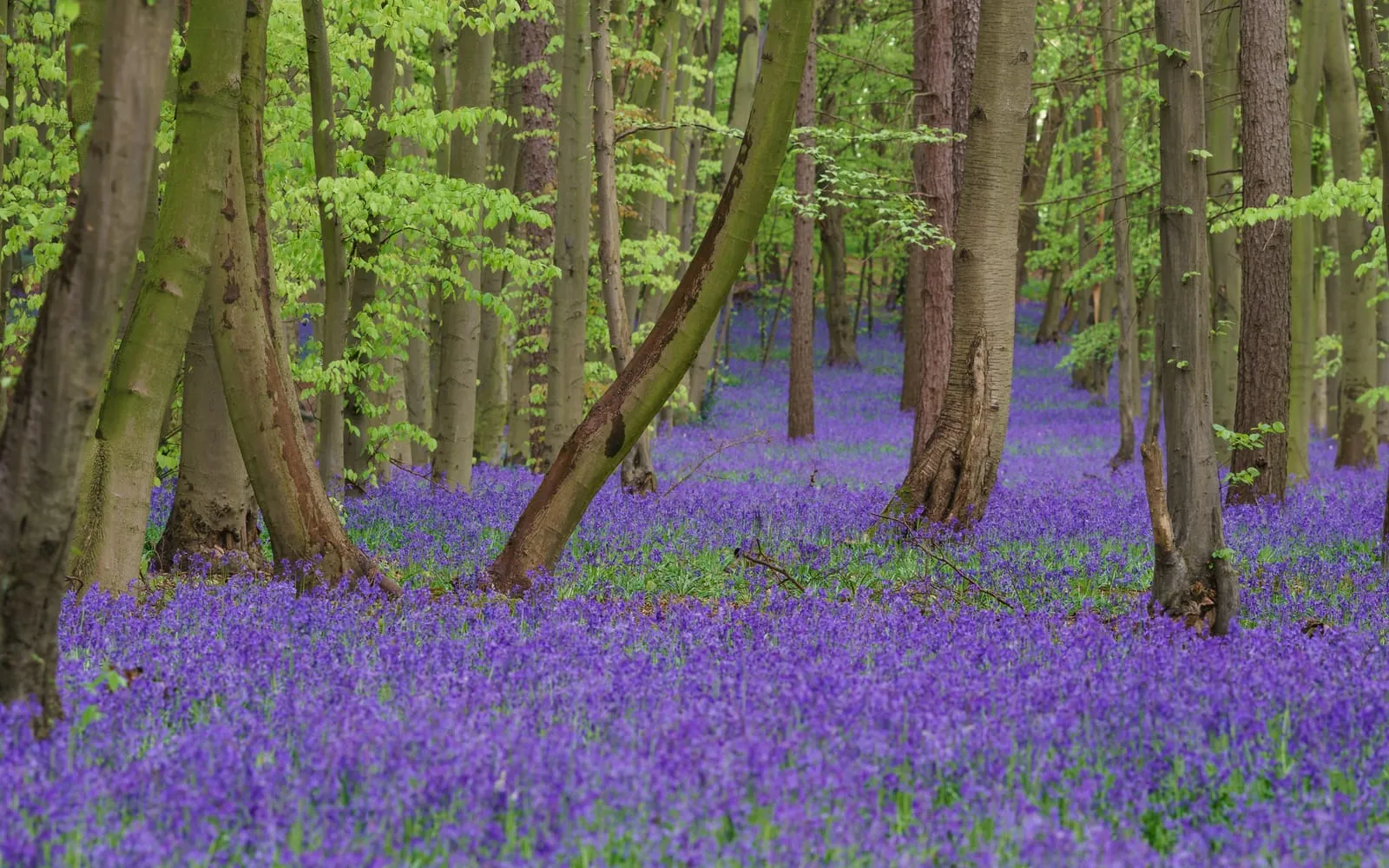
A bulbous perennial, 20 to 40 cm tall, growing in dense colonies and dormant from midsummer until the shoots reappear in midwinter.
Leaves are narrow, 1 to 1.5 cm across, strap-shaped, glossy and slightly channelled, arching over as they lengthen.
The flower spike is the identifying feature. It nods over at the top, and the flowers hang along one side of the stem rather than all round it.
Individual flowers are narrow tubular bells, 1.5 to 2 cm long, deep violet-blue, with the six petal tips rolled sharply back on themselves.
Pollen is creamy white, which is the single most reliable test in the field.
The scent is strong and sweet, and a whole wood in flower on a warm afternoon carries it a long way.
Spanish bluebells differ in every one of those respects. Their leaves are up to 3 cm wide, the spike stands upright, the flowers are held all round it, the bells are broader and more open with barely recurved tips, the pollen is blue, and there is little or no scent.
Where it is from
Atlantic western Europe, from north-west Spain and Portugal through France and the Low Countries to Britain and Ireland, where it is native and grows in ancient deciduous woodland, on shaded banks and in hedgerows. The name means different plants elsewhere. A bluebell is a harebell in Scotland, a Mertensia in the eastern United States and a Wahlenbergia in Australia, so search under Hyacinthoides for this one.
The mild wet oceanic climate of that western fringe is what the plant is built for, and it is a poor performer in dry continental conditions.
Bluebells are a spring ephemeral. The whole cycle of leaf, flower and seed happens between the soil warming in February and the tree canopy closing in June, after which the plant retreats to the bulb.
A dense carpet of bluebells is used as one indicator of ancient woodland, since the plant spreads slowly, at perhaps a metre or two per century by seed.
The Latin non-scripta, meaning unlettered, distinguishes it from the hyacinth of Greek myth, whose petals were said to carry the mourning letters AI AI for the dead Hyacinthus.
How it grows
Plant in the green, meaning growing plants lifted with their leaves on, in spring just after flowering. This establishes far more reliably than dry bulbs.
If planting bulbs, do it in September or October and get them in the ground the day they arrive. Bluebell bulbs have no protective tunic and shrivel within days of being lifted.
Plant 8 to 10 cm deep and about 10 cm apart, in dappled shade under deciduous trees or shrubs.
Buy from a reputable nursery and check the botanical name on the label. Bulbs sold loose as “bluebell” are very often Spanish or hybrid.
Never cut or mow the leaves until they have yellowed and collapsed, usually six weeks or more after flowering. The bulb builds next year’s flower during that period and cutting early starves it.
Deadhead if you want to limit spread, and leave the seed heads if you want the colony to thicken.
Divide congested clumps after flowering, replanting immediately without letting the bulbs dry.
Expect patience. A colony takes several years to look like anything, and seedlings need four to five years to reach flowering size.
Through the seasons
Winter brings the first shoots through, often in January. Nothing needs doing beyond clearing heavy leaf litter off the emerging tips.
Spring is the whole display. Leaves through March, flowers from mid-April into May, and planting in the green as the flowers fade.
Early summer is the die-back. Leave the foliage entirely alone until it has yellowed and collapsed, then clear it.
Autumn is bulb planting and mulching. Put leaf mould over the dormant colony and plant new bulbs the day they arrive.
Care difficulty
Easy once established, and the difficulty is in getting them started and in buying the right thing.
Dry bulbs are the commonest cause of failure, since they dehydrate quickly and many arrive already dead.
Cutting the leaves too early is the second, and it weakens a colony year on year until it stops flowering.
Identification is the part that needs attention rather than skill.
Beyond that they need no feeding, watering, staking or protection, and a established colony spreads slowly on its own.
Watering
Established bluebells need no watering.
Water plantings made in the green through their first spring while they root.
A dry spring shortens the display and yellows the leaves early. Mulching with leaf mould helps far more than watering.
Do not water the dormant bulbs in summer. They want a drier rest.
Containers are a poor home for bluebells, since the compost dries out during dormancy and the bulbs shrivel.
Warning signs, diseases and pests
Spanish and hybrid bluebells are the real threat, and they arrive as garden plants rather than as a disease. Check the pollen colour first, since native bluebells have creamy white pollen and the Spanish and hybrids have blue. Then check the spike, which nods and is one-sided on the native and stands upright with flowers all round on the Spaniard. If you find hybrids and your garden is near woodland, dig them out entirely, including every bulb, and dispose of them rather than composting.
Bulbs that never appear were almost always sold dry and had already shrivelled. Buy in the green, or from a supplier who despatches bulbs freshly lifted.
A colony that flowers less each year has usually had its leaves cut or mown too soon. Leave the foliage for at least six weeks after flowering.
Bluebell rust produces orange pustules on the leaves in damp crowded conditions.
Bluebell smut turns the flowers and stems into black powdery masses. Remove and destroy affected plants.
Slugs graze the emerging shoots in late winter, and the damage is cosmetic.
Yellowing leaves in early May rather than June point to a position that is too dry or too sunny.
Growing environment
Dappled shade under deciduous trees is the natural position, giving light in early spring and shade for the rest of the year.
Moist, humus-rich, free-draining soil, slightly acid, with plenty of leaf litter.
Avoid deep evergreen shade, waterlogged ground and hot dry open borders.
Give them somewhere they can spread slowly and stay put. Bluebells resent disturbance and dislike being lifted.
Plan for the summer gap. Ferns, hostas and later perennials cover the bare ground after the leaves have gone.
Keep them well away from any Spanish or hybrid bluebells already in the garden, which is difficult, since bees carry pollen a long way. Removing the hybrids entirely is the only real answer.
Grass is a possible position provided the mowing waits until July.
Feeding
Mulch with leaf mould or well-rotted compost each autumn. That is all the feeding required.
Fertiliser is unnecessary and encourages leaf at the expense of flower.
Fallen tree leaves left over the colony in winter do the job for nothing.
A colony that is thinning is more likely congested or cut too early than hungry.
Troubleshooting
How do I tell an English bluebell from a Spanish one? Look at the pollen, which is creamy white on the native and blue on the Spanish and hybrid. The native spike nods over with flowers along one side, the petal tips roll right back, the leaves are narrow, and the scent is strong.
Can I cut the leaves down after flowering? No. Leave them until they yellow and collapse, at least six weeks. Cutting early starves the bulb and the colony fades.
The bulbs I planted never came up. Bluebell bulbs have no tunic and dry out within days. Plant in the green in spring, or buy freshly lifted bulbs and plant them at once.
It flowers less every year. Usually the leaves have been mown or cut too soon. It can also mean a congested colony that needs dividing after flowering.
Can I dig some up from the wood? No. Digging up wild bluebell bulbs is an offence under the Wildlife and Countryside Act 1981. Buy from a nursery.
Are they poisonous? Yes, all parts, and the bulbs most of all. They contain cardiac glycosides. Keep dogs from digging them and wear gloves when handling bulbs.
Should I deadhead them? Only if you want to limit spread. Leaving the seed heads thickens the colony over several years.
Can I grow them in a pot? Poorly. The compost dries out during summer dormancy and the bulbs shrivel. Grow them in the ground.