
Edible
Prickly Pear Cactus
Opuntia ficus-indica
Also known as Indian fig, Nopal, Barbary fig, Tuna cactus
How to grow Opuntia ficus-indica. Why the invisible bristles are worse than the spines, how to prepare the pads and fruit, growing it in a cool climate, and the moth that saved Australia.
At a glance
- Difficulty
- Easy
- Water
- Every 2-3 weeks in summer. None from October to March
- Light
- Full sun, as much as possible
- Temperature
- Damaged below about -5 deg C, and only when bone dry
- Hardiness
- USDA 8-11, RHS H3, hardy to -8 C
- Type
- Evergreen succulent perennial
- Height
- 3-5 m in a warm climate, 1 m in a container
- Native to
- Central Mexico, in cultivation so long that no wild population is certain
- Best month
- May in the Northern Hemisphere, November in the Southern Hemisphere
Central Mexico, and the textbook invasive. Introduced to Australia in the nineteenth century, it covered around 24 million hectares of Queensland and New South Wales before the moth Cactoblastis cactorum was released in 1926 and collapsed it within a decade, which remains the most successful classical biological control ever attempted. It is a declared weed across much of Australia and South Africa.
Hardiness zones describe winter cold alone. Summer heat, humidity, rainfall and the length of the growing season decide as much, so treat the range as the outer limit rather than as a recommendation.
Every month named in this guide is for the temperate Northern Hemisphere. If you garden in the Southern Hemisphere, shift each one by six months, so May becomes November. Closer to the equator the wet and dry seasons matter more than the calendar, and the shift stops being a useful guide.
Skin irritant
- Safe to eat
- The young pads and the ripe fruit, both once the glochids are removed
- Harm from
- Handling it and sap in the eyes
- Affects
- People, cats and dogs
The plant is not poisonous, and it is mechanically hazardous, which is a different thing worth being precise about. The long spines are obvious and avoidable. The real problem is the glochids, tufts of tiny barbed bristles sitting in each areole, which are almost invisible, detach at the lightest touch, and work into skin where they cause persistent itching and irritation that can last for days. They are far harder to remove than the spines because you cannot see them. In the eye they are a genuine medical emergency. Wear thick gloves and eye protection when handling the plant, and never brush a pad with a bare forearm. To remove glochids from skin, press adhesive tape over the area and peel it away, or spread PVA glue over the spot, let it dry and pull it off. Tweezers work for the few you can see. Both the pads and the fruit are eaten widely in Mexico and around the Mediterranean, and both need the glochids removed by scrubbing, scraping or singeing before preparation. Dogs and cats that push into a plant get the glochids in their muzzle and paws and usually need veterinary help.
Sources: NC State Extension, Opuntia, RHS potentially harmful garden plants
About
By 1925 prickly pear covered around 25 million hectares of Queensland and New South Wales, in thickets up to two metres deep, and it was advancing at half a million hectares a year. Farms were abandoned. The Australian government tried poison, machinery and fire, and none of it worked.
The answer was a moth. Cactoblastis cactorum, brought from Argentina in 1925, whose caterpillars bore into the pads. Within six years the infestation had collapsed, and the biological control programme remains among the most successful ever attempted. There is a memorial hall in Boonarga, Queensland, dedicated to the insect.
That history explains why this plant is regulated in several countries and why it should never be planted out in a warm climate where it could escape. Outside the subtropics it is a container plant that would not survive a wet winter unaided.
Appearance and character
Flat oval pads, 30 to 50 cm long, blue-green and thick, growing in branching chains. Each pad is a flattened stem rather than a leaf, and the plant has no true leaves beyond small cylindrical ones that drop from new growth.
Older plants develop a genuine woody trunk beneath the pads, reaching three to five metres in a warm climate.
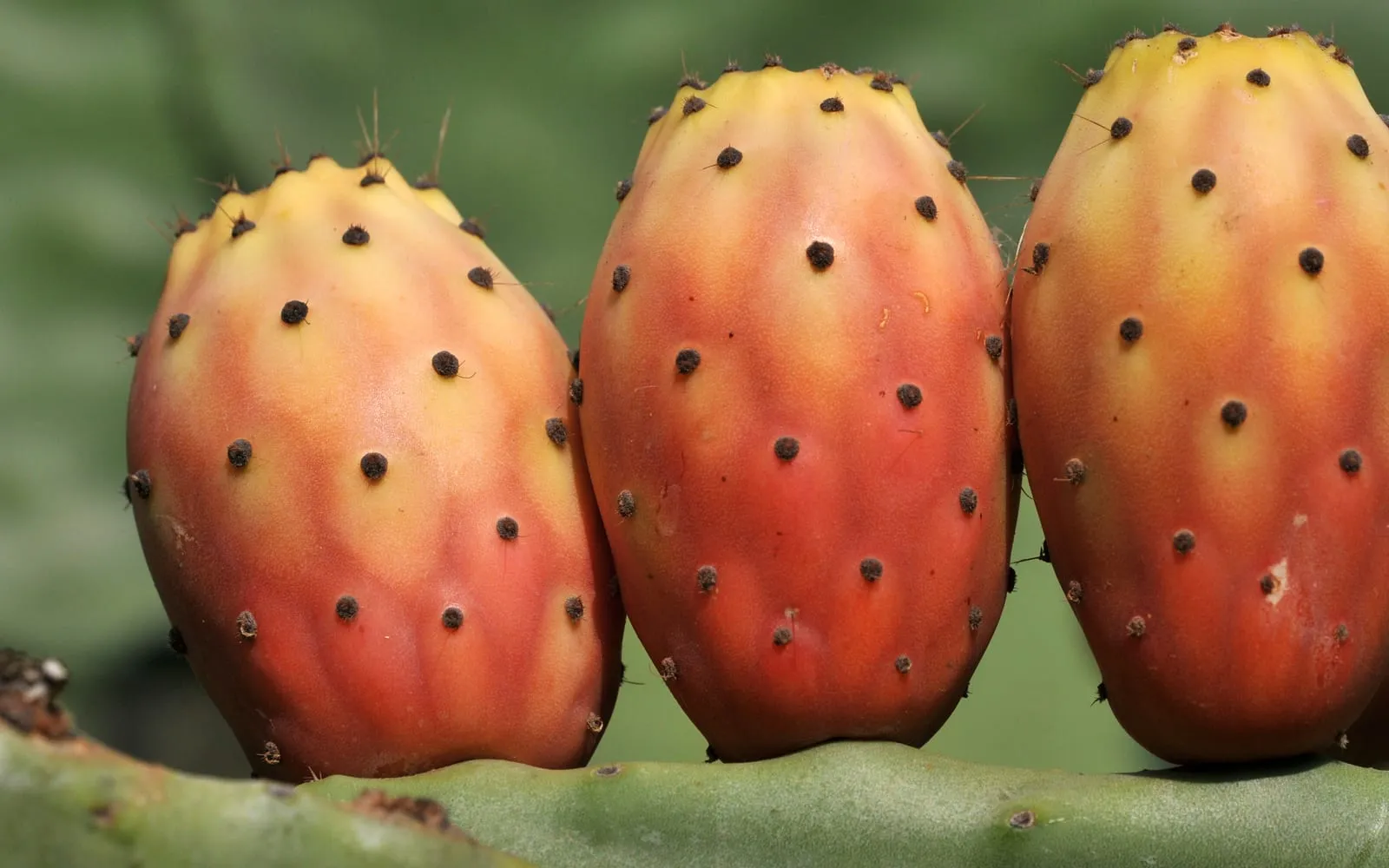
Areoles dot the pad surface in a regular pattern. Each carries a tuft of tiny barbed glochids, and on most forms a few longer white spines as well. Cultivated selections are often described as spineless, and they still carry glochids.
Flowers open in late spring and summer, large and cup-shaped in yellow shading to orange or red, sitting directly on the pad rim.
The fruit, called tuna, follows in late summer. It is oval, 5 to 10 cm, ripening from green through yellow to deep red or purple, with sweet magenta or amber flesh full of hard seeds.
Where it is from
Central Mexico, where it has been cultivated for so long that no certainly wild population has been identified. It appears on the Mexican flag.
Spanish ships took it across the Atlantic in the sixteenth century, initially for the cochineal insects farmed on it, which yielded the most valuable red dye in Europe. It naturalised rapidly around the Mediterranean, and the prickly pears of Sicily, southern Spain and North Africa all descend from that introduction.
Its home conditions are hot, dry, sunny and sharply drained. The plant uses crassulacean acid metabolism, opening its stomata at night to take in carbon dioxide and keeping them shut through the day, which cuts water loss enormously.
In a maritime climate the limiting factor is winter wet rather than cold. The plant tolerates a few degrees of frost when completely dry and rots at the base within weeks in cold saturated compost.
It is a serious invasive weed in Australia, South Africa, Ethiopia and parts of the Mediterranean.
How it grows
An evergreen succulent that grows by producing new pads from the areoles along the rim of existing ones.
New pads emerge soft, bright green and covered in small conical temporary leaves that shrivel and drop within a few weeks.
Growth happens in summer and stops entirely in winter.
Propagation is close to effortless. Twist off a mature pad with gloved hands, leave it in a dry shaded place for one to two weeks until the cut end has callused over, then stand it upright with the bottom third in gritty compost. Roots form within a month. Planting an uncallused pad causes it to rot.
Flowering usually begins on plants three or four years old and requires a good summer.
Fruit ripens in late summer and takes several months from flowering.
Through the seasons
Spring is when growth restarts. Repot now if needed, begin watering, and move container plants outside once frosts have finished, hardening them off gradually to avoid scorching the pads.
Summer brings flowering and the main growth. Water every two or three weeks and give the plant as much sun as possible. Feed twice.
Autumn ripens the fruit. Stop watering by the end of September and bring containers under cover before the rain sets in.
Winter means dry and cold. Keep the plant frost-free, bright and completely dry. No water at all. This is the season that decides whether it survives.
Care difficulty
Easy to grow and awkward to handle, and the two get confused.
The growing part is undemanding. Sun, gritty compost, an occasional soak in summer, nothing in winter. The plant asks for very little.
Winter wet is the only real threat. A prickly pear standing outside through a cool winter in ordinary compost will rot. Under cover and bone dry, it comes through easily.
Handling is the genuine difficulty, and the glochids are the reason. They are nearly invisible, detach on contact, and are miserable to remove. Thick gloves, long sleeves and eye protection turn every job on this plant from unpleasant to routine. Use folded newspaper or tongs to move pads.
Watering
Water every two to three weeks through summer, soaking thoroughly and then letting the compost dry out completely.
Stop watering entirely from October to March. A dormant prickly pear in a cool place needs none at all, and winter watering is the usual cause of death.
Never let the pot stand in water, and use a container with generous drainage.
Shrivelled, wrinkled pads in summer mean genuine thirst, and they plump up within days of a soak. Soft, yellowing, translucent pads mean rot, and are far more serious.
Plants grown in the ground in a very well drained sunny temperate garden need watering only in the first summer.
Warning signs, diseases and pests
Soft yellowing pads going translucent and collapsing at the base is rot from too much water or from cold wet compost. Cut away everything soft, let the healthy pads callus, and start again from a cutting.
Shrivelled pads that are firm rather than soft indicate drought and correct themselves.
Pale bleached patches on the pads are sunburn, usually after moving a plant outdoors too quickly in spring. Harden it off over a fortnight.
White woolly patches on the pads that crush to a vivid crimson are cochineal scale, the insect once farmed for dye. Scrub them off with a stiff brush.
Mealybugs gather in the joints between pads as white fluff and are hard to reach without gloves.
Corky brown patches on old pads at the base are normal ageing as the plant becomes woody.
Failure to flower usually means insufficient sun or a plant that is still too young.
Growing environment
Full sun, as much as the plant can get. This is not negotiable, and a shaded prickly pear grows pale, soft and rot-prone.
Very free-draining compost. Use a proprietary cactus mix, or one part loam-based compost to one part sharp grit, topped with a gravel mulch.
Grow it in a container in most temperate regions, so that it can be moved under cover for winter. A cold greenhouse, unheated conservatory or dry porch all suit it, and it needs light rather than warmth.
A very sheltered, sharply drained, sunny bed in a mild coastal garden can support it outdoors year-round with overhead rain protection through winter. Damage begins around -5 deg C, and only when the plant is dry.
Choose a heavy pot. A mature plant is top-heavy and blows over.
Site it well away from paths, doorways and anywhere people brush past. Glochids in a forearm are a lasting reminder of a badly placed cactus.
Feeding
Feed twice over the summer with a low-nitrogen cactus fertiliser, once in late spring and once in midsummer.
Avoid high-nitrogen feeds, which produce soft pale growth that rots and reduces flowering.
Feed nothing from autumn to spring.
Repot every three or four years into fresh gritty compost. Wrap the plant in several thicknesses of folded newspaper to handle it.
Plants in the ground need no feeding.
Troubleshooting
I have tiny invisible splinters and everything itches. Glochids. Press adhesive tape firmly over the area and peel it off, or paint the spot with PVA glue, let it dry and peel it away. Repeat as needed. Wear thick gloves next time.
A pad has gone soft, yellow and translucent. Rot from overwatering or winter wet. Cut back to firm green tissue, let the cut callus for a week or two, and root it as a new plant.
It has never flowered. Not enough sun, or the plant is under three or four years old. Give it the brightest spot you have.
How do I grow another one? Twist off a mature pad with gloves, leave it in a dry shaded place for one to two weeks until the cut end has sealed, then stand it a third deep in gritty compost. Do not water for the first fortnight.
Can I eat it? Yes, both parts. The ripe fruit is scrubbed or singed to remove glochids, then peeled and eaten raw or made into syrup. Young pads are scrubbed, the areoles scraped out with a knife, then sliced and grilled or boiled as nopales. Never skip the glochid removal.
Can it live outside all year in a cool climate? Only in a very well drained, sunny, mild coastal garden with overhead cover through winter. Everywhere else, grow it in a pot and bring it in.
The pads have shrivelled. If they are firm, it is thirsty and will recover from a soak. If they are soft, it is rotting.
White fluffy patches that stain red when squashed. Cochineal scale. Brush them off. This is the insect that produced carmine dye and made prickly pear commercially valuable in the sixteenth century.