
Outdoor plant
Foxglove
Digitalis purpurea
Also known as Common foxglove, Purple foxglove, Lady's glove, Digitalis
How to grow Digitalis purpurea. Why it flowers in its second year and then dies, how to keep a colony going, the plant it is dangerously confused with, and the drug it gave us.
At a glance
- Difficulty
- Easy
- Water
- Rarely once established. Water rosettes through a dry first summer
- Light
- Dappled shade or partial shade. It tolerates sun in damp soil
- Temperature
- Fully hardy, to about -20 deg C
- Hardiness
- USDA 4-8, RHS H6, hardy to -25 C
- Type
- Biennial, occasionally a short-lived perennial
- Height
- 1-2 m in flower
- Native to
- Woodland clearings, hedge banks and heathland across western Europe, including Britain
- Best month
- June in the Northern Hemisphere, December in the Southern Hemisphere
It is a biennial, so a plant flowers in its second year and dies, and a colony only continues if seedlings are allowed to establish. Cold is never a consideration. It has naturalised widely and is a listed weed through the American Pacific north-west, New Zealand and parts of Australia, where it takes over cleared forest and roadsides.
Hardiness zones describe winter cold alone. Summer heat, humidity, rainfall and the length of the growing season decide as much, so treat the range as the outer limit rather than as a recommendation.
Every month named in this guide is for the temperate Northern Hemisphere. If you garden in the Southern Hemisphere, shift each one by six months, so June becomes December. Closer to the equator the wet and dry seasons matter more than the calendar, and the shift stops being a useful guide.
Poisonous if eaten
- Do not eat
- Every part, including the seeds and the water from a vase of cut spikes
- Harm from
- Eating it and handling it
- Affects
- People, cats, dogs and horses
Every part of a foxglove contains cardiac glycosides, chiefly digitoxin and digoxin, which act directly on the heart muscle and slow and strengthen its contraction. In overdose they cause nausea and vomiting, abdominal pain, confusion, disturbed colour vision with a characteristic yellow-green cast, and dangerous heart rhythm disturbances. The ASPCA lists Digitalis as toxic to dogs, cats and horses, and the RHS places it in its most serious category for plants that are toxic if eaten. The margin between a therapeutic and a toxic dose of digoxin is narrow, which is what makes the raw plant hazardous, and the dried leaves are as potent as fresh ones. The danger worth naming specifically is misidentification. Foxglove rosettes in their first year closely resemble comfrey, and people have been poisoned, some fatally, by picking foxglove leaves for herbal tea. Both plants make soft, grey-green, hairy, oval leaves in a basal rosette on similar ground. Never gather leaves for consumption from a rosette that has not flowered. The sap also causes contact dermatitis in some people, so wear gloves when cutting the plant down. Water from a vase that has held cut foxgloves carries the glycosides and should be poured away where nothing will drink it. Foxgloves are safe to grow in a garden, and safe to have children and pets near, provided nobody eats them.
Sources: ASPCA (Foxglove, Digitalis purpurea), RHS potentially harmful garden plants
About
In 1785 a Birmingham physician named William Withering published An Account of the Foxglove, describing how an extract of the leaves relieved dropsy, the swelling we now recognise as congestive heart failure. He had the recipe from a Shropshire herbalist and spent ten years working out the dose.
Digoxin, refined from that same genus, remains in use today. Withering’s real achievement was the dosing, because the gap between a dose that helps a failing heart and one that stops it is narrow, and that narrowness is exactly what makes the raw plant dangerous.
In the garden the foxglove earns its place differently. It grows where little else flowers well, in the dry shade under trees and along a north-facing hedge bank, and it seeds itself into gaps you would not have thought to plant.
Appearance and character
In its first year a foxglove makes a flat rosette of soft, grey-green, veined oval leaves, downy on both sides and up to 25 cm long.
In its second year a single unbranched spire rises from that rosette to between 1 and 2 metres, carrying dozens of tubular bells ranged along one side.
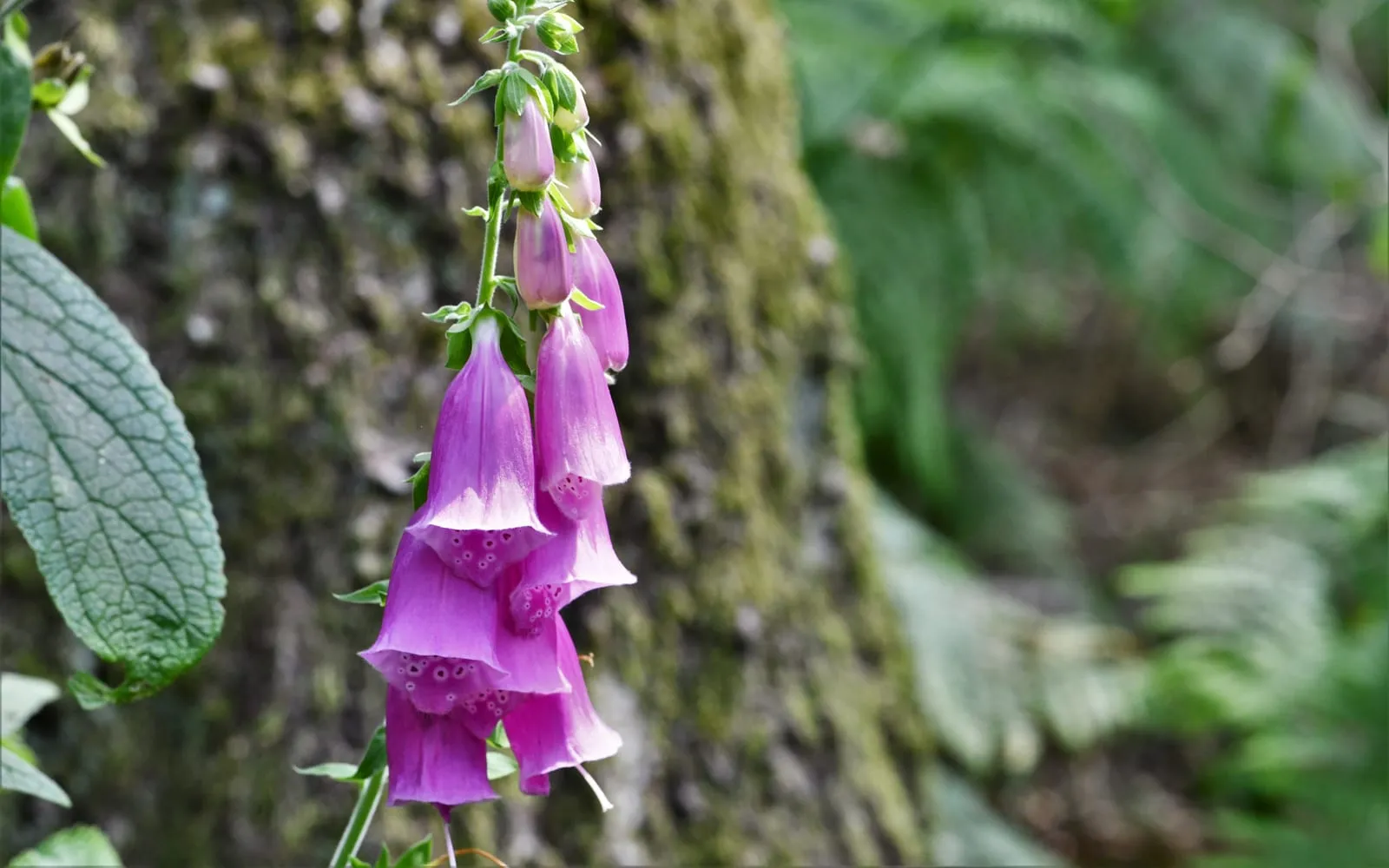
The bells are usually rosy purple, hanging downward, with a lower lip and a throat spotted maroon inside a white ring. Those spots are landing guides for bumblebees, and the tube is sized so that a large bee pushing in brushes both anthers and stigma.
Flowers open from the bottom of the spike upward over several weeks in June and July.
Digitalis purpurea f. albiflora is the pure white form, which comes true from seed if grown away from purple plants. The ‘Excelsior’ hybrids hold their flowers all round the stem rather than on one side, and ‘Sutton’s Apricot’ is a soft peach.
Where it is from
Woodland clearings, felled coppice, hedge banks, heathland and rocky slopes across western Europe, and native throughout Britain.
Its niche is disturbance. Foxglove seed sits dormant in woodland soil for decades and germinates when light reaches it, so a stand appears the year after a wood is thinned or a bank is cut back, flowers for a season or two, and vanishes as the canopy closes.
That behaviour is worth copying. Foxgloves suit a garden where you tolerate some movement year to year rather than one where every plant holds a fixed position.
The soil in that habitat is acid to neutral, moisture-retentive and full of leaf litter. Foxgloves grow poorly on thin chalk.
Winters are cold and wet and the rosette sits through them without trouble, provided the ground drains.
How it grows
A biennial. Seed germinates in summer or autumn, the plant spends its first full year building a rosette and a root system, flowers the following June, sets seed and dies.
Some plants behave as short-lived perennials and flower for a second season, particularly if the main spike is cut before it sets seed.
Because each plant dies, a foxglove colony persists by seeding rather than by individual longevity. A single spike produces one to two million seeds, dust-fine and wind-dispersed.
To keep a colony going, let at least one spike ripen and shed its seed each year. Gardens that deadhead everything lose their foxgloves within two seasons and blame the plant.
Cutting the main spike once the top flowers fade often produces four or five smaller side spikes that extend the display into August.
Self-sown seedlings transplant well in autumn while small. Move them to where you want them and firm them in.
Through the seasons
Spring brings rapid growth from overwintered rosettes. Slugs are the main threat now, and a mulch of leaf mould helps. Transplant any self-sown seedlings you want to move.
Early summer is the flowering season, from June into July. Bumblebees work the spikes all day.
Midsummer is the decision point. Cut the main spike for a second flush of smaller ones, or leave it standing to ripen seed. Do both across a group.
Late summer is when seed sheds and new rosettes germinate. Leave patches of bare soil for them to land on.
Autumn and winter need nothing. The rosettes sit tight through frost. Clear the dead flowered stems once they have shed.
Care difficulty
Easy, and the only common failure is a misunderstanding of the life cycle.
Gardeners buy a flowering foxglove, enjoy it, and find it dead the following spring. The plant did what it was always going to do. Buying first-year rosettes, or raising a few from seed each year, gives a permanent display from a plant that is never permanent.
The second common error is deadheading everything. No seed means no colony.
Beyond that the plant asks for very little. It tolerates dry shade better than most perennials, needs no staking despite its height, and is untroubled by deer and rabbits, which avoid it for the same reason we should.
Watering
Established foxgloves need no watering in ordinary cool summers.
Water first-year rosettes through a dry spell in their first summer while the root system is establishing. That is the only period when watering changes anything.
Water at the base rather than overhead, since wet foliage in still air encourages leaf spot and mildew.
Plants in containers need regular watering, though foxgloves are a poor choice for pots given their depth of root and short life.
The soil should hold moisture without staying wet. Crown rot in a waterlogged winter is the main way an established rosette dies.
Warning signs, diseases and pests
Slugs and snails shred young rosettes in spring and can destroy seedlings outright. This is the single biggest cause of losses.
Powdery mildew coats the leaves greyish-white in a dry summer, particularly on crowded plants in dry shade. Improve airflow and mulch to keep moisture in the soil.
Leaf spot appears as brown blotches with darker margins in wet crowded conditions. Remove affected leaves.
Crown rot on a rosette sitting in winter wet turns the centre soft and brown. Improve drainage before replanting.
A rosette that never produces a spike is not old enough yet. Foxgloves flower in their second year, and a plant that germinated late may take a third.
Aphids gather on the flower spike and rarely need action.
Plants flowering in their first year, occasionally seen, usually give a short weak spike and then die.
Growing environment
Dappled or partial shade suits it best. The edge of a wood, the north side of a hedge, or under deciduous trees where spring light reaches the ground all work.
Full sun is fine in soil that stays moist, and produces shorter, stockier plants. Dry soil in full sun gives a poor short spike.
The soil wants to be moisture-retentive, humus-rich, and acid to neutral. Add leaf mould or garden compost when planting. Foxgloves perform badly on thin alkaline chalk.
Fully hardy to around -20 deg C, so cold is never a consideration.
Space plants about 45 cm apart. They need no staking even at two metres, and a plant grown in shade with a strong root system stands up in wind that flattens delphiniums.
Site them where the seed can fall on open ground rather than into thick ground cover or onto gravel that will be weeded.
Feeding
A mulch of leaf mould or garden compost in spring is the whole feeding regime, and many gardens give nothing.
Avoid rich nitrogen feeds. They produce soft, tall, leafy plants that flop and are more prone to mildew.
If the soil is very poor, a scattering of general-purpose fertiliser around the rosettes in early spring helps the coming spike.
Add organic matter to hold moisture in the dry shade where foxgloves are usually planted.
Troubleshooting
It flowered beautifully and died. Foxgloves are biennial. That is the whole life cycle. Let one spike set seed and the next generation is already in the ground.
I have no foxgloves left after two years. You deadheaded them all. Leave at least one spike each year to ripen and shed.
Lots of rosettes but no flowers. They are in their first year. They will flower next June.
The spike has flopped over. Unusual, and it points to rich soil, too much shade or too much feeding. Grow them harder.
Can I move the seedlings? Yes, in autumn while they are small. They transplant easily. Larger rosettes resent it.
Are they safe to have in a garden with children or a dog? Yes, with the obvious condition that nobody eats them. The plant is dangerous when swallowed and harmless to be near. Teach children not to pick or suck the flowers, and pour away vase water where nothing will drink it.
Can I use the leaves for tea? No, and this is the one warning to take seriously. First-year foxglove rosettes look very like comfrey, and people have died from the confusion. Never gather leaves for any kind of consumption from a rosette that has not flowered.
Why do bees crawl right inside the flowers? The tube is sized for a large bumblebee, and the maroon spots inside guide it to the nectar past the anthers and stigma. The plant is built around that one pollinator.