
Outdoor plant
Common Houseleek
Sempervivum tectorum
Also known as Houseleek, Hens and chicks, Live-forever, Sempervivum
How to grow Sempervivum tectorum, the common houseleek. Why the parent rosette dies after flowering, why it survives winters that kill echeveria, and how to grow it on a roof.
At a glance
- Difficulty
- Easy
- Water
- Almost never outdoors. Occasionally for containers in drought
- Light
- Full sun. Shade makes the rosettes open out and lose colour
- Temperature
- Fully hardy, to about -20 deg C or lower
- Hardiness
- USDA 4-8, RHS H7, hardy to -30 C
- Type
- Monocarpic perennial. Each rosette flowers once and dies
- Height
- 5-10 cm, with flower stems to 30 cm
- Native to
- Rocky slopes and screes of the Alps, Pyrenees, Apennines and Carpathians
- Best month
- April in the Northern Hemisphere, October in the Southern Hemisphere
Alpine winters are cold and dry, and snow cover keeps the plants dry as well as insulated. A mild wet winter is what kills houseleeks, so sharp drainage, a gravel mulch and a position where rain runs off matter more than any amount of cold protection. Each rosette flowers once and dies, leaving the offsets around it, which is the plant working as intended.
Hardiness zones describe winter cold alone. Summer heat, humidity, rainfall and the length of the growing season decide as much, so treat the range as the outer limit rather than as a recommendation.
Every month named in this guide is for the temperate Northern Hemisphere. If you garden in the Southern Hemisphere, shift each one by six months, so April becomes October. Closer to the equator the wet and dry seasons matter more than the calendar, and the shift stops being a useful guide.
Not known to be toxic
Non-toxic. Sempervivum does not appear on the RHS list of potentially harmful garden plants, and the ASPCA does not list it among plants toxic to cats, dogs or horses. NC State Extension records no toxicity for the genus. The sap has a long folk history as a soothing application for burns and stings, in much the same way aloe vera is used, and the leaves were once chewed for mouth complaints. None of that makes it a food plant, and there is no reason to eat it, and a child or a pet that bites a rosette will come to no harm. This is a safe choice for a garden where small children play, which helps given how often it is planted in low containers and walls at exactly their height.
Sources: RHS potentially harmful garden plants, NC State Extension, Sempervivum tectorum
About
Sempervivum means always alive, and every individual rosette in the colony is going to die. Both statements are true, and the gap between them is the most interesting thing about the plant.
Each rosette grows for several years, then produces a thick flowering stem from its centre, blooms, sets seed and dies. Botanists call that monocarpic. What survives is the ring of offsets it has been throwing out on short runners the whole time, which is why the colony is immortal while its members are not.
The species name tectorum means of roofs. Houseleeks were deliberately planted on thatch and tiles across Europe, partly to bind the roof and partly because Charlemagne is said to have ordered it, in the belief that the plant warded off lightning and fire.
Appearance and character
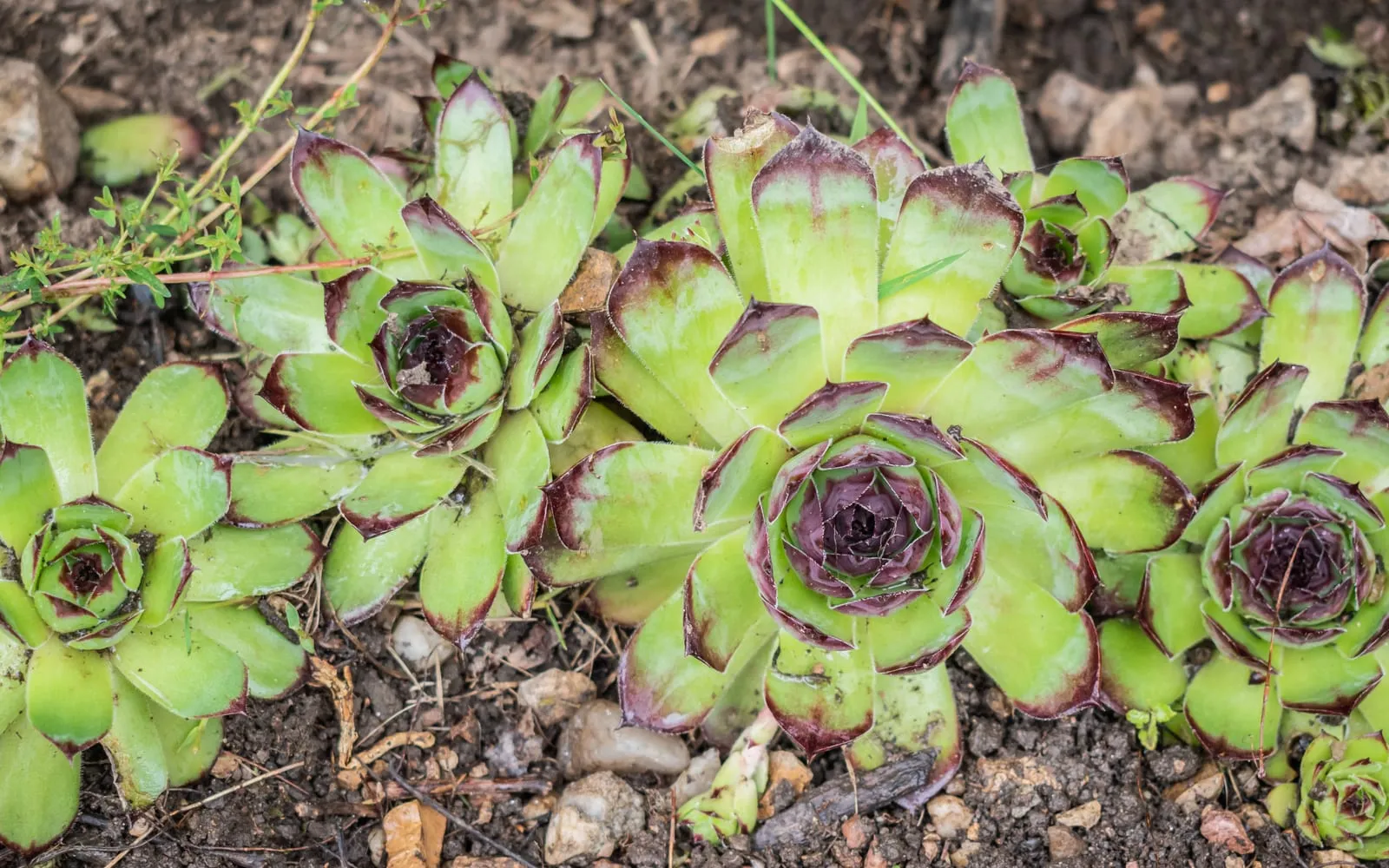
Tight symmetrical rosettes, 5 to 10 cm across, of thick fleshy pointed leaves arranged in a spiral.
The leaves are grey-green to blue-green, often tipped and sometimes flushed throughout with deep maroon or purple. Colour intensifies in strong sun, in poor soil and in cold weather, so the plants look their best in winter and in a hard dry summer.
Fine hairs fringe the leaf margins, and a related species, Sempervivum arachnoideum, is webbed all over with white threads like a cobweb.
Offsets appear on short stolons around the parent, sitting on the surface until they root. A single plant becomes a mat of thirty or more within a few years.
The flower stem rises 20 to 30 cm, thick and covered in overlapping leaves, carrying a flat head of starry pink or red flowers in July. It is handsome, and it marks the end of that rosette.
Hundreds of named cultivars exist in every shade from silver to near-black.
Where it is from
Rocky slopes, screes, cliff ledges and old walls in the mountains of southern and central Europe, from the Pyrenees through the Alps and Apennines to the Carpathians.
Growing on rock is the whole design. The plant roots into a crack with almost no soil, stores water in its leaves, and endures drought, blazing sun, hard frost and wind.
The one thing absent from that habitat is standing water, and it is the one thing that kills houseleeks in a temperate garden. Alpine winters are cold and dry, and snow cover keeps the plants dry as well as insulated. A mild wet winter does the opposite, and a rosette sitting in saturated compost rots at temperatures it would otherwise shrug off.
Poor soil is part of the design too. Feed a houseleek and it grows soft, loses its colour, opens out, and becomes vulnerable to rot.
Cold is no obstacle at all. These plants survive -20 deg C without protection, which is what separates them from the tender echeverias they resemble.
How it grows
A monocarpic perennial. Each rosette lives three to five years, flowers once, and dies, while the colony persists through offsets.
Offsets form on short runners through spring and summer, sit on the surface, then root where they touch. Detaching and replanting them is the simplest propagation of any garden plant. Pull one off, press it onto gritty compost, and it roots within weeks.
Flowering is triggered by age rather than by season, so a colony produces a few flower stems most years while the rest carry on.
When a rosette flowers, the gap it leaves fills within a season from the offsets around it. Pull the dead rosette out once it has dried and browned.
Growth above ground is slow, and colonisation is quick. A dozen rosettes cover a square metre of gravel in three or four years.
Seed is produced freely and seedlings vary, which is how the hundreds of named forms arose.
Through the seasons
Spring brings new growth and the first offsets. Replant any that have worked loose, and pull out rosettes that died over winter.
Summer is when the plants look tightest and most colourful. Flower stems rise in July. Leave containers to dry out thoroughly between any watering.
Autumn is the time to check drainage before the wet months. Top up gravel mulch, and tilt containers slightly so water runs off.
Winter is the season that matters. Cold is harmless and rain is not. Plants in open gritty ground are fine. Plants in containers benefit from being moved somewhere with overhead cover, or raised on pot feet so water drains freely.
Care difficulty
Easy, and among the most neglect-tolerant plants you can grow, provided you get one thing right.
Drainage is everything. A houseleek in gritty soil, on a wall, in a trough of sharp compost or in a gravel bed will look after itself for decades. The same plant in ordinary garden compost in a plastic pot without drainage holes will rot in its first winter.
The second common error is kindness. Watering and feeding both harm this plant. It wants to be hungry and dry.
The third is shade. Rosettes in shade open out, lose their colour and their symmetry, and become soft and prone to rot.
Watering
Plants in open ground need no watering at all in a temperate climate, in any season.
Container plants need water only in a prolonged summer drought, and even then sparingly. Let the compost dry out completely between waterings.
Never water in autumn or winter. The plant is dormant, and wet cold compost is the main cause of death.
Water at the base rather than into the rosettes, since water sitting in the centre of a rosette in cold weather rots the growing point.
If in doubt, do not water. A shrivelled houseleek recovers within days of rain, and a rotted one does not recover at all.
Warning signs, diseases and pests
Rosettes going soft, brown and mushy from the centre outward is rot from winter wet. Improve the drainage, remove the affected rosettes, and take the healthy offsets away to a drier position.
Rosettes opening out flat and losing their colour means too little sun, or too much feeding, or both.
A thick leafy stem rising from the middle of a rosette is a flower stem, and that rosette is at the end of its life. This is normal.
Sudden collapse of a rosette that lifts away with no roots means vine weevil grubs, which are a particular problem in containers. Check the compost for fat white grubs with brown heads.
Rust shows as orange-brown pustules on the leaves and is worse in damp shaded positions. Remove affected rosettes.
Birds pull loose rosettes out of gravel while looking for insects. Press them back in.
Etiolated pale growth stretching upward means the plant is in too much shade.
Growing environment
Full sun, all day. This is not a shade plant, and everything attractive about it depends on light.
Sharp drainage matters more than soil quality. Gravel beds, rockeries, scree, crevices in dry stone walls, alpine troughs, roof planting and the gaps between paving all suit it.
For containers use a gritty mix, roughly half John Innes No. 2 and half sharp grit or perlite, topped with a gravel mulch that keeps the rosettes clear of wet compost.
Terracotta suits it better than plastic because it breathes and dries. Drainage holes are essential, and pot feet help.
Fully hardy to -20 deg C and below, with no winter protection needed against cold.
Poor soil produces the best plants. Avoid enriched compost, and avoid planting into a border that gets fed.
A green roof, a wall top or the gaps in old stonework all work, which is where the plant grows in the wild and where the species name came from.
Feeding
Do not feed houseleeks. This is unusual advice and it is meant literally.
Fertiliser produces soft, pale, loose rosettes that lose their maroon colouring, grow too fast, and rot in the first wet winter. The plant evolved on bare rock and is at its best when hungry.
Refresh container compost every three or four years by replanting the best offsets into fresh gritty mix, which is all the nutrition they need.
If a colony in a trough is looking exhausted after many years, replant rather than feed.
Avoid siting them where lawn feed or a border fertiliser will reach them.
Troubleshooting
One rosette has grown a thick stalk and is dying. It is flowering, and each rosette flowers only once and then dies. The offsets around it carry on. Pull the dead rosette out when it has browned.
They rotted over winter. Wet rather than cold. Move them to gritty soil, add a gravel mulch under the rosettes, raise containers onto pot feet, or give them overhead cover through the wettest months.
They have lost their red colour. Too much shade, or too much feeding, or compost that is too rich. Move them into full sun and stop feeding.
The rosettes have opened out and gone floppy. Same causes. Sun and poverty tighten them up again.
How do I make more? Pull an offset off with your fingers and press it onto gritty compost. It roots within a few weeks. No hormone, no propagator, no skill required.
Do they need watering? In the ground, never. In a pot, only in a long summer drought, and then sparingly.
Can I grow them on a roof or a wall? Yes, which is where the species name comes from. They need only a shallow layer of gritty medium and full sun.
Are they the same as echeveria? No. Echeveria comes from Mexico and is tender, and sempervivum comes from the European mountains and is fully hardy. They look similar and want opposite winters.