
Houseplant
Aloe Vera
Aloe vera
Also known as True aloe, Barbados aloe, Aloe barbadensis
How to grow aloe vera indoors. Watering, light, dividing the pups, the difference between the gel and the yellow sap, and whether it is safe for pets.
At a glance
- Difficulty
- Easy
- Water
- Every 2-3 weeks in summer, monthly or less in winter
- Light
- Bright light, including several hours of direct sun
- Temperature
- 10-35 deg C. Never below 10 deg C
- Humidity
- Ordinary room humidity is fine
- Hardiness
- USDA 9-11, RHS H2, hardy to 5 C
- Type
- Evergreen perennial succulent
- Height
- 30-60 cm
- Native to
- The Arabian Peninsula
- Best month
- February in the Northern Hemisphere, August in the Southern Hemisphere
Arabian Peninsula, and known only in cultivation in the wild. It takes a light frost and no more, so it lives outdoors year round through USDA 9 and comes in for winter anywhere colder. Cold wet compost kills it long before cold air does.
Hardiness zones describe winter cold alone. Summer heat, humidity, rainfall and the length of the growing season decide as much, so treat the range as the outer limit rather than as a recommendation.
Every month named in this guide is for the temperate Northern Hemisphere. If you garden in the Southern Hemisphere, shift each one by six months, so February becomes August. Closer to the equator the wet and dry seasons matter more than the calendar, and the shift stops being a useful guide.
Harmful if eaten
- Do not eat
- The yellow sap just beneath the leaf skin
- Harm from
- Eating it
- Affects
- People, cats, dogs and horses
Two different substances come out of a cut aloe leaf and they matter differently. The clear gel in the middle is the part sold for skin, and the ASPCA describes it as edible. The yellow sap that seeps from just under the skin is not: it carries anthraquinones, chiefly aloin, which are a strong laxative and account for most of the trouble. The ASPCA lists aloe as toxic to cats, dogs and horses through saponins and anthraquinones, with vomiting, lethargy and diarrhoea, and the RHS puts it in category C, harmful if eaten. A cat or dog that chews a leaf will have an unpleasant day rather than a dangerous one. If you cut a leaf for the gel, stand it cut-end down for ten minutes and let the yellow sap drain away first.
Sources: ASPCA, RHS potentially harmful garden plants
About
Aloe vera is grown on windowsills across the world for the clear gel inside its leaves, and it has been for at least four thousand years. It is one of the easiest houseplants there is, provided you accept that it wants sun and resents water.
It is not a cactus, despite being sold beside them. Aloes belong to the Asphodelaceae, a family of southern hemisphere and African plants, and the resemblance to a cactus is convergence rather than kinship. The practical consequence is that it wants a bit more water than a desert cactus and rather more light than most people give it.
Nobody is certain where it grows wild. Aloe vera has been carried around by people for so long that its natural range was obscured, and the current view puts its origin on the Arabian Peninsula, in Oman and Yemen.
Appearance and character
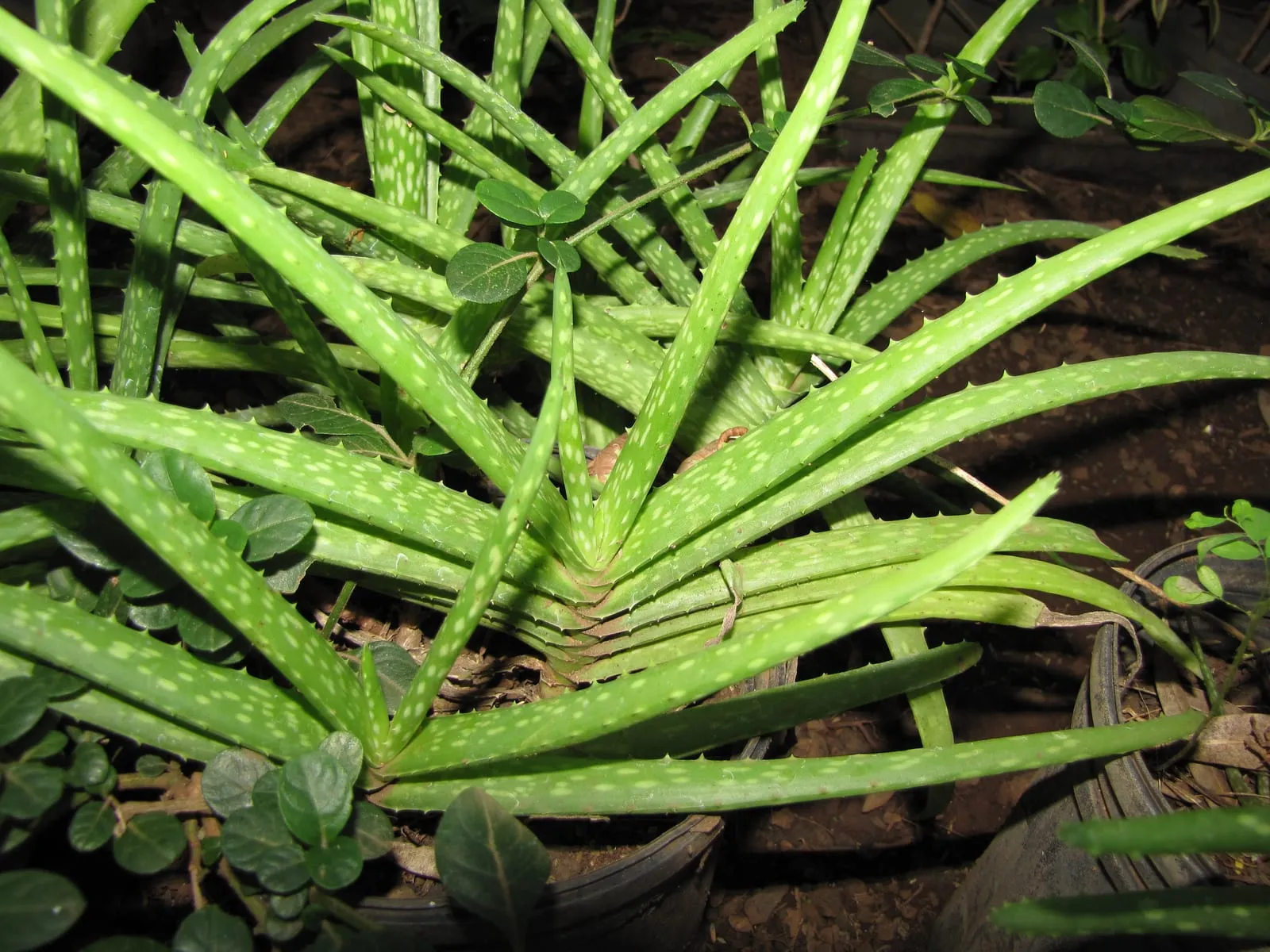
A rosette of thick, fleshy, grey-green leaves, each tapering to a point and edged with soft pale teeth that are firm rather than sharp. Young plants often carry pale spots that fade with age. A well-grown plant fills its pot with offsets and forms a clump.
Cut a leaf across and you see the structure that explains the whole plant. A tough green rind, then a thin yellow layer just inside it, then a large core of clear jelly. The jelly is water storage. The yellow layer is chemical defence, bitter and purgative, and it is what stops animals eating a plant that is otherwise a bag of water in a dry country.
Mature plants send up a tall spike of tubular yellow or orange flowers, though one grown indoors rarely obliges. It needs to be several years old, pot-bound, and given a proper cool dry winter rest.
Where it is from
The Arabian Peninsula, in dry rocky ground with intense sun and long rainless periods broken by heavy downpours.
The plant is built to fill up fast when water arrives and then live off its reserves for weeks. Watering it a little every few days gives it neither the soak nor the drought, and it is the most common way to make one rot.
How it grows
An evergreen succulent that grows from the centre of the rosette, adding new leaves in the middle while the outer ones age and eventually shrivel. Around the base it produces offsets, called pups, on short underground stems.
Growth happens in spring and summer. In winter it does very little, and in a cool room it stops entirely, which is when its water needs fall away to almost nothing.
Pups are the way to propagate it. Once one is about a fifth the size of the parent and has a few roots of its own, tip the whole plant out, separate the pup, let the wound dry for a day or two, and pot it into dry cactus compost. Wait a week before watering.
Through the seasons
Spring is the restart. Repot now if the plant is crowded or top-heavy, separate any pups, and begin watering and feeding properly again.
Summer is the growing season. Water every two or three weeks, feed monthly, and put it outside if you like. A sheltered sunny spot suits it, though move it out gradually over a week or two so it does not scorch.
Autumn is the wind-down. Bring it back indoors well before the first frost, and start stretching the gaps between waterings.
Winter is a dry rest, and the February pick is about coming out of it. Keep it above 10 deg C, water once a month at most, and give it the brightest windowsill you have while the light is poor. As the days lengthen from February, start increasing water slightly.
Care difficulty
Easy. It asks for sun, a gritty pot and infrequent water, and it tolerates being ignored.
Aloes are killed by kindness in winter, when a cold room, damp compost and a watering can meet. In summer the plant is growing and can use the water; in January it cannot, and wet compost around dormant roots turns to rot.
Watering
Soak it thoroughly until water runs from the drainage holes, then leave it completely alone until the compost has dried out all the way through. That is every two to three weeks in summer and monthly or less in winter.
Water onto the compost, never into the centre of the rosette. Water sitting in that funnel rots the crown, and a rotted crown is fatal because that is where all new growth comes from.
Terracotta helps here. Unglazed clay lets moisture evaporate through the sides, which shortens the time the roots spend wet, and its weight stops a top-heavy plant tipping over.
Empty the saucer. An aloe standing in water for a day is an aloe with a problem.
Warning signs, diseases and pests
Root and crown rot is the one that kills. The signs are leaves going soft, mushy and translucent, often browning from the base, and a plant that feels loose in its pot. Tip it out, cut away everything soft with a clean blade, let the remainder dry in the air for a couple of days, and repot into dry compost. If the crown itself has gone, take any healthy pups and start again.
Mealybugs settle in the crevices between leaves and at the base, as white waxy specks. Scale insects appear as small brown bumps on the leaf surface. Both come off with a cotton bud dipped in dilute washing-up water.
Fungus gnats mean the compost is being kept damper than it should be.
Leaves that go thin, flat and floppy, leaning outward with wide gaps between them, are not diseased. That is etiolation, and it means the plant is short of light.
Growing environment
Give it the brightest position you have. Bright light with several hours of direct sun suits it, and a south or west-facing windowsill is ideal. A plant in poor light stretches, pales and flops.
Introduce direct sun gradually. An aloe moved straight from a shaded shelf to a July windowsill develops brown, flat, scorched patches that never recover.
It tolerates 10 to 35 deg C, and should not go below 10 deg C. It can live outdoors through a cool temperate summer but must come in before autumn.
Ordinary room humidity is right. Use a free-draining cactus or succulent compost, or ordinary compost cut with a third grit or perlite.
Feeding
Once a month through spring and summer with a diluted succulent or cactus feed. Nothing at all from autumn through winter.
Aloe is a light feeder and over-feeding does more harm than under-feeding. Too much nitrogen produces soft, pale, floppy leaves that are more prone to rot.
Troubleshooting
Soft, mushy, translucent leaves. Overwatering and rot. Unpot, cut back to firm tissue, dry, and repot in dry compost.
Thin, curled leaves with brown dry tips. Underwatered, though this takes months to develop. A good soak fixes it.
Leaves flat, pale and flopping outward. Not enough light. Move it to the sunniest window you have, and expect the old leaves to stay floppy while new ones grow properly.
Brown or reddish flat patches. Sunburn, usually from moving it into direct sun too fast. Move it back to bright indirect light.
The whole plant is leaning or has tipped over. Top-heavy, or reaching for light on one side. Repot into a heavier terracotta pot and turn it regularly.
Pups crowding the pot. A good sign. Separate them in spring and pot them up.
Can I put the gel straight on a burn? For anything beyond a very minor kitchen scald, treat it as a first aid matter and cool it under running water. If you do use the leaf, drain the yellow sap off first, since it is the irritant part.
Aloe Vera problem guides
Not sure what is wrong? See the common houseplant pests guide.