
Outdoor plant
Silver Birch
Betula pendula
Also known as Warty birch, European white birch, Lady of the woods
How to grow Betula pendula. Why a short-lived tree is the right choice for a small garden, what the black diamonds on the bark are, the root system to plan around, and tapping the sap.
At a glance
- Difficulty
- Easy
- Water
- Through the first two summers only
- Light
- Full sun. It is a pioneer and will not tolerate shade
- Temperature
- Fully hardy. It grows further north than almost any broadleaf
- Hardiness
- USDA 2-7, RHS H7, hardy to -40 C
- Type
- Deciduous tree, short-lived for its size
- Height
- 15-25 m
- Native to
- Heath, moorland edge and light woodland across Europe and northern Asia
- Best month
- December in the Northern Hemisphere, June in the Southern Hemisphere
Cold suits it and heat does not. In North America bronze birch borer kills European and paper birches in warm summers and stressed trees go first, so river birch, Betula nigra, is the species to plant through the United States. In cool northern climates silver birch is short-lived by tree standards at eighty years or so and colonises bare ground faster than anything else.
Hardiness zones describe winter cold alone. Summer heat, humidity, rainfall and the length of the growing season decide as much, so treat the range as the outer limit rather than as a recommendation.
Every month named in this guide is for the temperate Northern Hemisphere. If you garden in the Southern Hemisphere, shift each one by six months, so December becomes June. Closer to the equator the wet and dry seasons matter more than the calendar, and the shift stops being a useful guide.
Not known to be toxic
Non-toxic. Betula pendula does not appear on the RHS list of potentially harmful garden plants, and the ASPCA does not list birch among plants toxic to cats, dogs or horses. The sap is drunk as a spring tonic across northern and eastern Europe and is fermented into birch sap wine in Britain, the inner bark has been used as famine food, and birch leaf tea has a long history in herbal medicine. The one health issue attached to this tree has nothing to do with eating it. Birch pollen is among the most significant airborne allergens in northern Europe, released in large quantities in April, and it affects a substantial share of hay fever sufferers. Some of those people also react to apples, cherries, hazelnuts and carrots through oral allergy syndrome, because the proteins are similar. That is worth weighing before planting one outside a bedroom window in a household with hay fever.
Sources: RHS potentially harmful garden plants, NC State Extension, Betula pendula
About
Birch is a pioneer. Its seed is tiny, winged and produced in enormous quantity, it germinates on bare ground, it grows fast in full light, and it dies young. Sixty to ninety years is a normal lifespan, against five hundred for an oak.
For a garden that short life is a feature rather than a fault. A birch reaches useful size within a decade, and the tree that outgrows its position is a problem your successors will not inherit.
The canopy is the other reason it suits gardens. Birch leaves are small and sparsely held, so the shade beneath is light and dappled, and bulbs, ferns and woodland perennials all grow happily under a birch where they would fail under a beech.
Appearance and character
A slender trunk with a light open crown and outer twigs that hang, which is what pendula refers to.
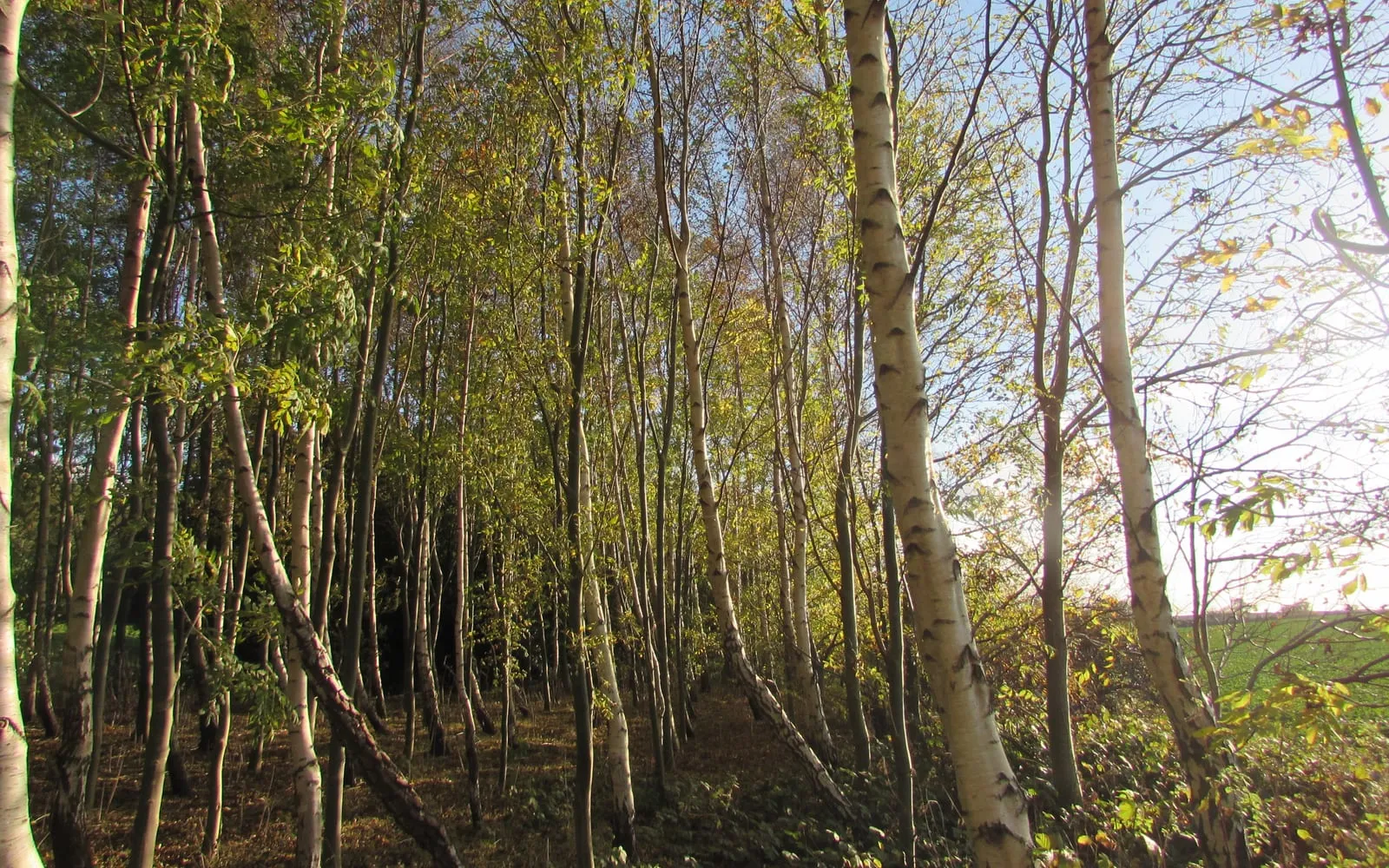
The bark is the feature. Young trees are coppery brown, turning brilliant white by around ten years old, peeling in fine papery sheets. As the tree ages the base develops rough black diamond-shaped fissures that spread upward over decades, so an old birch is black at the bottom and white above.
Leaves are small triangular diamonds, 3 to 6 cm, with a doubly toothed edge and a pointed tip, turning clear butter yellow in October.
Twigs are thin, warty to the touch with small resin glands, and hairless. That warty hairless twig separates Betula pendula from downy birch, Betula pubescens, which has hairy twigs without warts and prefers wetter ground.
Catkins appear in April, the males hanging in yellow-brown tassels and the females short, upright and green, later thickening and breaking up to release seed.
Multi-stemmed forms, three or five trunks from one point, are widely sold and make a strong feature in a small garden.
Where it is from
Heathland, moorland edges, light woodland and disturbed ground across Europe and northern Asia, and native throughout Britain.
Its niche is open ground after disturbance. Birch was among the first trees to recolonise Britain after the last ice age, and it still moves onto cleared land, burnt heath and abandoned quarries faster than anything else.
Being a pioneer explains the whole strategy. Fast growth, huge seed production, no shade tolerance, and a short life. Birch woods eventually give way to oak as the oaks grow up through them.
It favours light acid sandy soils and grows on almost anything that is not waterlogged, including thin poor ground where little else establishes.
It is remarkably cold-hardy and grows further north than almost any other broadleaved tree.
How it grows
A deciduous tree adding 40 to 60 cm a year when young, reaching 15 to 25 metres.
The root system is the thing to plan around. Birch roots are shallow, wide- spreading and vigorous, running well beyond the canopy edge and competing hard for water and nutrients. Planting a border right up to a birch trunk is a frustrating exercise.
Those roots are also why birch should not be planted close to drains, driveways or a building on shrinkable clay.
Trees establish far better as small whips than as large specimens, since the fine root system does not transplant well at size.
Birch bleeds sap heavily if cut in late winter and spring. Prune only between late summer and midwinter, and never in February or March.
Seed germinates readily on bare soil and self-sown seedlings appear in gravel and borders around a mature tree.
Through the seasons
Spring brings the catkins in April, along with the heaviest pollen release of the year. Sap rises strongly, so do no pruning now.
Summer is the main growing season. Water young trees in drought. Aphids can produce heavy honeydew that drips onto anything parked beneath.
Autumn gives clear yellow leaf colour in October, and this is a good planting season.
Winter is when the bark earns its place, and a group of white trunks against a dark hedge is the reason to plant birch at all. Prune now if you must, before the sap rises.
Care difficulty
Easy. Birch is among the least demanding trees you can plant, tolerant of poor soil, exposure and cold.
The difficulties are all in the siting. The roots are greedy and shallow, so avoid planting close to a house on clay, over drains, or in the middle of a border you intend to keep planted.
The second is pruning timing. Cut a birch in late winter or spring and it bleeds sap copiously for weeks, which weakens the tree. Prune between August and December.
The third is the pollen, which matters in a household with hay fever. Birch is one of the strongest airborne allergens in northern Europe.
Watering
Water young trees weekly through the first two summers, giving a deep soak.
Keep a clear circle of at least a metre around the trunk, mulched and free of grass. Grass competition is the main reason young birches fail to establish.
Established trees need no watering.
A mature birch draws a large volume of water from the surrounding soil, which is important if you are trying to grow anything demanding nearby. Plant tough dry-shade companions such as ferns, epimedium and hardy geraniums under it rather than thirsty perennials.
Keep mulch away from the trunk itself.
Warning signs, diseases and pests
Bracket fungi on the trunk indicate internal decay. Birch polypore, a smooth grey-brown bracket, is the common one and appears on trees that are already dying. Its presence means the tree is in its final years.
Thinning crown and dieback of the outer twigs in an old tree is usually the ordinary end of a short-lived species rather than a disease.
Witches’ brooms, dense twiggy masses in the crown, are caused by a fungus. They look dramatic and do little harm.
Aphids produce large quantities of honeydew in summer, which drips and turns sticky, then black with sooty mould. Parking a car under a birch is a mistake.
Rust shows as orange spots on the leaves in late summer and rarely matters.
Bronze birch borer is a severe pest of birches in North America and is not present in Britain. Readers in the United States should choose river birch, Betula nigra, which is resistant, in preference to European white birch, which is highly susceptible.
Leaf miners produce blotches within the leaf and do no lasting damage.
Asian longhorned beetle, a large black-and-white beetle with antennae longer than its own body, can also develop in birch and is not established anywhere outside Asia today. Every outbreak found in North America and Europe since 1996 has triggered eradication. Round pencil-width exit holes in the trunk are the sign to report immediately.
Growing environment
Full sun. Birch will not thrive in shade at any stage of its life.
Almost any soil, with a preference for light, well-drained, acid to neutral ground. It performs well on sand and thin poor soil where other trees struggle, and it dislikes permanently waterlogged clay.
Fully hardy to about -40 deg C, and tolerant of wind and exposure.
Site it at least 10 metres from a building, further on shrinkable clay, and away from drains and paving that shallow roots will lift.
Plant bare-root whips between November and March. Small trees establish far better than large ones.
Consider a multi-stemmed form for a small garden, which gives more bark for less height.
Group three or five together if you have room. Birch looks better in a stand than as a lone specimen, and that is how it grows in the wild.
Underplant with shade-tolerant, drought-tolerant plants rather than anything that needs steady moisture.
Feeding
Established birches need no feeding.
Young trees benefit from an annual mulch of compost or well-rotted manure spread in a circle around the base, kept clear of the trunk.
Avoid fertiliser. Birch grows quickly enough without it, and feeding produces soft growth.
Keeping the base free of grass does more for a young birch than any feed.
Avoid digging or cultivating under an established tree, since the feeding roots are shallow and easily damaged.
Troubleshooting
When should I prune it? Between August and December. Birch bleeds sap heavily if cut in late winter or spring, and a cut made in February can run for weeks.
The bark is brown, not white. Young trees are coppery brown and turn white at around ten years old. Give it time.
The bottom of the trunk has gone black and rough. Normal ageing. Old birches develop black diamond-shaped fissures at the base that spread upward with age.
Nothing will grow underneath it. The roots are shallow, wide and greedy. Plant dry-shade specialists such as ferns, epimedium, hardy geraniums and spring bulbs rather than anything needing steady moisture.
How long will it live? Sixty to ninety years, occasionally more. That is short for a tree of its size, and it is part of why birch suits a garden.
There is a bracket fungus on the trunk. The tree has internal decay and is probably in its last years. Have it assessed if it could fall on something.
Can I tap it for sap? Yes, in March before the leaves open. Drill a small hole about 3 cm deep into the trunk, insert a tube into a container, and take no more than a few litres from a mature tree. Plug the hole with a wooden dowel afterwards. Never tap a young or unhealthy tree, and stop once the leaves start to open.
Is birch a problem for hay fever? Yes. Birch pollen in April is one of the strongest airborne allergens in northern Europe. Think carefully before planting one close to the house if anyone in the household reacts to it.