
Guides
Common vegetable pests and how to identify them
Many vegetable pests are common across the world, while some belong to particular regions. This guide helps you identify what is eating your crop, tell minor damage from serious damage, and find the detailed page for each pest, with prevention advice that works against many of them.
Most vegetable damage comes from a small group of pests. Some, like aphids, slugs and cabbage caterpillars, occur in many regions. Others are regional, so a gardener in North America may deal with Colorado potato beetle, squash vine borer and tomato hornworm that a gardener in Europe or Africa will not see. This hub names the pests you are most likely to meet, groups them by how they feed, and links to a full page on each.
Start with the quick table. Match what you can see to the likely pest, open its page to confirm the identification against photographs and similar pests, then decide whether you need to act. A strong plant tolerates more damage than a weak one, and some feeding is minor. Where a pest is a notifiable quarantine species in your country, the page says so, and reporting it comes first.
What is eating my vegetables?
Match what you can see to the likely pest, then open its guide to confirm it.
| What you are seeing | Likely cause |
|---|---|
| Dense clusters of small soft-bodied insects on shoot tips, with sticky leaves below | Aphids |
| Clouds of tiny white flies rising off a brassica when you brush against it | Whitefly |
| A fine peppering of small round holes across seedling leaves | Flea beetles |
| Brassica leaves eaten to lace, with green caterpillars on the undersides | Caterpillars |
| Fat yellow-and-black striped beetles and red grubs stripping potato foliage | Colorado potato beetle |
| Ragged holes in soft leaves and silvery slime trails on the soil | Slugs and snails |
| Rusty-brown tunnels running just under the skin of carrots | Carrot fly |
| Newly planted brassicas wilting and pulling up with no roots | Cabbage root fly |
| A squash or courgette wilting suddenly, with sawdust-like frass at a hole in the stem | Squash vine borer |
| Stunted plants whose lifted roots carry rows of knotted galls | Root-knot nematodes |
Recognise six common pests
These are common pests on vegetable crops. Open any one for more photographs and checks.
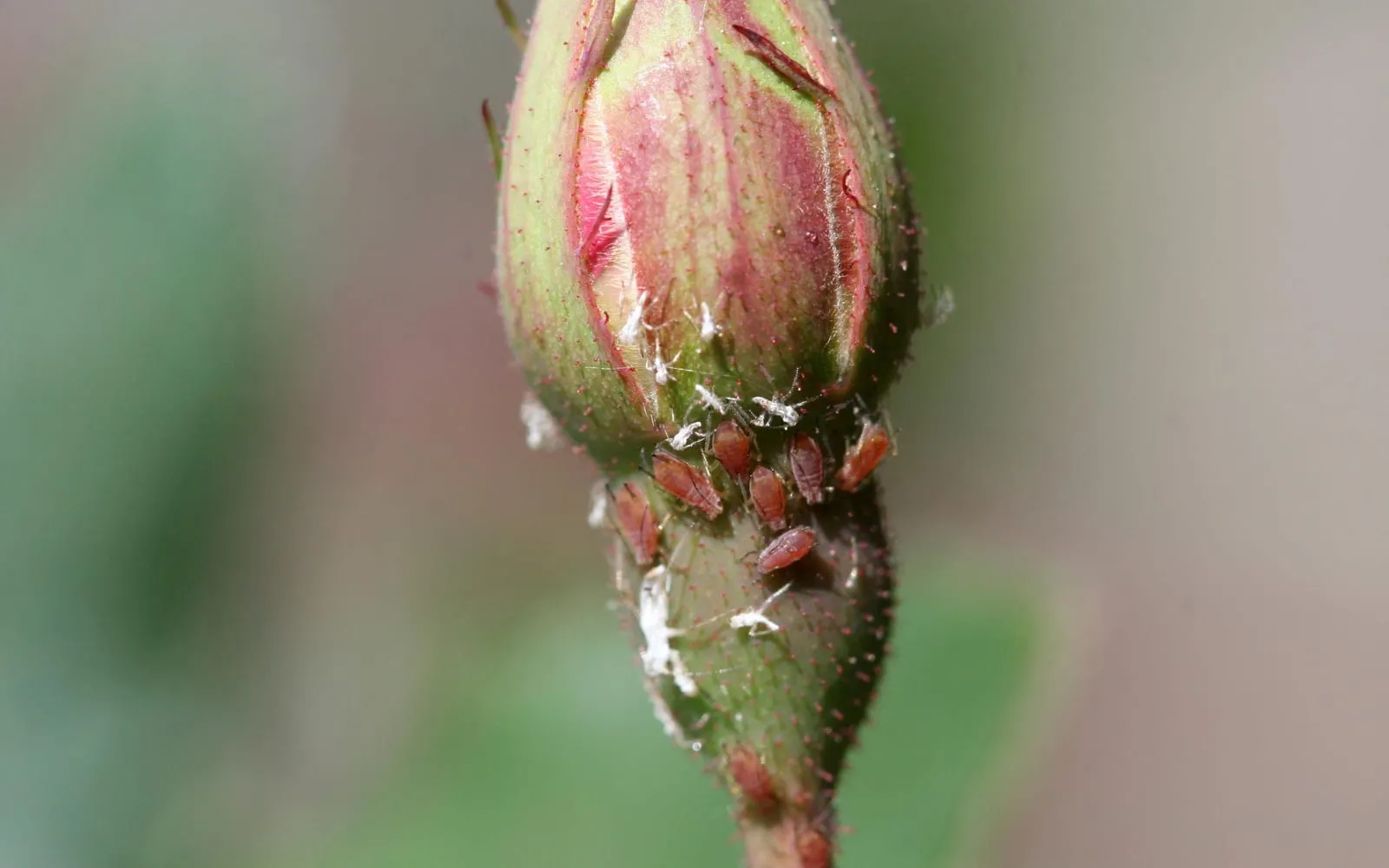 Aphids
Photo by Whitney Cranshaw, Colorado State University, CC BY 3.0 us. Resized from the original. 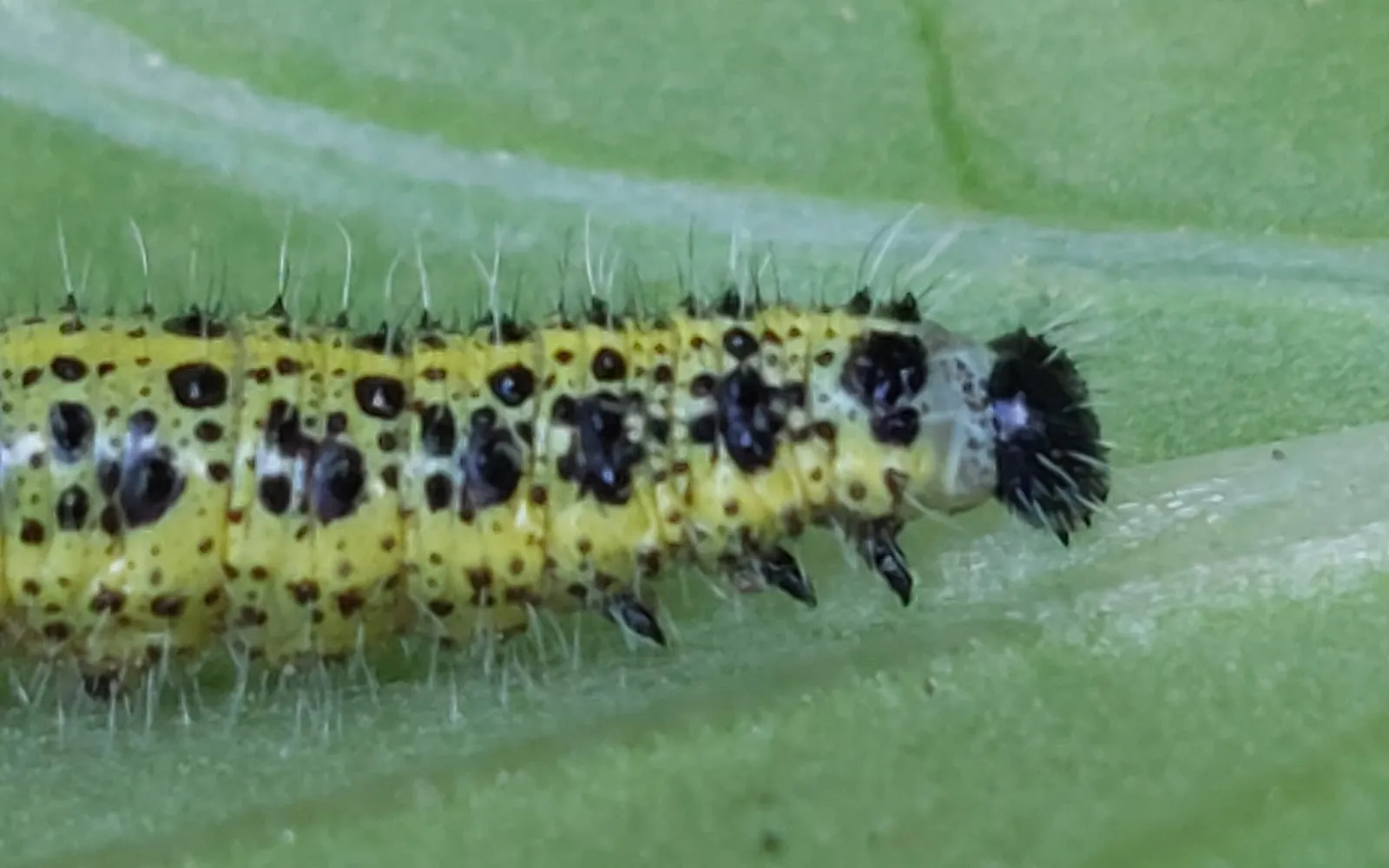 Caterpillars
Photo by Schlaghecken Josef, CC BY-SA 4.0. Resized from the original. 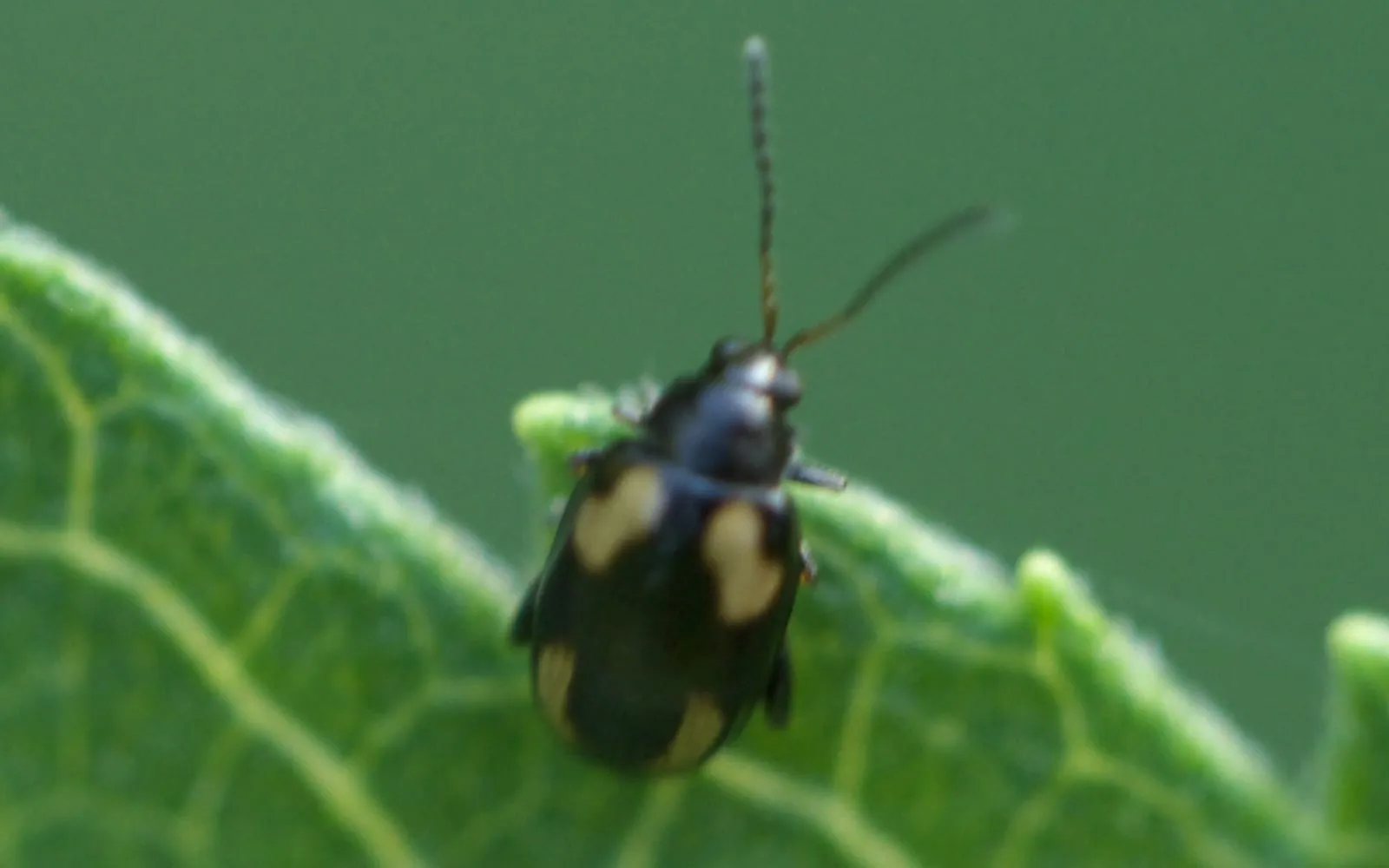 Flea beetles
Photo by xpda, CC BY-SA 4.0. Resized from the original. 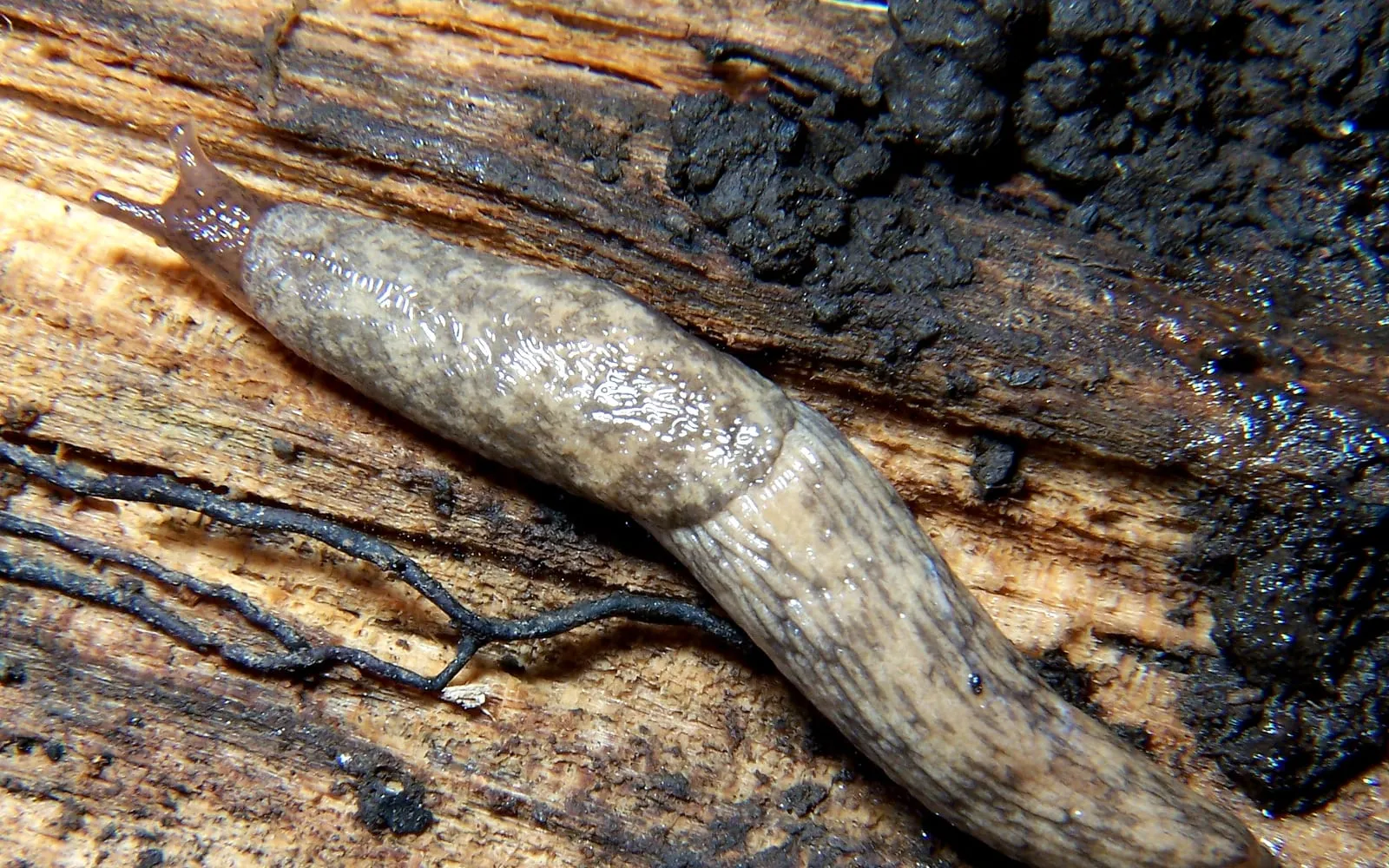 Slugs and snails
Photo by Bruce Marlin, CC BY-SA 3.0. Resized from the original. 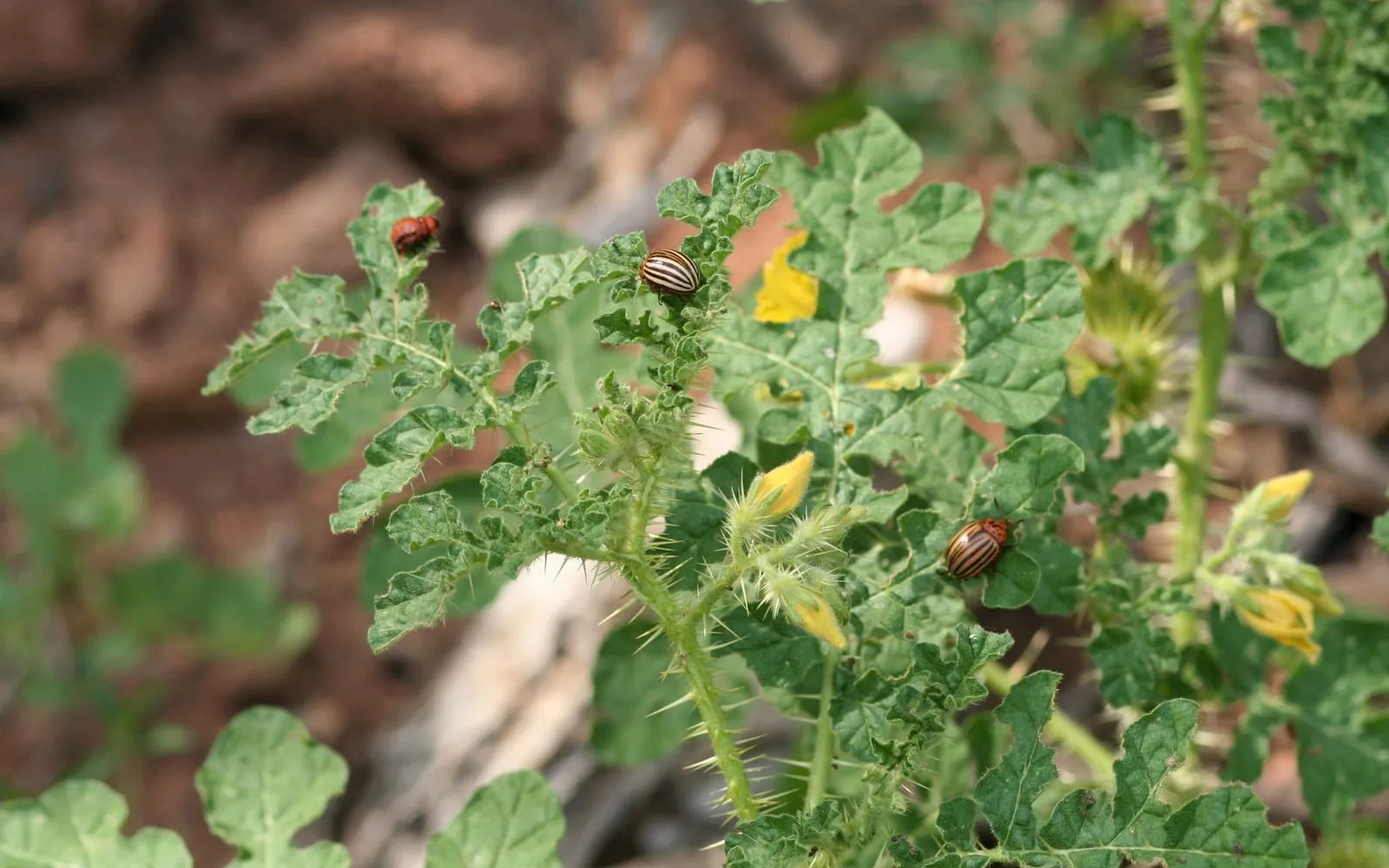 Colorado potato beetle
Photo by Whitney Cranshaw, Colorado State University, Bugwood.org, CC BY 3.0 us. Resized from the original. 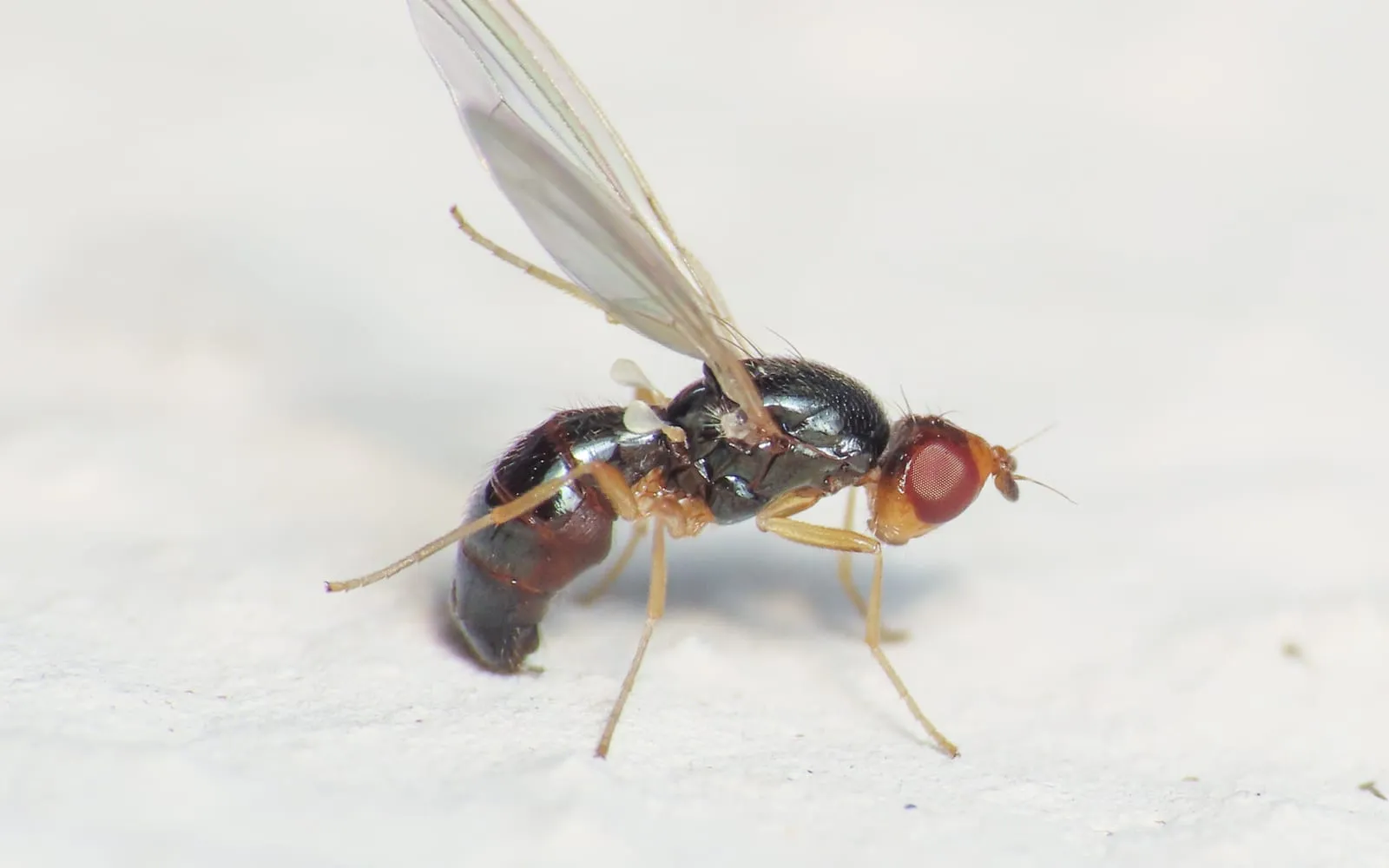 Carrot fly
Photo by Emanuele Santarelli, CC BY-SA 4.0. Resized from the original.
Sap-sucking pests
These insects push a needle-like mouthpart into the leaf or stem and drink sap. You may notice sticky honeydew, sooty mould or ants before you notice the insects. Sap-sucking can weaken growth and spread plant viruses from one crop to the next, but a light colony on an established plant often washes off with water or declines once predators find it.
Aphids
Weakens the plantWatch on Broad beans, brassicas, tomatoes, courgettes and most soft new growth
Aphids are soft-bodied insects a few millimetres long, green, black, grey or pink. They gather in dense colonies on shoot tips, flower buds and the undersides of young leaves. They feed on sap, pass viruses between plants, and coat the leaves below in sticky honeydew that grows black sooty mould. New growth puckers and curls. Most colonies wash off under a hard jet of water or squash between finger and thumb, and ladybirds and hoverfly larvae often reduce the rest.
How to identify and deal with aphidsWhitefly
Weakens the plantWatch on Tomatoes, cucumbers, cabbage, kale and sprouts
Whitefly are tiny white insects about two millimetres long. They shelter on the undersides of the youngest leaves and rise in a cloud when the plant is knocked, then settle again. The flat translucent scales stuck to the leaf are the young, and they do not move. Like aphids they leave honeydew and sooty mould, so lower leaves yellow and the crop weakens over a season. Kale and sprouts can carry them through winter, and the sooty deposits make leaves unpleasant to prepare.
How to identify and deal with whiteflyRed spider mite
Destroys the crop or displayWatch on Tomatoes, cucumbers, aubergines, beans and strawberries
Red spider mite does most harm in hot dry air, especially under glass and on tomatoes, cucumbers, beans and aubergines. The first sign is fine pale speckling across the upper leaf, like dust that will not wipe away. As colonies build, whole leaves turn dull, then bronze, then drop, and fine silk webbing appears between the shoot tips. The mites are tiny pale specks on the leaf underside that move when watched for a few seconds. Raising humidity and washing the plants slows them.
How to identify and deal with red spider miteThrips
Weakens the plantWatch on Onions, leeks, peppers, cucumbers and tomatoes
Thrips are slender insects about a millimetre long, dark brown or pale yellow. They rasp the surface of leaves and petals and feed from the damaged cells. The damage shows as silvery or bleached flecking, often with tiny black dots of excrement. New leaves come through puckered and scarred, and flower buds open badly. Thrips run rather than fly when disturbed, and hide in the crevices of unfurling growth.
How to identify and deal with thripsRoot aphids
Weakens the plantWatch on Lettuce, endive, globe artichoke and container plants
Root aphids feed unseen on roots, so the plant may wilt in afternoon sun and recover overnight until one day it stops recovering. Nothing on the leaves explains the wilting. Knock the plant out of its pot or lift it, and look for small grey, yellow or cream aphids clustered on the roots and crown, often under a white or bluish waxy powder. Ants often tend them for honeydew. Lettuce, endive and globe artichoke suffer most.
How to identify and deal with root aphids
Beetles and bugs
Beetles and true bugs chew plant tissue or feed on sap, and several can destroy a crop rather than only mark it. Some occur widely; several belong to the Americas and are not expected elsewhere. If a species is a notifiable quarantine pest in your country, report a sighting before treating it.
Flea beetles
Destroys the crop or displayWatch on Rocket, radish, turnip and brassica seedlings
Flea beetles are tiny dark beetles that jump when a hand passes over them. They pepper the leaves of rocket, radish, turnip and brassica seedlings with dozens of small round holes and shallow pits. Some pits go only part way through and leave a translucent window. A heavy attack can check or kill a young row within a week, and they are worst in warm dry spells on slow seedlings. Water well and cover with fine mesh until the plants are larger.
How to identify and deal with flea beetlesColorado potato beetle
Destroys the crop or displayWatch on Potatoes, aubergines and tomatoes
Colorado potato beetle can strip a potato plant to bare midribs within a fortnight. The adult is 10 mm long, with black and cream stripes down the wing cases and an orange-red head spotted with black. Its grubs are humpbacked and orange-red, with two rows of black dots along each side. They cluster on leaf undersides beside batches of upright yellow-orange eggs. It also feeds on aubergine and tomato. Where it is established, hand-picking beetles, grubs and eggs is the main control. Report a suspected sighting in Britain, Australia or New Zealand.
How to identify and deal with colorado potato beetleCucumber beetle
Destroys the crop or displayWatch on Cucumbers, melons, watermelon and squash
Cucumber beetle is a small yellow beetle, 5 to 7 mm long, either black-striped or spotted. It chews the cotyledons and flowers of young cucumbers, melons and squash. The feeding matters less than the bacterium it can spread, which blocks the vine water channels and makes the plant wilt from the tip inward over a week or two. The plant does not recover overnight. Cut a wilted stem and a milky sap strings out from it. This is an American pest, so cover seedlings from the day they emerge where it occurs.
How to identify and deal with cucumber beetleMexican bean beetle
Destroys the crop or displayWatch on French, runner, butter and soya beans
Mexican bean beetle is a coppery-yellow relative of the ladybird, 6 to 8 mm long and domed, with sixteen black spots in three rows across the wing cases. Unlike the ladybirds it resembles, it eats bean leaves rather than aphids. Adults and spiny pale-yellow grubs feed together from the leaf underside. They skeletonise leaves between the veins and scar the pods. It is confined to the Americas and is worst in the Mid-Atlantic and Appalachian United States.
How to identify and deal with mexican bean beetleHarlequin bug
Destroys the crop or displayWatch on Cabbage, broccoli, kale and other brassicas
Harlequin bug is a boldly patterned shield bug about a centimetre long, marked in black with red and orange. It feeds on cabbage, kale, broccoli and other brassicas, leaving irregular white or pale cloverleaf-shaped blotches that spread into large dead patches. A heavy attack can wilt and blacken young seedlings, since they have less tissue to lose. It feeds mostly on brassicas and belongs to the southern and central United States rather than the wider world.
How to identify and deal with harlequin bug
Caterpillars and grubs
Caterpillars are the larvae of moths and butterflies. They eat leaves, bore into cobs and fruit, or cut seedlings off at soil level. Frass, the dark crumbly droppings they leave, is often the first sign. Many feed at night or from the leaf underside and are hard to find by day. Count the fleshy prolegs to tell a caterpillar from a sawfly grub, which feeds in a similar way but needs different controls.
Caterpillars
Destroys the crop or displayWatch on Cabbage, kale, sprouts, broccoli and lettuce
Caterpillars chew ragged holes through the middle and edges of leaves and drop dark frass pellets as they feed. They often hide on the leaf underside by day. On brassicas, cabbage white caterpillars can reduce cabbage or kale leaves to lace and bore into the heart. Yellow-and-black caterpillars feeding in groups are large whites; lone green ones are small whites. To separate any caterpillar from a sawfly grub, count the fleshy prolegs, since a sawfly has more pairs. Squash the yellow egg clusters and net the bed before the butterflies lay.
How to identify and deal with caterpillarsDiamondback moth
Destroys the crop or displayWatch on Cabbage, cauliflower, broccoli and Asian greens
Diamondback moth is a small grey-brown moth whose green caterpillars pepper brassica leaves with pinholes and leave translucent windowpanes where they graze the underside. Poke a leaf and the caterpillar wriggles backward and drops off on a silk thread. It is the most damaging insect pest of brassicas worldwide, and it has evolved resistance to many insecticides. Netting, predators and crop hygiene matter most.
How to identify and deal with diamondback mothCorn earworm
Destroys the crop or displayWatch on Sweetcorn, tomatoes and peppers
Corn earworm works down through the silks and feeds inside the tip of a sweetcorn cob. By the time damage shows, the caterpillar is hidden from any spray. It also bores single holes into green tomatoes and peppers, which is why it is also called tomato fruitworm. The caterpillars range from pale green through pink to nearly black, all with fine pale stripes down the body. It is an Americas pest; an identical-looking relative, the Old World bollworm, fills the same role elsewhere.
How to identify and deal with corn earwormTomato hornworm
Destroys the crop or displayWatch on Tomatoes, aubergines, peppers and potatoes
Tomato hornworm is a green caterpillar up to 10 cm long, with white diagonal stripes and a curved horn at the tail. It is hard to see against tomato stems, and it can strip whole branches of tomato, chilli or aubergine overnight. Dark pellet-shaped droppings on the leaves and soil are often the first sign. Leave any hornworm carrying rows of white cocoons on its back, because it has been parasitised and will do no more harm. It belongs to North and South America.
How to identify and deal with tomato hornwormCutworms
Destroys the crop or displayWatch on Lettuce, brassicas, beetroot, onions and sweetcorn
Cutworms are fat soft caterpillars, grey, brown or greenish, that live in the top few centimetres of soil and feed at night. They cut through young lettuce, brassicas, beet and sweetcorn stems at ground level, so a row can topple overnight with the severed tops left beside the stumps. Scratch the soil near a cut plant and you may find the caterpillar curled into a C. Older plants may have ringed or gnawed stems rather than being cut down. Hoe to expose cutworms and fit stem collars.
How to identify and deal with cutworms
Root and stem pests
These pests feed out of sight in the soil or inside stems. The plant may wilt, stunt or die before anything shows on the surface. Top growth can look sound until you lift the plant or slit the stem and find the maggot, grub or gall. Newly broken ground and beds where the same crop returns year after year often carry more of them, which is why rotation and clean transplants help.
Carrot fly
Destroys the crop or displayWatch on Carrots, parsnips and parsley
Carrot fly is often noticed only when you lift or cut the crop and find rust-brown tunnels through the outer flesh of carrots, parsnips and parsley. Above ground, the first hint is a bronze or reddish cast to the foliage, which later yellows. The low-flying adult finds the row by scent, especially when you thin or brush the leaves. Sow thinly to avoid thinning, and screen the bed with fine mesh or a low vertical barrier the flies will not climb over.
How to identify and deal with carrot flyCabbage root fly
Destroys the crop or displayWatch on Brassica transplants, radish, swede and turnip
Cabbage root fly can make newly planted brassicas wilt within a week and die. White legless maggots up to 9 mm long eat the fine roots and tunnel the tap root, so the plant turns blue or purple, stops growing and pulls straight out of the ground with little root left. Radishes, swedes and turnips can come up riddled with brown tunnels. Transplants are most at risk. Fit a disc of card or felt tight around each stem at planting, or cover the bed with mesh from day one.
How to identify and deal with cabbage root flyWireworms
Destroys the crop or displayWatch on Potatoes, carrots, beetroot and seedlings
Wireworms are the thin, stiff, orange-brown grubs of click beetles, up to 25 mm long with three tiny pairs of legs at the front. They bore clean round tunnels into potatoes and up through carrots, beetroot and seedling stems. A transplant with its stem chewed below ground wilts and dies alone in the row. Wireworms are worst in the first three or four years after old turf is dug up and fade as the ground is worked. Lift maincrop potatoes promptly and fork the plot over to expose them.
How to identify and deal with wirewormsLeatherjackets and chafer grubs
Destroys the crop or displayWatch on Seedlings, brassicas and root crops
Leatherjackets are the legless grubs of crane flies, greyish-brown and tough-skinned, up to 4 cm long with no obvious head. They chew through roots and stem bases in the top few centimetres of soil, thinning seedbeds and leaving bare patches. On lawns, damaged turf may lift easily while birds and badgers pull it up to reach the grubs. They are most common on ground that was grass the year before. Fork the bed through before sowing and firm new transplants in well so the grubs cannot pull them under.
How to identify and deal with leatherjackets and chafer grubsRoot-knot nematodes
Destroys the crop or displayWatch on Tomatoes, cucumbers, carrots, potatoes and okra
Root-knot nematodes are microscopic worms that feed inside roots and swell them into rows of beads and knotted galls. The plant above ground stunts, yellows and wilts in heat however much you water it, because the damaged roots can no longer take up enough water. Lift a failing plant and the galls are clear: they are swellings that are part of the root rather than pests stuck to it. They persist in warm soil, build up wherever the same crop returns, and hit tomatoes, cucumbers, carrots and potatoes hardest.
How to identify and deal with root-knot nematodesSquash vine borer
Destroys the crop or displayWatch on Courgettes, pumpkins and winter squash
Squash vine borer can collapse a healthy courgette or squash within a day or two, often starting with a single runner. Look at the base of the wilted stem for a hole packed with moist, sawdust-like orange-green frass. Slit the stem there and you may find a cream caterpillar up to 2.5 cm long hollowing it out. Courgettes and pumpkins suffer far more than butternut squash growing alongside. It is an American moth, so a wilting vine elsewhere is more likely to be drought, verticillium wilt or another cause.
How to identify and deal with squash vine borer
Slugs and larger animals
Larger pests usually leave clearer signs. Slugs and snails feed at night on soft growth near the ground and leave slime trails. Birds and mammals take whole rows in daylight or overnight, leaving torn leaves, droppings and grazed stems. A suitable barrier, whether netting, mesh or a fence, protects the crop more reliably than anything scattered on the ground.
Slugs and snails
Destroys the crop or displayWatch on Seedlings, lettuce, hostas, beans and potatoes
Slugs and snails feed after dark and in wet weather, rasping smooth-edged holes in soft leaves and cutting seedlings off at the stem. By morning the plants may be gone, with only silvery slime trails across the soil and pots left behind. They can clear a row of lettuce, a hosta or a tray of seedlings overnight, and they graze craters into potato tubers below ground. Most species do little harm; grey field slug, keeled slugs and garden snail are the main ones to guard young plants against.
How to identify and deal with slugs and snailsWood pigeons
Destroys the crop or displayWatch on Cabbage, sprouts, kale, peas and beans
Wood pigeons strip leaves from cabbages, sprouts and kale until only thick midribs and stalks are left, especially in daylight through the coldest months when other food is scarce. Torn ragged edges and grey-white droppings on the plants separate the damage from caterpillars and slugs. They also pull up rows of pea and bean seedlings and strip buds and blossom from fruit. Taut netting held clear of the crop, or a fruit cage, is the only reliable defence. In other regions, other pigeons and parrots can cause similar damage.
How to identify and deal with wood pigeonsRabbits and deer
Destroys the crop or displayWatch on Lettuce, beans, hostas, tulips and young trees
Rabbits and deer can clear rows of vegetables and young shoots overnight, and the cut on the stem helps tell them apart. Rabbits bite through cleanly at a sharp angle and browse up to about 50 cm. Deer tear shoots off, leaving a ragged frayed end, and reach 1.2 m or more. Both gnaw bark from young trees in winter, and deer can also shred stems by rubbing their antlers on them. Round droppings and hoof slots in soft ground confirm the cause. A fence of the right height, sunk against rabbits, keeps them out.
How to identify and deal with rabbits and deer
Keeping pests off your vegetables
Preventing damage is easier than reacting to it. The same handful of habits work against many of the pests above. None depends on a spray, and together they usually achieve more than any single product.
Move the crop families around
Many pests specialise in one family of plants and build up in soil where that family grows year after year. Move each group, the brassicas, the roots, the onions and the legumes, to a fresh bed on a three or four year cycle, and keep a simple plan of what grew where. Nematodes, cabbage root fly and flea beetle all decline when their host crop moves and their eggs or grubs hatch without food.
Cover vulnerable crops before the pest arrives
Fine insect mesh and horticultural fleece keep flying and jumping pests off a crop by excluding them. Put covers on before the plants are at risk rather than after damage starts. Mesh stops carrot fly, flea beetle, cabbage white butterflies, root flies and pigeons where the gauge is fine enough and the edges are weighted down to the soil. Cover cucurbits until they flower, then open them for a few hours so bees can reach the blooms.
Feed the predators that hunt them
Ladybirds, lacewings, hoverfly larvae, ground beetles, birds and tiny parasitic wasps eat or parasitise large numbers of aphids, caterpillars and grubs. A plot with flowers for nectar, a patch of rough cover and a little water supports more of them than a bare plot. A broad-spectrum insecticide kills these predators along with the pest and often leaves you worse off, so keep any spray for a last resort.
Keep the soil and the plants strong
A plant growing steadily in living, well-fed soil tolerates more pest damage than a struggling plant. Work in garden compost or well-rotted manure, mulch to hold moisture and feed soil life, and disturb the ground only when you need to. Steady growth with no drought checks helps more than most treatments applied after damage is under way.
Walk the rows and pick off early
Look under the leaves and along the stems two or three times a week through the growing season. An egg batch, a first aphid colony or a young caterpillar is quick to deal with while it is small and confined to a leaf or two. Rub it out, pick it off, or cut away the leaf it sits on. Nearly every pest here is easier to stop early than to clear once it has spread across the bed.
Treat a spray as the last resort
Use a spray only when a pest is doing real harm and gentler controls have not worked, and choose the narrowest product you can. A broad-spectrum insecticide kills the ladybirds, hoverflies and wasps that keep other pests down, so a plot can end up with a worse problem than the one you sprayed for. Check what your own country still permits, since approvals differ and change. Most vegetable pests can be managed through a season without a spray.
Identify the pest before treating it. A lot of alarming damage is harmless or already over. Decide whether it is doing enough harm to need action. Start with prevention and with physical or biological controls, and keep sprays for the last resort, because broad sprays kill the predators you want to keep. The same order of steps works whether you garden in Auckland, Ontario or Phoenix.
Common questions
- What are the most common vegetable pests?
- Aphids, slugs and snails, caterpillars and flea beetles occur on vegetable plots in many regions and account for much of the damage. Which others matter depends on where you garden. A North American plot may also have Colorado potato beetle, squash vine borer, cucumber beetle and tomato hornworm, while a European or African plot is more likely to have carrot fly, cabbage root fly and local caterpillars. Aphids, slugs, caterpillars and flea beetles are the core group many growers meet.
- How do I keep pests off my vegetables without pesticides?
- Most vegetable pests can be handled without a spray. Cover vulnerable crops with fine mesh or fleece before the pest arrives, rotate the crop families each year so soil pests lose their host, and encourage the ladybirds, birds and parasitic wasps that hunt pests by growing flowers and leaving a little cover. Walk the rows often and rub out egg batches and young colonies by hand. Keep plants growing strongly in good soil, since a healthy plant tolerates more damage than a weak one.
- How do I tell which pest is eating holes in my leaves?
- Look at the shape of the holes and what is left behind. Small round pits peppered across seedling leaves are flea beetles; ragged holes with dark frass and green caterpillars underneath are cabbage whites or their relatives; smooth-edged holes with silvery slime trails are slugs and snails. Leaves eaten to a lacy skeleton between the veins point to a beetle such as Mexican bean beetle. Turn a leaf over and check the undersides, where many of these pests feed and hide.
- Which pests attack vegetable roots out of sight?
- Several feed below ground and show only as wilting or stunting above it. Carrot fly maggots tunnel rust-brown lines through carrots and parsnips; cabbage root fly maggots eat the roots off young brassicas so they pull straight out; wireworms bore clean holes into potatoes; and root-knot nematodes swell roots into beaded galls. Root aphids cluster on the roots under a white waxy powder and flag the plant in the heat. Lift a failing plant and check its roots before you blame anything above ground.
Sources
Compiled from these authorities. Each linked problem page carries its own sources as well.
- RHS: Crop rotation
- RHS: Aphids
- RHS: Slugs
- UC IPM: Flea beetles
- UC IPM: Root knot nematodes
- Cornell IPM: Colorado potato beetle
Reviewed by Matthew Moughtin
Last reviewed
Cannot see your problem here? Search the whole library, or start from what the plant is showing you.