
Pest
Whitefly
Aleyrodidae
Also called Glasshouse whitefly, Cabbage whitefly
Whitefly gathers on the undersides of young leaves and leaves sticky honeydew below. Spraying adults does little to the scales, so control depends on repeated washing or parasitoid wasps under cover.
At a glance
- Type
- Pest
- Cause
- Insect
- Severity
- Weakens the plant
- Affects
- Herbs and edibles, Houseplants, Garden plants
- Active
- All year
- Established in
- Worldwide
What you are seeing
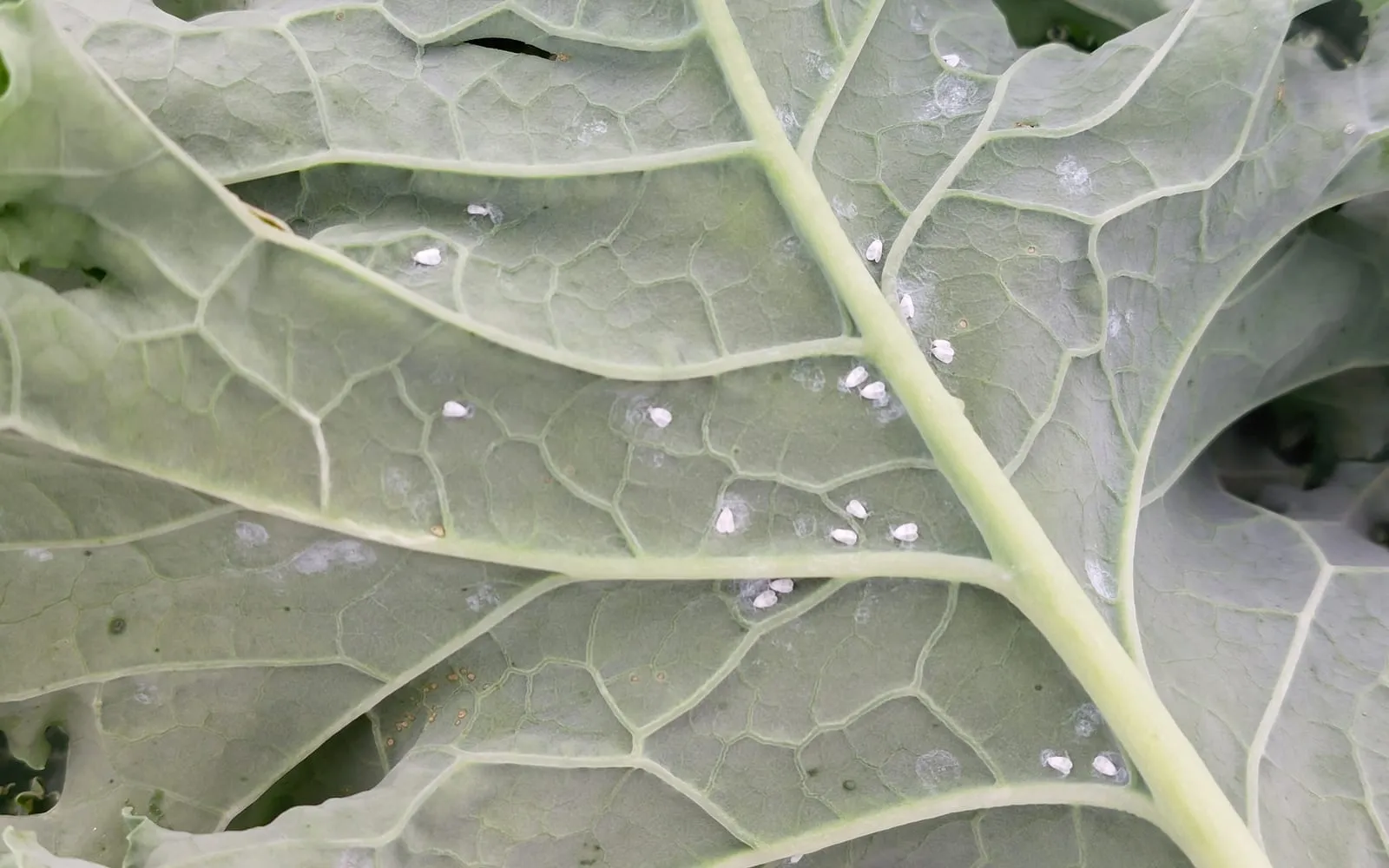
- A cloud of small white insects rising when the plant is disturbed, then settling back on the leaves
- Adults about two millimetres long on the undersides of the youngest leaves, wings held roof-like and dusted with white wax
- Flat, oval, translucent scales on the leaf underside, which are the young and do not move
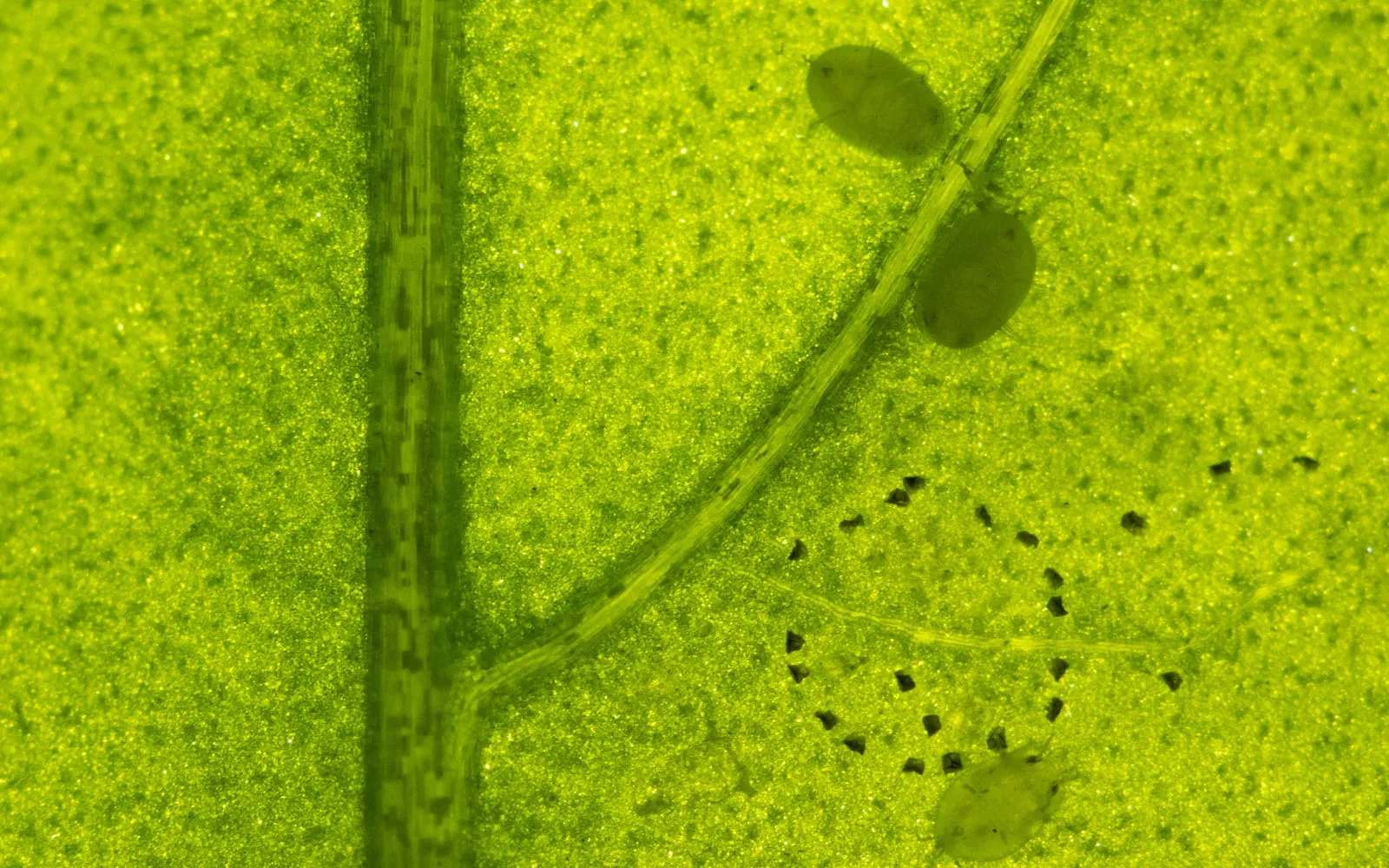
- Eggs laid in a neat arc or circle on the leaf underside
- Sticky honeydew on the leaves below, and black sooty mould growing on it
- Leaves yellowing and the plant losing vigour over a season
- Sooty deposits on kale and sprouts making the crop unpleasant to prepare
Before you treat anything
Nothing recommended here is harmful to a child, a pet or a pond. Sticky traps will catch small beneficial insects as well as whitefly, so keep them just above the crop rather than hanging them among flowering plants, and take them down once numbers have fallen.
What you are looking at
Brush past a tomato or a kale plant and a cloud of small white insects lifts off, circles briefly and settles again. That behaviour is diagnostic on its own. No aphid colony does it, and no scale insect does anything at all.
The adults are about two millimetres long, with four wings held roof-like over the body and dusted with a white waxy powder. They sit on the undersides of the youngest leaves near the growing point, so a plant can look perfectly clean from above.
Despite the name they are not flies. They belong with the aphids, scale insects and mealybugs, and like all of those they feed by pushing a stylet into the phloem and drinking sap.
The stage nobody looks at
Turn a leaf over and look past the adults. The eggs are laid in a neat arc or a complete circle, because the female pivots around her inserted mouthparts as she lays.
What hatches crawls for a short time, then settles, flattens, and becomes an oval translucent scale stuck to the leaf. It stays there through three more stages until it emerges as an adult. Those scales are most of the population, they are almost invisible, and they do not move.
That is why swatting, vacuuming and spraying the adults achieves so little. The plant carries a fortnight’s worth of replacements on the leaves you have just cleared.
Two species, two different problems
Glasshouse whitefly, Trialeurodes vaporariorum, is a tropical insect that cannot survive a frosty winter outdoors. It lives permanently under glass and indoors, breeds all year in a heated greenhouse, and is the one that ruins tomatoes, cucumbers, fuchsias and poinsettias. It is also notoriously resistant to insecticides.
Cabbage whitefly, Aleyrodes proletella, is a native outdoor insect that overwinters on living brassicas and does relatively little harm. It makes kale, sprouts and cabbage unpleasant to prepare rather than reducing the crop. Anyone told to spray a kale bed for this is being sold a solution to an inconvenience.
Treat the greenhouse one as a pest and the brassica one as a nuisance, and the whole subject becomes much more manageable.
What the damage amounts to
Sap loss slows a plant down, and heavy populations yellow the leaves and reduce cropping. That is the smaller half.
The larger half is honeydew. It falls onto the leaves and fruit below, black sooty mould grows on it within a couple of weeks, and the mould blocks light without infecting anything. On a greenhouse tomato it coats the trusses; on kale it turns the crop grey.
Glasshouse whitefly also transmits several plant viruses, which is a further argument for keeping numbers low rather than tolerating them.
What to do about them
Keep it out. Glasshouse whitefly arrives on bought plants, so quarantine new arrivals for three weeks and look under the leaves each week. Clear the greenhouse right out between crops, and overwinter pelargoniums and fuchsias somewhere other than beside next year’s young tomatoes.
Then use Encarsia formosa. A parasitoid wasp under a millimetre long, it has been used commercially against this insect since the 1920s and remains the best answer available to a gardener. It lays into the settled scales, and the parasitised ones turn black, so you can watch it work. Release it when you find the first few adults, repeat every fortnight for three releases, and keep the greenhouse above about 18 degrees C with reasonable light.
Hang yellow sticky traps to monitor rather than to control. A trap that fills faster this week than last is telling you the wasps need topping up.
Strip the lower leaves off tomatoes and brassicas as the season goes on, since they carry most of the settled young and do little for the plant. Bag them.
For cabbage whitefly, wash the undersides with a hose, clear old brassica stumps in spring, and rinse the crop before cooking.
Why no spray is listed here
Glasshouse whitefly has developed resistance to several classes of insecticide, and the settled scale stages are protected by a waxy covering that contact products struggle to wet. A spray therefore kills the adults, which are the easiest and least important part of the population, and leaves the scales to emerge next week.
It also kills Encarsia. Anyone who releases the wasps and then reaches for a bottle when the numbers do not fall in three days has spent money twice and undone the more effective of the two.
Fatty acid and plant oil products have the same coverage problem and the same effect on beneficial insects.
What it gets mistaken for
Fungus gnats are dark rather than white, they come up out of the compost rather than off the leaves, and they drift about the pot instead of settling back on the foliage.
Aphids sit still in dense clusters on shoot tips and do not fly up when disturbed, and the white flecks among them are shed skins rather than insects.
Scale insects are immobile domes on stems and leaf veins, and while the settled young of a whitefly do look similar, the adults flying about settle the question in a second.
White fluff in the leaf joints is mealybug, an animal under a coat of wax rather than an insect with wings.
Small white flakes that fall off and do not fly are usually the waxy scurf whitefly leave behind, or in a greenhouse, the fine debris from a shed leaf.
What to do, in order
Start here
Prevention, and the changes that stop the problem returning. Most of these pages should end at this tier.
- Quarantine new plants for three weeks
- Glasshouse whitefly cannot survive a frosty winter outdoors, so it reaches most gardens on a bought plant. Keeping a new fuchsia, pelargonium or tomato apart and checking the leaf undersides weekly stops it entering the greenhouse at all.
- Empty the greenhouse between crops
- Overwintering pelargoniums and fuchsias standing alongside next year's young tomatoes is how a population carries over from one season to the next. Clear the old crop out completely, and keep the plants you are overwintering somewhere separate.
- Clear brassica stumps and debris
- Cabbage whitefly overwinters as adults on living plants, so old sprout stalks and kale left standing into spring hand the population directly to the new crop. Pull them and remove them.
- Separate winter and summer brassicas
- Planting spring cabbages next to the kale you are still picking gives the insect a bridge between seasons. A few metres, or a different bed, makes that crossing much less likely.
- Take off the lower leaves
- Old leaves at the base of a tomato or a kale plant carry most of the settled young and contribute little to the plant. Removing them steadily through the season removes the population with them.
Then reach for a barrier
Netting, hand removal and water. Nothing here harms anything except the target.
- Hang yellow sticky traps
- Whitefly are strongly drawn to yellow. Traps catch adults, and more usefully they tell you whether numbers are rising before the plant shows anything. Keep them just above the top of the crop.
- Vacuum the adults
- A vacuum nozzle passed over a disturbed plant takes most of the flying adults in a few seconds. It is a stopgap rather than a control, and on a greenhouse tomato it keeps numbers down while a biological control establishes.
- Wash the undersides with a jet of water
- On robust plants such as kale and sprouts, a firm spray under the leaves dislodges adults and a good share of the settled young. Repeat weekly, and do it in the morning so the foliage dries.
- Wash the honeydew off before you cook
- Sooty mould on brassica leaves is unpleasant rather than harmful, and it comes off in cold water. It does not mean the crop is spoiled.
Then bring in the predators
Encourage what already lives in the garden, and buy predators in where the problem is under glass and nothing will arrive on its own.
- Introduce Encarsia formosa under glass
- A parasitoid wasp under a millimetre long, used commercially since the 1920s and still the standard answer. It lays in the settled whitefly scales, and a parasitised scale turns black, so you can see it working. It needs about 18 degrees C and good light, so use it from spring onwards.Sold by licensed biocontrol suppliers across Europe, North America, Australia and New Zealand, where it is already approved for release. Buy from a supplier in your own country: importing a live agent yourself is an offence in most of them.
- Put it out early, while numbers are low
- Encarsia works through a population rather than knocking it down, so it needs to be released when you find the first few adults rather than after the leaves have gone sticky. Introduce it every fortnight for the first three releases.
- Try Macrolophus on a greenhouse tomato
- Macrolophus pygmaeus is a predatory bug that eats whitefly at every stage as well as spider mite and thrips. It establishes slowly and then persists, which suits a tomato crop grown in the same greenhouse each year.
- Leave the black scales alone
- Blackened whitefly scales on a leaf underside contain developing Encarsia rather than a second pest. Stripping those leaves off removes the wasps that would have dealt with the next generation.
Biological controls are live organisms and their sale and release are regulated country by country. An agent sold freely in one place may be unapproved in another, so buy from a licensed supplier where you live and never import or move one yourself.
In pictures
Plants affected
Guides that name it among the problems to watch for. The list is the plants it is characteristic of rather than everything it will feed on.
Common on UK allotments
This is one of the pests and diseases allotment growers meet most often. See it alongside the other common problems on the allotment guide.
Common allotment pests and diseasesA common houseplant pest
This is one of the pests and problems that houseplant owners meet most often. See it alongside the others, with a quick table for telling them apart, on the houseplant pests guide.
Common houseplant pestsA common tomato problem
This is one of the problems tomato growers meet most often. See it alongside the other pests, diseases and disorders on the tomato guide.
Common tomato problemsA common vegetable pest
This is one of the pests that vegetable growers meet most often. See it alongside the others on the vegetable pests guide, grouped by how they feed and with prevention that works against most of them.
Common vegetable pests