
Pest
Colorado potato beetle
Leptinotarsa decemlineata
Also called Ten-striped spearman, Potato bug
Colorado potato beetle can strip a potato plant to bare stems within a fortnight. Hand-picking works for gardens where the beetle is established, while suspected sightings in Britain should be reported.
At a glance
- Type
- Pest
- Cause
- Insect
- Severity
- Destroys the crop or display
- Affects
- Herbs and edibles
- Active
- May to September
- Established in
- North America, Europe and Asia
What you are seeing
- Potato, aubergine or tomato foliage stripped to bare midribs and stems within one to two weeks
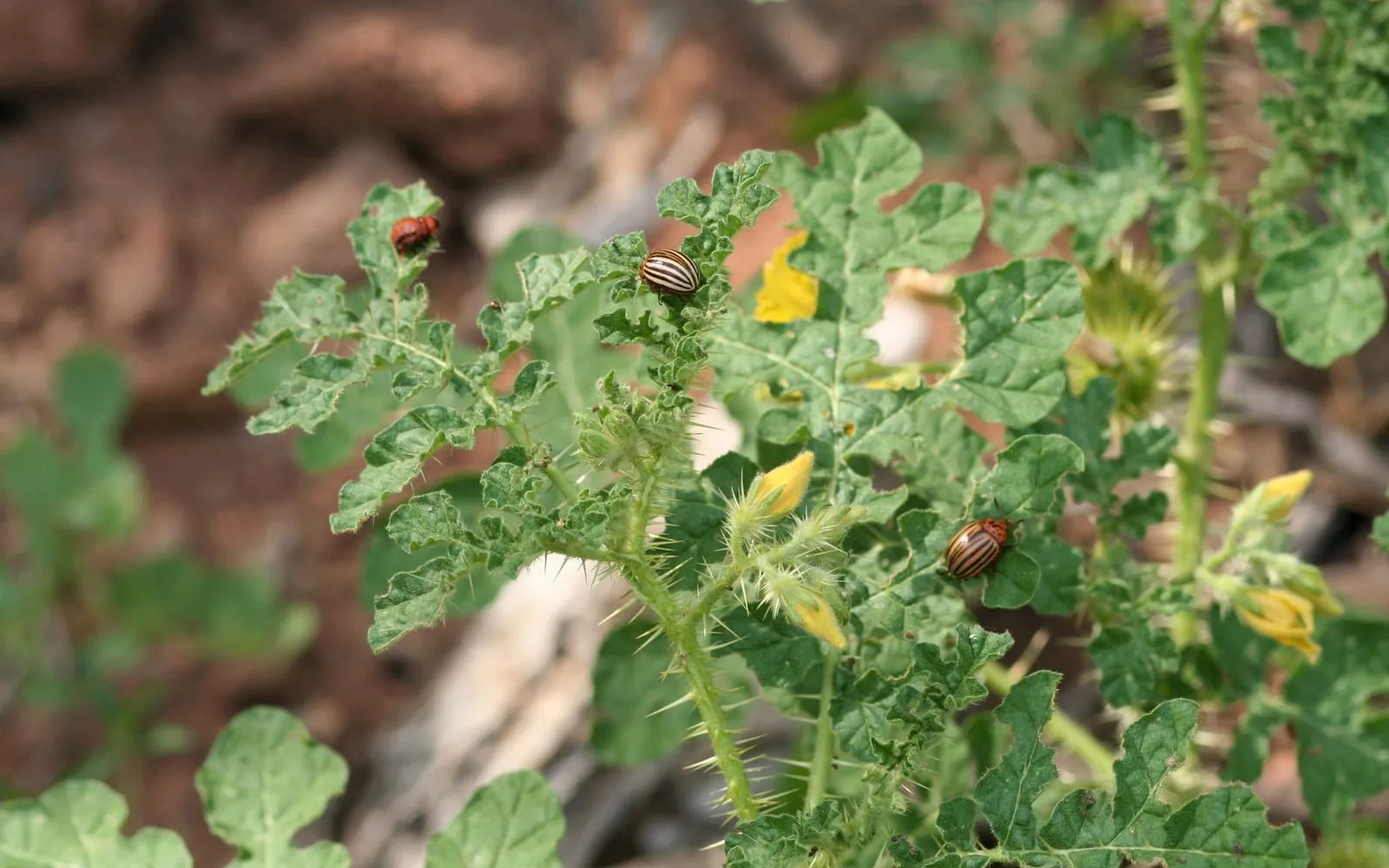
- Adult beetles 10 mm long, boldly striped black and cream lengthwise down the wing cases, with an orange-red head marked with black dots
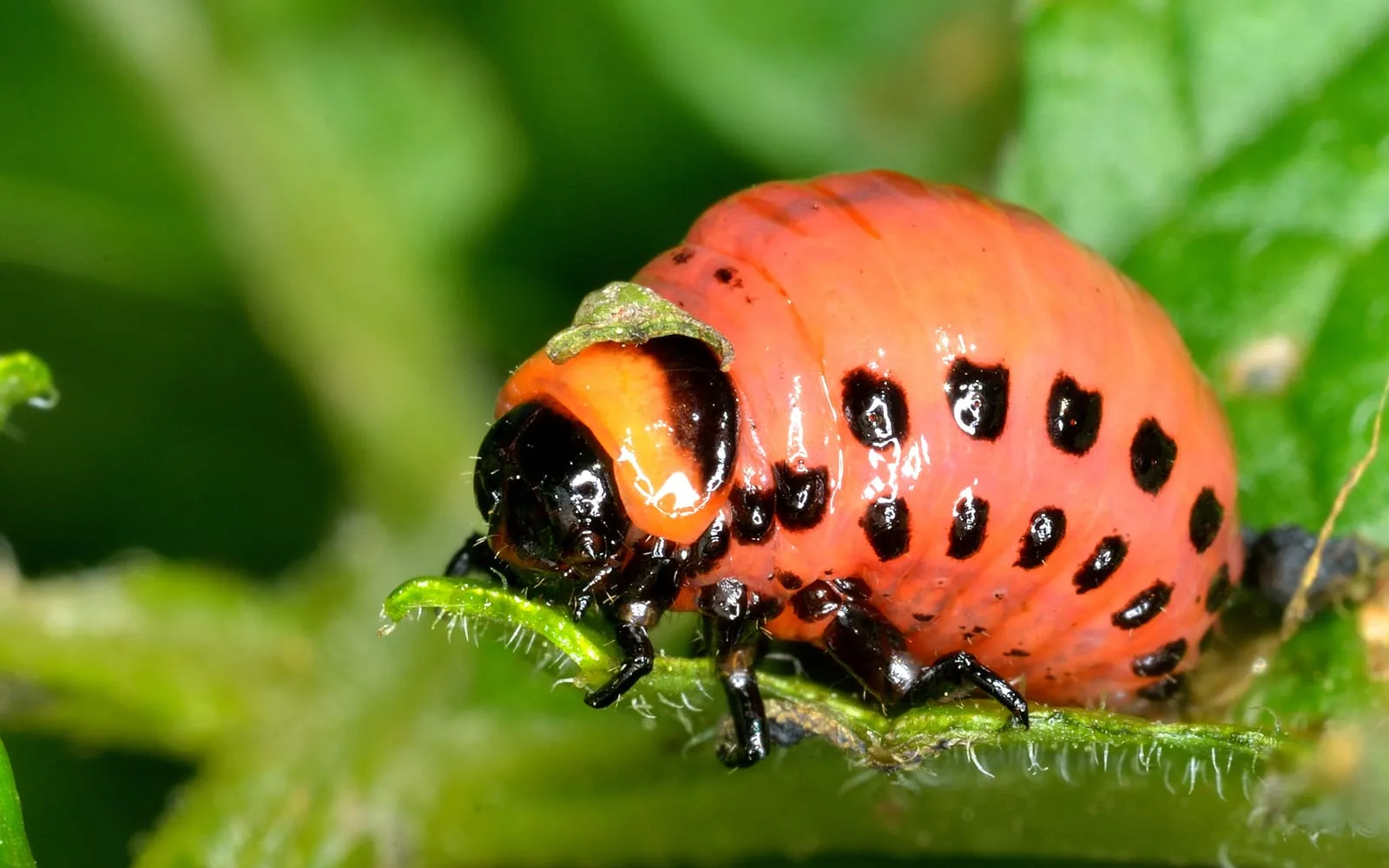
- Humpbacked, soft-bodied orange-red grubs with two rows of black spots along each side, clustered on the underside of leaves
- Clusters of 20 to 30 bright yellow-orange eggs, laid upright on end on the leaf underside
- Tuber yield falling sharply where defoliation happens before flowering
- Two overlapping generations through a single summer wherever it is established
Before you treat anything
Wear gloves when hand-picking in quantity; the beetle produces no venom or irritant but the grubs are unpleasant to crush with bare fingers. Tubers from a defoliated plant are safe to eat, though yield and size both suffer.
What you are looking at
A potato bed that looked fine a week ago and is now bare stems and skeletal leaves. The culprits are hard to miss once you know to look: a beetle about 10 mm long with cream and black stripes running the length of each wing case and an orange-red head dotted in black, alongside soft, humpbacked, orange-red grubs in two sizes clustered on the leaf undersides.
Look closer at an unstripped leaf nearby and there are likely clusters of 20 to 30 bright yellow-orange eggs standing on end on the underside, the next generation queued up.
Potato takes the worst of it, and aubergine and tomato foliage are both eaten too. Defoliation before the plant has flowered costs tuber yield directly, and a heavy attack can strip a bed twice in one summer.
Where this happens, and where it does not
This is a North American beetle first, native to the foothills east of the Rocky Mountains, and it only became a potato pest once European settlers brought the crop within reach in the nineteenth century. It reached France in 1922 and has since spread to predominate across potato-growing regions in 21 European Union member states and through much of temperate Asia.
Britain sits inside that European range geographically and outside it in practice. DEFRA treats it as a notifiable quarantine pest, it has been found and eradicated more than 160 times since it first turned up, and the last established outbreak was in 1976. A beetle matching this description on a UK allotment is a call to the plant health authority, not a pest to hand-pick, because a confirmed finding triggers containment measures well beyond one garden.
Australia and New Zealand have never had it and both run active biosecurity programmes to keep it that way. Anyone in the Southern Hemisphere seeing a similarly striped beetle on potatoes should assume a lookalike and report it for confirmation rather than treat it as this species by default.
The year it has where it is established
Adults overwinter in the soil of the previous year’s potato bed and emerge in spring once the ground warms, typically as the first shoots appear. They mate, and each female lays several hundred eggs over the following weeks in the bright clusters described above.
Larvae pass through four stages over two to three weeks, growing from tiny dark grubs to the fat orange-red fourth instar that does most of the damage; a single adult can strip about 10 square centimetres of foliage a day, and a fourth-instar larva eats faster than that. They pupate in the soil for five to ten days, and a first generation of adults is on the wing by midsummer. A second generation follows by late summer in most years, feeding hard before entering the soil to overwinter without breeding again that year.
What to do about it
Check leaf undersides from the moment shoots break the surface, and pick off every adult, grub and egg cluster you find into a jar of soapy water. This alone controls the pest on a garden scale almost everywhere it occurs.
Rotate potatoes, aubergines and tomatoes as far from last year’s bed as the plot allows, since the overwintering adults walk into a new planting rather than searching far for one.
On a bed too large to check by hand daily, a plastic-lined trench around the perimeter intercepts migrating adults, and insect mesh laid over young plants excludes them until flowering.
Spray Bacillus thuringiensis subsp. tenebrionis on young larvae where it is registered, timed to the first instars rather than the fat fourth-instar grubs that are already past the point where it works well.
Cut down the haulm once the tubers have sized up to deny the second generation its food before it goes into the ground for winter.
What it gets mistaken for
Capsid bugs leave small ragged holes that expand as the leaf grows, never a plant stripped to stems within a fortnight.
Leaf miners tunnel within the leaf tissue and leave the surfaces intact, a pale winding trail rather than an eaten edge working inward.
Flea beetles put many small round holes across a leaf rather than removing it entirely, and their damage stays cosmetic on an established plant rather than skeletonising it.
Not established in Australia and New Zealand
Do not prune, spray or otherwise treat a suspected case. Doing so risks spreading an organism the country has kept out, and it disturbs the evidence needed to identify it. Photograph what you can see, leave the plant alone, and contact your national or state plant health authority. The control advice further down this page is written for regions where this problem is already established.
Native to the Rocky Mountain foothills of North America, where it fed on wild nightshades before potato farming gave it a continent to expand across. It reached France in 1922 hidden in war supplies and now predominates in potato-growing regions across 21 EU member states, plus much of temperate Asia. The United Kingdom is the exception within Europe: DEFRA lists it as a notifiable quarantine pest, it has been eradicated there more than 160 times since first arriving, and the last established outbreak was in 1976. Australia and New Zealand have kept it out entirely and both treat a sighting as a biosecurity emergency.
What to do, in order
The steps below apply where this problem is already established.
Start here
Prevention, and the changes that stop the problem returning. Most of these pages should end at this tier.
- Rotate potatoes and other solanaceous crops well away from last year's bed
- Adults overwinter in the soil of the previous potato patch and walk rather than fly into a new one nearby. US extension guidance puts the useful separation at a quarter to half a mile, which is impractical for most gardens but the principle scales down: the far end of the plot beats the same square metre, and a full rotation away from any bed that grew potatoes, aubergines or tomatoes in the last two years beats no rotation at all.
- Check leaf undersides from the moment shoots emerge
- Overwintered adults find the first potato shoots within days of emerging and lay eggs immediately. Catching the first adults and egg clusters before they hatch removes an entire generation for the cost of five minutes a day at the point when the plant can least afford to lose leaves.
- Kill the vines or harvest early once the crop is made
- Second-generation adults feed through late summer with nothing left to do but build fat reserves for winter. Cutting the haulm down once the tubers have sized up denies that generation its food and reduces the number going into diapause.
Then reach for a barrier
Netting, hand removal and water. Nothing here harms anything except the target.
- Hand-pick adults, grubs and egg clusters into soapy water
- This is the control that matters most on a garden scale. Adults are slow and conspicuous, the egg clusters are bright yellow-orange and easy to spot on the leaf underside, and squashing or removing eggs before they hatch is far more effective than treating grubs afterward. Two or three checks a week from shoot emergence through to flowering keeps a small planting clear without another control needed.
- Dig a plastic-lined trench around the bed
- Adults walk into a new planting from the soil surface rather than flying in, at least early in the season, and a steep-sided trench lined with plastic sheeting intercepts them before they reach the crop. Combined with a trap crop of early potatoes planted just outside the trench, this is standard practice on organic farms too large to hand-pick.
- Cover young plants with insect mesh until flowering
- A floating mesh laid over the bed from planting keeps the overwintered adults off entirely, provided the ground underneath was not itself host to potatoes, aubergines or tomatoes the previous year, since beetles can also emerge from the soil beneath the cover. Remove it at flowering so pollinators can reach the crop.
Then bring in the predators
Encourage what already lives in the garden, and buy predators in where the problem is under glass and nothing will arrive on its own.
- Encourage ground beetles and spined soldier bugs
- Twelve-spotted ladybirds, the predatory ground beetle Lebia grandis and the spined soldier bug all take eggs, larvae or pupae where pesticide use is kept low enough for them to build up. None will clear a heavy infestation alone, but a bed with a resident population of predators needs far less hand-picking.
- Spray Bacillus thuringiensis subsp. tenebrionis on young larvae
- This subspecies of Bt targets leaf beetles specifically and works only on young larvae that are actively feeding, so timing the spray to the first and second instars matters more than the product itself. It breaks down quickly in sunlight and needs reapplying through a generation rather than once.Sold as a biological insecticide in North America and much of Europe under names including Novodor. Registration varies by country, and it is not relevant where the beetle is absent, so there is nothing to buy or release in the United Kingdom, Australia or New Zealand.
Biological controls are live organisms and their sale and release are regulated country by country. An agent sold freely in one place may be unapproved in another, so buy from a licensed supplier where you live and never import or move one yourself.
In pictures
Plants affected
Guides that name it among the problems to watch for. The list is the plants it is characteristic of rather than everything it will feed on.
A common vegetable pest
This is one of the pests that vegetable growers meet most often. See it alongside the others on the vegetable pests guide, grouped by how they feed and with prevention that works against most of them.
Common vegetable pests