
Pest
Cabbage root fly
Delia radicum
Also called Cabbage fly, Cabbage maggot, Root fly
Cabbage root fly makes brassica transplants wilt and die, with white maggots feeding in the roots. Fit collars tight to the stem and protect plants before the spring, summer and autumn flights.
At a glance
- Type
- Pest
- Cause
- Insect
- Severity
- Destroys the crop or display
- Affects
- Herbs and edibles
- Active
- April to September
- Established in
- Europe, North America and Asia
What you are seeing
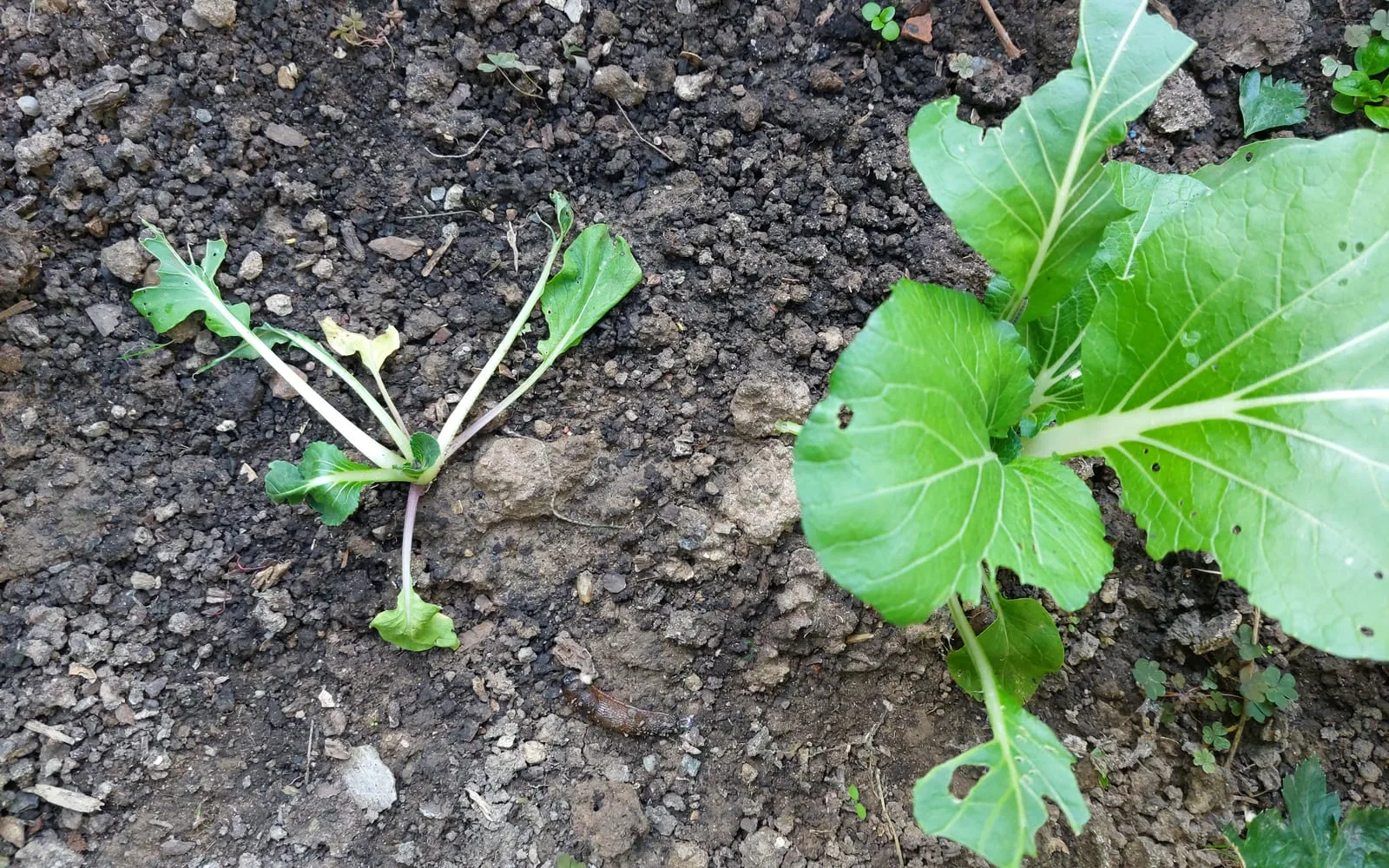
- Newly planted brassicas wilting within a week and dying a few days later
- Plants coming loose in the soil when pulled gently, with no anchoring roots left
- A blue or purple cast to the leaves before the plant collapses
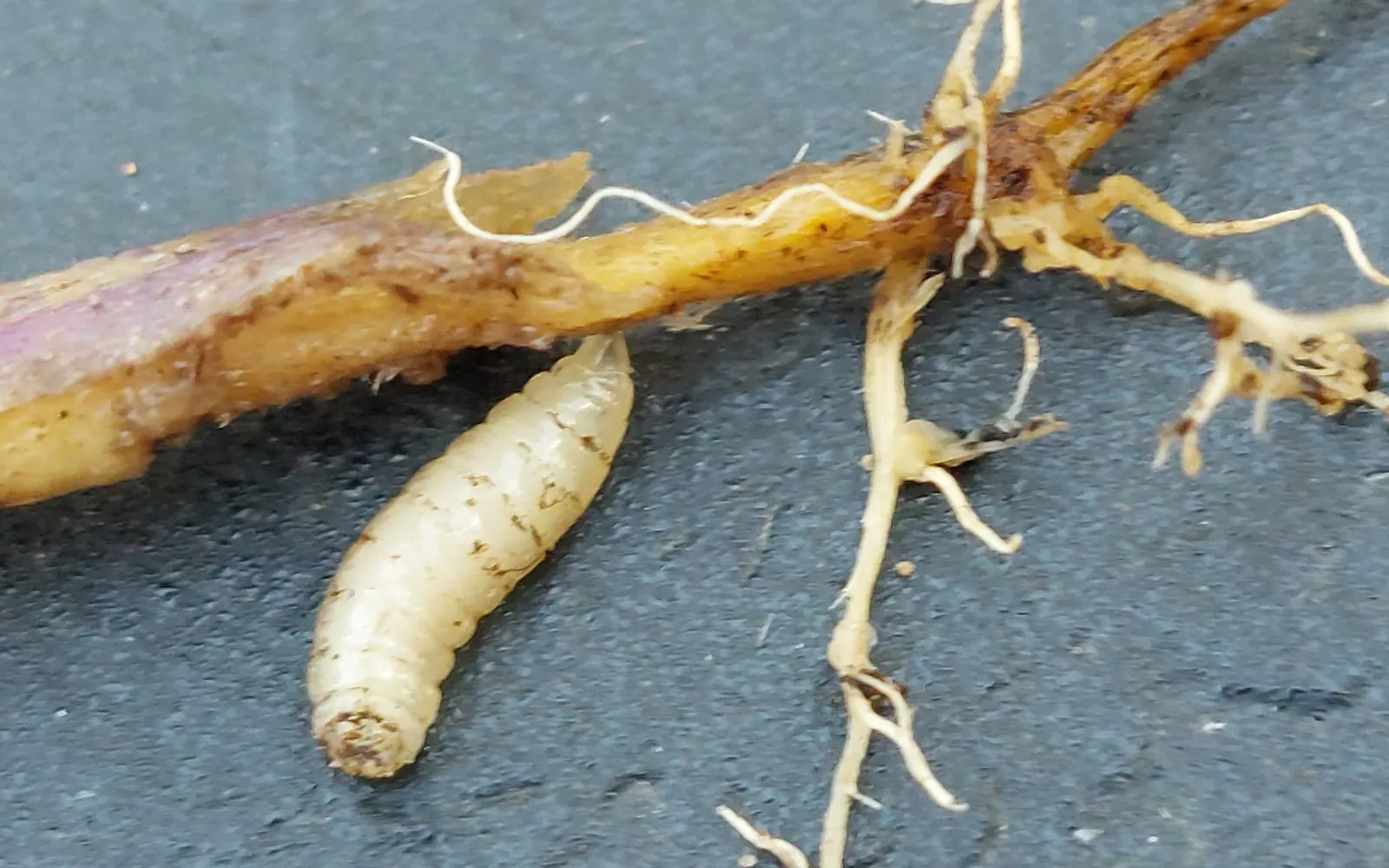
- White legless maggots up to 9 mm long in the soil around the stem base
- Fine roots eaten away and the tap root tunnelled and browned
- Radishes, swedes and turnips riddled with brown tunnels under the skin
- Older plants surviving but staying stunted and never hearting up
Before you treat anything
Nothing here is harmful. Roots that have been tunnelled are unpleasant rather than dangerous, and radishes or swedes can be pared down and eaten.
What you are looking at
A brassica planted out ten days ago is flagging in the middle of the day. Within a week it is flat, the leaves still green or turning a dull blue-purple, and it lifts out of the ground between finger and thumb with almost nothing holding it.
Turn the root over. The fine roots have gone, the tap root is tunnelled and brown, and white legless maggots up to 9 mm long are in the soil around the stem. They have no head capsule and no legs at all, which separates them from every beetle grub and caterpillar you might dig up instead.
On radish, swede and turnip the maggots go into the swollen root itself, leaving brown tunnels under the skin that show when it is cut.
Why transplants die and established plants do not
The fly lays in the soil surface within a couple of centimetres of the stem. The maggots hatch, work down to the root and eat the fine feeding roots first.
A young transplant has a root ball the size of a plum and no reserve. Losing the fine roots takes away everything it drinks with, and it wilts and dies while its leaves are still green and undamaged. That is the puzzle people bring to this problem, since nothing has touched the part of the plant they can see.
A cabbage that has been in the ground since May has roots out beyond the reach of the maggots and a stem thick enough to make its own new ones. The same attack sets it back and it grows on.
Everything on this page follows from that. Get the plant past the first flight, or big enough that the first flight cannot finish it, and the crop is safe.
Three flights and a collar
The fly emerges from overwintering pupae from late April, with a second generation through June and July and a third in August and September. The first is the one that kills.
The collar is the classic answer and it still works. A disc of something firm about 15 cm across, slit to the centre and fitted around the stem so it lies flat on the soil, denies the female the bare warm ground she lays into. Carpet underlay is the traditional material. Cardboard lasts one season and costs nothing.
Insect-proof mesh over hoops does the same job for a whole bed and excludes cabbage caterpillars and whitefly at the same time, which is why it is the better buy if you are growing brassicas seriously. It has to be sealed to the soil all the way round, and it has to go over ground that grew no brassicas last year, or the emerging pupae are shut in with the crop.
What to do about it
Fit collars at planting, or put mesh over the bed the same day.
Plant out in June where the crop allows it, so the worst flight has passed.
Firm every plant in hard and set it slightly deeper than it stood in the pot.
Water and feed a stunted survivor rather than pulling it, because many recover.
Lift the dead ones with their soil and bin them, and take the stumps out at the end of the season.
Leave some cover between the rows for the ground beetles, and keep insecticide off the bed, because the beetles are doing more against this pest than anything you can buy.
What it gets mistaken for
Clubroot also stunts and wilts, and its roots are swollen into clubs rather than eaten away. The two can be present in the same bed and the roots tell them apart in a second.
Damping off kills seedlings before planting out, with a dark pinched stem right at compost level.
Slugs take the leaves off a transplant overnight and leave the stem and roots. Root fly does the opposite.
Wireworms tunnel potatoes and other roots and are thin, orange, hard-bodied and obviously segmented, with three pairs of legs at the head end. Root fly maggots are soft, white and legless.
Drought wilts a plant that comes back after a good soak and stays back. A brassica that wilts on wet ground has lost its roots to something.
What to do, in order
Start here
Prevention, and the changes that stop the problem returning. Most of these pages should end at this tier.
- Plant out in June rather than May
- The first flight in late April and May is the one that kills transplants, because a young plant has no root system to spare. Brassicas planted after it has passed meet the second generation as established plants and shrug it off. Where a crop has to go out early, this is the moment to use a collar or mesh.
- Firm plants in hard and plant deep
- A well-firmed plant set slightly deeper than it grew in the pot puts out adventitious roots from the buried stem, and those replace what the maggots take. A loosely planted brassica in a fluffy hole is the one that dies.
- Water and feed a stunted plant through
- A plant that survives the attack can regrow its roots if it is kept watered and given a nitrogen feed. Many of the stunted cabbages written off in June come good by September on nothing more than that.
- Rotate, and keep the old stumps out of the ground
- The pupae spend the winter in the top few centimetres of soil where the crop stood. Lift and bin brassica stumps at the end of the season and put the next crop somewhere else. The flies still fly in, so rotation thins the problem rather than solving it.
- Leave ground cover rather than bare soil between the rows
- Ground beetles and rove beetles eat a large share of the eggs and young maggots, and they hunt under cover. A clean-swept bed removes their shelter along with the weeds. Undersow the crop, lay a loose mulch, or leave a strip unhoed, and the predators doing the work stay in the bed.
Then reach for a barrier
Netting, hand removal and water. Nothing here harms anything except the target.
- Fit a collar around each stem at planting
- A disc about 15 cm across, slit to the centre and fitted snugly around the stem where it meets the soil, stops the female laying at the base. Carpet underlay, thick card, roofing felt or old rubber matting all work. This is the cheapest reliable defence there is and it takes thirty seconds per plant.
- Cover the bed with insect-proof mesh
- Mesh over hoops from the day of planting, sealed into the soil all the way round, keeps every generation out. Use it only on ground that grew no brassicas last year, since pupae under the mesh would be sealed in with the crop.
- Pull and destroy plants that have collapsed
- Each dead transplant holds maggots that will pupate in that spot. Lift them with the surrounding soil and bin them rather than leaving them at the end of the row.
Then bring in the predators
Encourage what already lives in the garden, and buy predators in where the problem is under glass and nothing will arrive on its own.
- Keep the beetles and stop spraying over them
- Ground beetles, rove beetles and their larvae are the main natural check on this pest in a British vegetable garden, and every one of them is killed by a broad-spectrum soil or foliar insecticide. Leaving a rough edge, a log or a strip of unhoed ground next to the brassica bed supports more of them than anything that can be bought.
Biological controls are live organisms and their sale and release are regulated country by country. An agent sold freely in one place may be unapproved in another, so buy from a licensed supplier where you live and never import or move one yourself.
In pictures
Plants affected
Guides that name it among the problems to watch for. The list is the plants it is characteristic of rather than everything it will feed on.
Common on UK allotments
This is one of the pests and diseases allotment growers meet most often. See it alongside the other common problems on the allotment guide.
Common allotment pests and diseasesA common vegetable pest
This is one of the pests that vegetable growers meet most often. See it alongside the others on the vegetable pests guide, grouped by how they feed and with prevention that works against most of them.
Common vegetable pests