
Pest
Caterpillars
Lepidoptera
Also called Cabbage white caterpillars, Loopers, Leaf-eating grubs
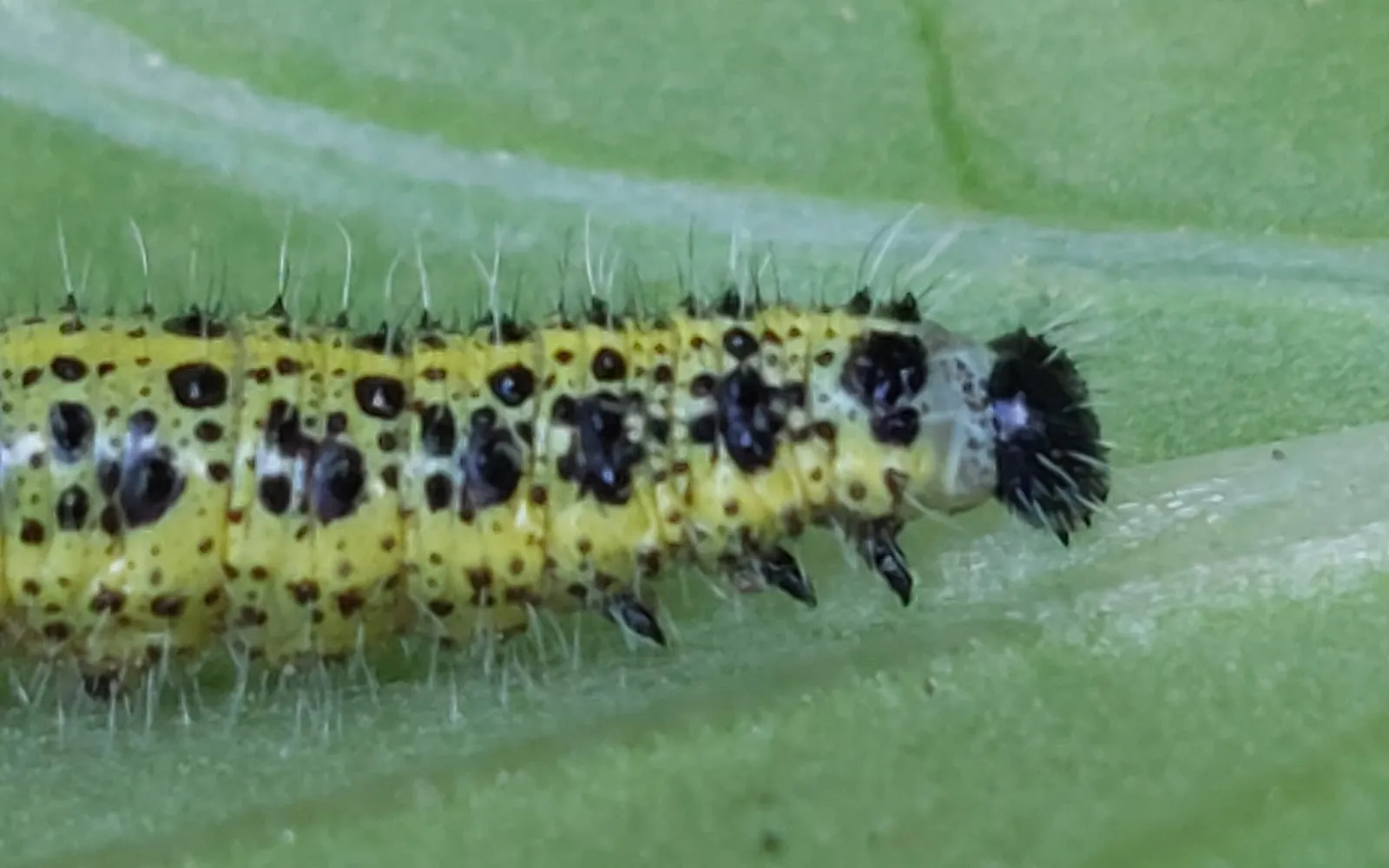
Caterpillars chew ragged holes, leave dark frass and often hide on leaf undersides. Count the prolegs to separate them from sawfly larvae, and use netting early on brassicas.
At a glance
- Type
- Pest
- Cause
- Insect
- Severity
- Destroys the crop or display
- Affects
- Garden plants, Herbs and edibles, Houseplants
- Active
- April to October
- Established in
- Worldwide
What you are seeing
- Irregular holes in the middle of leaves and chewed leaf edges, with ragged rather than clean margins
- Dark pellets of frass on the leaves below the damage and on the soil
- Clusters of yellow eggs on the undersides of brassica leaves
- Leaves rolled or spun together with silk at a shoot tip
- Whole plants skeletonised, with only the veins left
- Seedlings cut off at soil level overnight with the tops left lying beside them
- Webbing over box hedging with green and black caterpillars inside it
Before you treat anything
A few British caterpillars have hairs that irritate skin, and the browntail moth and oak processionary moth are the ones to know about. Oak processionary is established in parts of London and the south east, forms nose-to-tail processions on oak trunks and builds white silk nests on the trunk and branches. Do not touch it or its nest, and report it to the Forestry Commission through TreeAlert.
What you are looking at
Holes in the middle of leaves, chewed edges, and margins that are ragged rather than cut cleanly. Below the damage there are dark pellets of frass on the leaves and on the soil, and that is the sign that separates a chewing insect from a disease or a disorder.
Where the animal itself is hiding depends on the species. Cabbage whites feed in the open, in groups, on the upper leaf surface. Winter moth caterpillars pull two leaves together with silk at a shoot tip and eat inside. Tortrix moths roll a single leaf into a tube. Cutworms come up out of the soil after dark and are gone by morning.
Count the legs before you do anything
A great deal of caterpillar advice is applied to animals that are not caterpillars, and the distinction changes what works.
Three pairs of jointed true legs at the front is common to both. What differs is the fleshy prolegs on the abdomen behind them. A caterpillar, meaning the larva of a butterfly or a moth, has at most five pairs, and each one carries a ring of tiny hooks. A sawfly larva, which is a relative of the wasps, has six pairs or more, and no hooks.
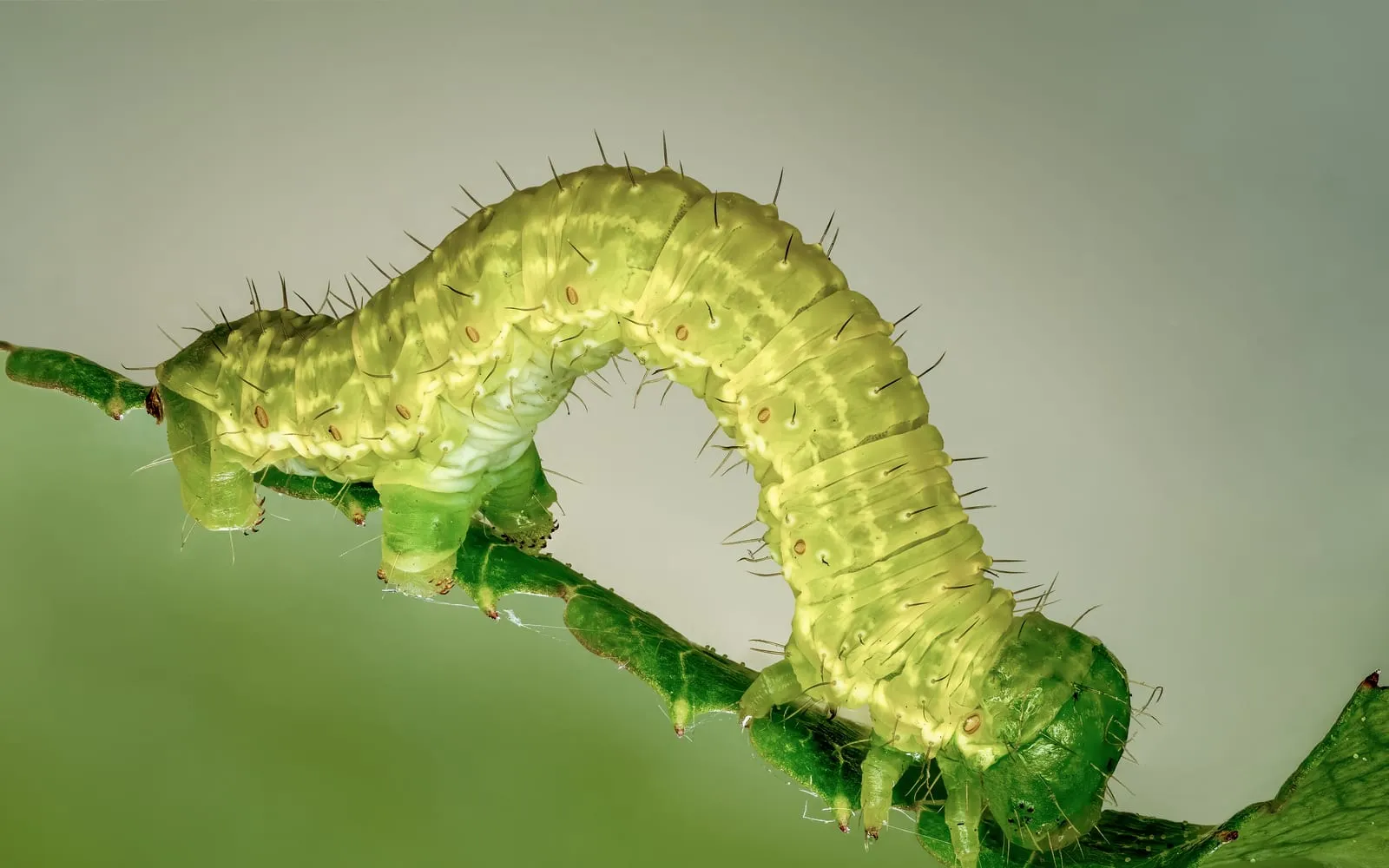
Loopers are caterpillars that have gone the other way. Geometrid moths, including winter moth, have only two or three pairs of prolegs, all at the back, so the animal has to arch its body into a hoop to move at all. The gait identifies the family from a distance.
Sawfly larvae are the ones stripping a gooseberry bush, a Solomon’s seal or a rose in early summer. Nothing sold or recommended for caterpillars affects them, which is why so many gooseberry treatments fail.
Most of them are not a problem
Britain has about 2,500 species of moth. Perhaps a dozen do damage in a garden worth acting on, and the rest are the foundation of the food web the garden sits in. A single brood of blue tits is fed several thousand caterpillars, and the timing of the whole breeding season is built around the flush of them on oak and fruit trees in May.
So the useful question is not what is eating the leaves. It is whether the plant being eaten is one you needed intact.
An ornamental shrub with some chewed leaves in August recovers completely and costs you nothing. A cabbage reduced to veins is a crop lost. A box hedge with box tree caterpillar in it will be dead in two seasons. Spend the effort on the second and third, and let the first alone.
The few worth acting on
Large and small white on brassicas and nasturtiums, from May to September, in two or three generations. Large white lays clusters of yellow eggs on leaf undersides and the caterpillars feed in groups; small white lays singly and its caterpillars are green and burrow into the heart of a cabbage.
Winter moth on apple, pear, plum, cherry and roses. Flightless females walk up the trunk between October and March, and the caterpillars hatch with the buds and eat the developing leaves and blossom.
Box tree caterpillar, which has gone from unknown to the most destructive garden pest in the south east of England in a decade, and which is a different order of problem from everything else here.
Cutworms in a vegetable bed, which cut seedlings off at soil level overnight and get blamed on slugs every spring.
What to do about them
For brassicas, net. Fine mesh over hoops from the day the plants go out, with a gap between the mesh and the leaves, because a butterfly will lay through netting resting on foliage. That one measure removes the problem for the season, and it does it without touching anything else living in the garden.
Where a crop is already infested, look for the eggs rather than hunting the caterpillars. A batch of large white eggs rubbed off with a thumb is thirty or forty animals dealt with in two seconds.
Then hand pick, twice a week, under the leaves and along the midribs. On a garden scale that is enough on its own.
For fruit trees, put grease bands on in October. The winter moth female cannot fly, so she has to climb, and a barrier around the trunk and the stake stops the whole thing before it starts.
For box, act quickly and use something targeted. Bacillus thuringiensis or Steinernema carpocapsae applied to the hedge and nothing else, at the point the caterpillars are small.
Leave the parasitised ones. A dying large white caterpillar with a cluster of small yellow cocoons beside it is producing a generation of Cotesia wasps that will find the next batch for you.
Why no spray is listed here
A broad-spectrum insecticide applied to a garden kills the caterpillars of every butterfly and moth it reaches, along with the parasitoid wasps and predatory insects that were controlling them, and it removes food that nesting birds are depending on that fortnight.
Against the one problem where a treatment is warranted, box tree caterpillar, a targeted biological gives a better result anyway, because it reaches the animals inside the webbing that a contact spray runs off.
The whole of the rest of this page is netting, a thumb and a grease band, and between them they cover almost every case.
What it gets mistaken for
Sawfly larvae look like caterpillars and are not, and the proleg count settles it. They strip gooseberries, Solomon’s seal, roses and aquilegia, often working from the middle of the bush outwards, and they leave no webbing.
Slugs and snails eat holes with smooth rounded edges and leave a slime trail and no frass.
Vine weevil adults cut neat semicircular notches in from the leaf margin and never make a hole in the middle.
Leaf-cutter bees remove smooth semicircles from rose and lilac leaves with edges as clean as scissor cuts. They are pollinators and should be left entirely alone.
Earwigs chew ragged holes in dahlia and clematis flowers at night, and on a fruit tree they eat more aphids than petals. The damage is mostly to blooms rather than foliage.
What to do, in order
Start here
Prevention, and the changes that stop the problem returning. Most of these pages should end at this tier.
- Decide whether it needs doing at all
- Britain has around 2,500 species of moth and 59 of butterfly, and a handful of them do damage worth acting on. A shrub with some chewed leaves in July is feeding the birds and will be unmarked next spring. Save the effort for the crop plants and the box.
- Cover brassicas from the day they go out
- The whole brassica problem is solved by keeping the butterflies off, and it has to be done before the eggs are laid rather than after. Mesh over hoops, on from planting to harvest, is the whole answer for cabbage, kale, sprouts and cauliflower.
- Grow the plants well
- A brassica growing strongly outpaces moderate feeding, and a stressed one does not. Firm planting, steady water and a good root run matter more than they appear to when a population arrives in August.
- Keep hedges, long grass and a wild corner
- Caterpillars are the main food of nestling birds, and a single brood of blue tits works through several thousand of them. A garden with somewhere for birds to nest and forage handles this without being asked.
- Sow a few nasturtiums away from the vegetables
- Large and small whites will use nasturtium readily, and a patch of it at the far end of a plot takes some of the pressure off the brassica bed while giving you somewhere easy to inspect and pick from.
Then reach for a barrier
Netting, hand removal and water. Nothing here harms anything except the target.
- Use mesh that does not touch the foliage
- A butterfly will lay through netting resting on a leaf. Support the cover on hoops with a clear gap, tuck the edges in at soil level, and check under it weekly, since one female that gets inside is worse than no net at all.
- Look for the egg batches, not the caterpillars
- Large white lays clusters of yellow, ribbed, upright eggs on the undersides of brassica leaves. Rubbing one batch off with a thumb removes thirty or forty caterpillars before they hatch, and it takes seconds.
- Pick them off by hand
- On a domestic scale this works and nothing else is needed. Go over the plants twice a week during the flight season, look under the leaves and along the midribs, and drop what you find somewhere else in the garden or into water.
- Put grease bands on fruit trees in October
- The female winter moth cannot fly and has to walk up the trunk to lay. A band of horticultural glue or a greaseproof barrier around the trunk and the stake from October to March intercepts her, and it prevents the spring leaf damage on apples, pears and cherries entirely.
- Fit collars against cutworms
- Cutworms are moth caterpillars that live in the soil and cut seedlings off at ground level after dark. A collar of cardboard or plastic pushed two centimetres into the soil around each transplant stops them, and a torch after dark finds them at work.
Then bring in the predators
Encourage what already lives in the garden, and buy predators in where the problem is under glass and nothing will arrive on its own.
- Put up nest boxes
- Blue tits and great tits time their broods to the caterpillar flush on oaks and fruit trees, and they take enormous numbers. Boxes with a 25 mm hole, put up in autumn facing between north and east, are the cheapest pest control in the garden.
- Leave the parasitised caterpillars alone
- A sluggish large white caterpillar surrounded by a cluster of small yellow silk cocoons has been parasitised by the wasp Cotesia glomerata. Those cocoons are the next generation of a control agent working for free. Move it out of the way rather than killing it.
- Use Bacillus thuringiensis only where it is needed
- A bacterium that kills caterpillars that eat treated foliage, sold in the UK mainly for box tree caterpillar and approved for organic growing. It does not distinguish between species, so it will kill any butterfly or moth larva feeding on the plant you treat. Confine it to the box hedge, read the approved uses on the label, and never spray it over a garden generally.Registered for amateur use in most countries, Australia and New Zealand included, though the approved strain and the products carrying it differ. Check the label names your target caterpillar before buying.
- Water nematodes onto box hedging or against cutworms
- Steinernema carpocapsae is sold for box tree caterpillar and for cutworms in the soil. It needs warmth and moisture, and it stays where you put it, which is what makes it a better fit than anything sprayed broadly.Widely sold across Europe and North America. Australia and New Zealand permit far fewer species, because releasing an entomopathogenic nematode that is not already approved is prohibited there. Check what is registered locally rather than ordering from overseas.
Biological controls are live organisms and their sale and release are regulated country by country. An agent sold freely in one place may be unapproved in another, so buy from a licensed supplier where you live and never import or move one yourself.
In pictures
Plants affected
Guides that name it among the problems to watch for. The list is the plants it is characteristic of rather than everything it will feed on.
Common on UK allotments
This is one of the pests and diseases allotment growers meet most often. See it alongside the other common problems on the allotment guide.
Common allotment pests and diseasesA common tomato problem
This is one of the problems tomato growers meet most often. See it alongside the other pests, diseases and disorders on the tomato guide.
Common tomato problemsA common rose problem
This is one of the pests, diseases and disorders that rose growers meet most often. See it alongside the others on the common rose problems guide.
Common rose problemsA common vegetable pest
This is one of the pests that vegetable growers meet most often. See it alongside the others on the vegetable pests guide, grouped by how they feed and with prevention that works against most of them.
Common vegetable pests