
Pest
Squash vine borer
Melittia cucurbitae
Also called Squash borer
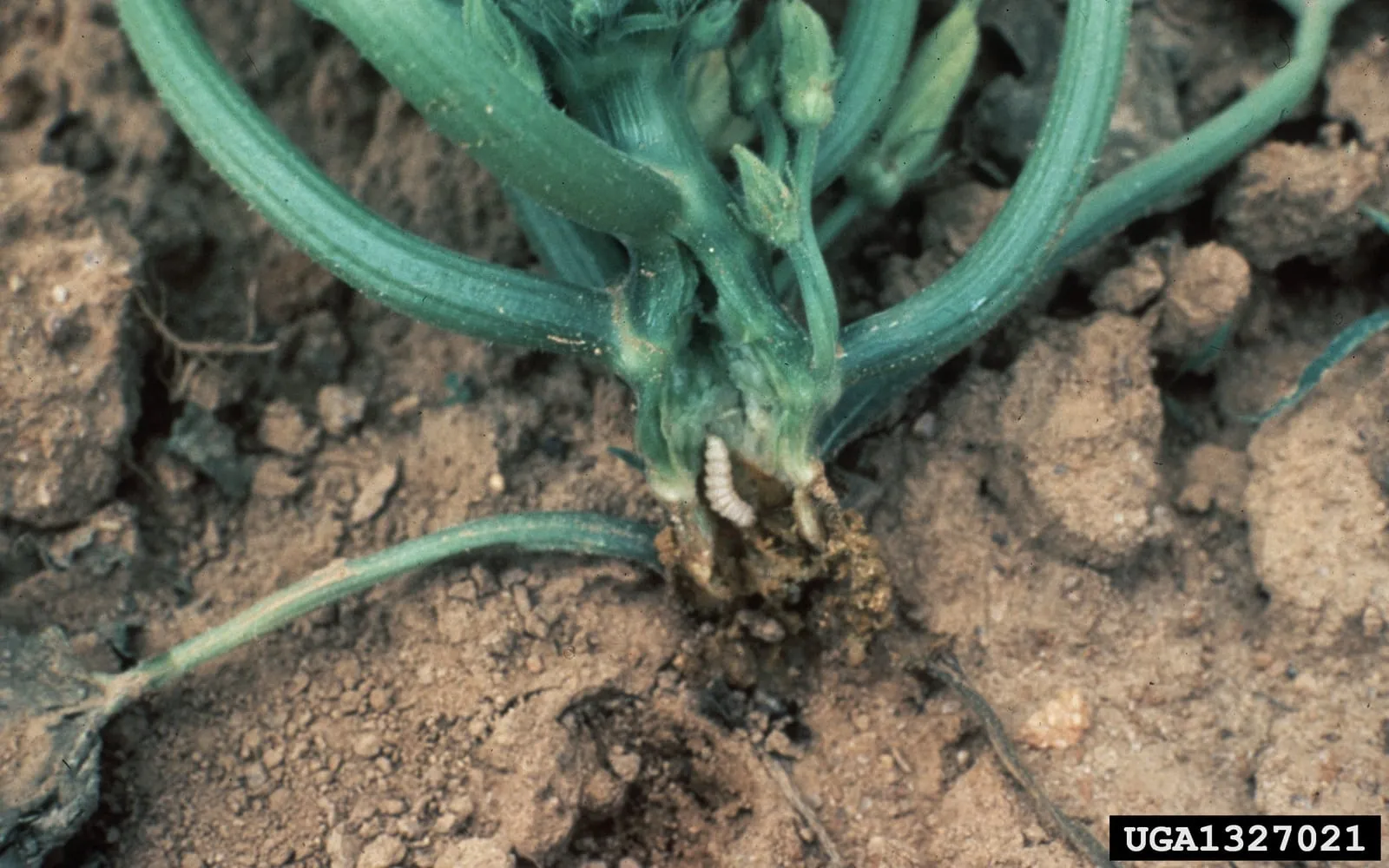
Squash vine borer makes a healthy-looking squash collapse, with sawdust-like frass at the base of the vine. Check stems early, remove larvae where possible and bury damaged sections so they reroot.
At a glance
- Type
- Pest
- Cause
- Insect
- Severity
- Destroys the crop or display
- Affects
- Herbs and edibles
- Active
- June to August
- Established in
- North America and Central and South America
What you are seeing
- A vine that was healthy and is wilted or collapsed within a day or two, often starting with a single runner rather than the whole plant
- Moist, sawdust-like orange-green frass piled at a hole in the stem near the base
- A soft, hollowed-out section of stem where cut open, sometimes packed with a cream-coloured caterpillar up to 2.5 cm long
- Small holes in the main stem near soil level, easy to miss before the wilting starts
- Symptoms appearing on courgette and pumpkin far more often than on butternut squash growing alongside them
Before you treat anything
None. A vine that recovers after the borer is removed crops normally, and any lost vines can go straight on the compost heap.
What you are looking at
A squash or pumpkin vine that looked healthy yesterday and is wilted or collapsed today, often just one runner rather than the whole plant at first. At the base of the affected stem, close to soil level, there is usually a small hole with moist, greenish-orange, sawdust-like frass pushed out of it. Cut the stem open near the hole and the inside is hollowed out, sometimes with a fat cream-coloured caterpillar up to 2.5 cm long still inside.
Courgette and pumpkin, both Cucurbita pepo, take the worst of it. Butternut squash growing in the same bed often escapes with far less damage, because its more solid, less hollow stem suits the borer poorly, though it is not immune.
A moth that looks like a wasp
The adult is unusual among caterpillar pests for flying by day and looking more like a wasp than a moth: about 2.5 cm long, with a stout orange-and-black body, clear hindwings and metallic olive-green forewings. It is easy to mistake for a hunting wasp visiting the flowers, and most gardeners never see it at all before the wilting starts.
Eggs are laid singly at the base of the stem from late June into July across most of its range. The caterpillar bores in within a week or two, feeds inside the stem for four to six weeks, destroying the tissue that carries water and nutrients along the vine as it goes, then leaves and burrows into the soil to pupate. One generation runs through a season across most of the range, with a partial second further south.
What to do about it
Cover young plants with row cover until they flower, removing it once bees need access.
Check the stem base weekly from late June for frass, and act on it immediately. Slit the stem lengthwise above the hole, pick out the caterpillar, and mound moist soil over the wound.
Encourage the vine to root at other nodes by mounding soil over them as it runs, so the plant has more than one point drawing water if a section is lost.
Rotate cucurbits to a different bed each year and till the old one after harvest to disturb overwintering pupae.
Where borer pressure is high and butternut squash is an acceptable substitute, growing it instead of or alongside courgette shifts the odds without giving up the crop entirely.
What it gets mistaken for
Verticillium wilt develops over days to weeks rather than overnight, with no frass and brown staining inside the stem instead of a hollowed, sawdust-packed cavity.
Collar rot softens and darkens the stem base itself, usually following waterlogged soil, and produces no frass.
Plain heat wilt during the hottest part of the day recovers by evening. A vine that stays collapsed after the sun goes down is not simple heat stress.
What to do, in order
Start here
Prevention, and the changes that stop the problem returning. Most of these pages should end at this tier.
- Rotate cucurbits away from last year's bed
- Pupae overwinter in the soil directly beneath where an infested vine grew. Moving squash, pumpkin and courgette to a different part of the garden each year, and tilling the old bed after harvest, reduces how many adults emerge near this year's crop.
- Grow a resistant squash alongside a vulnerable one
- Butternut and other Cucurbita moschata types have a more solid stem than courgette, pumpkin and other Cucurbita pepo types and are attacked far less often, though not never. Where space allows, giving the borer a less rewarding host to encounter first reduces pressure on the varieties that matter more to you.
- Delay or stagger sowing to miss the main egg-laying window
- Adults are on the wing and laying eggs mainly from late June into July in most of their range. A late sowing that is still small and unattractive during that window, or an early one already established and vigorous by the time eggs are laid, both fare better than a planting that is at its most vulnerable stage exactly when the moths are flying.
Then reach for a barrier
Netting, hand removal and water. Nothing here harms anything except the target.
- Cover young plants until flowering
- A floating row cover over newly planted or transplanted squash keeps egg-laying moths off entirely. Remove it once flowers open so bees can reach them, which is also roughly when the main flight has passed in most areas.
- Check the stem base weekly and slit out any borer found
- Frass at a hole near the base is the signal to act immediately. Slit the stem lengthwise above the hole with a sharp blade, just enough to expose and remove the caterpillar, then mound moist soil over the cut section of stem. Vines root readily where they touch the ground, and a slit vine often recovers if the borer is taken out before it has hollowed out too much of the stem.
- Mound soil over stem nodes as the vine runs
- Squash and pumpkin root from the nodes along a running vine wherever those nodes touch damp soil. A plant with several rooted points survives losing one section to a borer far better than one relying on a single base, since the rest of the vine keeps drawing water from an unaffected root.
Then bring in the predators
Encourage what already lives in the garden, and buy predators in where the problem is under glass and nothing will arrive on its own.
- Inject Bacillus thuringiensis or beneficial nematodes into the stem
- A weekly injection of Bt into the base of the stem with a syringe, starting when adult moths are first seen, kills young larvae before they tunnel deep enough to be out of reach. Beneficial nematodes watered into the soil around the stem base work on larvae that have already left the plant to pupate, reducing the population for next year rather than saving this year's vine.Bt products and Steinernema nematodes are sold for home garden use across North America. Neither is relevant outside the pest's range.
Biological controls are live organisms and their sale and release are regulated country by country. An agent sold freely in one place may be unapproved in another, so buy from a licensed supplier where you live and never import or move one yourself.
Plants affected
Guides that name it among the problems to watch for. The list is the plants it is characteristic of rather than everything it will feed on.
A common vegetable pest
This is one of the pests that vegetable growers meet most often. See it alongside the others on the vegetable pests guide, grouped by how they feed and with prevention that works against most of them.
Common vegetable pests