
Pest
Thrips
Thysanoptera
Also called Thunderflies, Thunderbugs, Western flower thrips
Thrips are slender insects that rasp the surface from leaves and flowers, leaving silver streaks and black specks. Their life cycle includes stages in compost, so repeated control is needed.
At a glance
- Type
- Pest
- Cause
- Insect
- Severity
- Weakens the plant
- Affects
- Houseplants, Garden plants, Herbs and edibles
- Active
- All year
- Established in
- Worldwide
What you are seeing
- Silvery or bleached flecking on the leaf surface, sometimes with a faint metallic sheen
- Minute black dots like specks of varnish scattered through the damaged area
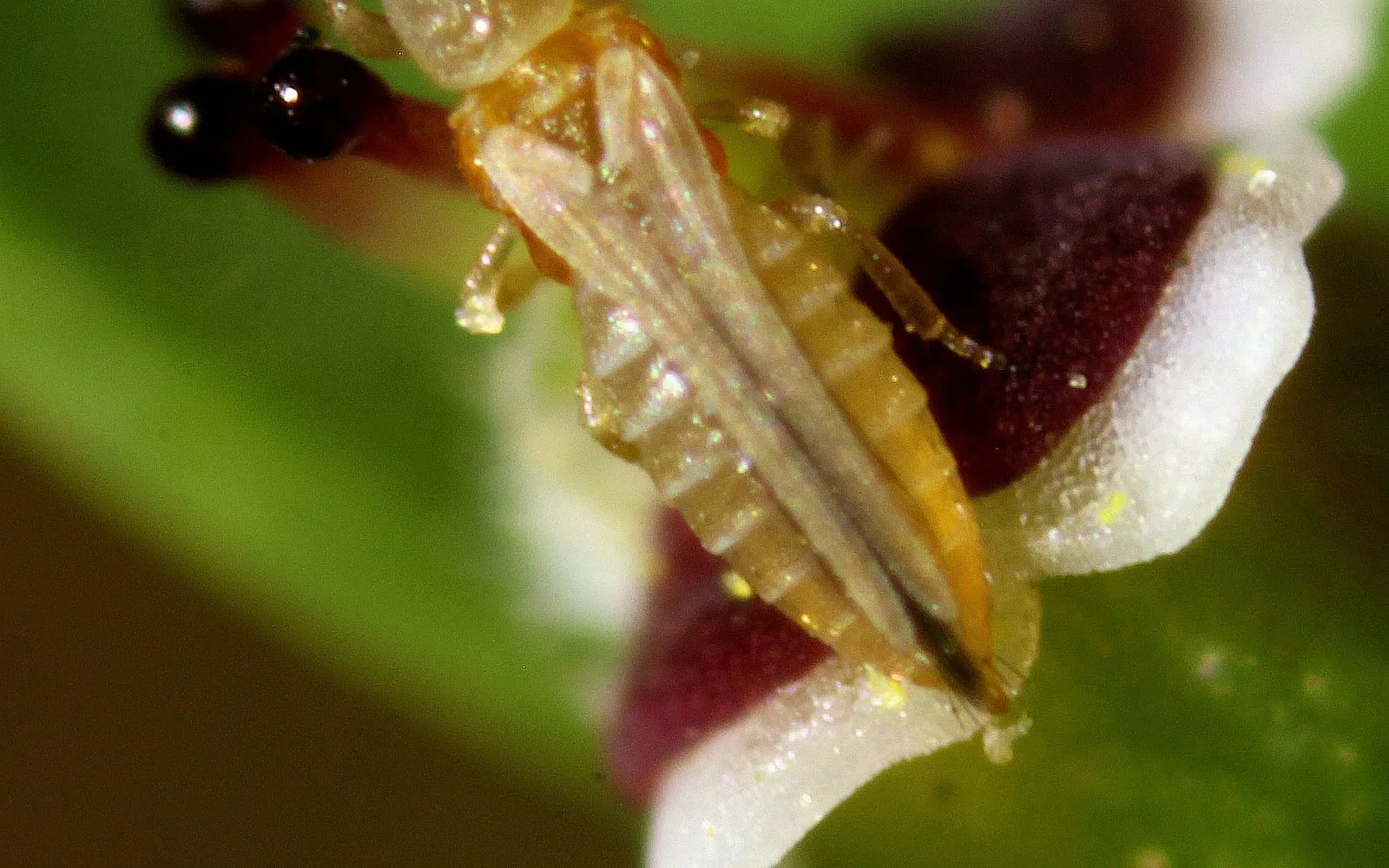
- Slender insects about a millimetre long, dark brown or pale yellow, that run rather than fly when disturbed
- New leaves emerging distorted, puckered or with brown scarring
- Pale streaks and flecks on petals, and flower buds that fail to open properly
- Damage worst on the youngest growth and in the crevices where a new leaf is unfurling
Before you treat anything
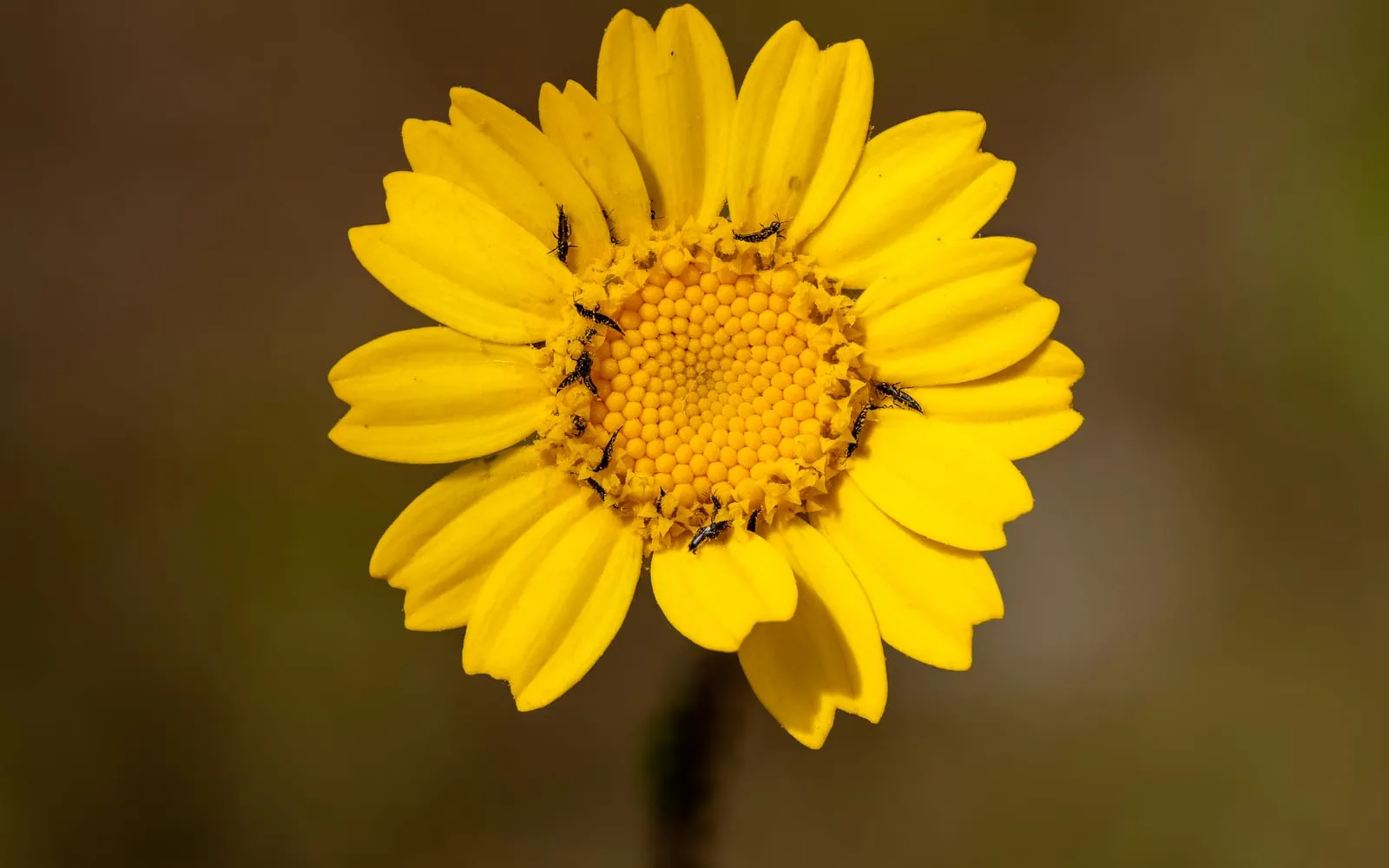
Thrips do not damage people, though the cereal thrips that drift in clouds on humid summer afternoons will land on skin and give a faint prickle, and they get behind picture glass and into smoke alarms. That species does nothing to garden plants and needs no action.
What you are looking at
The damage arrives before the insect does. Patches of the leaf go silvery or bleached, sometimes with a faint metallic sheen, as though the colour has been scraped off. On a monstera or an alocasia it shows first on the newest leaf, near the point where it was rolled up.
Look closely at the silvered area for minute black dots, like flecks of dried varnish. That is thrips excrement, and silvering plus black dots is the combination that settles the diagnosis. Nothing else produces both.
The animal itself is about a millimetre long, slender and cigar-shaped, dark brown or straw-yellow depending on species and stage. Prod it and it runs, or drops. Its wings are two narrow straps fringed with long hairs, which is what the order name means, and they are only visible under magnification.
The word is thrips whether there is one or a thousand. There is no such thing as a thrip.
Why the surface goes silver
They do not pierce a vein and drink, as an aphid does. A thrips punctures individual surface cells with a single mandible, sucks out the contents and moves on, leaving an empty cell behind. Air fills the space, and air under a transparent cuticle reflects light, which is why the damage looks metallic rather than brown.
Once the cells are empty they stay empty. A silvered leaf never recovers, and the plant grows out of the problem rather than repairing it.
Flowers show it as pale streaks and flecks in the petals, and buds that will not open cleanly. New leaves that were being fed on while still furled emerge puckered, scarred and misshapen, which is the form that alarms houseplant owners most.
Half the life cycle happens in the compost
A female inserts her eggs into plant tissue with a saw-like ovipositor, so the eggs are inside the leaf and nothing applied to the surface touches them. Two larval stages feed on the plant. Then, in most of the species that matter, the larvae drop off and pupate in the top layer of the compost or the soil, and the adults come back up.
So at any moment part of the population is inside the leaf, part is on it, and part is underground. Treating only the foliage leaves two thirds of them alone, which is why thrips have such a reputation for coming back.
Work the leaves and the compost at the same time. A predatory mite on the foliage, and a soil predator or a nematode drench underneath it.
What the damage amounts to
Cosmetically it is severe and permanent on the leaf it affects. Practically, an established plant loses photosynthetic area and keeps going, and it grows out of a light infestation once the population is dealt with.
The serious risk is viral. Western flower thrips is the principal vector of tomato spotted wilt virus and impatiens necrotic spot virus, both of which are untreatable and both of which mean destroying the plant. That is the reason to take an infestation on a houseplant collection seriously rather than tolerating it.
What to do about them
Find out whether you have them. Hang a blue sticky trap. Thrips respond to blue far more strongly than to yellow, and the yellow traps most people already own are the reason so many infestations go unnoticed for months.
Raise the humidity, take off the spent flowers, and shower the plant weekly, paying attention to the crevice where a new leaf is unrolling.
Then treat the leaves and the compost together. Amblyseius mites in sachets hung on the plant deal with the larvae on the foliage, and Stratiolaelaps mites or Steinernema feltiae nematodes in the compost deal with the pupae. Under glass in summer, Orius takes the adults in the flowers.
Remove the worst leaves. They will not green up again, and they are carrying eggs inside the tissue.
Why no spray is listed here
Western flower thrips is among the most insecticide-resistant pests in world horticulture, carrying resistance to several chemical groups simultaneously in commercial populations. A treatment that kills most of a colony selects for the survivors.
The life cycle makes it worse. Eggs inside the leaf and pupae in the compost are both out of reach of anything sprayed on the foliage, so a spray addresses the one stage it can see and the population rebuilds from the two it cannot.
Contact products also kill the predatory mites, which are the control that does work.
What it gets mistaken for
Red spider mite produces a fine even pale stippling rather than larger silvered patches, leaves no black excrement dots, and in a heavy infestation spins fine webbing at the shoot tips. Thrips never spin anything.
Leaf scorch and sun damage bleach a leaf in a broad area on the side that faced the light, with no black specks and no distortion of new growth.
Hard water and foliar feed residues leave white deposits sitting on the surface that wipe off with a damp cloth. Thrips damage is in the leaf.
Fungus gnats are dark and about the same size, and they fly around the pot rather than feeding on the plant. No leaf damage means they are not the cause of anything.
Downy mildew on some plants produces greyish patches, but on the underside and with angular yellow blotches above bounded by the veins.
What to do, in order
Start here
Prevention, and the changes that stop the problem returning. Most of these pages should end at this tier.
- Quarantine new plants for a month
- Thrips arrive on bought plants and are almost invisible on arrival. Keep new arrivals in a separate room and check the newest leaves weekly, since the damage shows on new growth before the insects are noticed.
- Raise the humidity
- Dry air suits them and moist air does not, which is the same lever that works against red spider mite. A tray of damp gravel, plants grouped together and a humidifier through the heating season all slow the population down.
- Take off spent flowers
- Flower thrips live and breed in blooms, so a plant carrying old flowers is carrying the colony. Deadheading is a control measure on pelargoniums, chrysanthemums and roses.
- Clear weeds and old growth around the greenhouse
- Thrips overwinter in plant debris and on weeds outside, then drift in on the air in spring. A clear metre around the door and clean staging inside cuts the number that arrive.
- Ease off the nitrogen
- Soft, heavily fed foliage carries larger populations. Feed at the rate on the bottle and stop through the darkest months, and the plant produces tissue that supports fewer of them.
Then reach for a barrier
Netting, hand removal and water. Nothing here harms anything except the target.
- Hang blue sticky traps rather than yellow
- Thrips are more strongly drawn to blue than to yellow, which is why the yellow traps hanging in most greenhouses catch whitefly and miss these. Blue traps are sold for exactly this and are the easiest way to find out whether you have them.
- Shower the plant
- Tepid water over the leaves, into the crevices where new growth is unfurling, removes a good share of the adults and larvae. Repeat weekly, because the eggs are inside the leaf tissue and nothing washes them out.
- Remove the worst leaves
- Heavily silvered leaves will not recover and are still carrying eggs. Taking them off and bagging them sets the population back and improves the look of the plant at the same time.
- Isolate an infested plant
- They drift on air currents and walk between touching leaves. Standing an affected plant away from the rest of a collection while you deal with it prevents a slow spread along a shelf.
Then bring in the predators
Encourage what already lives in the garden, and buy predators in where the problem is under glass and nothing will arrive on its own.
- Introduce Amblyseius predatory mites onto the leaves
- Amblyseius cucumeris and Amblyseius swirskii eat the first larval stage on the foliage. They are supplied in sachets that hang on the plant and release mites over several weeks, which suits a pest with overlapping generations.Sold by licensed biocontrol suppliers across Europe, North America, Australia and New Zealand, where it is already approved for release. Buy from a supplier in your own country: importing a live agent yourself is an offence in most of them.
- Treat the compost as well as the leaves
- Most thrips drop off the plant to pupate in the top layer of compost, so a leaf treatment alone always leaves half the population untouched. Stratiolaelaps scimitus, sold as Hypoaspis, lives in that layer and eats them there.
- Water on Steinernema feltiae
- The same nematode used against fungus gnats reaches thrips pupae in moist compost. Applied alongside a foliar predator it closes the other half of the cycle.Widely sold across Europe and North America. Australia and New Zealand permit far fewer species, because releasing an entomopathogenic nematode that is not already approved is prohibited there. Check what is registered locally rather than ordering from overseas.
- Use Orius in a greenhouse in summer
- Orius laevigatus is a predatory bug that hunts adult thrips in flowers. It needs long days and warmth, so it works from late spring to early autumn under glass and not on a windowsill in February.
Biological controls are live organisms and their sale and release are regulated country by country. An agent sold freely in one place may be unapproved in another, so buy from a licensed supplier where you live and never import or move one yourself.
In pictures
Plants affected
Guides that name it among the problems to watch for. The list is the plants it is characteristic of rather than everything it will feed on.
A common houseplant pest
This is one of the pests and problems that houseplant owners meet most often. See it alongside the others, with a quick table for telling them apart, on the houseplant pests guide.
Common houseplant pestsA common tomato problem
This is one of the problems tomato growers meet most often. See it alongside the other pests, diseases and disorders on the tomato guide.
Common tomato problemsA common rose problem
This is one of the pests, diseases and disorders that rose growers meet most often. See it alongside the others on the common rose problems guide.
Common rose problemsA common vegetable pest
This is one of the pests that vegetable growers meet most often. See it alongside the others on the vegetable pests guide, grouped by how they feed and with prevention that works against most of them.
Common vegetable pests