
Pest
Root-knot nematodes
Meloidogyne species
Also called Root knot eelworm, Southern root-knot nematode, Northern root-knot nematode, Meloidogyne
Root-knot nematodes swell roots into beads and knots that restrict feeding. They have wide host ranges, persist in warm soil and can overcome some resistant tomatoes when soil gets hot.
At a glance
- Type
- Pest
- Cause
- Nematode
- Severity
- Destroys the crop or display
- Affects
- Garden plants, Herbs and edibles
- Active
- May to October
- Established in
- Worldwide
What you are seeing
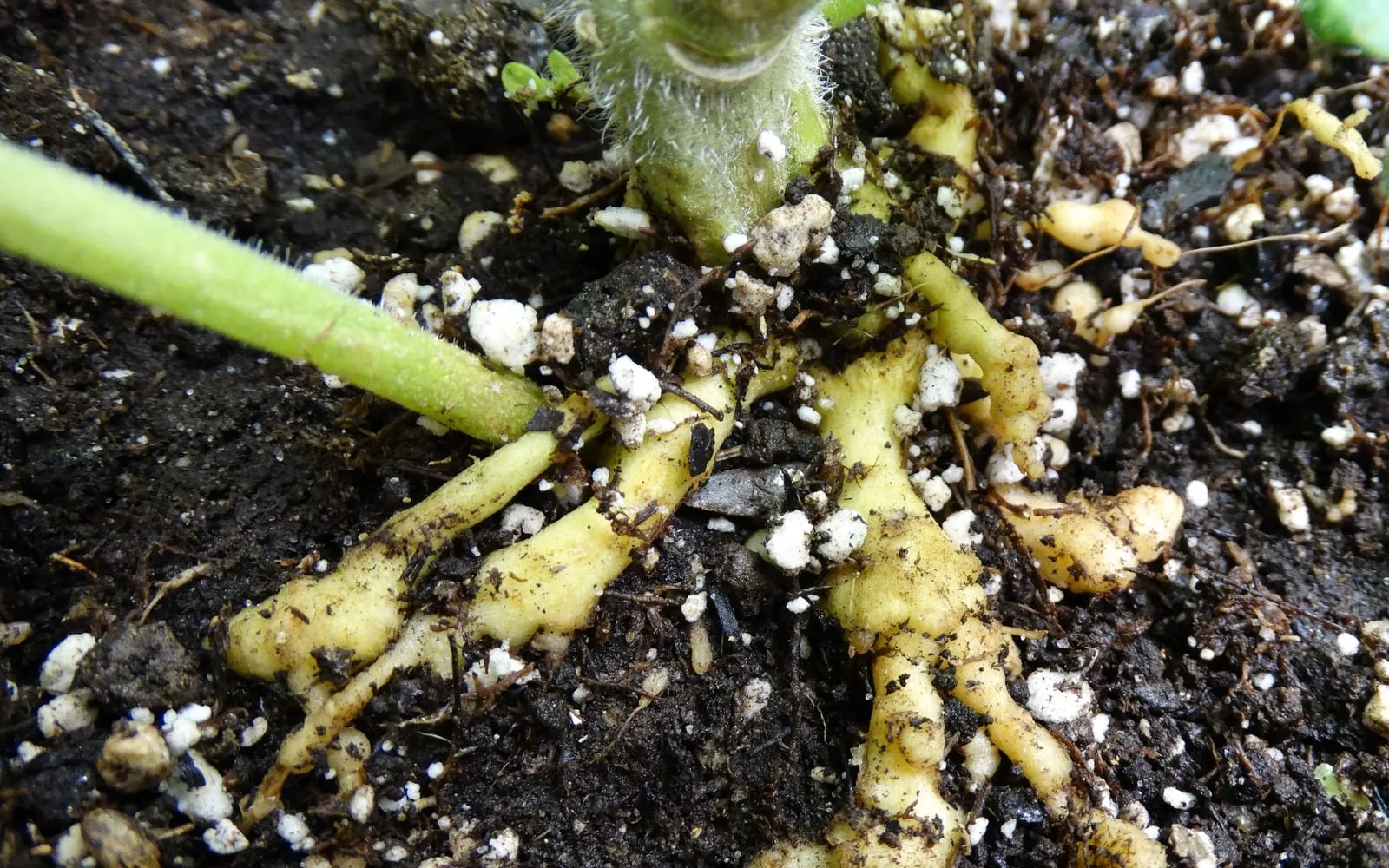
- Roots swollen into beads, knots and irregular clubs along their length
- Galls that are part of the root itself, so the root runs into one side and out of the other
- Nothing comes away when you rub a gall between finger and thumb
- Plants wilting at midday in soil that is plainly moist, then recovering overnight
- Stunted, pale plants that do not green up after feeding
- A patch of a bed growing poorly while the rest of the row looks ordinary
- Carrots and parsnips forked, stubby or studded with small swellings
- Tomatoes and cucumbers cropping lightly from midsummer and finishing early
- The same patch worse each year, spreading slowly outwards
Before you treat anything
Root-knot nematodes cannot affect people, pets or livestock. Vegetables from an infested crop are safe to eat, and a galled carrot needs nothing more than trimming.
What you are looking at
Pull up a struggling tomato, courgette or carrot and wash the soil off the roots in a bucket. Root-knot shows as swellings strung along the root like beads on a thread, some of them the size of a pinhead and some as thick as a pea, running together into knobbled clubs where the infestation is heavy.
Take one between finger and thumb and rub. Nothing comes off. The gall is the root, swollen from within, and you can trace the root running into one side of it and out of the other.
Above ground the plant tells you less. It is smaller than its neighbours, paler than it should be, and it wilts on a hot afternoon in soil you know is wet. By morning it has recovered, and by the following afternoon it is flat again. It does not respond to feeding, the patch it sits in maps onto nothing you can see on the surface, and the patch is bigger this year than it was last year.
Carrots and parsnips show it differently, as forking, stubby stunted roots and small warty swellings, all of which get blamed on stony ground.
What the swelling is
A second-stage juvenile hatches in the soil, swims a short distance through the film of water around the soil particles, and pushes into a root just behind the tip. It then does something no other garden pest does. It injects a set of proteins that reprogramme half a dozen root cells into giant cells, each one enlarged hundreds of times over and packed with nuclei, and it spends the rest of its life with its head in them, drawing off everything the plant sends past.
The gall is the root’s response to that. The tissue around the feeding site swells, the water-conducting vessels are pushed aside and interrupted, and the root beyond the gall is left with a narrowed supply. A plant with a hundred galls is not a plant that has lost its roots. It is a plant whose plumbing has been pinched in a hundred places, which is why it wilts in wet soil and why watering it more often helps.
The female swells into a pear shape inside the gall and lays several hundred eggs into a jelly mass, usually pushed out through the root surface. At 27 degrees C the whole cycle takes three to four weeks, so a single warm season runs several generations and the population climbs steeply.
Why the rotation that beats cyst eelworm fails here
Anyone who has dealt with potato cyst eelworm knows the drill of six or seven years between potato crops, and the mechanism behind it is clean. Cyst eelworm takes potatoes and tomatoes and nothing else that matters, the eggs will not hatch without a chemical signal leaking from those roots, and taking the host away for long enough starves the population down to something croppable.
Root-knot has no such bottleneck. M. incognita has been recorded from over two thousand plant species, and the list covers most of what anybody grows in a vegetable bed along with a good share of the weeds around it. A four-year rotation through beans, brassicas, roots and salads feeds it four times.
So the measures that work here are different ones. Find a non-host and hold the ground in it for a full season rather than a fortnight, and grasses and cereals are usually the answer. Break the season with a suppressive cover crop that draws juveniles in and then fails to feed them. Where the summer is hot enough, solarise. And grow the susceptible crops on resistance or on a graft, which brings us to the part that catches people out.
The resistance that switches off in hot weather
Tomato breeders have used one gene, Mi-1, since the 1940s. It came out of a wild relative in Peru, it gives good protection against the three common warm-soil species, and it is the N in the VFN code on a seed packet.
It stops working when the soil goes above about 28 degrees C.
Above that threshold the resistance response does not trigger at all. The nematodes establish as though the gene were absent, and a grower who chose a resistant variety in April finds galled roots in August. The temperature at which it fails is the temperature at which the nematode does its fastest work, so the protection disappears in precisely the season it was bought for.
Mi-1 also does nothing against M. hapla, the cool-soil species, which is the one most likely to be behind forked carrots in a temperate garden.
Grafting onto a resistant rootstock has the same weakness at the same temperature and buys more than a resistant variety does, because the rootstock is bred for vigour as well. Under glass in a hot climate, shading the border to keep the root zone below the threshold is worth as much as the graft.
Marigolds, and how they have to be grown
Every gardening forum recommends planting marigolds among the tomatoes. The chemistry behind the advice is sound and the way it is usually followed is not.
Tagetes roots release alpha-terthienyl, a compound that kills nematode juveniles in the soil immediately around them. The distance over which it works is a few centimetres, and it works while the marigolds are growing rather than after they have been pulled up. So the treatment is a solid stand of marigolds covering the whole bed for two to three months, dug in at the end, and grown as that season’s crop.
A dozen plants dotted between tomatoes leaves nine-tenths of the soil untreated, and the nematodes in it carry on as before. That is the version most people try, and it is why the advice has a reputation for being folklore.
Choose a cultivar sold for nematode suppression. Some marigolds are themselves good hosts for M. hapla, and planting one of those on infested cool soil makes the following year worse.
What to do about it
Get the species identified through a soil test before you plan a rotation around it.
Rotate to a grass or a cereal for a full season rather than through the vegetable bed’s usual sequence.
Grow resistant varieties or grafted plants, and treat the resistance as unreliable once the soil is hot.
Sow a suppressive cover crop, or a solid stand of marigolds, on ground that has gone downhill.
Solarise through the hottest six weeks of the year where the climate allows it.
Raise transplants in fresh compost and inspect the roots of anything you buy.
Water, mulch and feed an affected crop generously, since the plant is short of plumbing rather than short of root.
Pull the whole root system at the end of the season and burn or bin it.
Keep soil, tools and boots away from the clean end of the plot.
What it gets mistaken for
Nitrogen-fixing nodules on peas, beans and clover bring more people to this page than anything else. A nodule sits on the side of a root like a bead of solder, comes away cleanly when you rub it, and is pink inside when it is working. A gall is a swelling of the root itself, will not detach, and is pale throughout. Nodules on a legume are the plant doing well.
Potato cyst eelworm leaves pinhead spheres attached to the outside of a root that is otherwise the right shape, white or gold at first and browning through the season. They flick off with a fingernail.
Clubroot swells brassica roots into one fused club that rots and smells, and root-knot mostly ignores brassicas.
Root rot leaves roots brown, soft and slipping out of their skins in wet ground. Galls are firm.
Carrot fly tunnels rusty channels through the surface of a root without swelling it.
Crown gall produces one large rough tumour at the base of the stem or on a main root rather than many small beads along the fine roots.
What to do, in order
Start here
Prevention, and the changes that stop the problem returning. Most of these pages should end at this tier.
- Find out which species you have before planning around it
- Warm-soil species run three or four generations in a season and collapse a crop by August. M. hapla manages one or two in a cool summer and shows up as forked carrots rather than dead tomatoes. The two need different rotations and different resistant varieties, and the galls hint at the answer: M. hapla makes small galls that often sprout a tuft of side roots, while the warm-soil species make larger, smoother swellings. A soil test through an agricultural laboratory settles it, and it is worth the fee on ground you intend to crop for years.
- Rotate, and accept that it will not do what it does for cyst eelworm
- Potato cyst eelworm has two hosts and starves without them. M. incognita has been recorded from more than two thousand plant species, so a bed rotated through beans, courgettes, lettuce and tomatoes has fed it four times over. Rotation still helps where you can find a genuine non-host to rotate to, and grasses and cereals are the usual answer outside the rice-growing tropics. Treat it as one measure among several rather than the answer on its own.
- Grow resistant varieties, and know the temperature at which they stop
- The Mi-1 gene bred into tomatoes gives good resistance to the three common warm-soil species and none at all to M. hapla. It also switches off when soil temperature passes about 28 degrees C, which is the weather in which the nematode does most damage. A resistant variety is worth growing and should not be relied on through a heatwave. Seed packets carry it as the N in a VFN code, and grafted plants on a resistant rootstock are the stronger option under glass.
- Grow a suppressive cover crop rather than leaving the ground bare
- Sunn hemp and several sorghum-sudangrass hybrids are poor hosts that draw juveniles in and then fail to support them, which empties the soil rather than merely starving it. Sow one for a full season on ground that has gone downhill, and dig it in green. Check the variety before you buy, since some sorghum lines host the nematode perfectly well.
- Grow marigolds as a crop, not as a companion
- Tagetes roots release alpha-terthienyl, which is toxic to juveniles in the soil around them. The effect is real and it needs a solid stand of French or African marigolds grown for two to three months and then turned in, at a density that leaves no bare soil. A dozen plants dotted between tomatoes achieves nothing measurable, which is how most gardeners meet the advice and why most of them conclude it does not work. Some cultivars also host M. hapla, so choose a variety named for nematode suppression rather than for flower colour.
- Raise your own transplants in clean compost
- Most new infestations arrive on the roots of a bought plant. Sow into fresh bagged compost, keep the trays off infested ground, and knock a plant out of its pot to look at the roots before you buy it. A gall on a module-raised seedling is small and easy to miss.
- Water and feed an affected crop harder than seems reasonable
- A galled root system behaves as though it is in a drought whenever the surface dries, because the galls interrupt the plumbing rather than removing the root. Frequent watering, a mulch and a steady liquid feed will kill nothing and often carry a crop through to a usable harvest on ground that would otherwise fail.
- Sow early where the soil warms late
- Warm-soil species need the ground above roughly 18 degrees C to move and do their fastest work above 25. A crop sown early enough to be growing strongly before the soil reaches that point is a crop with a head start, and early potatoes and spring lettuce come off before the population peaks.
- Keep soil where it is
- Juveniles and eggs travel in soil on boots, tools, tyres and the rootball of a shared plant. Work the clean end of the plot first, knock the soil off a fork before you carry it, and turn down divisions from a garden whose owner has been complaining about stunted tomatoes.
Then reach for a barrier
Netting, hand removal and water. Nothing here harms anything except the target.
- Solarise the ground where the summer is hot enough
- Water the bed, cover it with clear polythene sealed at the edges, and leave it through the hottest six weeks of the year. In a climate that drives the top 10 cm above 45 degrees C this is the most effective thing available to an amateur, and it takes the population down for a season or two. In a cool maritime summer it does very little, and the polythene is better spent on a rain shelter.
- Lift and burn the roots of an affected crop
- Every gall left in the ground is several hundred eggs waiting for the next crop. Pull the whole root system rather than cutting the stem off at the surface, bin or burn it, and keep it out of a garden compost heap, which never runs hot enough for long enough.
- Grow in containers or a raised bed of clean soil
- Where a small plot is heavily infested and solarisation is not an option, growing the susceptible crops above the ground is the reliable escape. Use fresh medium each year for anything in a pot, and stand the pots on a hard surface rather than on the infested soil, since roots find their way out of a drainage hole.
- Cultivate a bare fallow through the dry season
- Turning infested ground every few weeks and keeping every weed off it exposes juveniles to drying and starves the rest. It costs a season and it works, and the weeds are the part people get wrong, since fat hen, chickweed and nightshade all host the nematode happily.
Then bring in the predators
Encourage what already lives in the garden, and buy predators in where the problem is under glass and nothing will arrive on its own.
- Feed the soil that already fights it
- Compost, leaf mould and green manures raise the population of predatory mites, springtails and nematode-trapping fungi that live on juveniles in the top few centimetres. This will not clear an infestation and it makes a measurable difference to how much damage the crop takes, which is the argument for the mulch regardless.
- Consider Purpureocillium lilacinum where it is sold as a nematicide
- The fungus colonises eggs inside the gall and reduces the next generation. It suits a container or a glasshouse border better than open ground, and it works alongside the measures above rather than replacing them.Registered as a biological nematicide in parts of Europe, North America, Australia, India and South Africa, and unavailable in many other countries. Live agents are regulated nationally, and New Zealand requires approval under the HSNO Act before any new organism is released. Check what is approved where you garden before ordering.
- Do not expect anything from the nematodes sold for vine weevil
- Steinernema and Heterorhabditis are sold in packets to water onto compost, and they hunt insect larvae by carrying bacteria that kill them. They have no interest in roots and no effect on root-knot. The two uses of the word nematode have nothing in common beyond the shape of the animal, and a great deal of money is spent on this misunderstanding every year.
Biological controls are live organisms and their sale and release are regulated country by country. An agent sold freely in one place may be unapproved in another, so buy from a licensed supplier where you live and never import or move one yourself.
Plants affected
Guides that name it among the problems to watch for. The list is the plants it is characteristic of rather than everything it will feed on.
A common vegetable pest
This is one of the pests that vegetable growers meet most often. See it alongside the others on the vegetable pests guide, grouped by how they feed and with prevention that works against most of them.
Common vegetable pests