
Pest
Carrot fly
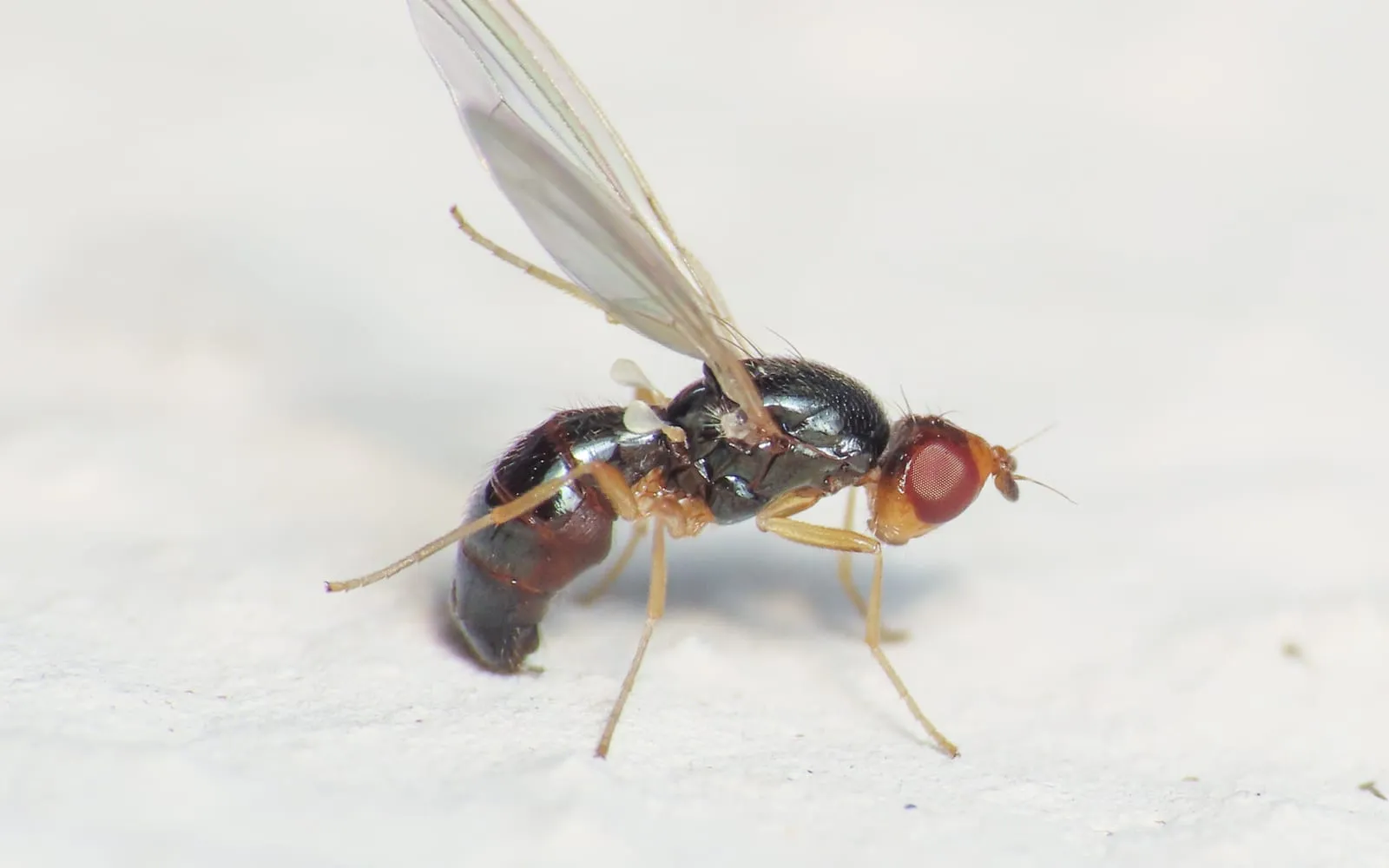
Chamaepsila rosae
Also called Carrot root fly, Carrot rust fly
Carrot fly causes bronzed foliage and rust-brown tunnels through the roots. Low barriers, fine mesh and careful sowing dates protect the crop before each generation lays eggs.
At a glance
- Type
- Pest
- Cause
- Insect
- Severity
- Destroys the crop or display
- Affects
- Herbs and edibles
- Active
- May to September
- Established in
- Europe, North America, Asia, New Zealand and Australia
What you are seeing
- Rust-brown tunnels running through the outer flesh of the root, showing when it is cut or scraped
- Creamy yellow maggots up to 9 mm long in the tunnels
- Foliage taking on a bronze or reddish cast and later yellowing
- Seedlings and young plants stunted or killed outright
- Roots splitting and rotting in the ground where tunnels let in bacteria
- Damage found at lifting on a crop that looked healthy from above
Before you treat anything
Tunnelled carrots are safe once the damaged tissue is pared away. Discard any root that has gone soft or started to rot around a tunnel.
What you are looking at
The tops go first, taking on a bronze or reddish tint that spreads across the row and later turns yellow. Plants stay small. On a badly hit sowing the seedlings die outright.
The proof comes at lifting. Scrape or cut a root and rust-brown tunnels run through the outer flesh, sometimes just under the skin and sometimes deep enough to split the carrot. Creamy yellow maggots up to 9 mm long lie in them, and the tunnels they made earlier have gone corky and dark.
Parsnip, celery, celeriac and parsley get the same treatment, and parsley grown for a season often carries more damage than the carrots beside it.
The fly that cannot climb
Chamaepsila rosae flies close to the ground. It hunts along the surface, a few centimetres up, following the smell of carrot foliage to a row where it lands and lays in the soil at the base of the plants. Faced with a vertical obstacle it goes round rather than over.
That single habit is why a fence of fleece or mesh 60 to 75 cm high, taken right down to the soil and left open at the top, protects a bed. It looks like it should not work and it does.
Smell is the other half. A female locates a crop by the volatiles carrot foliage gives off, and bruised foliage gives off far more than intact foliage. Thinning a row on a warm afternoon broadcasts an invitation across the allotment, which is why the advice to sow thinly matters more here than anywhere else in the vegetable garden.
Two generations, and the second does the damage
Adults from overwintering pupae fly through May and into early June and lay into young crops. A second and larger generation flies in August and September, and its maggots feed through the autumn into the roots that are sitting in the ground waiting to be used.
A crop sown in June comes up after the first flight and has grown a root worth eating before the second arrives. A crop lifted in September misses most of what the second generation would have done. Carrots left in the soil through October and November are the ones that come up ruined, and by then the tunnels have let in the bacteria that turn a root soft.
What to do about it
Put up a barrier, or cover the bed with mesh from the day of sowing. Either one does more than everything else on this page combined.
Sow thinly enough to avoid thinning. Where you must thin, do it at dusk, water afterwards, and take the thinnings off the plot.
Sow the maincrop in June.
Lift in September rather than leaving roots in the ground through autumn.
Choose ‘Flyaway’ or ‘Resistafly’ and treat the resistance as a bonus on top of the barrier.
Move the row to fresh ground each year.
What it gets mistaken for
Slug damage on carrots is open to the air. Broad shallow craters, usually at the shoulder where the root sits proud of the soil, with rasped edges and slime. Carrot fly tunnels are covered by intact skin until you cut in.
Splitting from irregular watering leaves a clean crack running down the root with no discolouration and no tunnels.
Forked and fanged roots come from stones, fresh manure or a disturbed tap root at the seedling stage. The flesh inside is sound.
Violet root rot coats the outside of the root in a purple felt of fungal threads.
Cavity spot leaves small sunken elliptical pits across the surface, greyish rather than rust-coloured, and they run across the root rather than along it.
What to do, in order
Start here
Prevention, and the changes that stop the problem returning. Most of these pages should end at this tier.
- Sow thinly and avoid thinning at all
- The female finds the crop by smell, and bruised carrot foliage carries for a long way. A row sown thinly enough to need no thinning gives off nothing to follow. Station-sow a few seeds at final spacing if the seed is fresh, or use pelleted seed.
- Thin in the evening, and take the thinnings away
- Where thinning cannot be avoided, do it at dusk when the flies have stopped moving, water the row afterwards to settle the soil and damp the scent, and carry the thinnings off the plot rather than dropping them between the rows.
- Sow in June to miss the first generation
- The first flight runs through May and early June. A maincrop sown after it comes up into a quiet fortnight and grows away before the second generation arrives. Early carrots sown in March under fleece and lifted by July also escape, since they are out of the ground before the damage is done.
- Lift the crop before autumn rather than leaving it in the ground
- Damage from the second generation builds through autumn, so carrots left in the soil into November come up far worse than the same crop lifted in September. Where they have to be stored, lift and store them dry.
- Grow a partially resistant cultivar
- 'Flyaway', 'Resistafly', 'Maestro' and 'Sytan' carry some resistance and take noticeably less damage. None of them is immune, and they are worth combining with a barrier rather than relied on alone.
- Move the row each year
- Pupae overwinter in the soil where the crop stood, so a bed that grew carrots last year starts the season with its own population. The adults fly in from elsewhere as well, which is why moving the row helps without settling the matter.
- Treat companion planting as unproven
- Interplanting with onions is the advice everyone has heard and the trials behind it are weak. Onion foliage masks the smell only while it is growing strongly, which is not the whole of the carrot's season. Spend the effort on a barrier instead.
Then reach for a barrier
Netting, hand removal and water. Nothing here harms anything except the target.
- Build a barrier 60 to 75 cm high around the bed
- The fly cruises low, a few centimetres above the ground, and will not climb over a vertical obstacle. Fine mesh or horticultural fleece stapled to four corner posts and taken right down to the soil turns it away. Leave the top open. This is the traditional allotment answer and it works better than it has any right to.
- Cover the crop with insect-proof mesh from sowing
- Mesh laid over hoops and sealed into the soil at every edge excludes both generations completely. Put it on the day you sow, on ground that grew no carrots last year, and lift it only to weed.
Plants affected
Guides that name it among the problems to watch for. The list is the plants it is characteristic of rather than everything it will feed on.
Common on UK allotments
This is one of the pests and diseases allotment growers meet most often. See it alongside the other common problems on the allotment guide.
Common allotment pests and diseasesA common vegetable pest
This is one of the pests that vegetable growers meet most often. See it alongside the others on the vegetable pests guide, grouped by how they feed and with prevention that works against most of them.
Common vegetable pests