
Pest
Flea beetles
Alticini
Also called Flea beetle, Turnip fly, Cabbage flea beetle, Cabbage stem flea beetle, Phyllotreta
Rocket, radish and brassica seedlings peppered with small round holes, and tiny beetles that vanish with a jump. Getting the crop through the seedling stage fast beats every other measure, and the mesh most gardeners own has holes big enough to let them through.
At a glance
- Type
- Pest
- Cause
- Insect
- Severity
- Destroys the crop or display
- Affects
- Garden plants, Herbs and edibles
- Active
- April to September
- Established in
- Worldwide
What you are seeing
- Small round holes and pits peppered across the upper surface of the leaves
- Pits that go part way through, leaving a translucent window rather than a hole
- Seedlings and cotyledons so heavily pitted they look sandblasted
- A row of rocket or radish checked and yellowing within a week of germinating
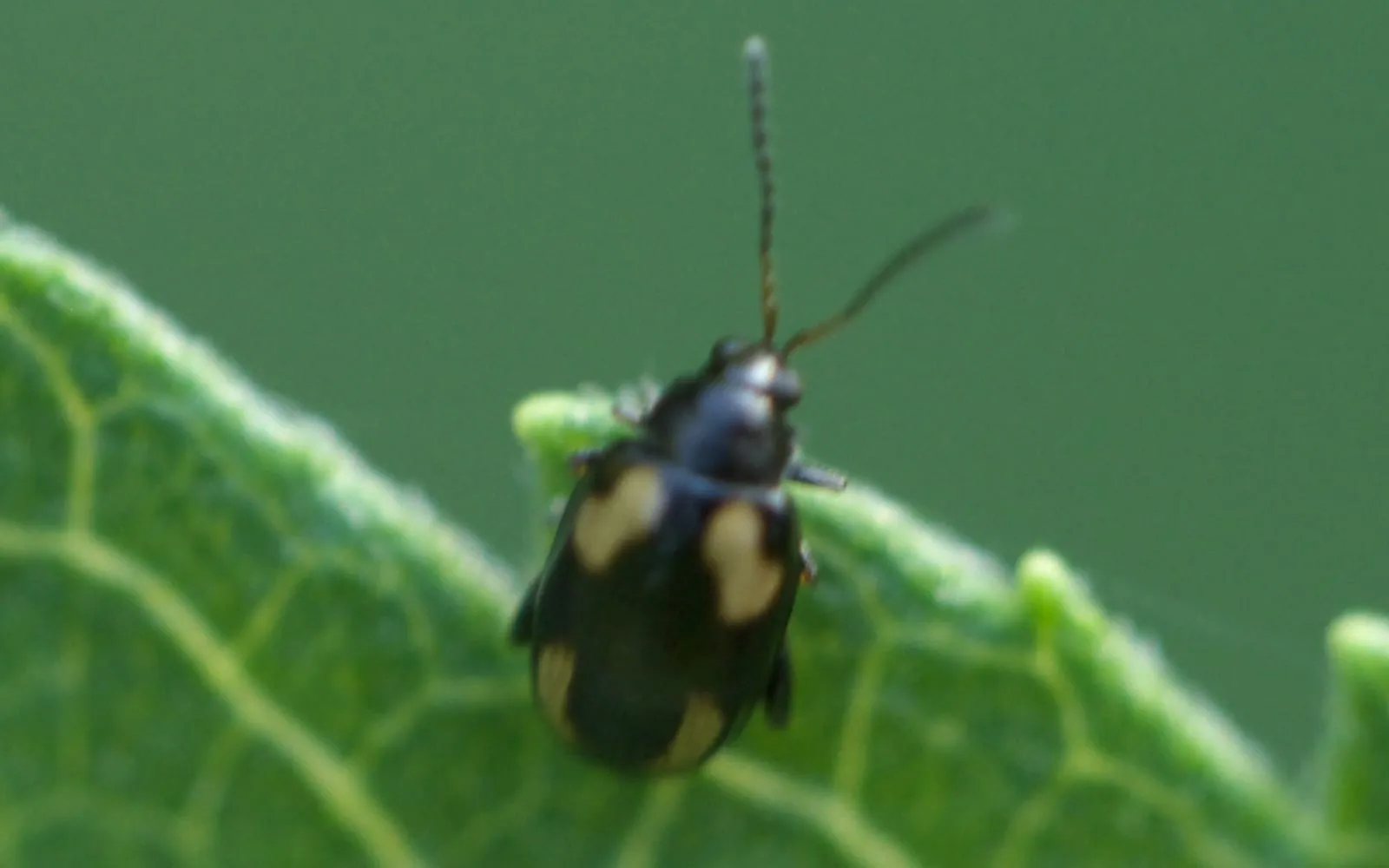
- Tiny dark beetles, 2 to 3 mm long, that spring away as your shadow falls on them
- Damage worst in hot dry weather and heaviest in spring and again in late summer
- Mature brassicas carrying the same holes on the outer leaves and growing on regardless
- Wilting shoot tips on oilseed rape and winter brassicas, with a white grub inside a split petiole
- Shallow winding scars and pits in the skin of lifted potatoes
Before you treat anything
Flea beetles cannot harm people or pets, and pitted salad leaves are safe to eat once washed. Potatoes scarred by Epitrix feeding are edible after peeling.
What you are looking at
A row of rocket or radish that came up well and now looks as though someone has been at it with a pin. The holes are small and round, a millimetre or two across, scattered over the upper surface of the leaf rather than the edge. Some go straight through and some stop at the lower skin, leaving a pale translucent window that dries and falls out later.
On seedlings the effect is severe out of all proportion to the size of the holes. A cotyledon with thirty pits in it has lost a third of the surface it needs to feed the plant, and a row can check, yellow and die inside a week.
Bend down to look and the culprits are gone. Flea beetles feel the shadow of a hand and jump, and they do it fast enough that most gardeners conclude there was nothing there. Stay still for half a minute and they come back, a scatter of dark specks 2 to 3 mm long, some of them striped yellow.
Mature plants tell a different story. A cabbage in July may be well holed on the outer leaves and cropping perfectly, because the same feeding on a large plant is a blemish.
The jump confirms it
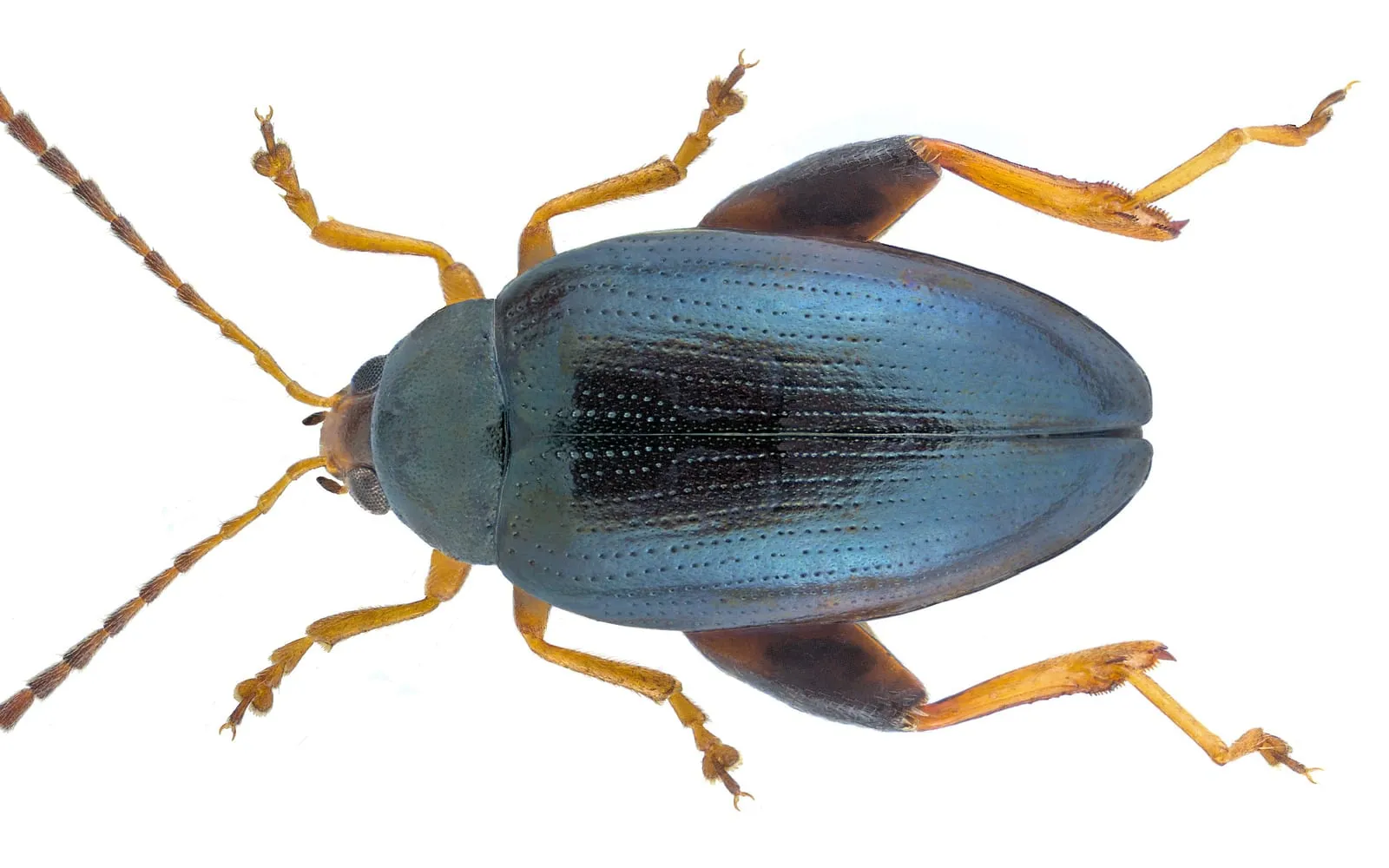
Every beetle in this group has a pair of grossly enlarged hind thighs, and inside each one is a curved, spring-loaded plate that stores energy from the muscle and releases it in one go. That is the whole of the identification. If it is small, on a brassica, and gone when you look again, it is a flea beetle.
Nothing else that pits a leaf behaves like that. Adult vine weevils drop and play dead, capsid bugs run sideways, and caterpillars stay where they are.
The jump is also why the greased board works, and why the mesh has to be finer than you would expect: an animal that escapes upwards will land on anything sticky held above it, and an animal a millimetre across will walk through anything with holes wider than a millimetre.
Four groups, and only one of them matters in most gardens
Phyllotreta is the one behind holed salad leaves. Several species take brassicas and their relatives, which means cabbage, kale and swede but also rocket, mizuna, radish, watercress, wallflower and nasturtium. The adults do all the damage you see, and the larvae feed harmlessly on the fine roots.
Psylliodes chrysocephala, the cabbage stem flea beetle, works the other way round. The adults shot-hole the leaves in autumn, and the larvae then mine inside the leaf stalks and the stem through the winter, hollowing out the growing point. It is the reason oilseed rape has become hard to grow across much of Europe. In a garden it turns up on winter brassicas as a wilting shoot tip with a small white grub inside a split petiole.
Epitrix species feed on potato and tomato foliage in the Americas and, more seriously, scar the tubers. Two of them are quarantine pests in Europe, where a suspected finding is reported rather than treated.
And Longitarsus jacobaeae is on the other side of the ledger entirely. It was released deliberately in North America and Australia to control ragwort, and it works. Not every flea beetle in the garden is a problem.
Why there is nothing to spray
For an amateur gardener, no useful spray product is available. Flea beetles are one of the clearest garden examples of chemical control running out.
Oilseed rape was protected by neonicotinoid seed treatments until they were withdrawn from use on the crop in Europe in 2013. Growers fell back on pyrethroid sprays, and within two years resistance to those was confirmed in Britain, Germany and Denmark. It is now widespread, and spraying a resistant population does nothing to the beetles while killing the ground beetles and parasitoid wasps that were suppressing them.
So the crop that had the most money and the most chemistry behind it ended up where a gardener already was, relying on timing, mesh, vigour and predators. Everything in the ladder above is what commercial growers are now using too.
What to do about it
Sow into warm moist soil and keep the seedlings growing hard, since speed through the vulnerable fortnight is worth more than everything else combined.
Raise anything you have lost before in modules and plant it out with several true leaves.
Water overhead in the morning through hot dry spells and mulch between the rows.
Time sowings to germinate between the spring and late summer flushes.
Sow a sacrificial row of mustard or rocket upwind, and pull it before it breeds.
Cover from the day of sowing with mesh of 0.8 mm or finer, weighted down all round, and use fleece for the earliest sowings.
Sweep a greased board along the row on a warm afternoon.
Leave the rough grass, log pile and hedge bottom for the ground beetles, and let an umbellifer flower near the vegetables.
Clear brassica debris off the bed in autumn.
Do not spray, and do not expect rotation to help.
What it gets mistaken for
Caterpillars chew bigger irregular holes and leave frass pellets underneath.
Slugs and snails take ragged bites from the margin and leave slime.
Capsid bugs make small holes as well, and the leaf grows on puckered and distorted around them.
Leaf miners tunnel between the leaf surfaces and leave the skin intact over a pale winding track.
Colorado potato beetle is ten times the size and strips the plant rather than pitting it.
Downy mildew kills patches of tissue that later drop out, so check the underside of the leaf for a grey bloom before deciding an insect did it.
What to do, in order
Start here
Prevention, and the changes that stop the problem returning. Most of these pages should end at this tier.
- Get the plant through the seedling stage as fast as you can
- This is the whole game. A cotyledon losing a third of its area is a seedling that may not survive, and the same beetles doing the same feeding on a plant with six true leaves are a cosmetic problem. Sow into warm soil rather than cold, water and feed to keep growth moving, and never sow a salad crop into a dry seedbed and hope. Every other measure on this page is a way of buying time for this one.
- Raise transplants in modules and plant them out at size
- A rocket or brassica seedling raised under cover and set out with four or five true leaves walks past the stage at which flea beetles can kill it. Direct sowing is quicker and it hands the beetles the vulnerable fortnight. For anything you have lost before, use modules.
- Keep the surface damp
- Flea beetles feed hardest in hot dry conditions and go quiet in cool damp ones, and the difference is large enough to see across a bed. Watering overhead in the morning through a dry spell, and mulching between the rows, reduces the damage on its own and helps the seedlings grow away at the same time.
- Sow to miss the peak
- Adults come out of overwintering and feed heavily as the weather warms, then the new generation emerges and feeds again in late summer. A sowing that germinates between the two flushes takes far less damage. In a temperate spring that usually means holding salad sowings back a fortnight and putting the main crop in early, or sowing in late summer for autumn once the second flush has passed.
- Sow a trap crop and let it take the damage
- Flea beetles prefer some brassicas strongly over others, and a sacrificial row of mustard, Chinese cabbage or rocket sown a fortnight before the main crop and placed upwind of it draws a good share of them away. Pull and bin the trap row rather than leaving it to breed, and do not put it next to the crop you are protecting.
- Do not count on rotation
- The adults fly and the overwintering sites are hedge bottoms and leaf litter rather than the bed itself, so moving the brassicas to the far end of the plot achieves much less here than it does against clubroot or cabbage root fly. Rotate for the other reasons and expect nothing from it against this.
- Grow the crops that shrug it off, and the varieties that do
- Damage varies a great deal between species and between cultivars. Red and purple-leaved brassicas are generally less attacked than green ones, and hairy or waxy leaves take less than smooth soft ones. Rocket, mizuna and radish suffer worst because the leaf you are growing is the leaf being holed.
- Tidy the crop debris and leave the rest of the garden alone
- Clearing spent brassica stumps and fallen leaves from the bed in autumn removes feeding and shelter. Stripping every scrap of cover from the wider garden costs you the ground beetles and rove beetles that eat the eggs and larvae, so leave the hedge bottom, the log pile and the long grass where they are.
Then reach for a barrier
Netting, hand removal and water. Nothing here harms anything except the target.
- Use fine mesh, and check the hole size before you buy it
- This is where most gardeners go wrong. An adult flea beetle is 2 to 3 mm long and around a millimetre across, so it walks through the standard insect netting sold for carrot fly and cabbage white, which has a mesh around 1.3 mm. You need an ultra-fine grade at roughly 0.8 mm or below. Read the specification rather than the words on the packet, since "insect proof" is sold against several different insects.
- Put the mesh on at sowing and seal every edge
- Cover the bed the day you sow, not the day you notice the holes, and bury or weight the edges all the way round. A cover thrown over a crop that already has beetles under it keeps them in and the predators out. Where flea beetles bred in that bed last year, put the mesh over fresh ground instead.
- Fleece an early sowing
- Horticultural fleece excludes the beetles and warms the soil, which pushes the seedlings through the vulnerable stage faster at the same time. It is the better choice than mesh for the earliest sowings and the worse one once the weather turns hot, since it will cook a salad crop.
- Run a greased board over the row
- An old trick that works because of how the animal escapes. Smear a piece of board or stiff card with grease or petroleum jelly, hold it just above the plants, and sweep it along the row. The beetles jump as it passes and stick to it. Two or three passes on a warm afternoon take a noticeable share of the population off a small bed, and a yellow sticky trap laid flat between the rows does a slower version of the same thing.
Then bring in the predators
Encourage what already lives in the garden, and buy predators in where the problem is under glass and nothing will arrive on its own.
- Keep the ground beetles you already have
- Ground beetles and rove beetles hunt flea beetle eggs and larvae in the top few centimetres of soil, and they need cover to live in. A permanent edge of rough grass, a log pile and an undisturbed hedge bottom near the vegetable beds do more against this pest over several seasons than anything you can apply in one. Birds take the adults.
- Leave the parasitoid wasps to it
- Several small braconid wasps attack flea beetles, laying into the adults so that the female stops laying. They arrive on their own where the garden carries flowers they can feed at, so an umbellifer or two allowed to flower near the vegetables is the practical way to encourage them. None is sold as a released control.
- Expect little from bought nematodes
- Steinernema and Heterorhabditis are sold against vine weevil and leatherjackets and are sometimes suggested for flea beetle larvae in the soil. The evidence for it is thin, the larvae of the brassica species do little damage anyway, and the money is better spent on ultra-fine mesh.Widely sold across Europe and North America. Live agents are regulated nationally and New Zealand requires approval under the HSNO Act before any new organism is released, so check what is permitted where you garden.
Biological controls are live organisms and their sale and release are regulated country by country. An agent sold freely in one place may be unapproved in another, so buy from a licensed supplier where you live and never import or move one yourself.
In pictures
Plants affected
Guides that name it among the problems to watch for. The list is the plants it is characteristic of rather than everything it will feed on.
Common on UK allotments
This is one of the pests and diseases allotment growers meet most often. See it alongside the other common problems on the allotment guide.
Common allotment pests and diseasesA common vegetable pest
This is one of the pests that vegetable growers meet most often. See it alongside the others on the vegetable pests guide, grouped by how they feed and with prevention that works against most of them.
Common vegetable pests