
How to encourage the predators that eat your pests
Many aphid predators and parasitoids are already nearby. They need shallow flowers for nectar, enough prey to keep them present, and somewhere sheltered to spend the winter.
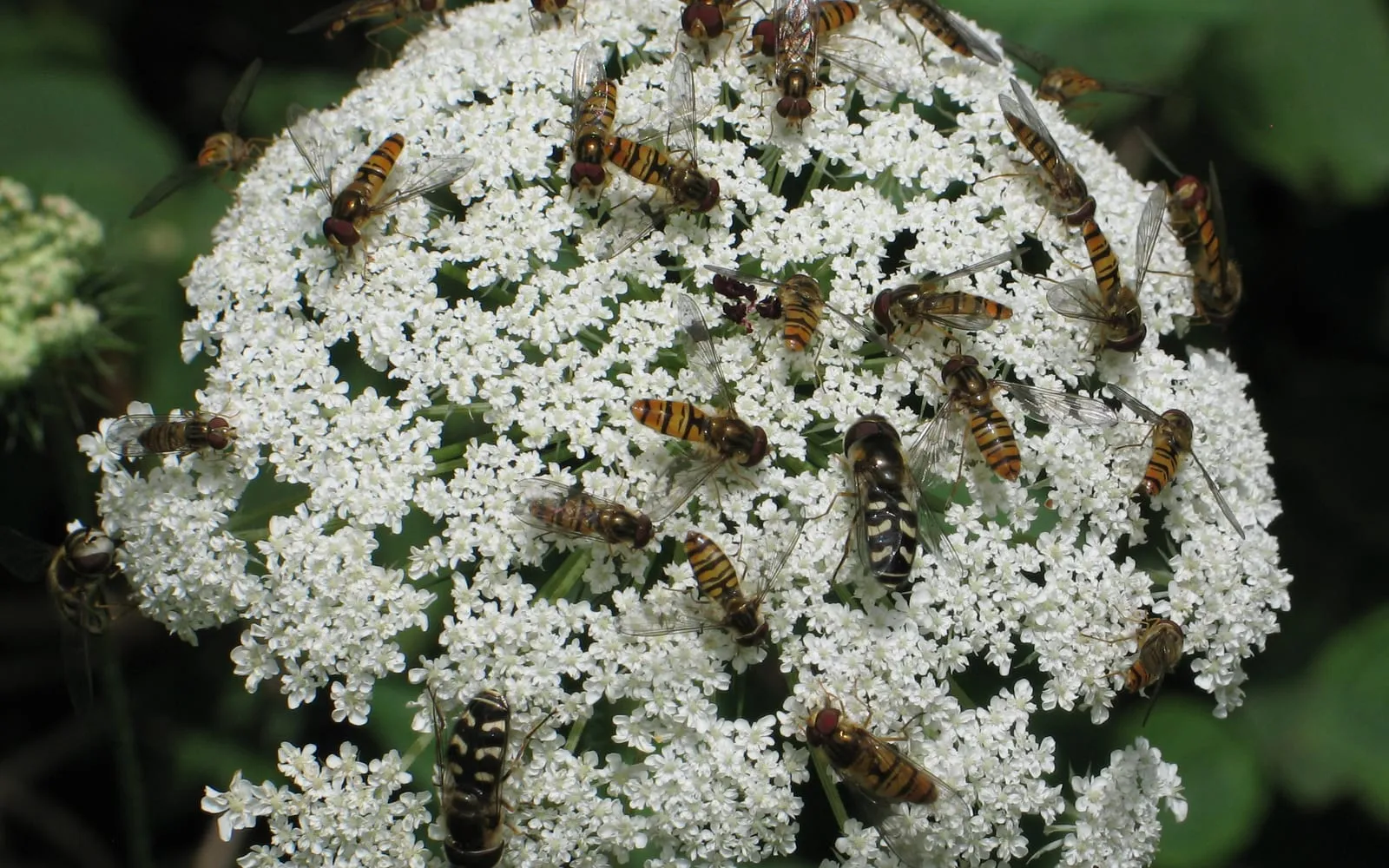
Aphids reproduce faster than most predators can respond. In warm weather, an aphid can already be carrying developing young when it is born. A colony can grow for days before hoverfly eggs hatch and the larvae start feeding.
That delay is why spraying feels reasonable. The aphids are visible, the predators are not, and the plant is getting worse. A broad-spectrum spray may remove the aphids for a short time, but it also kills the predators and parasitoids that had started to arrive. Aphids recolonise quickly from nearby plants, and the next colony has fewer enemies around it.
Encouraging predators means reducing that delay. Give adults nectar, leave places for them to overwinter, and keep enough harmless prey in the garden that predators are present before the outbreak starts.
Predators and parasitoids are different
A predator eats many prey during its life. A ladybird larva can eat several hundred aphids before it pupates. A parasitoid uses one host. The adult lays an egg in or on the host, the larva develops there, and the host dies.
The difference changes what you see on the plant. Predators leave fewer pests. Parasitoids leave visible remains. A swollen bronze aphid stuck to a leaf has an Aphidius wasp developing inside it. A whitefly scale that has turned black may contain Encarsia formosa. The white cocoons on the back of a tomato hornworm are braconid wasps that have already fed inside the caterpillar and emerged to pupate. Leave that caterpillar in place.
The difference also changes the value of flowers. Many adult parasitoids feed on nectar and do not hunt. Sugar affects how long they live and how many eggs they lay. Parasitoids are usually more specific about their host than predators are, so they respond strongly to particular pests. Generalist predators provide the background pressure that keeps small outbreaks from growing.
The groups doing the work
Aphid specialists. Hoverfly larvae are among the strongest aphid predators. They are blind, legless and semi-transparent, and they move across the leaf surface taking aphids one by one. Ladybirds hunt as adults and larvae. The larva looks unlike the adult beetle: narrow, dark and often marked with orange. Lacewing larvae have sickle-shaped jaws. The aphid midge Aphidoletes aphidimyza leaves tiny orange larvae among aphids. Aphidius wasps leave mummified aphids. In humid weather, the fungus Entomophthora can kill aphids where they sit, leaving them swollen and furred.
Some ladybirds eat plants rather than pests. The Epilachna and Henosepilachna group includes the Mexican bean beetle, which damages leaves. The mealybug destroyer Cryptolaemus montrouzieri is useful, but its larva looks like a large white woolly mealybug, so it is easy to mistake for the pest.
Generalists on the soil and foliage. Ground beetles hunt at soil level after dark. They eat slug eggs, cutworms, root fly eggs and some weed seeds. Rove beetles use the same layer, and Aleochara parasitises cabbage root fly puparia underground. Spiders take a wide range of flying and crawling insects. Orb weavers catch flying insects in webs. Wolf spiders hunt on the ground. Jumping spiders hunt across leaves in daylight. Harvestmen and centipedes also work through small prey near the ground.
Predatory bugs. Minute pirate bugs in the genus Orius are only a few millimetres long and eat thrips, mites and eggs. Damsel bugs and predatory mirids take caterpillars and whitefly. Assassin bugs wait for prey and pierce it with a strong beak.
Predatory mites. These are hard to see without a lens, but they matter against spider mite. Phytoseiulus persimilis specialises in two-spotted spider mite and can clear a glasshouse infestation. The Amblyseius and Neoseiulus group is broader and can also take thrips.
Parasitoid wasps and flies. Braconid and ichneumonid wasps attack caterpillars and beetle larvae. Trichogramma wasps develop inside moth eggs. Tachinid flies are parasitoids too, although many adults look like ordinary houseflies. Some tachinids glue white eggs to a caterpillar’s back. Adults need nectar, so gardens with no flowers support fewer of them.
Vertebrates. Birds, bats, amphibians and reptiles can all reduce pest numbers. Blue tits in Europe, chickadees in North America and fantails in New Zealand feed caterpillars to their young. Bats take moths at night. Frogs, toads, newts and many lizards hunt in the lower layers of the garden. A pond with a sloping edge helps amphibians more than any bought product.
Below ground. Entomopathogenic nematodes attack vine weevil grubs and fungus gnat larvae in compost. The fungi Beauveria and Metarhizium infect insects and kill them from inside.
Which species you get depends on where you are
The jobs are similar across regions, but the species doing them are local. A species list written for one continent will be partly wrong on another.
Assassin bugs occur nearly worldwide and are especially diverse in the Americas. The wheel bug Arilus cristatus is a large North American species and can give a painful jab if handled. Australia has Pristhesancus plagipennis in a similar role. The spined soldier bug Podisus maculiventris is North American, feeds on other stink bugs and Colorado beetle larvae, and is sold there rather than in Europe. Minute pirate bugs also vary by region, with Orius insidiosus in North America and Orius laevigatus in Europe.
Ladybirds vary in the same way. The seven-spot ladybird is native to Europe and introduced across North America. The convergent ladybird Hippodamia convergens is the North American species often sold for aphid control. Both the mealybug destroyer and the vedalia beetle came from Australia. In Australia and New Zealand, the brown lacewing Micromus tasmaniae does much of the aphid control that hoverflies do elsewhere.
Advice about vertebrate predators varies even more. Slow-worms are European. Geckos and skinks are more important in warm climates. Hedgehogs are useful in many British gardens, but they were introduced to New Zealand and can harm native invertebrates, lizards and ground-nesting birds there. Encourage the native predators for your region, not a species list copied from somewhere else.
Adult predators and parasitoids need flowers
In hoverflies, parasitoid wasps, tachinid flies, many garden lacewings and aphid midges, the adult feeds on nectar or pollen while the larva eats pests. A female that can feed on nectar lives longer and lays more eggs.
Flower shape matters. A tiny parasitoid wasp cannot reach nectar inside a deep foxglove or fuchsia flower. It needs a shallow, exposed nectary on a flower it can stand on.
Grow these flowers among the vegetables and they double as companion planting, feeding the predators that keep the crop’s pests down.
Flowers, by the group you are feeding
Umbels, especially for parasitoid wasps. The carrot family produces many small florets on a flat platform with exposed nectaries. That shape suits tiny wasps and hoverflies. Fennel, dill, coriander, angelica, lovage, chervil, caraway, cow parsley and wild carrot all work. Parsley left to flower gives the same kind of bloom.
Composite discs, for hoverflies, lacewings, tachinids and adult ladybirds. A daisy head is a cluster of many small florets on one landing platform. These flowers also provide pollen.
- Yarrow, Achillea millefolium, is a strong perennial choice. It has flat clusters of small composite heads, flowers for months and tolerates drought and poor soil.
- Cosmos, Cosmos bipinnatus, gives open discs from midsummer until frost. Tachinids and hoverflies use it heavily.
- Pot marigold, Calendula officinalis, flowers for a long season and feeds many small insects.
- French marigold, Tagetes patula, is a different plant with different uses. It is grown more often for whitefly under glass and for its effect on root-knot nematodes than as a nectar plant.
- Coneflower, Echinacea purpurea, gives a large landing disc from midsummer into autumn.
- Sunflower, Helianthus annuus, gives a large disc and also has extrafloral nectaries on the stem and bracts.
- Black-eyed Susan, Rudbeckia, tansy, feverfew, ox-eye daisy and zinnia fit the same group. Michaelmas daisies and goldenrod extend the supply into autumn.
Choose single-flowered forms. A pom-pom cosmos, double marigold or ball dahlia has had many of its reproductive parts bred into extra petals, so it offers much less nectar and pollen.
Sweet alyssum, for hoverflies and small parasitoids. Lobularia maritima is widely used in commercial insectary planting. It has many tiny four-petalled flowers with shallow nectaries, flowers for months and stays low enough to grow between crop rows. Adult ladybirds use its pollen when aphids are scarce.
Pollen for ladybirds. Adult ladybirds eat pollen between aphid outbreaks. Dandelions are often among the earliest useful flowers in a garden. Buckwheat flowers about six weeks from sowing. Phacelia, coriander and yarrow also provide pollen as well as nectar.
Flowers across the season. A parasitoid emerging in early spring and a hoverfly emerging in autumn both need food. Dandelion and cow parsley open the season. Umbels and composites carry summer. Ivy flowers late, when little else does, but check its invasive status before planting it in North America or New Zealand.
Do not plant only for pest predators. Most flowers above are shallow and short-tubed. Long-tongued bees, butterflies and moths also need deeper flowers. Plant both kinds.
Winter is when you lose them
Many ladybirds and lacewings spend winter as adults in hollow stems, under loose bark, in evergreen foliage or in leaf litter. If you cut every herbaceous stem to the ground in autumn and clear every leaf, fewer adults survive to breed in spring.
Leave some dead stems standing until spring. Let leaves stay under shrubs where they are not smothering crowns or paths. Fennel and yarrow seed heads can also feed birds through winter.
Ground beetles need different shelter. They overwinter in the crowns of tussock-forming grasses. Farms use beetle banks for the same reason: raised grass ridges left uncut through fields. The garden version is an unmown strip along a fence or boundary.
A garden with no aphids in spring has no ladybirds in summer
Predators need prey before the main pest outbreak arrives. A garden kept completely clean in spring may have fewer predators when beans, roses or fruit trees need them.
Nettles are useful for this. The nettle aphid feeds on nettle and will not move onto beans. It appears early, so a nettle patch can support ladybirds and lacewings before crop aphids build up.
Greenhouse growers use the same idea with banker plants. A pot of barley with cereal aphids can support Aphidius wasps before tomato or cucumber pests arrive. The cereal aphids do not feed on those crops, but they keep the wasps breeding.
Ants are the complication
Aphids, scale insects and mealybugs excrete honeydew, and ants collect it. Ants often defend those colonies. They carry off ladybird eggs, disturb hoverflies that are trying to lay and drive parasitoid wasps away from the aphids.
A band of horticultural glue or a greased barrier around a trunk can stop ants reaching a colony on a fruit tree. It will not help if ants reach the colony by a branch touching a wall or fence, so check the route first. The ants and earwigs page covers the relationship in more detail.
Earwigs need a case-by-case judgement. In apple and pear trees, they are useful predators of woolly aphid and psyllids. On dahlias, clematis and ripening peaches, they can damage flowers or fruit. The same straw-filled flowerpot can be a trap in a flower bed and a shelter in a fruit tree.
What undoes all of it
A broad-spectrum insecticide kills predators and pests together. The pest often returns first, because aphids and mites reproduce quickly and recolonise from nearby plants. Entomologists call that pest resurgence.
Organic sprays can still harm predators. The word organic describes the source of the active ingredient, not how selective it is. Pyrethrins come from a chrysanthemum, but they kill ladybird larvae, hoverfly larvae and adult parasitoids. Fatty acid sprays, sold as insecticidal soap, kill soft-bodied insects by wetting them, so they can also kill hoverfly and aphid midge larvae.
Soap sprays are usually less damaging than persistent broad-spectrum insecticides because they leave no residue once dry and work only where they land. If you use one, treat only the infested shoots, spray in the evening when bees and hoverflies are not flying, and stop once predator larvae or aphid mummies appear.
Buying predators in, and why it is regulated
Releasing a predator that was not already present can help or cause harm. The vedalia beetle was collected in Australia and released in California in 1888. It controlled cottony cushion scale in citrus and became a landmark in classical biological control. The harlequin ladybird was introduced repeatedly for aphid control across North America and Europe, then spread widely and displaced native ladybirds. The cane toad in Australia is another example of a released predator causing serious ecological damage.
National regulators control the sale and release of biological control agents. The answer to “can I order these” depends on where you live. New Zealand requires approval before anyone releases a new organism. Our problem pages carry availability notes on bought-in agents for that reason.
Buying predators makes most sense under glass. A greenhouse or conservatory is a contained space, so introduced agents stay close to the crop. Encarsia formosa against whitefly and Phytoseiulus persimilis against two-spotted spider mite have both been used commercially for decades and work well in that setting. In open gardens, bought-in predators often disperse.
What to expect
The first season after you stop spraying may be the worst one. Pests can recover in days. A predator community takes months to build. Give the garden two or three seasons before you judge the result.
The aim is lower pest pressure, not a garden with no pests at all. You may still see aphids on roses in early summer. With enough predators and parasitoids, the colonies should be smaller, last for less time and collapse without spraying.
Some chewed leaves are part of that system. If you want outdoor plants with no insects on them, predator planting will not provide it. Spraying rarely provides it for long either, and it can leave fewer predators behind for the next outbreak.
Sources and further reading
- Habitat management to conserve natural enemies of arthropod pests in agricultureDouglas A. Landis, Stephen D. Wratten and Geoff M. Gurr. Annual Review of Entomology, 2000The review behind most of this piece, on feeding adult natural enemies and giving them alternative prey and winter shelter.
- The history of the vedalia beetle importation to California and its impact on the development of biological controlL. E. Caltagirone and R. L. Doutt. Annual Review of Entomology, 1989The 1888 cottony cushion scale campaign that founded classical biological control as a discipline.
- The harlequin ladybird, Harmonia axyridis: global perspectives on invasion history and ecologyHelen E. Roy and others. Biological Invasions, 2016The cautionary case of a biocontrol agent that spread far beyond its release sites and now displaces native ladybirds.
- Beetle banks as refuges for beneficial arthropods in farmlandAndy MacLeod, Stephen D. Wratten, Nick Sotherton and Mark Thomas. Agricultural and Forest Entomology, 2004The tussock-grass ridges that overwinter ground beetles, and the model for the unmown garden strip.
- Biological control in the gardenRoyal Horticultural SocietyWhich bought-in agents are sold to gardeners and where they make sense, written for a UK reader.
- Biological control and natural enemies of invertebratesUniversity of California Statewide IPM ProgramA photo gallery for telling predators and parasitoids apart, weighted towards North American species.