
Pest
Mexican bean beetle
Epilachna varivestis
Mexican bean beetle is a coppery, black-spotted ladybird relative that eats bean leaves instead of aphids. It is confined to the Americas and is worst in the Mid-Atlantic and Appalachian United States.
At a glance
- Type
- Pest
- Cause
- Insect
- Severity
- Destroys the crop or display
- Affects
- Herbs and edibles
- Active
- June to August
- Established in
- North America and Central and South America
What you are seeing
- Leaves eaten from the underside between the veins, leaving a lacy, skeletonised network that turns brown and papery
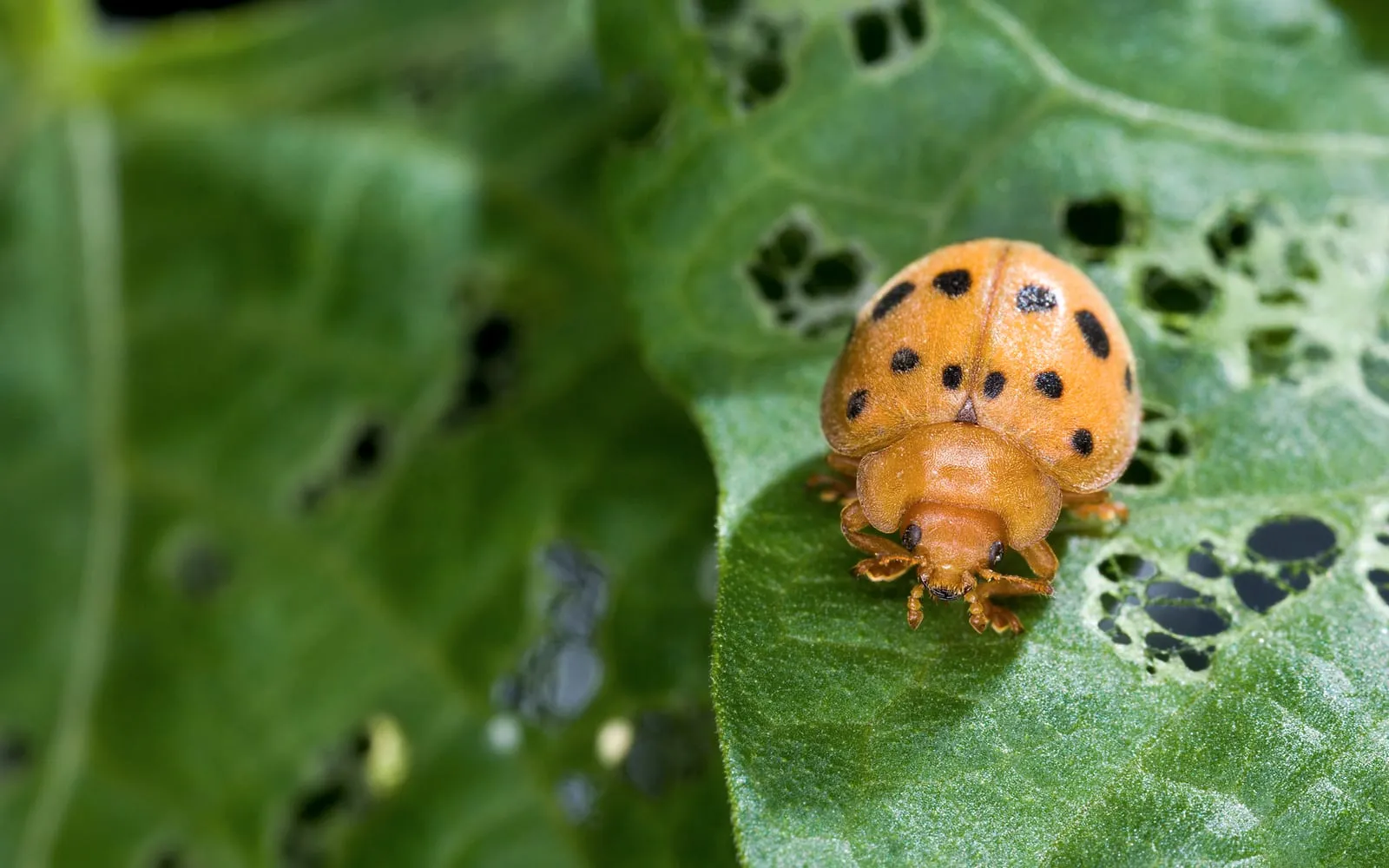
- Coppery-yellow adult beetles about 6 to 8 mm long, oval and domed like a large ladybird, with sixteen black spots arranged in three rows across the wing cases
- Spiny, pale yellow, soft-bodied larvae feeding in groups on the leaf underside, alongside the adults
- Clusters of pale yellow-orange eggs, laid upright in groups on the leaf underside
- Pods scarred and pitted where feeding has damaged the surface
- Damage building through the season as two to three overlapping generations pass through a planting
Before you treat anything
None beyond ordinary garden hygiene. Pods with surface scarring are safe to eat once trimmed of the damaged patches.
What you are looking at
Bean leaves eaten from the underside between the veins, leaving a lacy, skeletonised network that turns brown and papery as the damage spreads. Turn a leaf over and the culprit looks, at first glance, like a helpful visitor. It is a coppery-yellow, domed beetle about 6 to 8 mm long, marked with sixteen black spots arranged in three neat rows, closely resembling a large ladybird. Alongside it are spiny, pale yellow, soft-bodied larvae doing most of the actual damage, and clusters of upright yellow-orange eggs on the leaf underside nearby.
This is one of the very few plant-eating members of a family whose other members are usually aphid predators. Mistaking it for a helpful ladybird and leaving it alone is the most common reason an infestation gets ahead of a gardener.
Where it happens
Native to the highland regions of Mexico and Central America, this beetle has spread across most of the United States east of the Rocky Mountains and into southern Canada, though it stays uncommon in the humid Deep South and Florida. It does best in moderate summer conditions rather than intense heat, which is why the Mid-Atlantic states and the southern Appalachians carry the heaviest and most consistent pressure from it. It has not established outside the Americas, so a similarly domed, spotted beetle found eating bean leaves elsewhere is a genuine ladybird or an unrelated species rather than this one.
What to do about it
Check leaf undersides weekly from early summer and hand-pick adults, larvae and egg clusters; all three are large enough to see and remove without difficulty, and catching the first adults before they lay eggs prevents the more damaging larval generation entirely.
Cover young plants with row cover until flowering to exclude the first wave of overwintered adults.
Clear bean debris promptly after harvest and rotate the bed each year.
Where available, release the parasitic wasp Pediobius foveolatus timed to the first generation of larvae.
Grow a small early trap planting of a favoured bean variety to concentrate the first adults somewhere they can be dealt with directly.
What it gets mistaken for
A genuine ladybird is a similar shape and size but eats aphids rather than leaves and is never found in the dense feeding groups this species forms on the underside of a bean leaf. If the leaf beneath a “ladybird” is turning to lace, it is this species rather than a beneficial one.
What to do, in order
Start here
Prevention, and the changes that stop the problem returning. Most of these pages should end at this tier.
- Clear bean debris and rotate the bed after harvest
- Adults overwinter in plant debris, leaf litter and field margins near where beans grew. Removing spent plants promptly and rotating beans to a different part of the garden each year reduces the number of adults emerging near next year's crop.
- Grow a trap crop of an early-planted, preferred bean
- A small early sowing of a favoured variety draws the first overwintered adults away from the main crop, concentrating them somewhere they can be dealt with directly, either by hand-picking or by pulling and destroying the trap planting once it has drawn in a useful share of the population.
- Choose a fast-maturing variety where beetle pressure is heavy
- A crop that matures and is harvested quickly spends less of its life exposed to a building population, since numbers increase through the season as generations overlap.
Then reach for a barrier
Netting, hand removal and water. Nothing here harms anything except the target.
- Check leaf undersides weekly and hand-pick all life stages
- Adults, the spiny pale larvae and the clusters of upright yellow- orange eggs are all found on the leaf underside and are large enough to see and remove by hand. Doing this from the moment the first adults appear in early summer, before eggs hatch into the more damaging larval stage, is the single most effective control on a garden planting.
- Cover young plants with row cover until flowering
- A floating cover excludes the first overwintered adults from finding the crop at all, though it needs removing once flowers open for pollination.
Then bring in the predators
Encourage what already lives in the garden, and buy predators in where the problem is under glass and nothing will arrive on its own.
- Release the parasitic wasp Pediobius foveolatus where available
- This wasp parasitises the larval stage specifically and has to be released fresh each year in most of its range, since it does not reliably overwinter as far north as the beetle does. Timed to coincide with the first generation of larvae, it gives a real reduction in numbers for the rest of the season.Sold by biological control suppliers across the United States for release in the weeks after first larvae appear; not relevant or available outside the Americas.
Biological controls are live organisms and their sale and release are regulated country by country. An agent sold freely in one place may be unapproved in another, so buy from a licensed supplier where you live and never import or move one yourself.
Plants affected
Guides that name it among the problems to watch for. The list is the plants it is characteristic of rather than everything it will feed on.
A common vegetable pest
This is one of the pests that vegetable growers meet most often. See it alongside the others on the vegetable pests guide, grouped by how they feed and with prevention that works against most of them.
Common vegetable pests