
Pest
Cucumber beetle
Acalymma vittatum
Also called Striped cucumber beetle, Spotted cucumber beetle, Diabrotica undecimpunctata
A small yellow beetle on the seedling leaves that matters far more than its own bite, because it can inject a bacterium that kills the whole vine within weeks. Which cucurbits it wilts and which it mostly spares, and why row cover from day one beats any treatment after the fact.
At a glance
- Type
- Pest
- Cause
- Insect
- Severity
- Destroys the crop or display
- Affects
- Herbs and edibles
- Active
- May to August
- Established in
- North America and Central and South America
What you are seeing
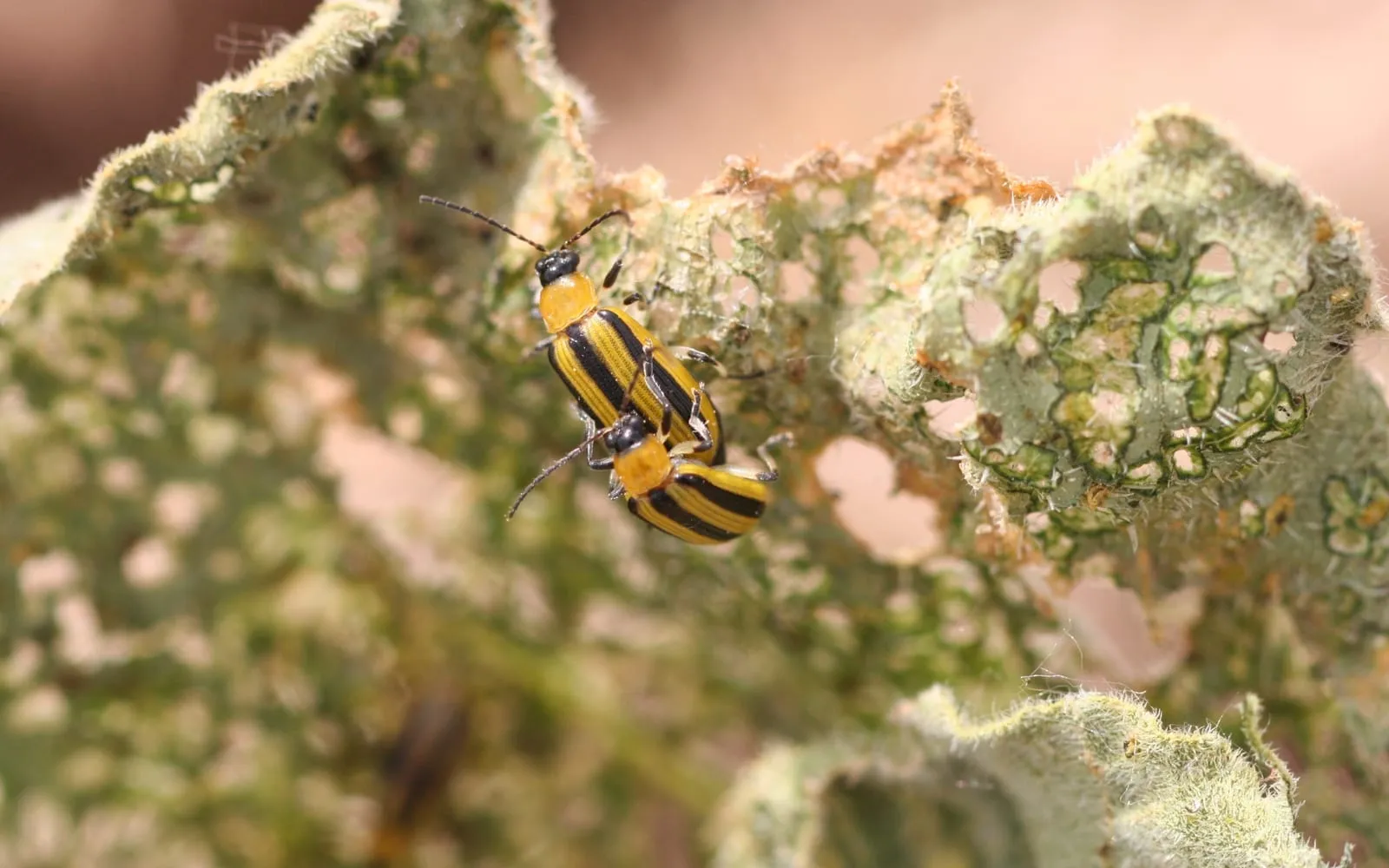
- Small beetles 5 to 7 mm long on seedling leaves and open flowers, either black-striped yellow or spotted yellow-green
- Ragged holes and scarring on cotyledons and young leaves, sometimes enough to kill a seedling outright
- A single vine wilting from the tip inward over one to two weeks, with no recovery overnight
- A cut stem near the wilted section oozing a milky, sticky sap that strings out when a knife is drawn away from it
- Whole plants collapsing in sequence along a row as bacterial wilt spreads from beetle to beetle
- Beetle larvae tunnelling in roots and the stem base, weakening plants independently of any disease
Before you treat anything
Fruit from a plant that later wilted and died is not worth eating; the vine usually collapses before fruit reaches harvestable size. Fruit from a plant that survived beetle feeding without wilting is unaffected.
What you are looking at
Small beetles, 5 to 7 mm long, working over seedling leaves and open flowers. The striped form is yellow with three bold black stripes running the length of the wing cases; the spotted form is yellow-green with a dozen black spots scattered across them. Both chew ragged holes in cotyledons and young leaves, which can kill a seedling outright on its own, but the bite itself is rarely the real problem.
The real problem shows up later, as a single vine wilting from the growing tip backward over a week or two with no overnight recovery. Cut the stem near the wilted section and a milky, sticky sap oozes out and strings between the blade and the stem as they are pulled apart. That is bacterial wilt, and once a plant shows it, there is no cure and no point treating it further.
Why the beetle matters more than its bite
Cucumber beetles carry Erwinia tracheiphila, the bacterium behind bacterial wilt of cucurbits, in their gut and deposit it in their droppings while feeding. The bacteria enter the plant through the beetle’s own feeding wounds and multiply inside the water-conducting tissue, eventually blocking it completely. A vine that was setting fruit normally can be dead within three to four weeks of the first beetle landing on it.
Susceptibility varies sharply between crops. Cucumber and melon are hit hardest and rarely survive a confirmed infection. Squash and pumpkin are less susceptible and often shrug off light beetle pressure without developing wilt. Watermelon is naturally resistant to the disease itself, so beetle feeding costs leaves rather than the whole plant.
Beetle larvae also tunnel in roots and stem bases independently of any disease, weakening plants directly, though this matters less than the bacterial wilt risk on the crops most susceptible to it.
What to do about it
Cover seedlings with row cover from the moment they go in the ground, sealed into the soil at the edges, and keep it on through the vulnerable early weeks. This single step prevents most bacterial wilt, because it keeps beetles off the plant during the stage when a bite is most likely to infect it and most likely to kill it outright.
Remove the cover once flowers open for pollination, and expect some beetle pressure to return; a plant with several true leaves tolerates it far better than a seedling did.
Set yellow sticky traps at seedling height to catch the first spring wave early.
Choose watermelon, or a bred-resistant cucumber or melon cultivar, where bacterial wilt has been a recurring problem in your soil.
Clear spent vines promptly after harvest and rotate the bed, since adults overwinter in the debris nearby.
What it gets mistaken for
Squash vine borer wilts one section with sawdust-like frass at a hole near the base and no milky ooze from a cut stem.
Verticillium wilt develops more slowly and shows brown staining inside the stem rather than the stringy white ooze of bacterial wilt, and is unrelated to beetle feeding.
Simple heat wilt during the hottest part of a sunny afternoon recovers by evening; bacterial wilt does not.
What to do, in order
Start here
Prevention, and the changes that stop the problem returning. Most of these pages should end at this tier.
- Choose resistant cultivars where they are bred
- Watermelon is naturally resistant to bacterial wilt itself, so beetle feeding on it costs leaf tissue but rarely kills the vine. Among cucumbers and melons, which are the most susceptible crops, several bred cultivars carry useful tolerance; check the variety description before planting where wilt has been a problem.
- Rotate cucurbits and clear old vines promptly after harvest
- Adults overwinter in plant debris and field edges near where cucurbits grew, then move into the youngest planting nearby in spring. Removing spent vines straight after harvest and rotating the bed reduces the population greeting next year's seedlings.
- Delay planting until after the first beetle wave, where the season allows
- The first generation of adults emerging in spring does the most damage to small seedlings, when a plant has the least leaf area to spare and is most easily killed outright. A slightly later sowing, or transplants already several leaves along, tolerates the same beetle pressure far better.
Then reach for a barrier
Netting, hand removal and water. Nothing here harms anything except the target.
- Cover seedlings with row cover from the moment they emerge or are transplanted
- This is the single most effective control, because it protects the plant during exactly the stage when a beetle bite is most likely to transmit bacterial wilt and most likely to kill the seedling outright. Seal the edges into the soil so beetles cannot walk in underneath, and remove the cover once flowers open so pollinators can reach them, accepting that some beetle pressure returns from that point.
- Use yellow sticky traps to monitor and reduce numbers
- Cucumber beetles are strongly drawn to yellow, and traps placed at seedling height give an early warning of the first spring wave as well as removing some adults directly. Useful alongside row cover rather than instead of it.
- Mulch with a reflective or straw layer around young plants
- A light-coloured mulch disrupts the visual cues beetles use to find host plants and reduces landings on young seedlings, for a modest but real benefit alongside the controls above.
Then bring in the predators
Encourage what already lives in the garden, and buy predators in where the problem is under glass and nothing will arrive on its own.
- Encourage soldier beetles, tachinid flies and general predators
- Several native predators and parasitoids attack cucumber beetle eggs and larvae, though none available to a home gardener gives control on the scale row cover does during the vulnerable seedling stage.
Biological controls are live organisms and their sale and release are regulated country by country. An agent sold freely in one place may be unapproved in another, so buy from a licensed supplier where you live and never import or move one yourself.
Plants affected
Guides that name it among the problems to watch for. The list is the plants it is characteristic of rather than everything it will feed on.
A common vegetable pest
This is one of the pests that vegetable growers meet most often. See it alongside the others on the vegetable pests guide, grouped by how they feed and with prevention that works against most of them.
Common vegetable pests