
Pest
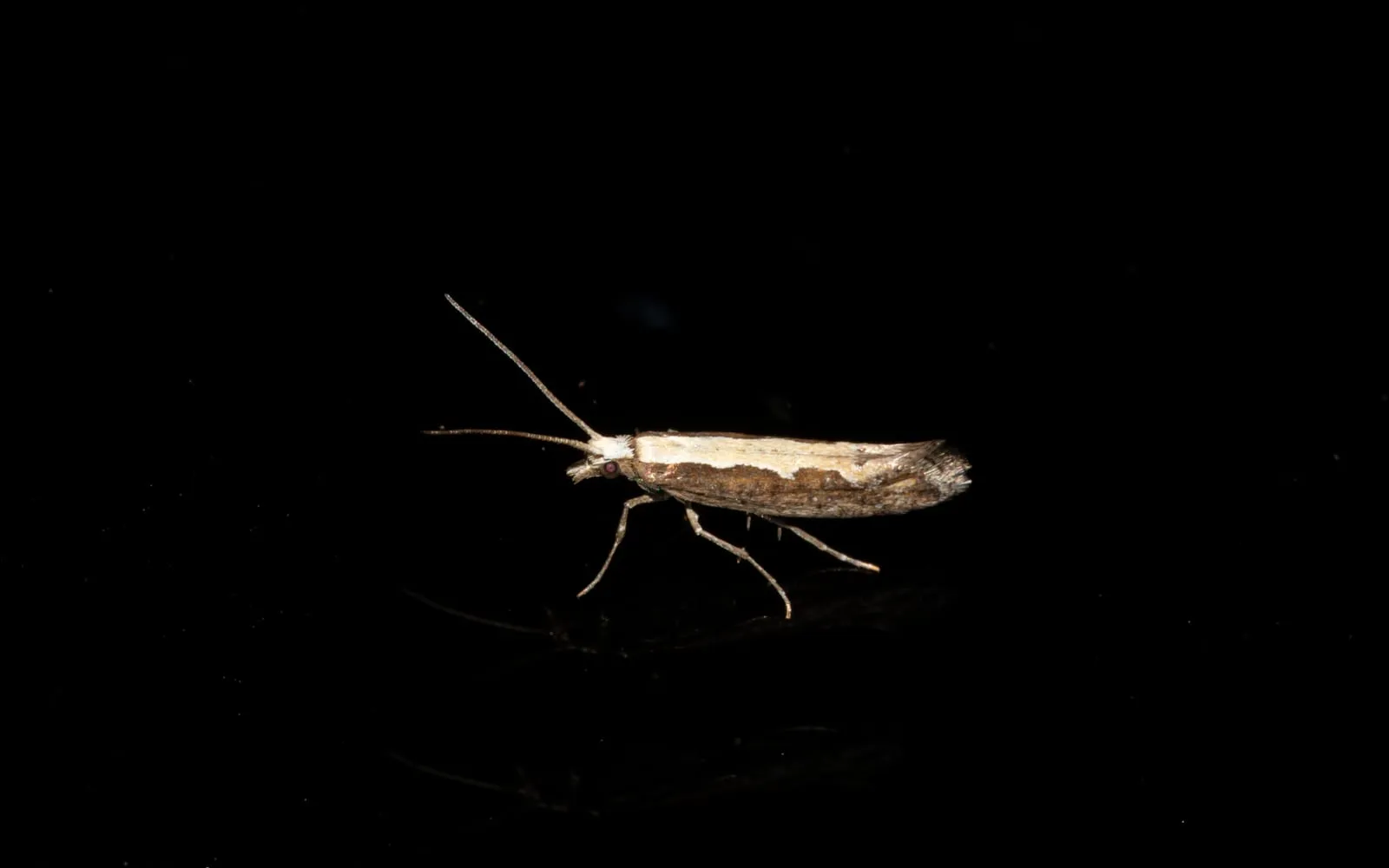
Diamondback moth
Plutella xylostella
Also called DBM, Cabbage moth
A small grey-brown moth whose caterpillars pepper brassica leaves with pinholes and windowpanes of skeletonised tissue, then wriggle backward off the leaf on a silk thread when disturbed. The single most economically damaging insect pest of brassica crops worldwide, and the one that has evolved resistance to nearly every insecticide ever used against it.
At a glance
- Type
- Pest
- Cause
- Insect
- Severity
- Destroys the crop or display
- Affects
- Herbs and edibles, Garden plants
- Active
- April to October
- Established in
- Worldwide
What you are seeing
- Small, irregular pinholes scattered across leaves, often concentrated near the growing point and on young leaves
- Larger patches of leaf tissue skeletonised to a papery, translucent "windowpane", with the lower leaf surface eaten out and the upper surface left intact
- Small, pale green, spindle-shaped caterpillars, up to about 12 mm long, tapering at both ends and wriggling vigorously when touched
- A caterpillar dropping from the leaf on a silk thread and hanging in the air when disturbed, then climbing back up once the threat passes
- Small silk cocoons, loosely woven and lattice-like, on the underside of leaves or among outer wrapper leaves, especially near harvest
- Growing points and young hearts damaged directly in seedlings and transplants, sometimes killing the plant outright, rather than only outer leaves being marked
What you are looking at
Small, irregular pinholes scattered across brassica leaves, often thickest near the growing point and on the youngest leaves, sometimes widening into larger patches where the lower leaf surface has been eaten out and only a papery, translucent “windowpane” of upper surface is left behind. On a seedling or young transplant the growing point itself can be damaged directly, which kills or badly checks the plant rather than just marking outer leaves.
The caterpillar responsible is small, pale green and spindle-shaped, tapering at both ends, rarely longer than about 12 mm. Touch one and it wriggles violently and drops off the leaf on a fine silk thread, hanging in mid-air until the disturbance passes and then climbing straight back up, a habit that is often the fastest way to identify it in the field. Small, loosely-woven, lattice-like cocoons on the underside of leaves or tucked among outer wrapper leaves mark where larvae have pupated.
The world’s most economically damaging brassica pest
Believed to have originated in Europe or the Mediterranean, this moth is now reported from more than 80 countries and is present everywhere brassica crops are grown, making it one of the most widely distributed insects on earth. In tropical and subtropical regions across Asia, Africa and the Americas it breeds continuously through the year, and it is there that it does the most damage and drives the resistance problem described below. In temperate regions, including Britain, it overwinters as an adult or in sheltered plant debris and builds through several generations between spring and autumn instead.
What sets this moth apart from other brassica caterpillars is its capacity to evolve resistance. It was the first insect recorded to develop resistance to DDT, and populations somewhere in the world have since developed resistance to essentially every class of insecticide brought against it, including organophosphates, pyrethroids, insect growth regulators and, in parts of Asia and the Americas where it has been used intensively, Bacillus thuringiensis itself. Global crop losses and control costs from this one species are estimated in the billions of dollars a year, most of it falling on vegetable-growing regions in the tropics and subtropics rather than on gardens in temperate climates, where damage is real but rarely as severe.
What to do about it
Cover the crop with fine insect mesh from the day of planting, fitted before the first eggs are laid and kept clear of the foliage.
Rotate brassicas away from the bed for at least a year, and clear and destroy old plants and wrapper leaves straight after harvest rather than leaving them to break down in place.
Where pressure is high, plant a border of a highly attractive brassica such as collards or Indian mustard as a trap crop, and monitor or treat that border rather than the main crop.
Avoid routine spraying and conserve the parasitoid wasps that provide substantial natural control on their own; where a treatment is needed, use Bacillus thuringiensis or spinosad and rotate between different modes of action rather than relying on the same product repeatedly, since resistance to almost every insecticide class has already been recorded somewhere in the world.
What it gets mistaken for
Large and small white caterpillars are bigger, feed openly in groups or bore into the heart of the plant, and do not drop on a silk thread when disturbed, unlike this moth’s caterpillars, which wriggle hard and drop off the instant they are touched.
What to do, in order
Start here
Prevention, and the changes that stop the problem returning. Most of these pages should end at this tier.
- Rotate brassicas away from the previous bed and remove crop debris promptly
- This moth breeds only on brassicas, so rotating away from the family for at least a year, and clearing and destroying old plants and wrapper leaves straight after harvest rather than leaving them to rot down in place, removes a local breeding ground between crops.
- Use resistant or less-preferred cultivars where available
- Some brassicas, including many mustards and turnips, are less attractive to egg-laying females than cabbage, broccoli or cauliflower, and breeding programmes in several countries have released cultivars selected for reduced susceptibility. Check what is recommended locally, since resistance varies by region and population.
- Plant a trap crop of a highly attractive brassica such as collards or Indian mustard around the main crop
- Females strongly prefer certain brassicas for egg-laying, and a border planting of one of these draws moths away from the main crop and concentrates them somewhere they can be monitored or treated directly, an approach used successfully in vegetable-growing regions across Asia and North America.
Then reach for a barrier
Netting, hand removal and water. Nothing here harms anything except the target.
- Cover the crop with fine insect mesh from planting
- The same fine mesh used against cabbage white butterflies works against this moth, provided it is fitted from the day of planting or transplanting, before the first eggs are laid, and kept clear of the foliage so a female cannot lay through it.
- Monitor with pheromone traps to time any treatment
- Sex pheromone traps catch adult males and give an early warning of a rising population, letting any treatment be timed against small larvae rather than applied on a routine schedule that resistance has already made unreliable in many regions.
Then bring in the predators
Encourage what already lives in the garden, and buy predators in where the problem is under glass and nothing will arrive on its own.
- Conserve and support parasitoid wasps
- Several small parasitoid wasps, including Cotesia vestalis and Diadegma species, attack this moth's larvae and pupae and provide substantial natural control where broad-spectrum insecticides are not disrupting them. Avoiding unnecessary spraying is the single biggest thing a grower can do to keep this control working.
- Use Bacillus thuringiensis or spinosad, rotated with other modes of action
- This moth has developed resistance to nearly every class of insecticide used against it somewhere in the world, including Bacillus thuringiensis itself in parts of Asia and the Americas where it has been used intensively. Rotating between different modes of action rather than relying on one product repeatedly, and treating only when monitoring shows it is needed, slows resistance developing locally.Both are widely available for edible crops across most regions, including for organic growing; check the product label for approved crops and pre-harvest intervals locally.
Biological controls are live organisms and their sale and release are regulated country by country. An agent sold freely in one place may be unapproved in another, so buy from a licensed supplier where you live and never import or move one yourself.
Plants affected
Guides that name it among the problems to watch for. The list is the plants it is characteristic of rather than everything it will feed on.
A common vegetable pest
This is one of the pests that vegetable growers meet most often. See it alongside the others on the vegetable pests guide, grouped by how they feed and with prevention that works against most of them.
Common vegetable pests