
Pest
Corn earworm
Helicoverpa zea
Also called Tomato fruitworm
A caterpillar working down through the silks to feed inside the tip of the cob, safe from most sprays by the time it is found. An Americas-only pest under one name on maize and another on tomato, with an equally destructive Old World relative filling the same role everywhere else.
At a glance
- Type
- Pest
- Cause
- Insect
- Severity
- Destroys the crop or display
- Affects
- Herbs and edibles
- Active
- July to September
- Established in
- North America and Central and South America
What you are seeing
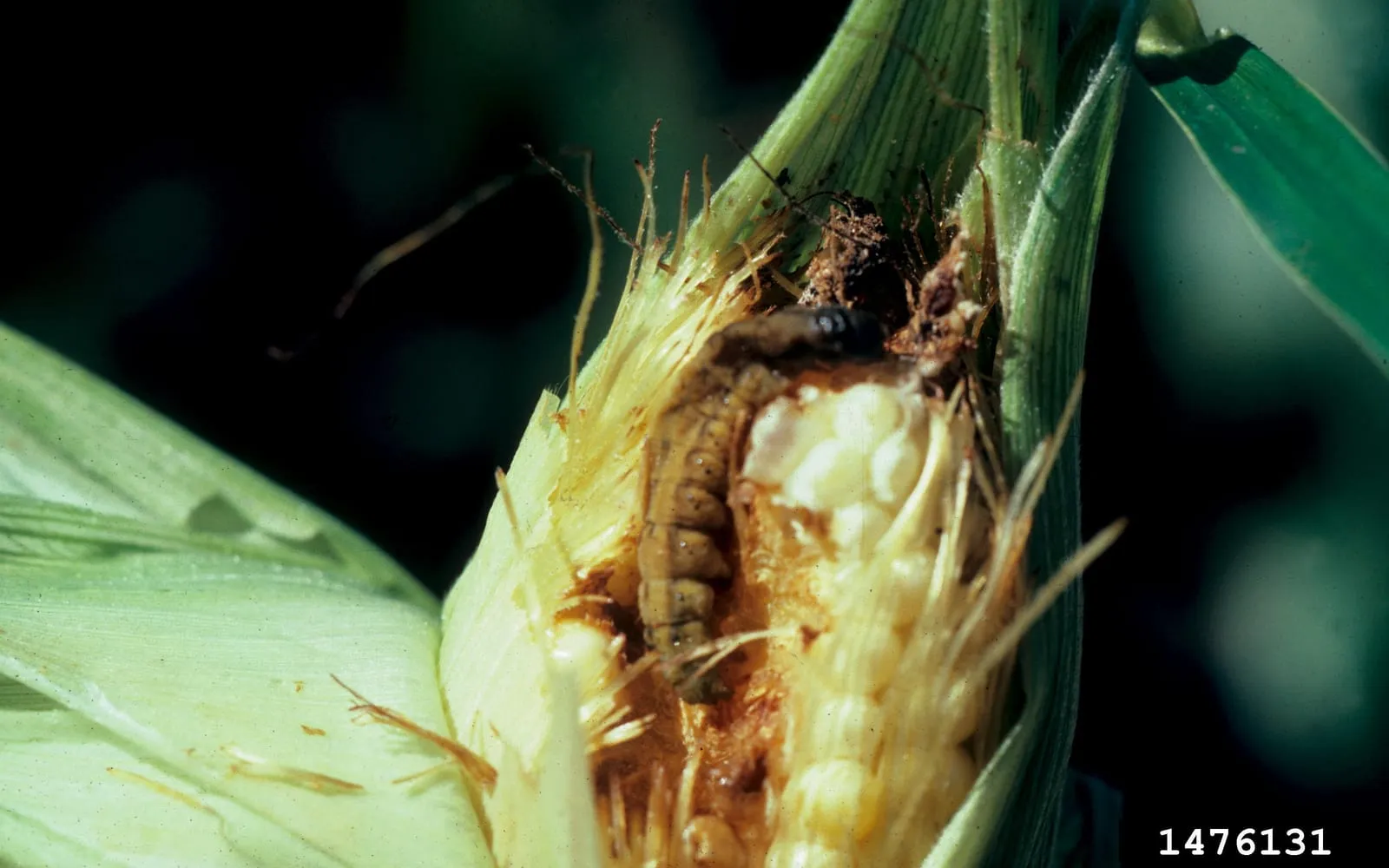
- A caterpillar feeding down through the silks and into the tip of a maize cob, leaving chewed kernels and dark, wet frass at the entry point
- Damage concentrated at the cob tip, since the caterpillar rarely moves far from where it entered and cannibalises any other larva it meets
- A single hole bored into a green tomato or chilli fruit, with the caterpillar feeding inside and out of sight
- Caterpillars varying widely in colour, from pale green to pink to nearly black, all marked with fine pale stripes running the length of the body
- Damage appearing well before harvest and often not found until the husk or fruit is opened
Before you treat anything
Cutting away the damaged tip of a cob or fruit leaves the rest safe and normal to eat.
What you are looking at
Silks browning normally on a maize cob, and inside the husk at the tip, a caterpillar has fed down through them and chewed into the kernels, leaving dark wet frass at the entry point. Damage stays concentrated at the tip because the caterpillar rarely travels far once it is inside, and if two end up in the same cob, one eats the other.
On tomato and chilli, the same species goes by different common names and does the same job in reverse: a single hole bored into a green fruit, with the caterpillar feeding out of sight inside it. Colour varies enormously between individuals, from pale green through pink to nearly black, but every one carries fine pale stripes running the length of the body.
One species with two names and a continental boundary
This is one insect causing damage under several different common names depending on which crop it is found on. It is corn earworm on maize, tomato fruitworm on tomato, and cotton bollworm where it attacks cotton. All are the same species, confined to the Americas, where it is native and among the most economically significant insect pests grown crops face.
Its role everywhere else on Earth is filled by a close relative, Helicoverpa armigera, the Old World bollworm, established across southern Europe, Africa, Asia and Australia and doing near-identical damage in near-identical ways. The two cannot be told apart without dissection or genetic testing. Helicoverpa armigera has begun appearing in South America in recent years, so a caterpillar matching this description there could now, in principle, be either species, though the American native remains overwhelmingly the more likely one.
What to do about it
Choose a tight-husked maize variety where seed catalogues note it, since a tighter husk slows entry.
Apply a few drops of mineral oil or Bt to the silk tip a few days after most silks have browned, once pollination is largely finished.
Time sowing, where the local season allows flexibility, to silk outside the peak of the local flight.
Remove and destroy damaged cobs and fruit rather than composting them near the crop.
Cut away the damaged tip of an affected cob or fruit rather than discarding the whole thing; the rest is normal to eat.
What it gets mistaken for
Tomato hornworm is far larger, feeds openly on foliage, and carries a distinctive tail horn, nothing like this species’ small size and habit of boring into fruit or a cob out of sight.
Damage from other caterpillars found on maize rarely concentrates so specifically at the cob tip; a chewed opening at the silk end with frass just inside it is close to diagnostic for this pest across its range.
What to do, in order
Start here
Prevention, and the changes that stop the problem returning. Most of these pages should end at this tier.
- Choose tight-husked maize varieties
- A caterpillar has to travel further through tightly wrapped husk leaves to reach the kernels, and several bred varieties resist entry for this reason alone. This is one of the few controls that works without any ongoing effort once the variety is chosen.
- Time sowing to avoid the peak flight where the local season allows
- Moth numbers build through summer in most of the pest's range, so a planting that silks before the peak, or well after it, meets fewer egg-laying females than one silking in the middle of the flight. Local extension advice on timing is worth checking, since the peak shifts by region.
- Remove and destroy damaged cobs and fruit promptly
- A caterpillar finishing inside a discarded cob or fruit left near the crop can still complete its life cycle. Clearing damaged material away from the growing area rather than composting it nearby reduces the population reaching next year.
Then reach for a barrier
Netting, hand removal and water. Nothing here harms anything except the target.
- Apply a few drops of mineral oil or Bt to the silk channel just after pollination
- Treating the silk tip a few days after most silks have turned brown, once pollination is largely complete, blocks and poisons the entry route before the caterpillar reaches the kernels. Applied too early it interferes with pollination; applied too late the caterpillar has already gone in and nothing reaches it.
- Cut away the damaged tip rather than discarding the whole cob or fruit
- Damage is almost always confined to the tip of a cob or the entry point of a fruit, since the caterpillar rarely tunnels far. Cutting away the affected inch or two leaves the rest perfectly good to eat.
Then bring in the predators
Encourage what already lives in the garden, and buy predators in where the problem is under glass and nothing will arrive on its own.
- Encourage predatory insects and birds around the crop
- Lacewings, minute pirate bugs and several parasitoid wasps attack eggs and small larvae before they reach the protection of the cob or fruit, and a planting with a resident population of these needs less intervention overall, though none will reach a caterpillar already feeding inside.
Biological controls are live organisms and their sale and release are regulated country by country. An agent sold freely in one place may be unapproved in another, so buy from a licensed supplier where you live and never import or move one yourself.
Plants affected
Guides that name it among the problems to watch for. The list is the plants it is characteristic of rather than everything it will feed on.
A common vegetable pest
This is one of the pests that vegetable growers meet most often. See it alongside the others on the vegetable pests guide, grouped by how they feed and with prevention that works against most of them.
Common vegetable pests