
Outdoor plant
Japanese Maple
Acer palmatum
Also known as Smooth Japanese maple, Acer
How to grow Acer palmatum. Shelter from wind, why leaf scorch is not a disease, verticillium wilt, and the maple that is dangerous to horses.
At a glance
- Difficulty
- Moderate
- Water
- Regularly. The fine roots dry out quickly
- Light
- Dappled shade, or morning sun with afternoon shade
- Temperature
- Hardy to about -15 deg C. Late spring frosts damage new growth
- Hardiness
- USDA 5-8, RHS H6, hardy to -25 C
- Type
- Deciduous tree, slow-growing and long-lived
- Height
- 2-8 m depending on cultivar
- Native to
- Japan, Korea, China
- Best month
- September in the Northern Hemisphere, March in the Southern Hemisphere
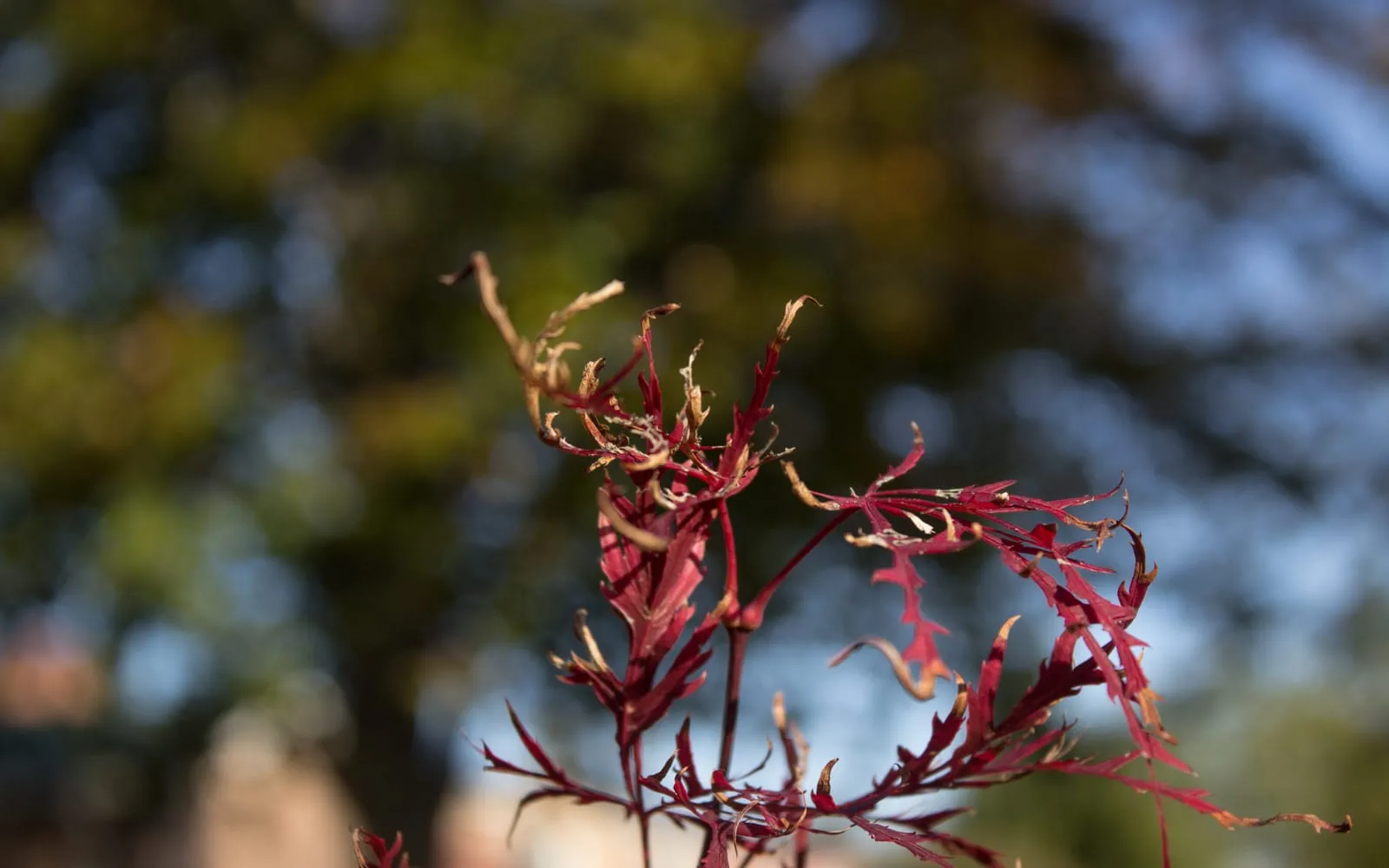
Wind is what disfigures it, and the thin leaves scorch brown at the edges in dry wind or hot sun long before cold becomes an issue. Give it shelter and dappled shade in any climate with summers above 30 C, and full sun only where summers stay cool. The dissected and variegated cultivars burn soonest. Late frost after the leaves open damages the shoots without killing the tree.
Hardiness zones describe winter cold alone. Summer heat, humidity, rainfall and the length of the growing season decide as much, so treat the range as the outer limit rather than as a recommendation.
Every month named in this guide is for the temperate Northern Hemisphere. If you garden in the Southern Hemisphere, shift each one by six months, so September becomes March. Closer to the equator the wet and dry seasons matter more than the calendar, and the shift stops being a useful guide.
Not known to be toxic
NC State Extension carries no toxicity section for Acer palmatum, and the species does not appear on the RHS list of potentially harmful garden plants or in the ASPCA database of plants toxic to dogs, cats and horses. As a garden tree it presents no known hazard. The reason this entry says more than that is the genus. The ASPCA lists red maple, Acer rubrum, as toxic to horses through tannins and gallic acid metabolised to pyrogallol, which destroys red blood cells and causes weakness, discoloured urine, laminitis and abortion in pregnant mares, and it notes that wilted leaves are the most toxic. Red maple is not toxic to dogs or cats. Anyone keeping horses near maples should identify which species they have, since a fallen branch of red maple left within reach of a paddock is a well-documented cause of equine death. Acer palmatum has no such record, and the distinction is worth making rather than leaving a horse owner to reason from the genus.
Sources: NC State Extension, Acer palmatum, ASPCA (Red maple, Acer rubrum)
About
Japanese maples are grown for two weeks in October and are worth it for the other fifty. The autumn colour is the reason most people buy one, and the layered branching and fine leaf texture carry the plant through the rest of the year.
They have been cultivated in Japan for centuries, where the practice of going out to look at autumn leaves has its own name, momijigari, and the tree has been selected into more than a thousand named cultivars.
Shelter from wind matters before almost anything else. Almost every disappointed Japanese maple in a temperate garden is in too exposed a position.
Appearance and character
A small deciduous tree with slender branches arranged in horizontal layers, giving a distinctly tiered silhouette that is as good in winter as in leaf.
Leaves are palmate, cut into five, seven or nine pointed lobes, and rarely more than 4 to 8 cm across. The dissectum group, sold as lace-leaf maples, have leaves cut so finely they look like feathers, and these form low weeping mounds rather than upright trees.
Colour varies enormously by cultivar. Green-leaved forms turn yellow, orange and scarlet in autumn. Purple-leaved forms such as ‘Bloodgood’ hold deep red all summer and intensify in autumn. ‘Sango-kaku’ has coral-red bark that is the point of the plant in winter.
Flowers are small and red-purple in spring, easy to miss, followed by winged seeds that spin as they fall.
Where it is from
Japan, Korea and China, growing as an understorey tree in woodland, under the canopy of larger trees and often on slopes near water.
Understorey is the operative word. This tree evolved in shelter, with filtered light overhead and larger trees taking the wind. Full midday sun scorches the fine leaves, and open wind dries them out faster than the roots can replace the moisture.
Woodland soil is also the model for what it wants underfoot. Leaf litter, plenty of organic matter, moisture-retentive without ever being waterlogged, and slightly acid.
It reached Britain in 1820 and has been a mainstay of gardens here ever since.
How it grows
A slow-growing deciduous tree, adding perhaps 20 to 30 cm a year, and living for many decades. Ultimate size depends entirely on cultivar, from 2 m dwarf forms to 8 m trees.
The root system is fine, fibrous and comparatively shallow, which explains two things. The tree dries out faster than its size suggests, particularly in a container, and it transplants reasonably well when young.
Autumn colour is a chemical process rather than simple decay. As chlorophyll breaks down, carotenoids already present show through as yellow and orange, and the tree actively manufactures anthocyanins for the reds. Bright days and cool nights in autumn produce the strongest colour, and a mild dull autumn produces a muted one.
Pruning should be minimal and done in winter when the tree is dormant. Pruning in spring causes heavy bleeding of sap. Restrict yourself to removing dead, damaged and crossing branches, and let the natural shape develop.
Container growing works well and suits the smaller cultivars, which is why Japanese maples are so common in pots.
Through the seasons
Winter is for structural pruning, done in December or January while fully dormant. The bare branching is at its most visible now, which makes shaping easier.
Spring brings the new leaves, and they are vulnerable. Late frosts scorch them, so fleece young trees when a hard frost is forecast. Feed lightly in mid-spring and mulch.
Summer is when scorch happens. Water regularly, particularly in containers, and shelter the tree from drying winds. Brown crisping leaf margins in July are the classic symptom.
Autumn is the display, usually from early October. This is also the best season for planting, since the soil is warm and the roots establish before winter.
Care difficulty
Moderate, and position accounts for nearly all of it.
Get the site right and the tree looks after itself. Dappled shade or morning sun, shelter from wind on all sides, and soil that holds moisture without sitting wet.
Get it wrong and you spend every summer looking at scorched brown leaf edges. Wind is the more damaging of the two factors, and it is the one people account for least, since a spot that feels sheltered at ground level can be a funnel between two buildings.
Container plants need real attention to watering, since the fine roots in a restricted volume dry out within a day in hot weather.
Watering
Water regularly. The fine fibrous root system dries out faster than the tree’s size suggests, and drought is the direct cause of leaf scorch.
Container specimens need daily watering through summer, sometimes twice in a heatwave. This is the main commitment of growing one in a pot.
Water at the base in the morning, so the foliage dries before evening.
Mulch thickly with leaf mould, bark or compost, keeping it clear of the trunk. This holds moisture, keeps the shallow roots cool, and does more for the tree than extra watering.
Established trees in decent ground cope with normal cool summers, though they appreciate a soak in a prolonged dry spell.
Waterlogging is the opposite danger. Heavy clay that sits wet through winter rots the roots, so improve the drainage or plant on a slight mound.
Warning signs, diseases and pests
Leaf scorch is by far the commonest complaint and it is not a disease. Leaf margins go brown, dry and crisp, usually from midsummer, and the cause is water lost from the leaves faster than the roots can supply it. Wind is the main driver, hot sun and dry soil the others. Move container plants to shelter, put up a temporary windbreak, mulch and water. The damaged leaves will not recover, and the tree will be fine.
Verticillium wilt is the serious disease. A branch or a whole side of the tree wilts suddenly and dies back, often in midsummer, and cutting into an affected stem shows dark staining in the wood. It is a soil-borne fungus with no chemical cure. Prune out affected branches well back into healthy wood, sterilising tools between cuts, improve drainage, and do not replant a susceptible species in the same ground.
Coral spot appears as raised pink-orange pustules on dead and dying wood and spreads into live wood from there. Prune out affected branches at least 15 cm below the visible infection and burn or bin the material.
Aphids cluster on soft new growth in spring and produce sticky honeydew.
Poor autumn colour is usually over-feeding with nitrogen, too much shade, or a mild dull autumn.
Asian longhorned beetle prefers maples above other trees but is not established anywhere outside Asia today. Every outbreak found in North America and Europe since 1996 has triggered eradication. Round pencil-width exit holes in the trunk are the sign to report immediately.
Growing environment
Dappled shade is ideal, and morning sun with afternoon shade works well. Full midday sun scorches the leaves, and the finely cut dissectum cultivars suffer worst. Purple-leaved forms tolerate more sun than green-leaved ones.
Shelter from wind matters as much as light. This is the requirement people underestimate, and it is the one that decides whether a Japanese maple looks good in August.
Hardy to about -15 deg C once established. Late spring frosts are the real hazard, since they catch the soft new leaves. Avoid frost pockets and east-facing positions, where early morning sun thaws frozen tissue too fast and kills it.
Soil should be moisture-retentive, free-draining and neutral to slightly acid, around pH 5.5 to 6.5. Improve heavy clay with grit and organic matter.
Containers suit the smaller cultivars. Use a loam-based compost, a pot with good drainage, and expect to water daily in summer.
Feeding
A light dressing of slow-release or ericaceous fertiliser in mid-spring, plus an annual top-dressing of leaf mould or well-rotted compost.
That is the whole programme, and less is better than more. Over-feeding produces soft leggy growth that scorches easily, is vulnerable to frost, and gives poor autumn colour.
Avoid high-nitrogen feeds entirely.
Container specimens can take a monthly half-strength liquid feed through the growing season, since a pot is a closed system.
Stop feeding by midsummer so growth hardens before autumn.
Troubleshooting
Brown crispy leaf edges from July. Leaf scorch from wind, sun or dry soil. Not a disease. Shelter it, mulch and water. The tree will be fine.
A whole branch wilted and died in summer. Verticillium wilt. Cut it out well into healthy wood with sterilised tools, and improve the drainage.
Pink-orange pustules on dead wood. Coral spot. Prune 15 cm below the infection and bin the prunings.
New spring growth blackened overnight. Late frost. Fleece young trees when frost is forecast, and avoid east-facing positions.
Autumn colour is disappointing. Over-feeding with nitrogen, too much shade, or a mild dull autumn. Cut the feeding and check the light.
Container plant declining despite watering. Either it is drying out between waterings or the compost is waterlogged. Check both, and repot every three years.
Leaves scorched on one side only. The prevailing wind. Put up a windbreak on that side.
Is this the maple that poisons horses? No. That is red maple, Acer rubrum, and its wilted leaves are the dangerous part. Acer palmatum has no such record.