
Guides
Common rose pests, diseases and disorders
Roses get many of the same pests, diseases and disorders in different gardens. Most are easier to recognise once you know which part of the plant to check. This guide names the problems you are most likely to see on a rose, shows how to tell them apart, and links to a detailed page on each.
Most rose trouble comes from a small group of pests, diseases and disorders that return year after year. Black spot, rust and powdery mildew mark the leaves, greenfly crowd the buds in spring, and frost or wind can damage new growth and roots. Once you know the common signs, a worrying patch on a favourite bush is easier to identify.
Start with the quick table below. Match what you can see to the likely cause, open the detailed page to confirm it, then decide whether you need to act. Much rose damage is minor, and a healthy rose tolerates more than a weak one.
What is wrong with my rose?
Match what you can see to the likely cause, then open the guide to confirm it.
| What you are seeing | Likely cause |
|---|---|
| Rounded purple-black spots with ragged edges, the leaves yellowing and dropping from the base up | Rose black spot |
| Raised orange or brown pustules on the undersides of the leaves, shedding powder on a finger | Rust |
| A white powdery coating on the buds, young leaves and shoot tips | Powdery mildew |
| Dense clusters of green or pink insects on the flower buds and soft shoot tips | Aphids |
| Leaves grazed to a lace of veins, or rolled tightly downward into tubes | Sawflies |
| Small ragged holes with brown rims in puckered young leaves, and nothing to be found | Capsid bugs |
| A grey fuzzy mould rotting the buds and open blooms in damp weather | Grey mould |
| Yellow mottling, wavy lines or ring patterns on the leaves that never come right | Mosaic virus |
| A whole stem or bush collapsing, with creamy white fungal sheets under the bark at the base | Honey fungus |
| Narrow, twisted, thread-like new growth with the shoot tips cupped and curled | Herbicide damage |
Six common rose problems
These are common rose problems on leaves, buds and stems. Open any one for more photographs and checks.
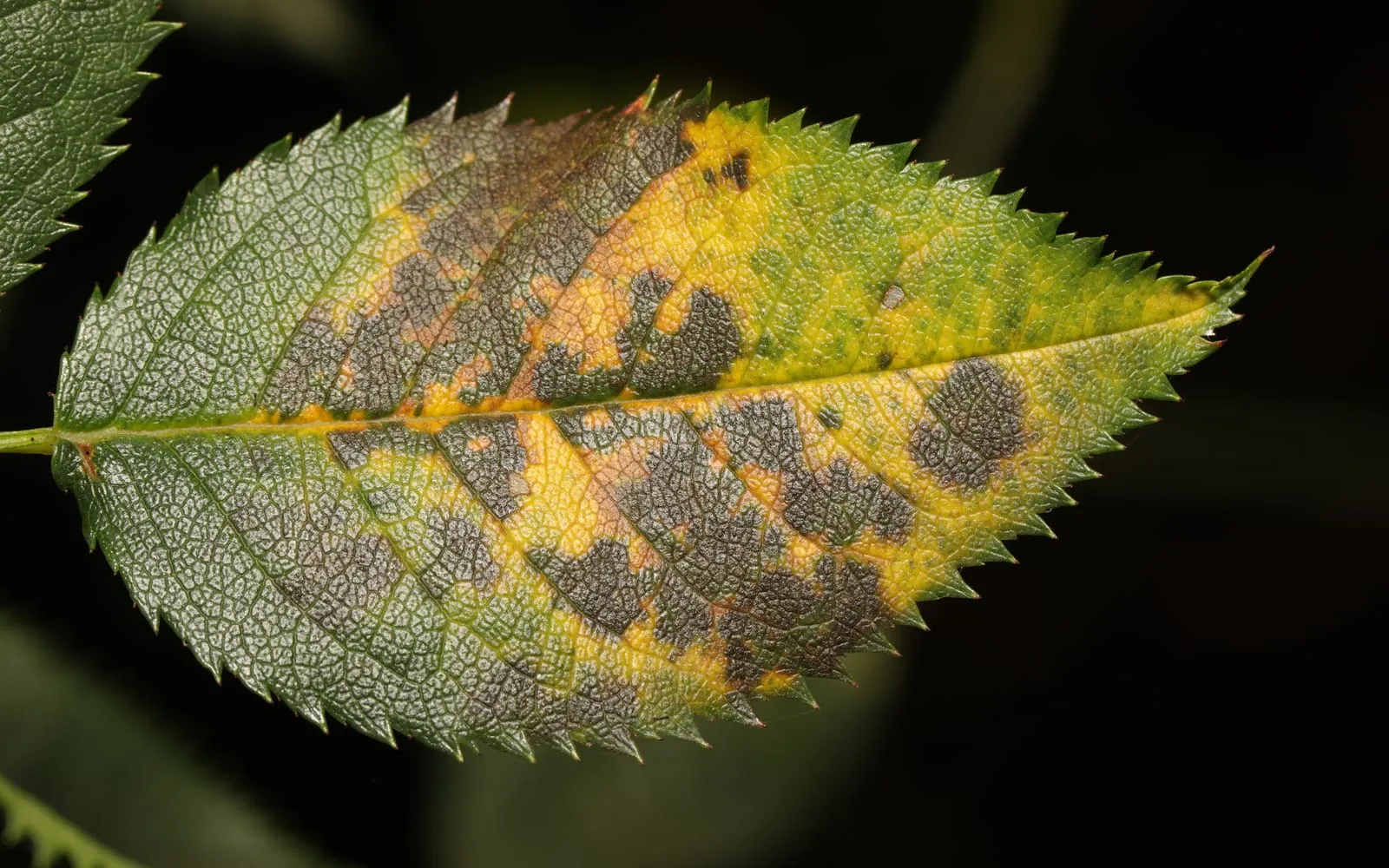 Rose black spot
Photo by Stephen James McWilliam, CC0. Resized from the original. 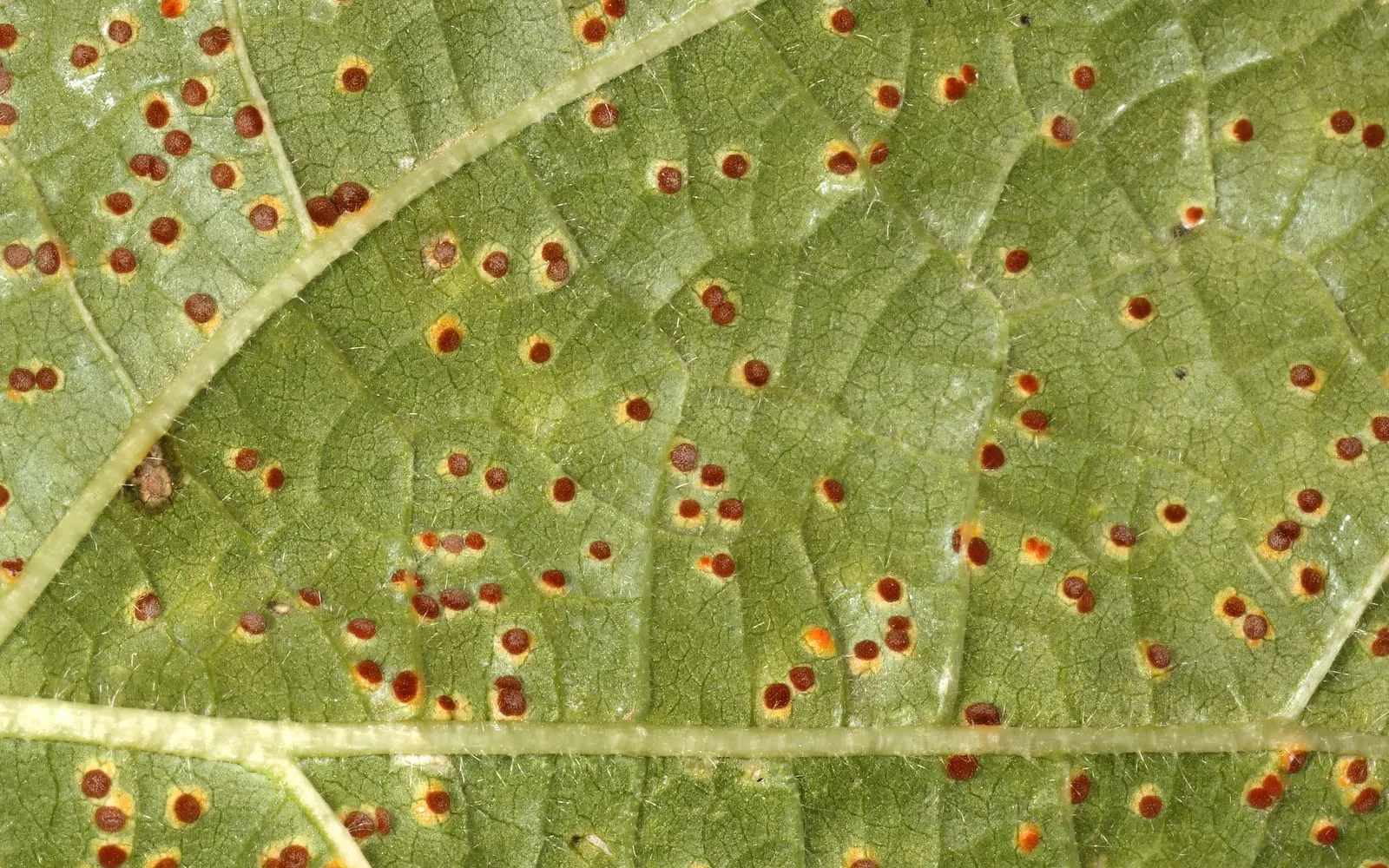 Rust
RustPhoto by SAplants, CC BY-SA 4.0. Resized from the original. 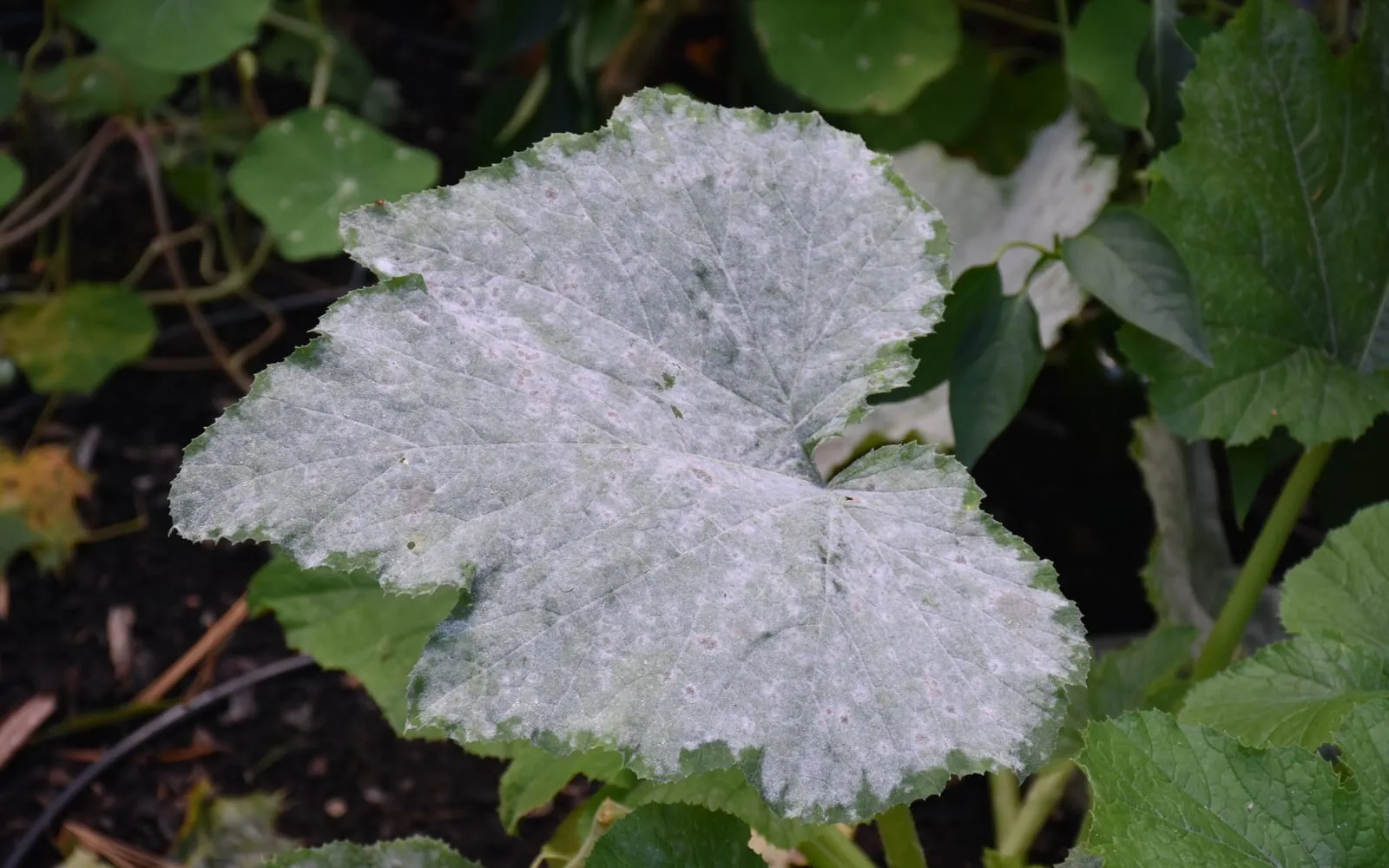 Powdery mildew
Photo by Dmitry Brant, CC BY-SA 4.0. Resized from the original. 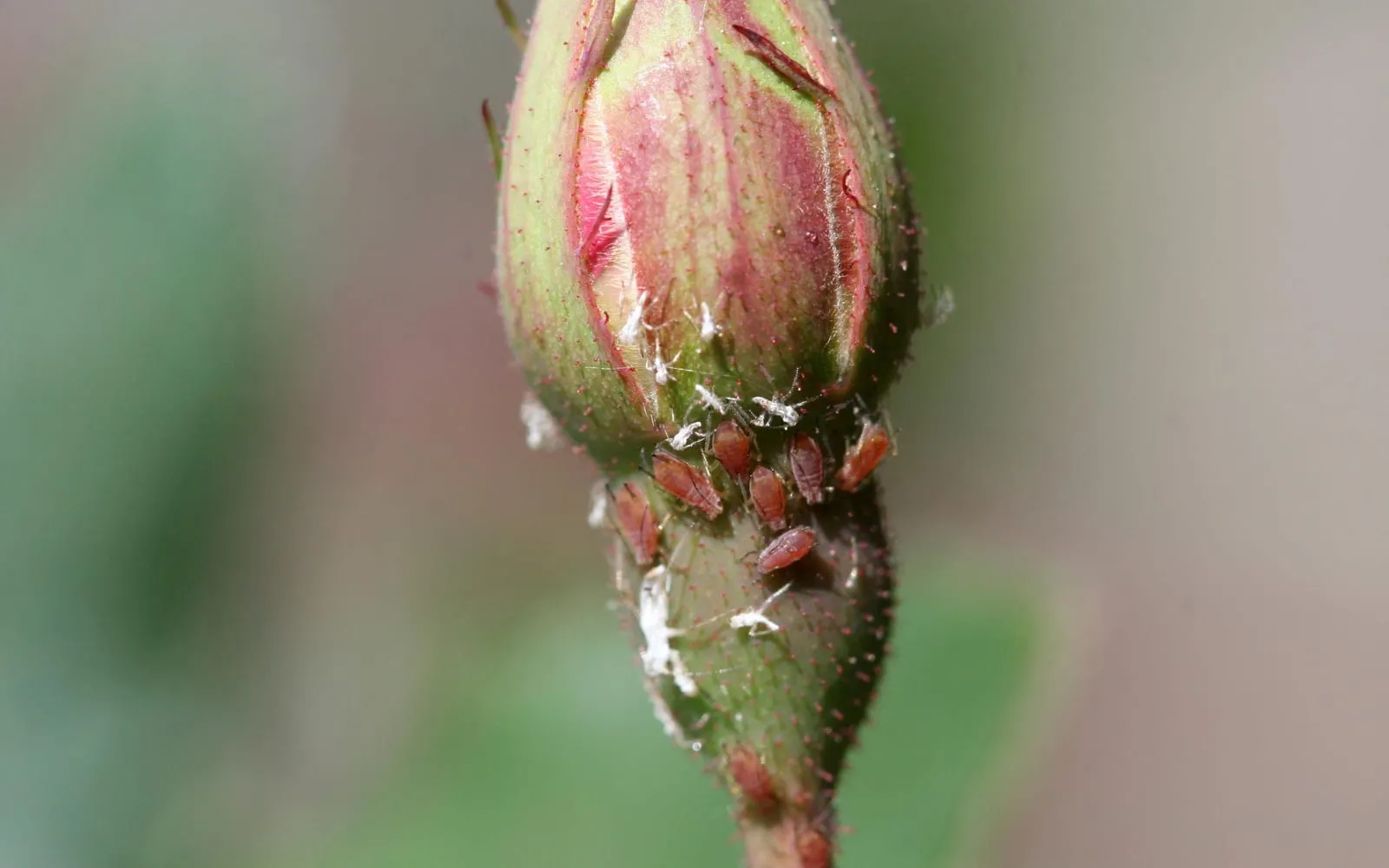 Aphids
Photo by Whitney Cranshaw, Colorado State University, CC BY 3.0 us. Resized from the original. 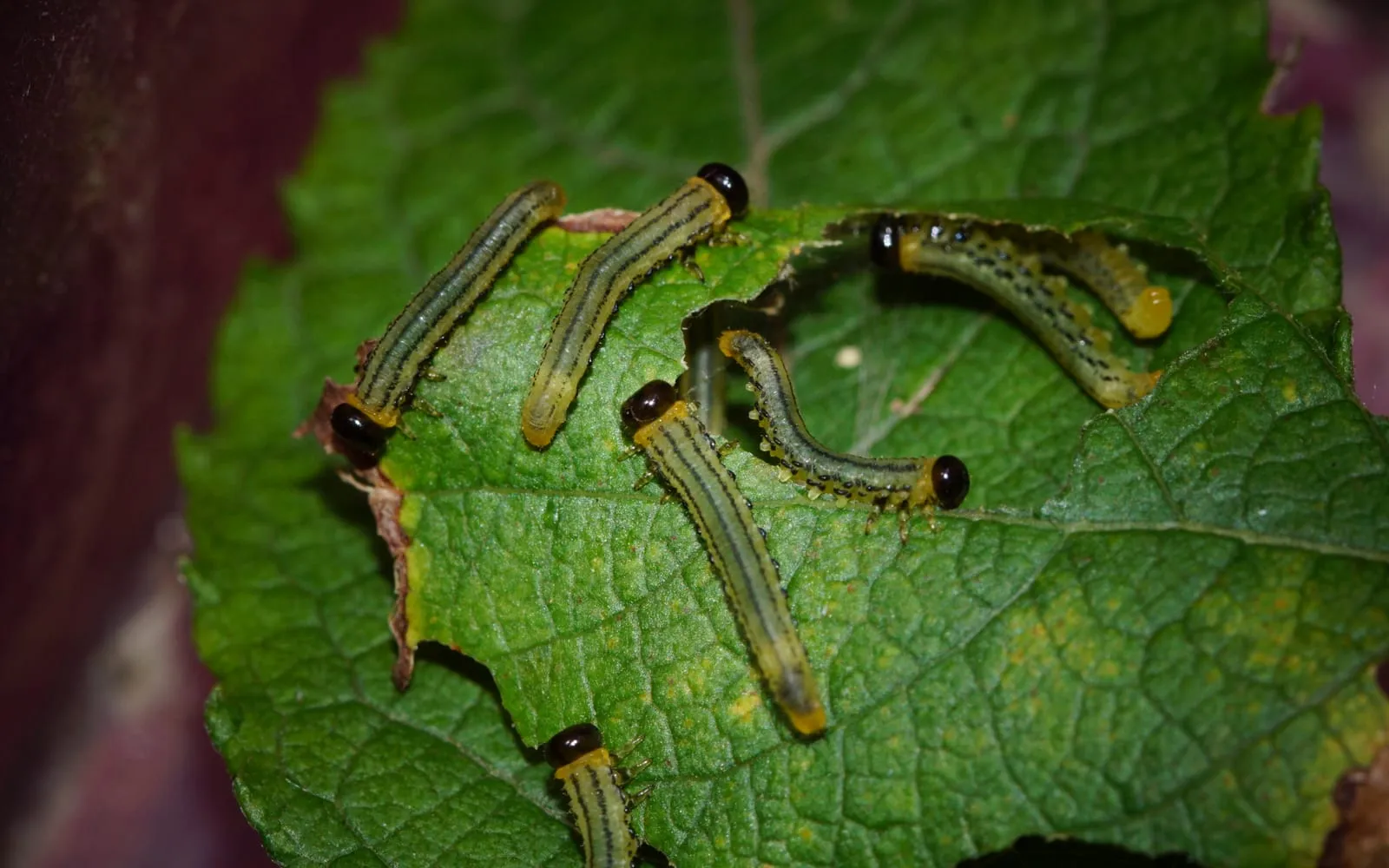 Sawflies
Photo by Ben Sale from UK, CC BY 2.0. Resized from the original. 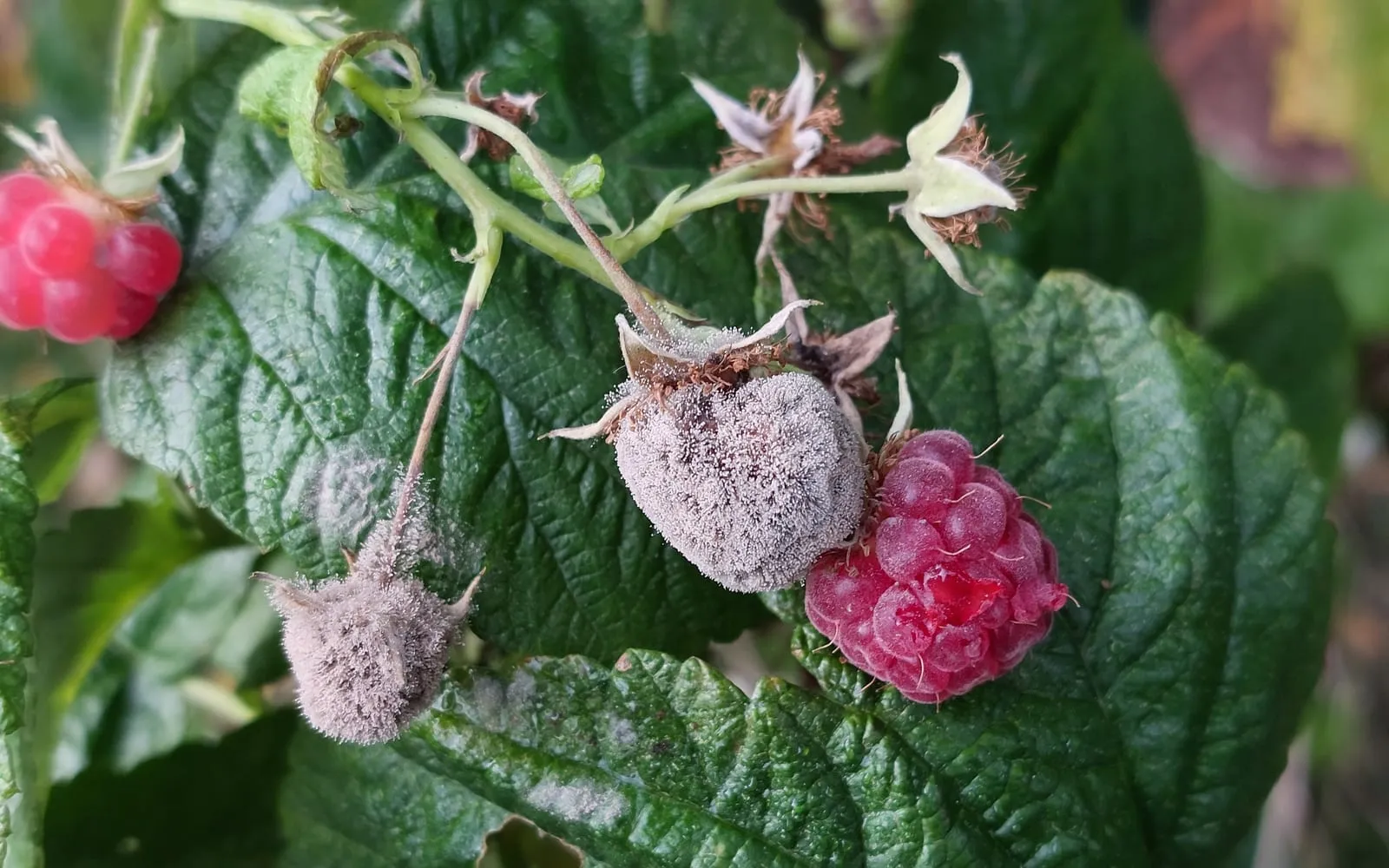 Grey mould
Photo by Schlaghecken Josef, CC BY 4.0. Resized from the original.
Sap-sucking pests
These insects and mites pierce rose leaves, buds and shoots and feed on sap. The first sign is often sticky honeydew, silvering or fine speckling rather than the pest itself, since most are small and several sit on leaf undersides. A light infestation on an established bush may only need washing or wiping off. A heavy one weakens growth and spoils flowers.
Aphids
Weakens the plantWatch on Flower buds and soft new shoots
Rose aphids, or greenfly, cluster in dense pink or green colonies where buds meet the stem and along soft new shoots. They breed fastest in spring on soft growth from heavily fed plants. They leave sticky honeydew that blackens with sooty mould, and a heavy colony can make buds open poorly. Run finger and thumb up an infested shoot to clear it quickly. Leaving a few early aphids can also support ladybirds and hoverflies.
How to identify and deal with aphidsScale insects
Weakens the plantWatch on Older canes and stems, worst on neglected bushes
Scale insects appear as small brown or whitish domes fixed to older canes and stems, often on the shady side near the base. Rose scale can form white crusts along neglected canes. It stays in place when pushed with a fingernail. Soft scales leave honeydew that blackens with sooty mould, while armoured rose scale leaves nothing sticky and can still weaken the cane. Scrape them off, or prune out a cane crusted along its length. Scale is worst on congested, shaded bushes left dry at the root.
How to identify and deal with scale insectsRed spider mite
Destroys the crop or displayWatch on Leaves, worst under glass or against a hot wall
Red spider mite makes rose leaves finely speckled, then dull, bronze, dry and likely to drop. It breeds fastest in hot dry air, so roses against sunny walls or under glass suffer most. Fine webbing over the shoot tips means a heavy attack. Tap a shoot over white paper and watch for moving specks. Wash the leaf undersides with water and keep the plant watered. Outdoors, rain and predators usually keep it in check.
How to identify and deal with red spider miteThrips
Weakens the plantWatch on Petals, flower buds and young leaves
Thrips rasp rose petals and young leaves, leaving silvery flecking with tiny black dots of excrement. Buds may open unevenly or fail to open at all. Pale roses show the petal streaking most clearly. New leaves damaged while still furled emerge puckered and scarred. Deadhead spent blooms where thrips breed, hang a blue sticky trap to check for them, and shower the plant. An established rose can grow through light damage once numbers are reduced.
How to identify and deal with thripsCapsid bugs
CosmeticWatch on The newest leaves and shoot tips
Capsid bugs feed on the youngest rose leaves and shoot tips. The damage shows only after the leaf expands, as small ragged holes with brown rims in puckered, uneven foliage. The fast green bug has usually gone by then, so you may not find it on the plant. Buds may open one-sided or fail. The holes can look serious, but they usually do little harm to an established rose. On most roses, leave it alone.
How to identify and deal with capsid bugs
Leaf, bud and stem eaters
These pests remove visible tissue, from grazed and skeletonised leaves to whole shoots torn away. Some feed at night or leave before the damage shows, so the pattern of damage may identify them better than a search of the plant. Much of this damage is minor on an established rose. The important question is whether the pest is damaging buds, new growth or young plants.
Sawflies
Weakens the plantWatch on Leaves and green shoots
Sawfly larvae damage rose leaves in three main ways. Rose slug sawfly grazes the surface off, leaving a lace of veins that dries brown. Leaf-rolling sawfly makes the leaflets curl tightly downward into tubes. The large rose sawfly eats whole leaves and cuts rows of slits into green stems to lay eggs, splitting the shoot along the line. Count the fleshy prolegs to tell sawfly larvae from caterpillars, since caterpillar treatments do not work on them. Pick the larvae off, or cut out stems that carry a line of laying slits.
How to identify and deal with sawfliesCaterpillars
Destroys the crop or displayWatch on Leaves, buds and shoot tips
Several caterpillars chew rose leaves, and the winter moth is the one that matters. Its looping green caterpillars hatch with the buds and eat the developing leaves and flower buds, spinning two leaves together at a shoot tip. Others leave ragged holes with dark frass pellets below, which separates them from the clean scallops of a leaf-cutter bee. Count the prolegs to tell a caterpillar from a sawfly larva. Pick them off by hand, and put grease bands on standard rose stems to stop the flightless winter moth females climbing up to lay.
How to identify and deal with caterpillarsRabbits and deer
Destroys the crop or displayWatch on Whole shoots, and bark on young plants
Deer tear rose shoots off and leave a ragged, frayed end because they have no upper incisors. They can graze well above head height. Rabbits cut lower shoots cleanly at a sharp angle and usually work below about 50 cm. Both can strip a bush to bare stems, and rabbits may gnaw bark from the base of a young rose over winter, which can ring and kill it. Check the cut and the height to identify the animal. A suitable fence is the only reliable protection.
How to identify and deal with rabbits and deerVine weevil
Can kill the plantWatch on Roots of container roses, and leaf margins
Vine weevil troubles roses grown in pots. The plump white legless grubs eat the roots through autumn and winter, so a container rose that was healthy collapses in spring and lifts out with almost no root left. The dull black adults notch neat semicircles from leaf margins at night, which warns that eggs are going into the compost. Knock a new pot out to check the compost before buying, water on nematodes while it is still warm, and grow vulnerable roses in the open ground where predators reach the grubs.
How to identify and deal with vine weevil
Diseases
Fungi, a water mould and a virus account for most rose disease. Black spot, rust and powdery mildew are the three many growers see most often. Fungal diseases spread fastest where leaves stay wet and air movement is poor, so an open, well-spaced bush in a sunny spot is less affected. Several diseases have no cure once the plant is infected, so the detailed pages focus on resistant varieties, airflow and hygiene rather than sprays that will not reach the fungus inside the leaf.
Rose black spot
Weakens the plantWatch on Leaves of most garden roses
Rose black spot can strip a bush bare by late summer. It makes rounded purple-black blotches with ragged edges on the upper leaf, and the leaf yellows around them and falls. The disease usually works up from the base. A badly affected bush may be half bare in high summer. Small dark blotches on young stems carry it through winter, and it also overwinters on fallen leaves. Clear fallen leaves, water at the roots and choose a resistant variety.
How to identify and deal with rose black spotRust
Weakens the plantWatch on Leaf undersides and, in spring, whole shoots
Rose rust shows as raised orange pustules on leaf undersides, with pale yellow spots on the upper surface directly above. The powder rubs off on a finger. Leaves yellow and drop from the base upward. In spring the fungus can swell and distort whole shoots, coating them in bright orange spores. Remove those shoots at the base. Rust needs the leaf wet for hours, so it builds in still, crowded, damp plantings. Space the bushes and clear every fallen leaf.
How to identify and deal with rustPowdery mildew
Weakens the plantWatch on Young leaves, shoots and flower buds
Rose powdery mildew coats young leaves, shoots and buds in a white powdery film. The growing tip often distorts and turns slightly purple before the coating shows. Buds may open badly or not at all. Unlike most rose diseases, it worsens when the roots are dry and the air is humid, so roses in dry soil at the foot of a wall are often affected first. Water the roots well, mulch to hold moisture, and give the bush room so air moves through it. The coating wipes off, which separates it from black spot.
How to identify and deal with powdery mildewDowny mildew
Destroys the crop or displayWatch on Leaves, in cool wet spells
Rose downy mildew is less common than black spot but moves much faster, sometimes stripping a bush in days in cool wet weather. It makes angular purplish or dark red blotches on the upper leaf, bounded by the veins, sometimes with faint greyish growth beneath. The leaves drop quickly. It appears in wet spring or autumn weather, and under glass on cutting-raised plants. Improve airflow, avoid wetting the foliage, and clear infected leaves. It will not rub off, which tells it from powdery mildew.
How to identify and deal with downy mildewGrey mould
Destroys the crop or displayWatch on Flower buds and open blooms
Grey mould, or botrytis, rots rose buds and open blooms in cool damp weather, coating them in a fuzzy grey-brown growth that puffs a cloud of spores when touched. Buds may go brown and fail to open, a fault sometimes called balling, and petals rot from the edges. It establishes on a dead or damaged petal first, then pushes into sound tissue, so it is worst in a wet spell and on crowded, poorly ventilated plants. Remove faded blooms and damaged tissue, improve the airflow, and cut cleanly without leaving snags.
How to identify and deal with grey mouldMosaic virus
Destroys the crop or displayWatch on Leaves of an infected plant
Rose mosaic shows as yellow mottling, wavy line patterns, rings or oak-leaf markings on the leaves, usually on a few canes rather than the whole plant. It does not improve with feeding or watering. An infected rose may be a little less vigorous and flower less freely, though many carry it for years and still grow well. It spreads through grafting and propagation rather than from plant to plant in the garden, so there is no garden spread to stop and no spray to use. Buy from a supplier who uses clean stock, and never propagate from a marked plant.
How to identify and deal with mosaic virusHoney fungus
Can kill the plantWatch on Roots and stem base of the whole plant
Honey fungus kills roses from the roots, and roses are among the shrubs it infects readily. A bush declines or collapses over a few weeks, with smaller paler leaves and dieback in the stems. It may flower unusually heavily the year before it dies. Confirm it by paring a flap of bark from the base below soil level and looking for a sheet of creamy white growth that smells strongly of mushroom, with black bootlace strands in the soil. Dig out the dead plant and as much root as you can.
How to identify and deal with honey fungus
Disorders and damage
These problems come from growing conditions or damage rather than from a pest or an infection. Fix them by changing what caused them. Yellowing that follows the veins points to a feeding or root problem, twisted new growth points to weedkiller, and blackened shoots after a cold night point to frost. None spreads from plant to plant, so the pattern across the garden and the recent weather help separate them from disease.
Nutrient deficiencies
Weakens the plantWatch on Leaves, in a pattern that follows the veins
A rose short of a nutrient yellows in a pattern that follows the veins, and the position on the plant helps identify the shortage. Magnesium shortage leaves the oldest leaves yellow between green veins, often with red margins, and often follows heavy feeding. Iron shortage turns the newest leaves almost white with a fine green net, usually where the soil is alkaline or the water is hard. Most yellowing comes from roots that cannot take up nutrients already in the soil, so check drainage and pH before feeding, and work in organic matter each year.
How to identify and deal with nutrient deficienciesHerbicide damage
Destroys the crop or displayWatch on New leaves and shoot tips
Roses are sensitive to hormone weedkillers, and a small amount can distort them. New leaves come out narrow, twisted or thread-like, with the blade barely formed. Shoot tips cup and spiral, while older lower leaves stay normal. The weedkiller may arrive as drift from lawn treatment, in clippings from a treated lawn, or in manure carrying aminopyralid residue. The pattern helps identify it, because it affects susceptible plants in one area rather than one isolated plant. Keep weedkillers and treated clippings well away from roses.
How to identify and deal with herbicide damageFrost damage
Destroys the crop or displayWatch on Soft new shoots and young leaves
A late frost can blacken soft new rose growth overnight, leaving shoots and young leaves limp while sheltered parts of the same plant remain untouched. The damage arrives in one night and does not spread, which separates it from disease. New growth is soft and vulnerable, so a mild spell that starts growth early makes a following frost worse. Leave blackened growth in place as insulation until hard frosts have passed, then cut back to a live bud.
How to identify and deal with frost damageWind rock
Weakens the plantWatch on The stem base and roots of tall bushes
Wind rock loosens a tall or leggy rose in the ground until a funnel-shaped hole opens in the soil around the stem base. The rocking tears fine feeding roots, slows growth, and lets rain collect against the collar through winter, where collar rot and other root diseases can start. Cut a leggy bush back by about half in autumn to reduce the top growth the wind catches. Then firm the soil back and fill the hollow so water cannot stand in it. Do the main pruning in spring.
How to identify and deal with wind rock
Preventing problems on roses
The best results come from preventing problems before they start. The same handful of habits work against most of the problems on this page. None of them is a spray, and together they do more for a rose than most products applied after damage appears.
Choose varieties bred for healthy foliage
Variety choice matters before the rose is planted. Modern shrub roses bred for disease resistance, and the rugosa group in particular, keep cleaner leaves in gardens where older hybrid teas may be bare by late summer. Check the breeder disease rating before choosing by flower colour alone. No rose is immune, and resistance is a good bet rather than a guarantee. Starting with a healthy variety saves a lot of later work.
Prune and clear for open air
Prune out crossing and congested stems in the dormant season so light and air reach into the middle of the bush and the leaves dry quickly after rain. Rake up and remove every fallen leaf, through summer as leaves drop as well as in autumn, because black spot and rust both overwinter on that litter and on small lesions on the stems. Bin the leaves rather than composting them, since a garden heap rarely gets hot enough to kill the fungus throughout.
Water at the roots, not over the leaves
Black spot, rust and downy mildew all need wet leaves for hours to infect. Water the soil at the base of the bush in the morning and keep the foliage dry. An overhead sprinkler running in the evening leaves the foliage wet all night and increases disease risk.
Mulch and feed for steady vigour
A rose growing strongly replaces leaves lost to disease and tolerates damage better than a starved plant. Mulch with compost or well-rotted manure in spring over damp, cleared ground, feed after the first flush of flower, and water through dry spells. A thick mulch also covers spores left on the soil surface and reduces rain splash onto new leaves.
Bring in the predators before you reach for a spray
Early spring aphid colonies support ladybirds, hoverflies and parasitic wasps, which often reduce later aphids. A rose can carry a little greenfly without serious harm. Grow open flowers such as fennel, dill and pot marigold to feed adult hoverflies, and rub off or wash away any colony you want gone now. A broad spray kills these helpers along with the pest, and the pest often returns first.
Keep weedkillers well away
Roses distort at a trace of hormone weedkiller, so keep lawn and path treatments away from them, never mulch with clippings from a treated lawn, and keep a separate labelled sprayer that has never held weedkiller. If you bring in manure, test it first by sowing a few beans in it, since aminopyralid residue passes through an animal unchanged and twists rose growth into threads.
Identify the problem before treating it. Much rose damage is minor or clears up once the plant is growing well. Act only when the damage is likely to matter. Start with prevention and with physical and biological controls, and use sprays only as a last resort, since they can kill helpful insects too. A resistant variety in the right spot prevents more trouble over time.
Common questions
- What are the most common rose problems?
- Black spot, rust and powdery mildew are the rose diseases many growers meet, and greenfly are the pest seen most often. Black spot can strip leaves by late summer, rust and mildew mark and weaken the foliage, and aphids crowd buds and soft shoots in spring. Which one matters most depends on the variety, the site and how wet the season is, though most gardens see some of this group.
- How do I deal with rose black spot?
- Clear fallen leaves through the season as well as in autumn, because the fungus overwinters on them and on small dark blotches on the stems. Water at the roots rather than over the foliage, since the spores need wet leaves for hours to infect. Give each bush room so air moves and leaves dry. When planting a new rose, choose a variety bred for resistance and put it in an open, sunny spot. Accept a little spotting on a bush that keeps growing.
- Should I spray my roses for greenfly?
- Usually no. Rose aphids look alarming but do little harm to an established bush, and early colonies help support ladybirds, hoverflies and parasitic wasps. A garden sprayed in spring can end up with more aphids later, because aphids recover faster than their predators. Where a colony has to go now, run finger and thumb up the shoot or knock it off with a jet of water. Neither harms a ladybird larva.
- Why is my rose not flowering or looking sickly?
- Start with the leaves and the growth. A rose stripped of leaves by black spot, rust or mildew makes less food and flowers less well the year after, so disease is a common reason a once-good bush fades. Yellowing that follows the veins points to a nutrient shortage or, more often, to roots that cannot take up nutrients because the ground is waterlogged, compacted or too alkaline. Buds that rot before opening are grey mould in a damp spell, and a bush loose in its socket after winter gales has had its roots torn by wind rock. Feeding will not fix those problems.
Sources
Compiled from these authorities. Each linked problem page carries its own sources as well.
- RHS (Rose black spot)
- RHS (Rose rust)
- RHS (Rose powdery mildew)
- RHS (Roses, choosing healthy cultivars)
- RHS (Aphids)
- RHS (Rose leaf-rolling sawfly)
Reviewed by Matthew Moughtin
Last reviewed
Cannot see your problem here? Search the whole library, or start from what the plant is showing you.