
Guides
Common tomato problems and how to tell them apart
Tomatoes get the same small group of problems whether they grow under glass or outside. This guide names the pests, diseases and disorders you are most likely to see on the plant and the fruit, shows how to tell them apart, and links to a detailed page on each. Start with the quick table, match what you can see, then open the guide to confirm it before deciding whether to act.
Most tomato problems come from a small group of causes. Sap-sucking insects gather under the leaves, a few diseases arrive on the wind or in the soil, and several alarming faults come from uneven watering or feeding rather than from any pest. It matters to separate them, because watering problems, viruses and insects all need different responses.
Start with what you can see on the plant. A mark on the fruit, a pattern of yellowing or a wilt that comes and goes can point to different causes. Some harmless problems also look serious at first. The table below pairs each symptom with the likely cause. Confirm it on the detailed page before you treat.
What is wrong with my tomato plant?
Match what you can see to the likely cause, then open the guide to confirm it.
| What you are seeing | Likely cause |
|---|---|
| Brown blotches on the leaves and firm patches on the fruit, the plant collapsing fast in warm humid weather | Blight |
| A sunken, leathery dark patch on the base of the fruit, opposite the stalk | Blossom end rot |
| Flowers opening and then dropping off without setting any fruit | Blossom drop |
| Split skins on ripening fruit a day or two after heavy rain or a heavy watering | Fruit splitting |
| A fuzzy grey-brown mould on stems, leaves or fruit that puffs spores when touched | Grey mould |
| A white powdery coating on the leaves that wipes off on a finger | Powdery mildew |
| Clouds of tiny white flies rising when you brush the plant | Whitefly |
| A large green caterpillar stripping the leaves and leaving dark droppings below | Tomato hornworm |
| A plant yellowing and wilting on one side, with a brown stain in the cut stem | Fusarium wilt |
| Mottled, distorted, fern-like young leaves that no feed corrects | Mosaic virus |
Six common tomato problems
These are common tomato problems on leaves, stems and fruit. Open any one for more photographs and checks.
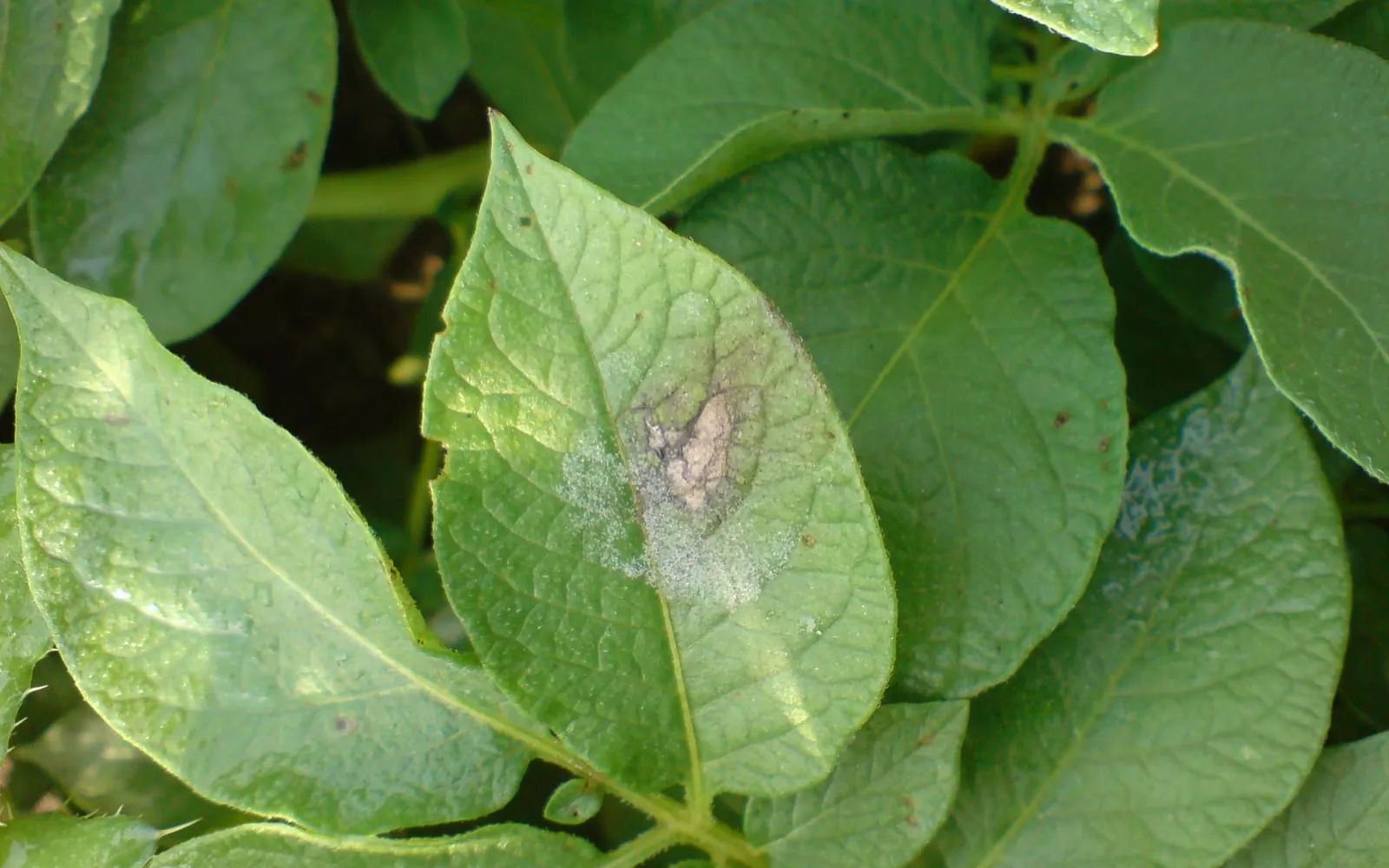 Blight
Photo by Bjorn Andersson (SLU), CC BY-SA 4.0. Resized from the original. 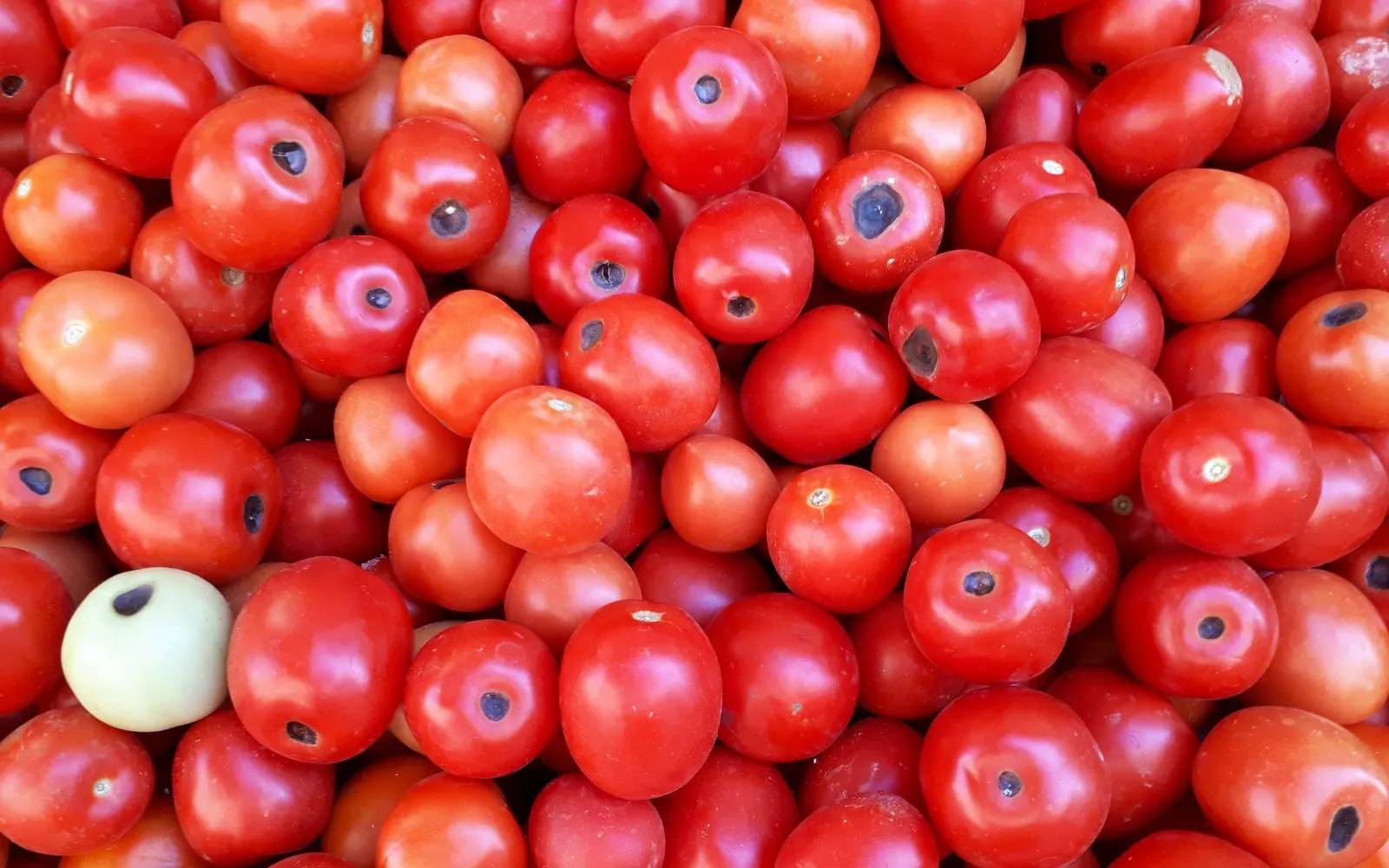 Blossom end rot
Photo by Fructibus, CC0. Resized from the original. 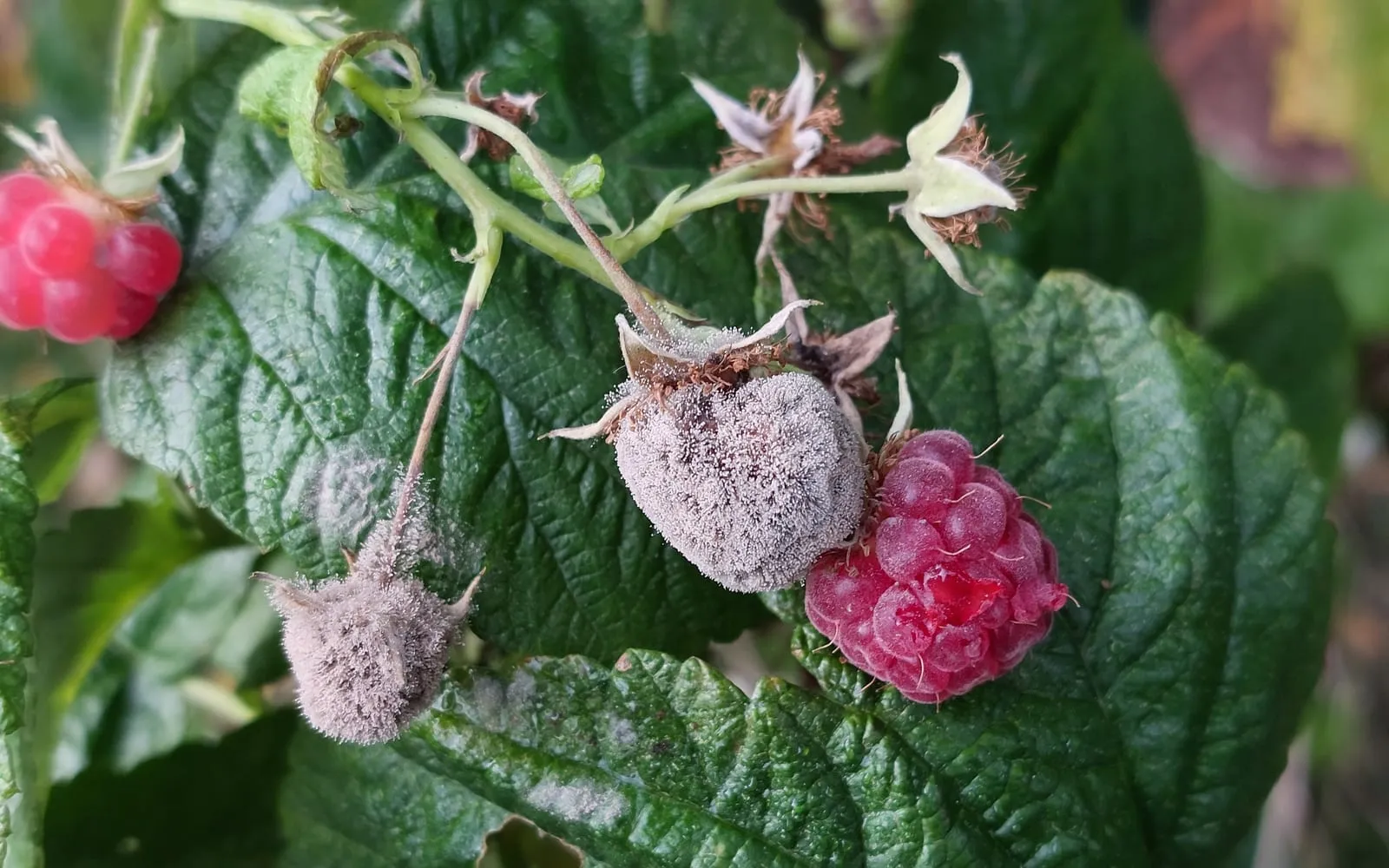 Grey mould
Photo by Schlaghecken Josef, CC BY 4.0. Resized from the original. 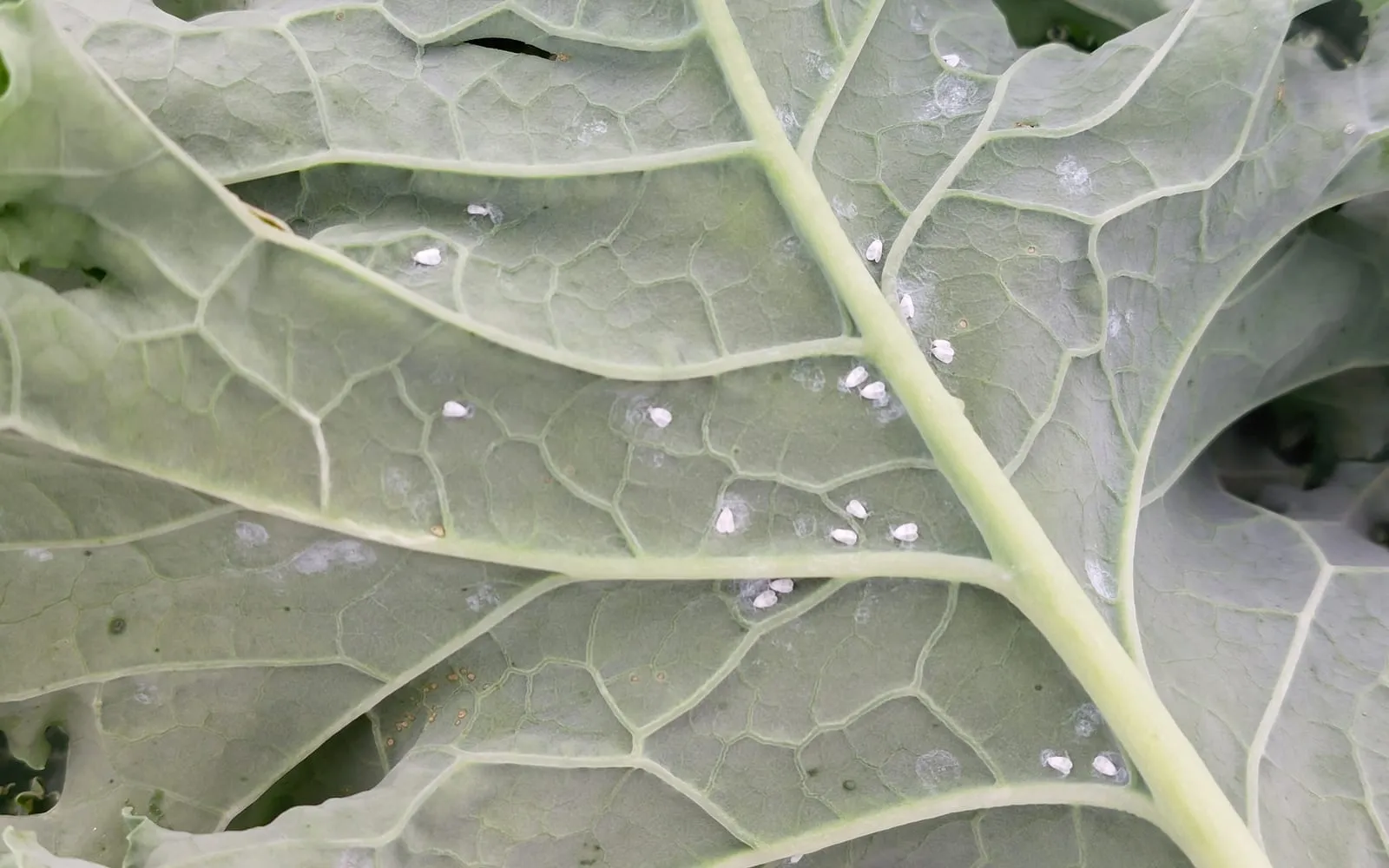 Whitefly
Photo by Schlaghecken Josef, CC BY-SA 4.0. Resized from the original. 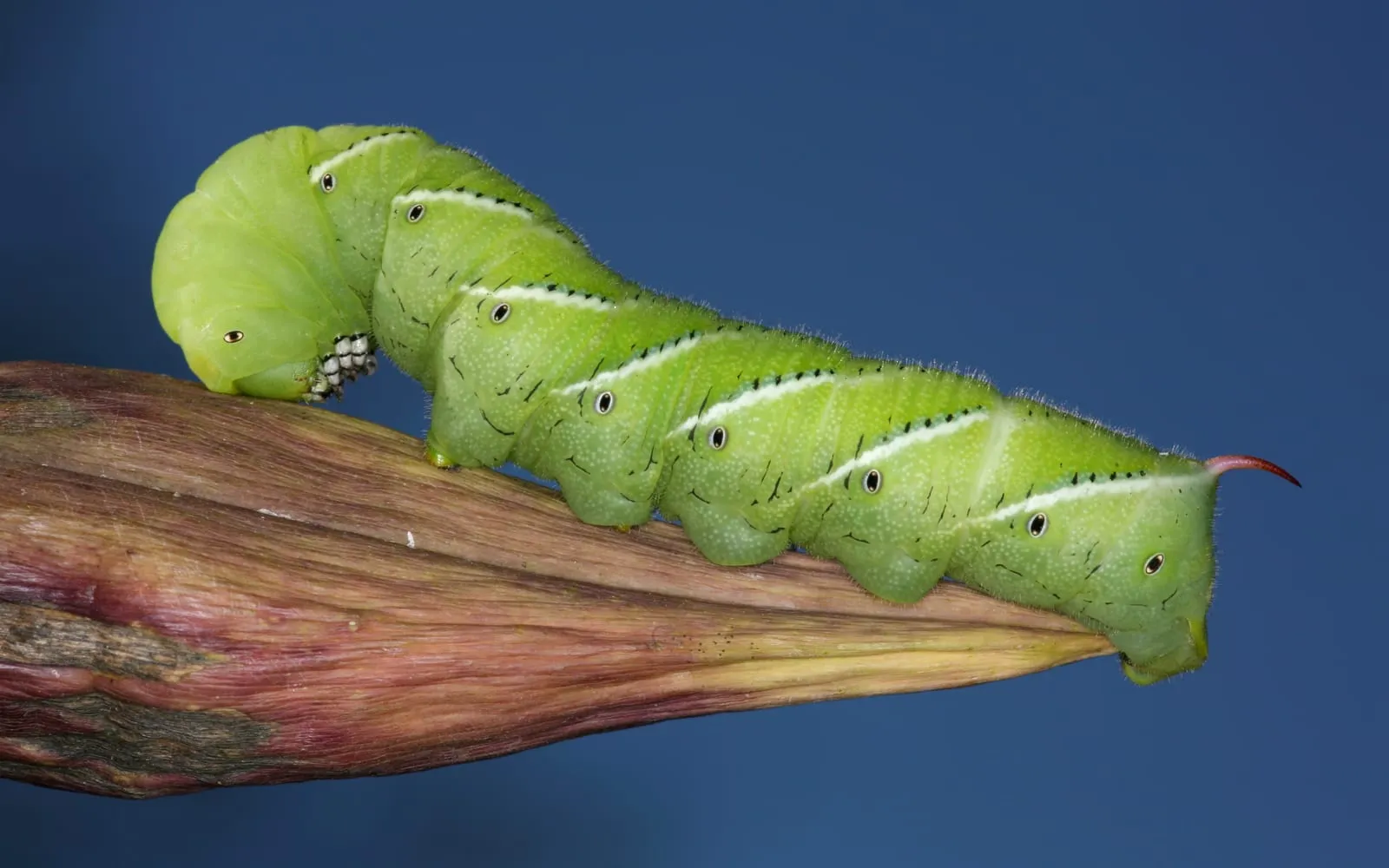 Tomato hornworm
Photo by Daniel Schwen, CC BY-SA 4.0. Resized from the original. 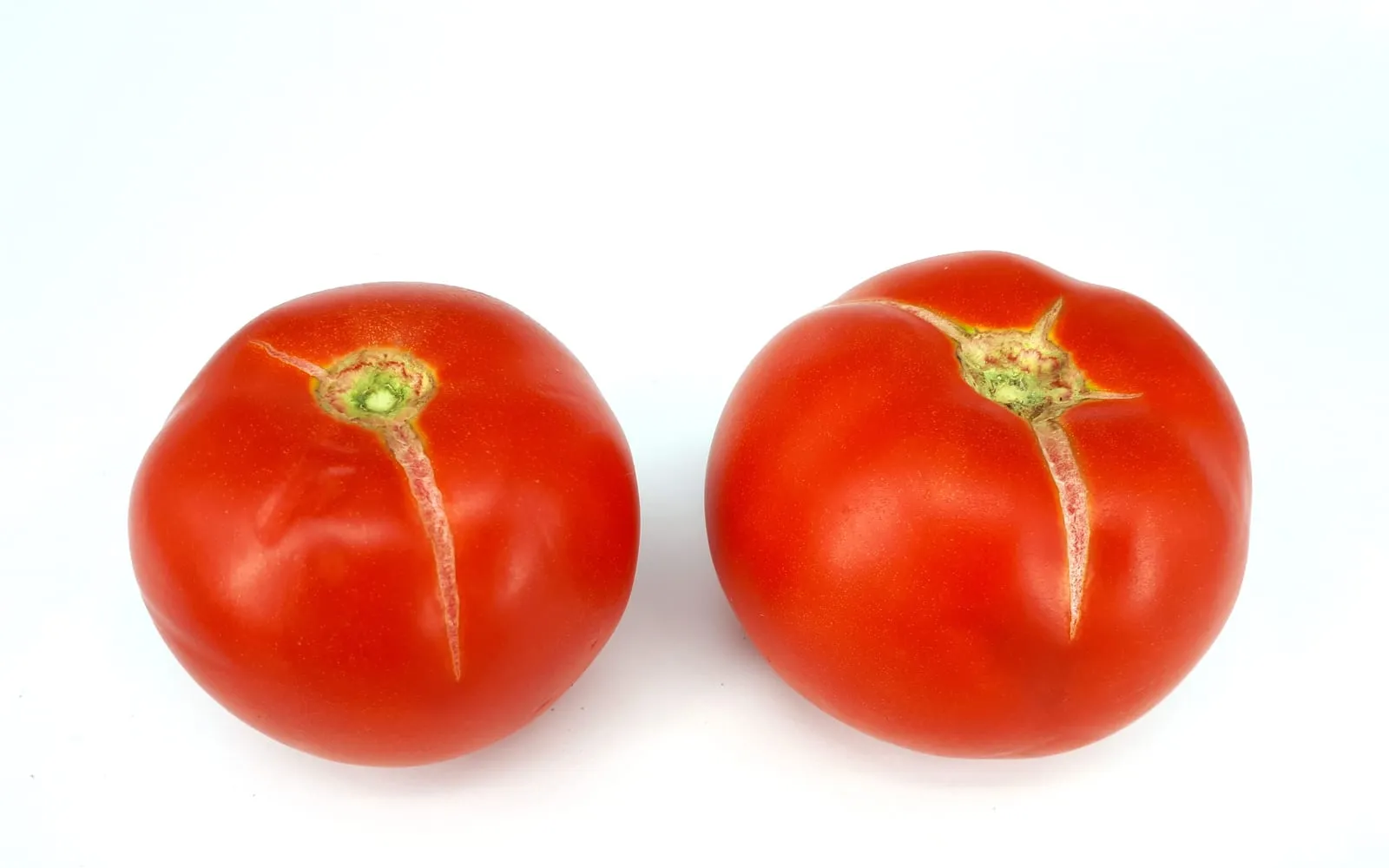 Fruit splitting
Photo by Fructibus, CC0. Resized from the original.
Sap-sucking pests
These insects and mites pierce tomato leaves and stems and feed on sap. The first sign is often sticky honeydew or fine speckling rather than the pest itself, since most sit under the leaves or near the growing tip. A light attack on a strong plant does little. Heavy feeding weakens growth, and several of these pests carry viruses, so keep numbers low.
Whitefly
Weakens the plantWatch on Greenhouse tomatoes, cucumbers and chilli peppers
Brush a greenhouse tomato and a cloud of tiny white insects lifts off the leaves and settles again. The adults sit under the youngest leaves near the growing tip. The young are flat translucent scales fixed to the leaf undersides, and they do most of the feeding. They drop sticky honeydew onto the trusses below, and black sooty mould follows. Glasshouse whitefly breeds all year under cover, weakens the plant and can carry viruses, so catch it before the leaves turn sticky.
How to identify and deal with whiteflyAphids
Weakens the plantWatch on Soft shoot tips and young leaves
Aphids gather on soft growing tips and the undersides of young tomato leaves, in green, black or pink colonies that sit still rather than flying up when disturbed. They breed fast in warm weather and coat the leaves below in honeydew, which then grows sooty mould. Direct feeding damage on an established plant is usually small. The greater risk is virus, since aphids can move cucumber mosaic and other viruses between plants quickly. Predators help more than a late spray.
How to identify and deal with aphidsRed spider mite
Destroys the crop or displayWatch on Leaves, worst under glass in hot dry air
Red spider mite makes tomato leaves look dull, then finely speckled with pale dots. It thrives in the hot dry air of a greenhouse, so plants near the glass or a vent often show symptoms first. Fine webbing across the shoot tips means the colony is already large. Turn a leaf over and tap it onto white paper to find the moving specks. Left alone under cover, the leaves bronze and drop, and the plant can lose most of its foliage in a month.
How to identify and deal with red spider miteThrips
Weakens the plantWatch on Young leaves and unfurling shoot tips
Thrips rasp tomato leaves and leave silvery or bleached patches with tiny black dots of excrement. The youngest leaves show it first and may come through puckered and scarred. An established plant can grow through light feeding. The reason to act is virus risk: thrips carry tomato spotted wilt, and a bronzed young plant with ringed fruit may already be infected. Blue sticky traps show whether thrips have arrived.
How to identify and deal with thrips
Leaf and fruit eaters
These pests remove visible tissue, from stripped leaves to holed fruit. Some feed at night and hide by day, so droppings, tunnels or the pattern of damage may identify them when the pest is out of sight. Hand-picking and a fine cover put on early deal with most of them. Leave any caterpillar already carrying wasp cocoons, because it has been parasitised.
Tomato hornworm
Destroys the crop or displayWatch on Leaves and green fruit, in the Americas
Tomato hornworm is a finger-thick green caterpillar up to 10 cm long, with pale diagonal stripes and a horn at the tail. It can strip whole tomato branches in a day or two and gouge green fruit. It hides well against the foliage, so dark pellet-shaped droppings on the leaves and soil are often the first sign. It is found across the Americas. Leave any hornworm carrying upright white cocoons, because a parasitic wasp has already stopped it feeding.
How to identify and deal with tomato hornwormCaterpillars
Destroys the crop or displayWatch on Leaves and fruit
Smaller caterpillars chew ragged holes in tomato leaves and bore into fruit, leaving dark pellets of frass on the foliage below. Under cover, the tomato moth caterpillar is a common cause. It is green or brown and feeds at night. In warmer regions, corn earworm and armyworms also tunnel into fruit. Count the fleshy prolegs to separate a true caterpillar from a sawfly larva, since the treatments differ. Hand-picking and a fine cover catch most of them, and any caterpillar dotted with small cocoons is already parasitised.
How to identify and deal with caterpillarsLeaf miners
Weakens the plantWatch on Leaves
A leaf miner is a grub living inside the leaf. It eats the green layer while both leaf surfaces stay intact. On a tomato it shows as pale winding tunnels or blotches, with a dark thread of droppings inside and a small grub at the growing end when the leaf is held to the light. Light mining does little harm to an established plant. Because the grub sits inside the leaf, a surface spray will not reach it. Remove mined leaves while numbers are low.
How to identify and deal with leaf miners
Diseases
Fungi, water moulds, bacteria and viruses spread fastest where leaves stay wet and air movement is poor. A crowded, humid greenhouse or a warm damp August outdoors gives many of them the conditions they need. Several have no cure once they take hold, so the detailed pages focus on prevention, airflow and resistant cultivars rather than on sprays that will not reach the problem.
Blight
Destroys the crop or displayWatch on Outdoor foliage and fruit
Late blight ends more outdoor tomato crops than anything else. Dark brown blotches spread from leaf tips and edges, brown streaks run up the stems, and firm leathery patches develop on the fruit, often from the shoulder down. In warm humid weather the whole plant can collapse within a week or two. There is no cure once it arrives, and marked fruit keeps rotting indoors. Grow a resistant cultivar, keep the foliage dry and raise tomatoes under cover where you can.
How to identify and deal with blightGrey mould
Destroys the crop or displayWatch on Stems, leaves and fruit under glass
Grey mould is a fuzzy grey-brown coat that puffs spores when touched. It starts on dead or wounded tomato tissue before moving into healthy growth. It often begins on a faded flower, a leaf scar or a pruning snag, then rots the stem or fruit. It can also leave pale ghost rings on otherwise sound skins. Still, damp air under glass favours it, so a heated but unventilated greenhouse is a high-risk place. Ventilation, spacing and clearing dead material help more than spraying.
How to identify and deal with grey mouldPowdery mildew
Weakens the plantWatch on Leaves, mainly under glass
Powdery mildew coats a tomato leaf in white or pale grey patches that wipe off on a finger, spreading until the leaf yellows, browns and drops early. It is most common under glass, on plants whose roots have run dry while the air stays humid, which is the reverse of most fungal disease. The plant is weakened rather than killed, though heavy defoliation cuts the crop short. Watering the roots well, mulching and moving air through the greenhouse hold it back better than reducing water, which is the common mistake.
How to identify and deal with powdery mildewFusarium wilt
Can kill the plantWatch on Whole plant, worst in warm soil
Fusarium wilt blocks the water-carrying tissue of a tomato from inside. The lowest leaves yellow first and the yellowing climbs, often on one side of the plant or one half of a leaf. The plant wilts in afternoon heat and recovers by morning, until one day it does not. Cut the stem across and a brown ring stains the wood well up from the base. It is worst in warm soil and there is no cure, so use resistant cultivars labelled F, or grafted plants, where a bed has a history.
How to identify and deal with fusarium wiltVerticillium wilt
Can kill the plantWatch on Whole plant, in cooler weather
Verticillium wilt looks much like fusarium, but it usually appears in cooler conditions and may slow once hot weather arrives. On a tomato it yellows the older leaves from the bottom up, wilts the plant by day, and stunts the crop. A cut stem shows a brown or olive stain in the wood. The fungus lives in the soil for many years and affects many hosts, so nothing cures an infected plant. Use grafted plants on resistant rootstocks, or grow in fresh compost in containers.
How to identify and deal with verticillium wiltTomato spotted wilt virus
Can kill the plantWatch on Young leaves and fruit
Tomato spotted wilt shows as pale or brown target-like rings on green or ripe fruit, with bronzed young leaves and dark streaks up one side of the stem. It is carried by thrips and there is no cure. Only thrips that fed on an infected plant as larvae can pass it on, so removing infected plants and clearing weeds that harbour the virus matters more than spraying adult thrips.
How to identify and deal with tomato spotted wilt virusMosaic virus
Destroys the crop or displayWatch on Leaves and fruit
Mosaic viruses mottle tomato leaves in irregular blocks of dark and pale green, with no clear edge and nothing growing on the surface. New leaves may come through puckered, blistered or narrowed to a fern-like strap. The fruit ripens unevenly and the plant stays stunted while its neighbours grow normally. Feeding or watering does not improve it, which is the clearest clue. Aphids carry many mosaic viruses, and tobacco mosaic spreads on hands and tools, so hygiene and removing infected plants are the main defences.
How to identify and deal with mosaic virusAlternaria leaf blight
Destroys the crop or displayWatch on Lower leaves and fruit
Alternaria, or early blight, makes dark brown spots on the oldest lowest tomato leaves. Each spot has a yellow halo and fine target-like rings inside it. The spots run together, the lower leaves collapse while still attached, and the damage climbs slowly over weeks while the growing tip stays green. Dark sunken lesions can form on the fruit at the stem end. Unlike late blight, it moves slowly and rarely destroys a crop. It travels on seed as well as on the wind, so clean seed and clearing old debris both help.
How to identify and deal with alternaria leaf blight
Disorders from watering and feeding
None of the problems in this group is a pest or an infection. Each is the plant responding to watering or feeding, which is why they are common in growbags and pots. A disorder is corrected by changing the growing conditions rather than by treating the plant. Most ease off once watering is steadier and the roots have more compost to grow through.
Blossom end rot
Destroys the crop or displayWatch on Fruit, the first truss most
Blossom end rot starts as a pale water-soaked patch on the base of a tomato, opposite the stalk. The patch darkens to brown or black, sinks a little and dries leathery while the rest of the fruit ripens normally. It is a calcium transport failure rather than a soil shortage. Swings between dry and drenched roots stop calcium reaching the fast-growing cells at the far end of the fruit. The first truss is usually worst. Steady watering and a larger volume of compost matter more than adding calcium, and long-fruited and plum types suffer most.
How to identify and deal with blossom end rotBlossom drop
Destroys the crop or displayWatch on Flowers, before fruit sets
Blossom drop means a tomato flowers freely but sets no fruit. The flowers yellow at the stalk and fall, leaving a clean scar. Tomato pollen works only within a band of temperature. It can fail below about 13 deg C at night or above about 30 deg C by day, so both cold spells and heatwaves can leave empty trusses. Very dry or very humid air also stops pollen shaking free, and too much nitrogen encourages leafy growth at the expense of fruit. Tap the trusses at midday and switch to a high-potassium feed.
How to identify and deal with blossom dropFruit splitting
Destroys the crop or displayWatch on Ripening fruit
Fruit splitting happens when a tomato swells faster than its skin can stretch. Radial cracks run down from the stalk scar after a surge of water, usually when a dry spell is followed by heavy rain or heavy watering. Fine rings around the shoulder come from swings in temperature and strong sun on exposed fruit. The largest, ripest fruit split first. The crack itself does little harm, but grey mould and brown rot can enter the wound within days, so pick split fruit and use it the same day.
How to identify and deal with fruit splittingNutrient deficiencies
Weakens the plantWatch on Leaves, older or younger by nutrient
Nutrient shortages show on tomato leaves as patterned yellowing, and the position on the plant helps identify the nutrient. Magnesium shortage is the most common. It yellows between the veins of older lower leaves and leaves a green herringbone, often with orange edges. Heavy high-potassium feed can bring it on. A whole plant that is pale and slow may be short of nitrogen. Much yellowing is not a shortage at all, since waterlogged roots, cold roots and exhausted compost can look similar. Check the roots and watering before feeding.
How to identify and deal with nutrient deficienciesDrought stress
Can kill the plantWatch on Whole plant in dry spells and containers
A wilting tomato may be short of water or drowning in it, and the two look identical from above. Put a finger in the compost before acting. Dry and light means drought; wet, heavy and sour means root rot, and watering it again will finish the plant. Drought browns the leaf edges crisply, yellows and drops the lower leaves, and sheds flowers and small fruit. A plant left to wilt hard again and again stops bouncing back. Water thoroughly and less often, mulch, and give containers enough volume to ride out a hot day.
How to identify and deal with drought stress
Preventing tomato problems
The same handful of habits prevents many of the problems above, and none of them is a spray. A tomato grown in clean ground, watered evenly, spaced well and fed at the right rate meets fewer problems and tolerates minor damage better. Prevention here means better growing conditions, not a product.
Start clean each year
Begin with fresh compost in containers, or use ground where tomatoes have not grown for a couple of years. Clear away the old crop completely at the end of the season. Blight, botrytis and wilt fungi can carry over on debris, old canes, string and soil, so empty and wash down a greenhouse between crops. Buy clean plants, since spotted wilt and mosaic often arrive on bought plants.
Give each plant room and take off the lower leaves
Air moving through the plant dries the leaves and reduces fungal disease. Space plants at the full distance, remove lower and crowded leaves through the season, and ventilate a greenhouse on any day warm enough for it. Removing the old leaves from the bottom of a cordon also removes settled whitefly and early blight or botrytis, which often begin low and climb.
Water evenly and mulch
Swings between very dry and very wet roots cause blossom end rot, split fruit and flower drop. Water steadily rather than heavily after a drought. A mulch over damp soil reduces those swings, especially in growbags and pots, which dry out and rewet faster than open ground. In a heatwave, shade and ventilate under glass to reduce stress on the plant.
Feed for fruit, not for leaf
Switch to a high-potassium tomato feed once the first truss has set, and feed at the rate on the bottle. Excess nitrogen gives soft growth that aphids, mildew and botrytis prefer, and it can make the plant drop its flowers. Overfeeding can also bring on magnesium shortage, because heavy potassium competes with magnesium at the root. A pale plant does not always need more feed.
Choose resistant cultivars
Variety choice matters before anything is sown. Blight-resistant tomatoes such as Crimson Crush or Mountain Magic can crop outdoors through a wet summer that badly damages older varieties. Cultivars labelled with an F, a V or Sw-5 resist fusarium, verticillium and spotted wilt. Where a bed or greenhouse border has a history of soil disease, choose a resistant cultivar or a grafted plant on a resistant rootstock.
Remove diseased plants promptly
A plant with a wilt fungus, a virus or blight will not recover. While it remains in place, it can shed spores or feed the insects that spread the infection. Pull it out with its roots as soon as you are sure, bag it and take it off the plot. Do not compost these plants, because a garden heap rarely gets hot enough to kill blight spores, viruses or the resting bodies of wilt fungi. Use household or municipal green waste instead.
Identify the problem before treating it. Many tomato marks are harmless or clear up once watering and growth improve, and disorders and diseases can look alike. Act only when the damage is likely to matter. Start with prevention and with physical or biological controls, and use sprays only as a last resort, since a broad one kills ladybirds and parasitoid wasps as well as pests.
Common questions
- What are the most common tomato problems?
- Blossom end rot, blight, whitefly, aphids and blossom drop are among the most common tomato problems, with grey mould, fruit splitting and magnesium shortage close behind. Which ones matter most depends on whether you grow under glass or outside and on how warm and wet the season is. Greenhouses see more whitefly, red spider mite and botrytis; outdoor crops in humid summers see more blight. Nearly every grower meets this core group at some point.
- Why has my tomato got a black patch on the bottom?
- A dark, sunken, leathery patch on the base of the fruit, opposite the stalk, is blossom end rot, and it is a disorder rather than a disease. The plant has failed to move enough calcium into the fast-growing far end of the fruit, almost always because the water supply at the root swung between dry and wet while that fruit was setting. The soil is rarely short of calcium. Water more steadily, give the roots a larger volume of compost, and feed at the stated rate. The rest of the fruit is safe to eat once the patch is cut away.
- How do I stop tomato blight?
- Blight cannot be cured once it is in the plant, so prevention matters most. Grow a resistant cultivar such as Crimson Crush, keep the foliage dry by watering at the base, and raise plants under cover where you can, since infection needs a film of water on the leaf. Keep tomatoes away from potatoes, which carry the same organism. Watch blight warnings for your area in warm humid spells. Once blight appears, pick fruit that has begun to colour and ripen it indoors, discarding any marked fruit.
- Why are my tomato leaves curling or turning yellow?
- Yellowing that starts on the lower leaves and works up, with a green herringbone of veins, is usually a magnesium shortage brought on by heavy tomato feed, and a foliar magnesium spray greens it up while you ease off the feed. Yellowing on one side of the plant with a brown stain in the cut stem is a wilt fungus, which has no cure. Rolling or curling leaves are often the plant reacting to heat or hard pruning and need no action, though a permanent mottle with distorted growth points to a virus and a plant to remove. Check the roots and the watering before feeding.
Sources
Compiled from these authorities. Each linked problem page carries its own sources as well.
- RHS: Tomatoes, growing your own
- RHS: Tomato blight
- RHS: Blossom end rot
- RHS: Tomato splitting and cracking
- RHS: Grey mould
- UC IPM: Fusarium wilt in tomato
Reviewed by Matthew Moughtin
Last reviewed
Cannot see your problem here? Search the whole library, or start from what the plant is showing you.