
Houseplant
Fiddle Leaf Fig
Ficus lyrata
Also known as Banjo fig, Fiddle-leaf fig
How to grow Ficus lyrata. Why it drops leaves when moved, telling root rot brown spots from sunburn ones, and how to make a single stem branch.
At a glance
- Difficulty
- Moderate
- Water
- When the top 3-5 cm is dry, roughly weekly in summer
- Light
- Bright indirect light, six hours. Some gentle morning sun is fine
- Temperature
- 16-27 deg C. Very sensitive to draughts and sudden changes
- Humidity
- Prefers above 40 per cent. Tolerates ordinary room air
- Hardiness
- USDA 10-12, RHS H1b, hardy to 13 C
- Type
- Evergreen tree
- Height
- 2-3 m indoors
- Native to
- The lowland rainforests of western Africa
- Best month
- July in the Northern Hemisphere, January in the Southern Hemisphere
Lowland rainforest in west Africa. It resents being moved more than most plants and drops leaves after a change of position, which owners then treat as a watering problem. Outdoors year round in USDA 10 and warmer, reaching 12 m.
Hardiness zones describe winter cold alone. Summer heat, humidity, rainfall and the length of the growing season decide as much, so treat the range as the outer limit rather than as a recommendation.
Every month named in this guide is for the temperate Northern Hemisphere. If you garden in the Southern Hemisphere, shift each one by six months, so July becomes January. Closer to the equator the wet and dry seasons matter more than the calendar, and the shift stops being a useful guide.
Harmful to pets if eaten
- Do not eat
- The milky sap in every part
- Harm from
- Eating it and handling it
- Affects
- Cats, dogs and horses
The ASPCA does not carry an entry for Ficus lyrata itself. It lists the sibling species Ficus benjamina, the weeping fig, as toxic to dogs, cats and horses through the proteolytic enzyme ficin and the compound psoralen, with gastrointestinal and skin irritation. The milky white latex that bleeds from a cut fiddle leaf fig stem is the same substance, so the sibling listing is the right guide here rather than direct evidence about this species. The RHS places Ficus benjamina in category C, noting it may cause a skin allergy and is harmful if eaten. In practice the risk is low and mostly about the sap rather than the leaves. It irritates skin and eyes on contact, so wash your hands after pruning and keep the latex away from your face. A cat or dog that chews a leaf may drool and be sick. Note also that the ASPCA page titled fiddle-leaf covers Philodendron bipennifolium, an unrelated plant, so searching that name gives the wrong entry.
Sources: ASPCA (Fig, Ficus benjamina), RHS potentially harmful garden plants
About
The fiddle leaf fig has a reputation for being temperamental, and the reputation is half deserved. It has one genuine weakness, which is that it hates change, and everything else about it is straightforward.
Move it across the room, change how often you water it, or put it near a door that opens onto a cold street, and it drops leaves. Leave it in one good spot with a consistent routine and it grows into a small tree.
In the wild it begins life very differently. A seed germinates high in the branches of another tree, the seedling sends roots down to the ground, and the fig eventually surrounds and kills its host. The plant on your living room floor is a strangler starting from the wrong end.
Appearance and character
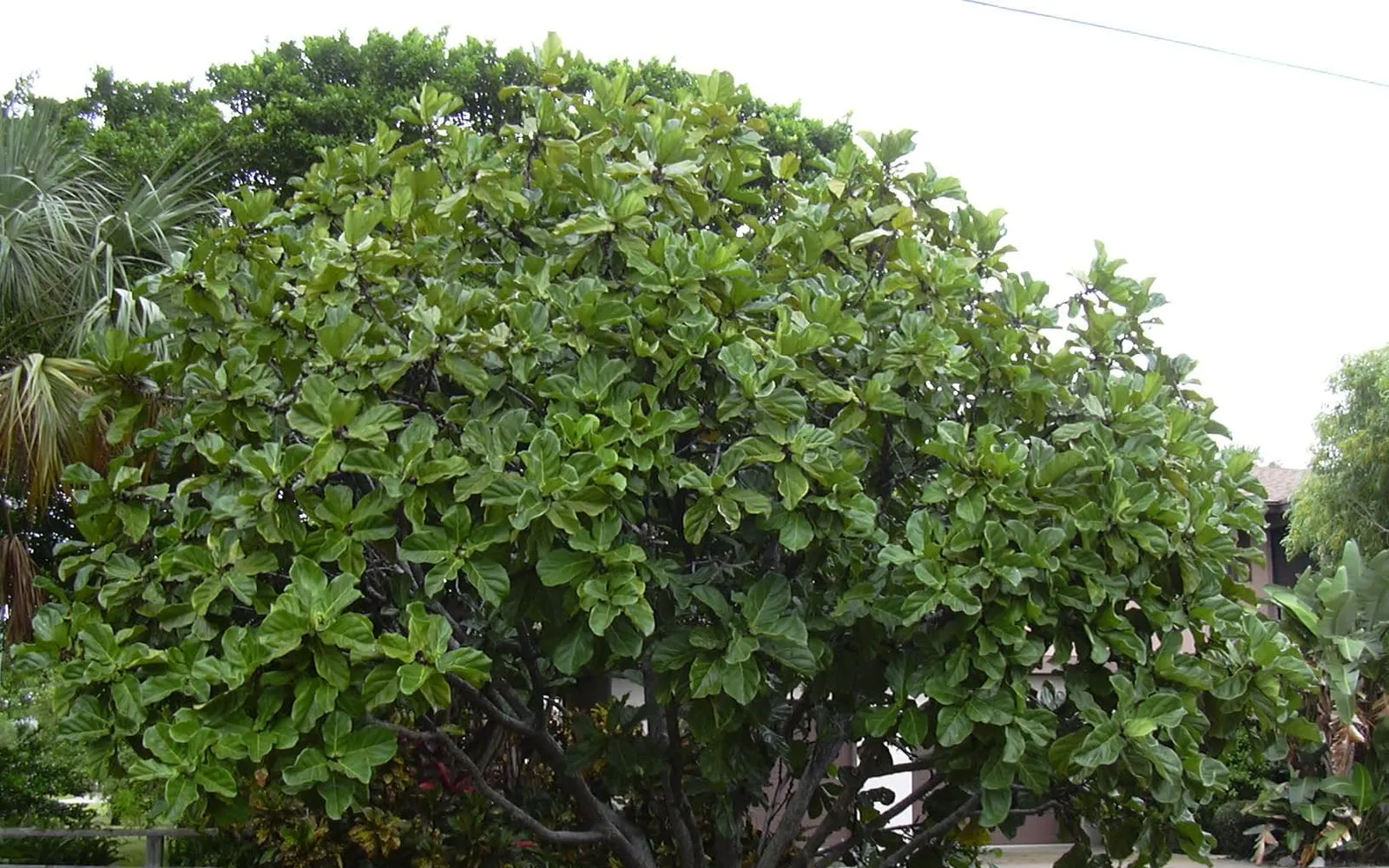
Very large leaves, up to 45 cm long, leathery and stiff, with prominent pale veins and wavy edges. The shape narrows in the middle and broadens at the tip, which is where the violin comparison comes from.
Growth is upright on a single woody stem unless something makes it branch. Indoors it reaches 2 to 3 m over years; in West African rainforest it becomes a 15 m tree.
Cutting or breaking any part releases a thick white latex. This is the ficin that gives the plant its toxicity listing, and it dries to a rubbery film.
New leaves emerge from a pale sheath at the growing tip, unfurling over several days. They are noticeably softer and lighter than mature leaves and darken as they harden off.
Where it is from
The lowland tropical rainforest of western Africa, from Cameroon west to Sierra Leone, in warm humid conditions with steady temperatures all year.
Nothing in that environment changes quickly, which is the origin of the plant’s intolerance for change. There are no cold draughts, no seasonal swings worth noticing, and no dry months.
Light in the canopy where it establishes is bright but filtered through leaves above, which translates indoors to a position near a window without direct midday sun on the foliage.
How it grows
An evergreen tree with a strongly apical habit, meaning the growing tip suppresses the buds below it and the plant runs straight up. Left alone you get a tall bare stem with leaves at the top.
Two techniques make it branch. Pruning the top removes the suppressing tip and usually produces two or three new shoots below the cut, and it is best done in spring. Notching is gentler: cut a small nick about a third of the way through the stem just above a dormant bud, and that bud often breaks into growth without losing any height.
Growth happens from spring to early autumn and stops in winter. A healthy plant puts out one new leaf every few weeks in summer.
Repotting is needed every two or three years, into a pot one size larger. It resents root disturbance, so do it in spring and disturb the rootball as little as possible.
Propagation from stem cuttings works, though slowly, and air layering is more reliable for a tall bare specimen.
Through the seasons
Spring is the time for anything disruptive. Repot, prune, notch and start feeding in April, when the plant has the vigour to recover.
Summer is growth. Water roughly weekly, feed monthly, wipe the leaves, and rotate the pot a quarter turn each month so it grows evenly rather than leaning.
Autumn slows. Stop feeding at the end of September, water less, and move the plant away from any window that will get cold.
Winter is a holding pattern. Keep it well away from radiators, cold glass and draughty doorways. Water sparingly. Expect no new growth, and do not treat the pause as a problem to be fixed with more water or feed.
Care difficulty
Moderate, and the difficulty is consistency rather than complexity.
Pick the position carefully before you bring the plant home, and then leave it there. Bright indirect light, away from doors, radiators and draughts. Moving a settled plant is the commonest cause of the leaf drop everyone complains about.
Water on the plant’s schedule rather than yours. Check the compost with a finger each week and water when the top few centimetres are dry, which will be more often in July than in January.
The third thing is patience with brown spots, since telling their causes apart determines whether you water more or less. Getting that backwards kills the plant.
Watering
Water when the top 3 to 5 cm of compost feels dry. In a warm room in summer that is about weekly; in winter it may be every two or three weeks.
Drench thoroughly until water runs from the drainage holes, then let it drain completely and empty the saucer. Half-watering leaves the lower rootball dry while the top stays wet.
Use room-temperature water. Cold water on tropical roots causes a check that shows up as leaf drop a fortnight later.
Consistency matters more than frequency. A plant watered lightly and often does worse than one drenched and then allowed to dry.
Sitting in water is fatal. This plant will not tolerate a pot without drainage.
Warning signs, diseases and pests
Root rot is what kills most fiddle leaf figs, and it follows overwatering or poor drainage. It shows as dark brown spots that start near the base of the plant and spread outward on the leaf, often with a yellow halo, accompanied by leaf drop and compost that stays wet. Unpot it, cut away any black mushy roots, repot into fresh free-draining compost, and water considerably less.
Sunburn produces a different mark. The patches are pale tan or bleached rather than dark, dry and papery to touch, and they appear on the leaves nearest the glass. The remedy is the opposite of the one for root rot, so identify the spots before acting.
Leaf drop after moving the plant, or from a cold draught, is a stress response. Restore stable conditions and wait. New growth resumes in spring.
Spider mites stipple the leaves and web the leaf joints in dry air. Wipe the leaves and rinse the plant.
Scale insects appear as small brown bumps on stems and leaf undersides with sticky honeydew beneath.
Mealybugs show as white cottony patches in the leaf joints.
Red or brown speckling on brand new leaves is usually oedema from uneven watering rather than disease, and it fades as the leaf hardens.
Growing environment
Bright indirect light for at least six hours. A position a metre or two back from a south or west window, or directly in an east-facing one, suits it. Gentle morning sun is tolerated. Harsh afternoon sun through glass scorches.
Warmth of 16 to 27 deg C, steady. Sudden changes are what it objects to, so keep it away from exterior doors, air conditioning, and the cold pane of a window in January.
Humidity above 40 per cent is preferred and ordinary room air is usually acceptable. A pebble tray helps in a centrally heated room in winter.
Compost must drain freely. A peat-free houseplant compost mixed with bark chips and perlite gives the open structure the roots want.
Wipe the large leaves with a damp cloth every month. Dust on a leaf this size measurably reduces the light reaching it.
Feeding
A balanced liquid houseplant fertiliser monthly from April to September. A formulation around 3:1:2 nitrogen to phosphorus to potassium suits foliage plants.
Stop feeding entirely from October to March.
Over-feeding causes brown leaf margins and a crust of salts on the compost. Flush the pot through with plain water if this appears.
Feed at half strength for a couple of months after repotting, since fresh compost carries its own nutrients.
Troubleshooting
Dark brown spots spreading from the leaf base, with wet compost. Root rot. Unpot, trim the dead roots, repot in fresh compost, and water much less.
Pale dry tan patches on leaves near the window. Sunburn. Move it back from the glass.
Dropped several leaves after I moved it. Stress from relocation. Put it somewhere suitable and then leave it alone. It recovers.
Tall bare stem with leaves only at the top. Natural apical growth. Prune the top in spring, or notch above a dormant bud to make it branch.
New leaves much smaller than the old ones. Not enough light, or not enough feed during the growing season.
Leaves drooping with dry compost. Underwatering. Drench it thoroughly.
Nothing has grown since October. Normal winter dormancy. Do not compensate with extra water or feed.
Red speckles on a brand new leaf. Oedema from uneven watering. It fades as the leaf matures.
Fiddle Leaf Fig problem guides
Not sure what is wrong? See the common houseplant pests guide.