
Houseplant
Alocasia
Alocasia amazonica
Also known as Amazonian elephant's ear, African mask plant, Alocasia Polly
How to care for Alocasia x amazonica. Recognising winter dormancy rather than death, getting the watering right, treating spider mite, and why it drips water.
At a glance
- Difficulty
- Difficult
- Water
- When the top 3-4 cm of compost has dried
- Light
- Bright indirect light, and never direct sun
- Temperature
- 18-25 deg C. Never below 15 deg C
- Humidity
- High. This is the requirement that decides success
- Hardiness
- USDA 10-12, RHS H1b, hardy to 15 C
- Type
- Evergreen perennial from a corm, dormant in winter
- Height
- 45-90 cm indoors
- Native to
- A nursery hybrid, from parents in tropical south-east Asia
- Best month
- January in the Northern Hemisphere, July in the Southern Hemisphere
Tropical Asia, on a wet and dry cycle. A plant that drops every leaf in winter is usually going dormant rather than dying, and the rhizome will reshoot if kept barely moist and warm. Outdoors year round in USDA 10 and warmer.
Hardiness zones describe winter cold alone. Summer heat, humidity, rainfall and the length of the growing season decide as much, so treat the range as the outer limit rather than as a recommendation.
Every month named in this guide is for the temperate Northern Hemisphere. If you garden in the Southern Hemisphere, shift each one by six months, so January becomes July. Closer to the equator the wet and dry seasons matter more than the calendar, and the shift stops being a useful guide.
Toxic if eaten
- Do not eat
- Every part, and the sap and corm most of all
- Harm from
- Eating it, handling it and sap in the eyes
- Affects
- People, cats and dogs
Alocasia belongs to the arum family and carries the same defence as dieffenbachia and philodendron. The tissue is packed with calcium oxalate raphides, microscopic needle-shaped crystals held under pressure, and chewing any part fires them into the soft tissue of the mouth. The ASPCA lists Alocasia as toxic to cats and dogs. The result is immediate intense burning of the lips, tongue and throat, drooling, difficulty swallowing and vomiting, and swelling severe enough to affect breathing in rare cases. The pain is immediate and severe, which usually stops a child or an animal after a single mouthful. Sap on skin causes irritation, and in the eye it is genuinely painful and should be flushed with water for fifteen minutes. Wear gloves when dividing the corms or taking offsets, and wash your hands afterwards. The corm holds the highest concentration, which matters because repotting is when most people handle it. One related point often causes alarm and is entirely harmless. Alocasia leaves push out droplets of water at their tips and margins, especially at night, through a process called guttation. That liquid is sap rather than dew and it carries the same compounds in dilute form, so wipe up the drips and keep them off surfaces a pet licks.
Sources: ASPCA (Elephant's Ear, Alocasia), RHS potentially harmful garden plants
About
January is when most alocasias get thrown away, and most of them are not dead.
The plant grows from a corm, and in a cool winter it does what it would do in a dry season at home. It drops its leaves one by one, sometimes all of them, and sits underground doing nothing until the light returns in March. An owner who keeps watering a leafless pot at the same rate rots the corm, and an owner who throws it out loses a plant that was about to come back.
The rest of the difficulty is humidity and spider mite, which are the same problem. Alocasia wants air far damper than a centrally heated room provides, and red spider mite thrives in exactly the dry warmth that stresses the plant.
Appearance and character
An evergreen perennial growing from an underground corm, forming a clump of upright stalks 45 to 90 cm tall indoors.
Each stalk carries a single large leaf, which is what gives the plant its architectural, almost artificial look.
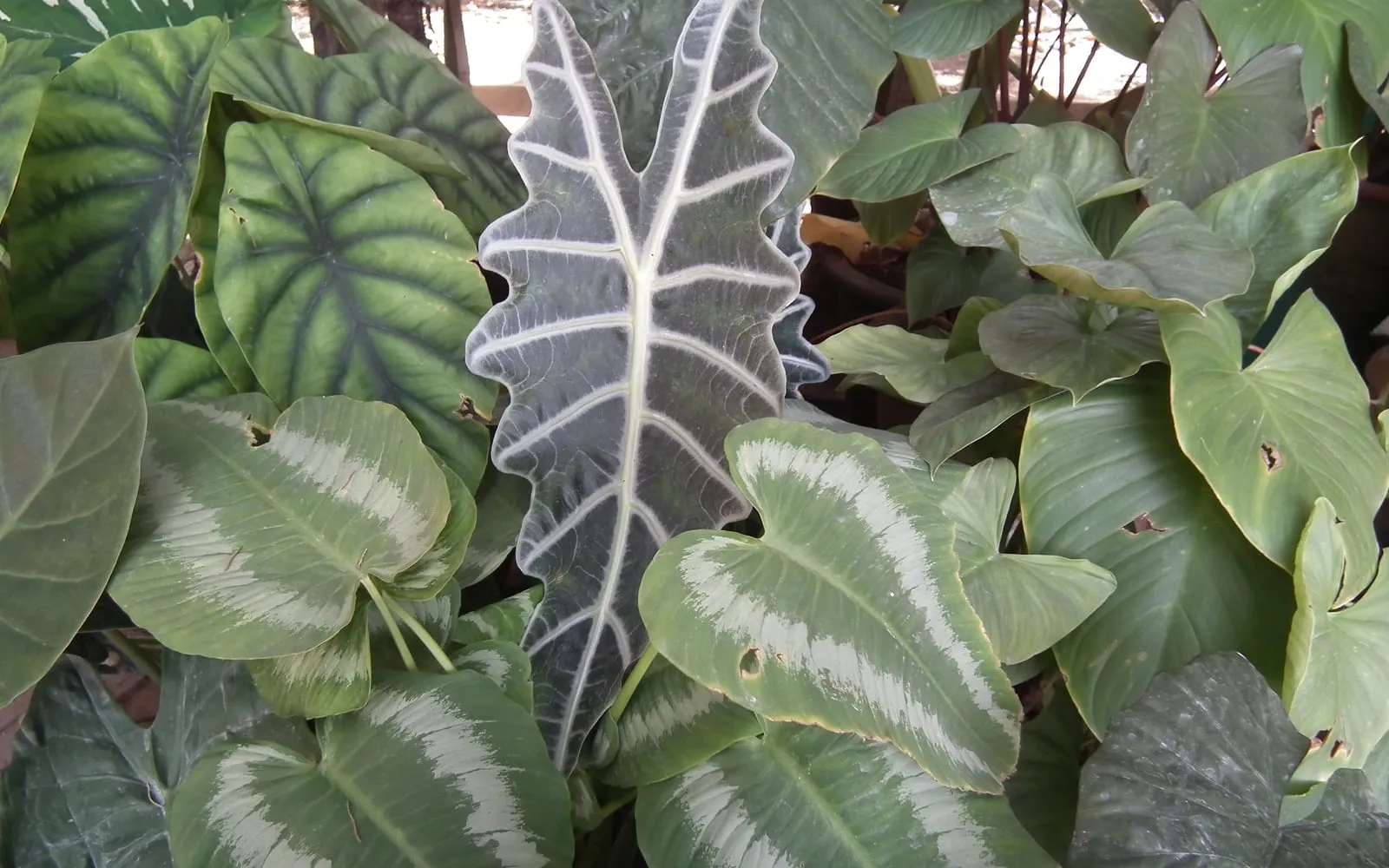
Leaves are the whole point. Arrow or shield-shaped, 20 to 40 cm long, very dark green with a metallic sheen, and cut into a deeply scalloped wavy margin.
The veins are picked out in bold ivory-white and stand proud of the surface, which is where the name African mask comes from.
The underside is usually flushed purple.
Stalks are thick, upright and often mottled.
Flowers appear occasionally as a pale green spathe around a spadix, in the manner of a peace lily. They are unremarkable and worth removing, since they take energy from the leaves.
The corm sits below the compost and produces offsets, which are how the plant is propagated.
Related plants are grown the same way. Alocasia zebrina has striped stalks and plain leaves, Alocasia ‘Black Velvet’ is small with matt near-black foliage, and Alocasia macrorrhizos is the giant.
Where it is from
A nursery hybrid rather than a wild plant, despite the name. Alocasia x amazonica was raised in the 1950s at a Florida nursery, and the Amazon has nothing to do with it. The parents, Alocasia longiloba and Alocasia sanderiana, both come from south-east Asia.
Alocasia sanderiana is native to the Philippines, where it is now critically endangered in the wild while being propagated by the million in cultivation.
The wild parents grow on the floor of humid tropical rainforest, in constant warmth, deep shade under a canopy and very high humidity.
That habitat explains everything. Filtered light rather than sun, warmth without seasonal cold, and air far damper than any heated house in winter.
The corm is a survival organ for the dry season, and it is why the plant goes dormant rather than dying when conditions turn against it. A cool dim winter reads to the plant as a dry season.
How it grows
Position it in bright indirect light. An east-facing window, or a metre or two back from a south-facing one, suits it. Direct sun scorches the leaves.
Keep it warm and steady, 18 to 25 deg C, and never below 15 deg C.
Raise the humidity, which is the requirement that decides whether an alocasia thrives or limps along. A humidifier is the effective answer, and a pebble tray or grouping with other plants helps. Misting does very little.
Use a very open mix. Ordinary houseplant compost with a third added orchid bark and perlite, or a coir-based aroid mix. A dense peat-free compost holds too much water around the corm.
Water when the top 3 to 4 cm of compost has dried, thoroughly, letting it drain completely.
Cut watering right back in winter. From November to February the plant is barely growing and may be dormant. Water perhaps every three weeks, just enough to stop the corm shrivelling.
Feed monthly from April to September at half strength, and not at all in winter.
Wipe the leaves regularly with a damp cloth. It removes dust and is the earliest warning of spider mite.
Repot every two years in spring, into a pot only slightly larger. Alocasia flowers and grows better slightly snug.
Divide the offsets from the corm at repotting to make new plants, wearing gloves.
Remove yellowing leaves at the base with clean scissors. Each stalk carries one leaf and does not regrow it.
Through the seasons
Winter is the hard part. Growth stops, leaves yellow and drop, and the plant may go fully dormant. Water very sparingly, stop feeding, keep it warm, and do not throw it away.
Spring is the return. New shoots push up from the corm in March. Repot now, resume feeding, and increase watering as growth restarts.
Summer is the growing season. Water when the surface dries, feed monthly, keep humidity high, and check weekly for spider mite.
Autumn is the wind-down. Reduce watering and feeding from October and move the plant away from cold glass and draughts.
Care difficulty
Difficult, and it earns the rating for two reasons rather than any single hard requirement.
Winter dormancy is misread as death by most first-time owners, who either overwater a resting corm or discard a plant that would have returned.
Red spider mite finds alocasias faster than almost any other houseplant, and a heavy infestation on a plant this size is very hard to clear.
Humidity is the underlying condition. A plant kept properly humid resists mite and holds its leaves through winter far better.
The plant itself grows quickly and recovers well when the conditions are right.
Watering
Water when the top 3 to 4 cm of compost has dried, which in summer usually means weekly.
Water thoroughly until it drains, then empty the saucer. Never leave the pot standing in water.
Reduce watering sharply from November, to perhaps every three weeks, and give a dormant leafless plant only enough to keep the corm from shrivelling.
Use tepid water. Cold water on the roots checks a tropical plant.
Rainwater or filtered water reduces the brown tips that hard tap water causes.
Yellowing leaves with wet compost mean overwatering. Drooping with dry compost means thirst, and the plant recovers within hours.
Warning signs, diseases and pests
Losing every leaf in winter is usually dormancy rather than death. Stop watering almost completely, keep the pot warm, and wait. Check the corm by feeling through the compost. A firm corm will reshoot in spring, and a soft mushy one has rotted.
Red spider mite is the pest that ruins alocasias. Look for fine pale stippling on the upper leaf surface, a dull dusty appearance, and fine webbing between the stalks and along the leaf undersides. It multiplies fast in dry heat. Raise the humidity, shower the plant, wipe every leaf, isolate it, and treat repeatedly. Catching it early is everything.
Brown crispy edges and tips mean the air is too dry, or the tap water is hard, or the plant has been overfed.
Yellowing lower leaves one at a time is normal ageing. Each stalk produces one leaf, and older ones are shed as new ones come.
Sudden collapse with a soft stalk base is root or corm rot from cold wet compost. Unpot, cut away rotted tissue, and repot any firm corm into fresh open mix.
Drooping leaves usually mean thirst, and occasionally the opposite, so check the compost before watering.
Water droplets at the leaf tips are guttation and are normal. Wipe them up.
Growing environment
Bright indirect light. An east-facing window is close to ideal, and direct summer sun scorches the foliage.
Warmth of 18 to 25 deg C, and never below 15 deg C. Cold is what triggers leaf drop.
High humidity, which matters more than anything else. A humidifier is the reliable solution, and a bathroom with good light works well.
Away from radiators, draughts, external doors and cold glass.
A very open free-draining mix with bark and perlite, in a pot with drainage holes only slightly larger than the rootball.
Out of reach of pets and small children, since the sap burns the mouth.
Somewhere you will notice it, since the leaves are the reason to own it and a plant tucked in a corner is a plant whose spider mite goes unspotted.
Feeding
Feed monthly from April to September with a balanced liquid houseplant fertiliser at half the stated strength.
Stop feeding entirely from October to March. A resting plant cannot use it and the salts build up.
Repot every two years in spring into fresh open mix, which does more than feeding.
Flush the compost through with plain water occasionally to clear fertiliser salts, which contribute to brown tips.
Resume feeding only once new growth appears in spring.
Troubleshooting
It dropped all its leaves in winter. Is it dead? Probably not. Alocasia grows from a corm and goes dormant in low light and cool conditions. Stop watering almost entirely, keep it warm, and wait for spring. Feel for the corm. Firm means alive, soft means rotted.
Fine speckling on the leaves and webbing between the stalks. Red spider mite, which finds alocasias very readily. Raise the humidity, shower and wipe the plant, isolate it, and treat repeatedly.
Brown crispy edges. Dry air, hard tap water, or overfeeding. Raise the humidity and use filtered water or rainwater.
Water is dripping from the leaf tips. Guttation, which is normal. It is sap rather than dew, so wipe it up and keep it off surfaces a pet licks.
A leaf has yellowed and drooped. Each stalk carries one leaf for a limited time. Losing the oldest one occasionally is normal. Losing several at once points to watering or cold.
How often should I water it? When the top 3 to 4 cm has dried, roughly weekly in summer and every three weeks or less in winter.
Should I mist it? Misting achieves very little. A humidifier or a pebble tray raises the humidity in a way that lasts.
Is it safe around a cat? No. The sap contains calcium oxalate crystals that cause severe mouth pain and swelling. Keep it out of reach.
Alocasia problem guides
Not sure what is wrong? See the common houseplant pests guide.