
Edible
Chilli Pepper
Capsicum annuum
Also known as Chili, Sweet pepper, Bell pepper, Cayenne
How to grow chilli peppers, Capsicum annuum. Sowing early enough, where the heat sits in the fruit, overwintering a plant, and what to do about capsaicin on your hands.
At a glance
- Difficulty
- Moderate
- Water
- Regularly, keeping the compost evenly moist but never sodden
- Light
- Full sun, and as much of it as possible
- Temperature
- 20-30 deg C. Growth stops below 12 deg C and frost kills it
- Hardiness
- USDA 9-11, RHS H1c, hardy to 2 C
- Type
- Tender perennial, grown as an annual where frost comes
- Height
- 45-90 cm, varying widely by variety
- Native to
- Central America and Mexico
- Best month
- February in the Northern Hemisphere, August in the Southern Hemisphere
Growth stops below 12 deg C and the flowers drop above about 32, which leaves a working band narrower than a tomato's. Heat itself raises capsaicin, so the same cultivar is hotter from a hot dry season than from a cool wet one. In the tropics it is a short-lived perennial and cropping for three or four years is normal.
Hardiness zones describe winter cold alone. Summer heat, humidity, rainfall and the length of the growing season decide as much, so treat the range as the outer limit rather than as a recommendation.
Every month named in this guide is for the temperate Northern Hemisphere. If you garden in the Southern Hemisphere, shift each one by six months, so February becomes August. Closer to the equator the wet and dry seasons matter more than the calendar, and the shift stops being a useful guide.
Skin irritant
- Safe to eat
- The fruit
- Harm from
- Eating it, handling it and sap in the eyes
- Affects
- People, cats and dogs
Chillies are food, and the compound that makes them hot is a genuine irritant worth respecting. Capsaicin binds to the same receptor that responds to physical heat, which is why the sensation is burning rather than a taste. It is concentrated in the pale pith and the placental tissue holding the seeds rather than in the seeds themselves, so removing the pith is what reduces the heat. Capsaicin is oil-soluble and water will not wash it off. Handling hot varieties without gloves leaves it on the skin for hours, and transferring it to the eyes is intensely painful and can scratch the cornea through rubbing. Wear disposable gloves for anything above a jalapeno, and remove it from skin with oil, milk or washing-up liquid rather than water. Cats and dogs experience the same burning and will drool, vomit and paw at the mouth after biting a fruit, and the ASPCA notes irritation rather than serious poisoning. Never cut chillies near an open eye, and keep plants of hot varieties out of a small child's reach.
Sources: RHS potentially harmful garden plants, NC State Extension, Capsicum annuum
About
Sweet peppers and fiery chillies are the same species. Capsicum annuum covers bell peppers, jalapenos, cayenne, poblano and padron, and the difference between a bland salad pepper and something that hurts is a handful of genes controlling capsaicin production. It is one of five Capsicum species domesticated in the Americas, and the mildest of the five in most of its everyday varieties.
The critical decision in a short season is the sowing date. Chillies need a long season, often 100 to 150 days from planting out to a ripe red fruit, and a plant sown in April will still be carrying green fruit when the light goes in October. Sow in February.
Everything else follows from warmth. This is a plant of Central American lowlands, and a cool summer barely satisfies it outdoors.
Appearance and character
A bushy branching plant, 45 to 90 cm depending on variety, with stems that turn woody at the base as the season goes on.
Leaves are oval, pointed and glossy mid-green, sometimes flushed purple in ornamental varieties.
Flowers are small, white or greenish-white, with five or six pointed lobes and purple anthers. They are self-fertile and set readily.
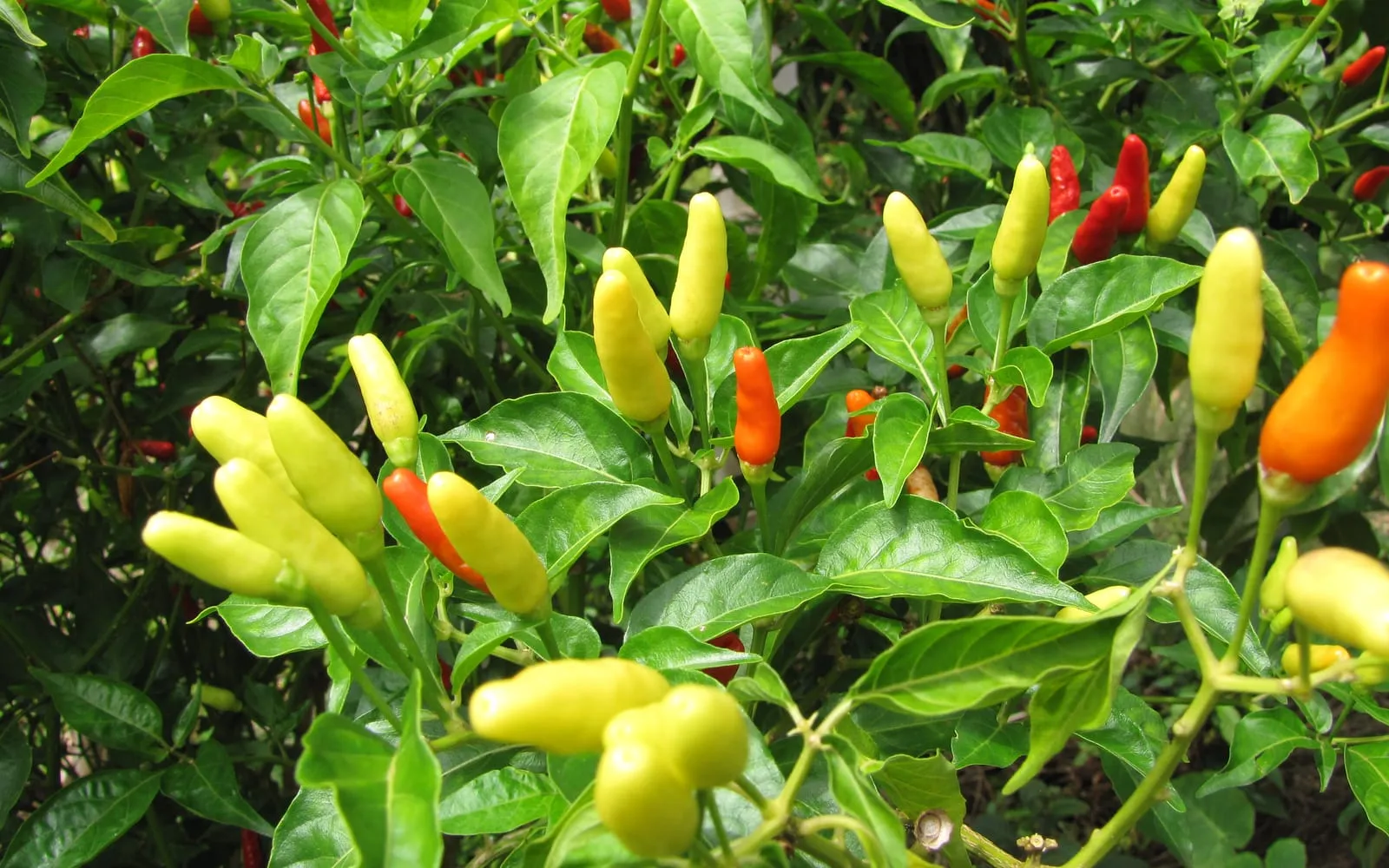
Fruit varies enormously. Blocky bells, long tapering cayennes, squat jalapenos, tiny upright bird’s eyes, all in green ripening to red, yellow, orange, purple, brown or near-black.
Every chilli is green before it ripens. Ripe fruit is sweeter, hotter and better-flavoured, which is the argument for sowing early enough to get there.
Where it is from
Central America and Mexico, where Capsicum annuum was domesticated at least six thousand years ago and where the wild ancestor, the tiny fiery chiltepin, still grows.
Capsaicin evolved as a defence against mammals, whose molars destroy seeds, while leaving birds unaffected because they lack the receptor it binds to. Birds swallow the fruit whole and distribute the seed intact.
Columbus took them to Europe in 1493 and they spread across Asia and Africa within a century, faster than almost any other New World crop. Indian, Thai, Sichuan and Hungarian cooking all rest on a plant that reached them after 1500.
The native climate is warm, bright and humid, with a long frost-free season. Where summers are cool that means a greenhouse, a polytunnel or a sunny windowsill for anything other than the quickest cultivars.
How it grows
Sow indoors from late January to early March, in a propagator at 21 to 25 deg C. Chilli seed germinates slowly and unevenly and hates cold compost.
Germination takes one to three weeks, and longer for the very hot varieties. Bottom heat makes the difference between a good and a poor strike rate.
Pot on as the plants grow, into 9 cm pots and then into their final 20 to 30 cm pot or growbag.
Grow on somewhere warm and bright. Cool nights early on stall the plants and set the season back.
Plant into their final position in May, keeping them under cover unless you have a sheltered sunny wall and a quick variety.
Pinch out the growing tip at about 20 cm to encourage branching, which gives more flowers and a sturdier plant.
Flowering starts in June, and fruit follows. Green fruit is edible; ripe fruit takes another three to six weeks and is worth waiting for.
Through the seasons
Late winter is sowing. Get seed in from late January to early March with bottom heat. This is the decision that determines the whole season.
Spring is potting on and growing under cover. Keep the plants warm and bright, and harden them off carefully before moving them out.
Summer is the crop. Feed weekly with high-potassium fertiliser once flowering starts, water evenly, ventilate the greenhouse, and watch for red spider mite.
Autumn ends outdoor growing. Pick everything before the first frost. Green fruit ripens indoors on a windowsill, and whole plants can be cut and hung upside down to finish.
Care difficulty
Moderate, and the difficulty is climate rather than technique.
Heat is the whole problem. Below about 12 deg C the plants sit and sulk, and below 15 deg C fruit sets badly. A greenhouse or polytunnel makes chillies easy and an exposed garden makes them frustrating.
Season length is the second issue. Ripening a habanero outdoors in a cool summer is unrealistic, and a jalapeno or cayenne is achievable.
Watering needs consistency. Swings cause blossom end rot and fruit drop.
Red spider mite is the standard greenhouse pest and thrives in exactly the hot dry conditions the plants want.
Watering
Keep the compost evenly moist through the growing season, watering thoroughly and letting the surface dry before the next.
Never leave the pot standing in water. Chillies rot at the root faster than tomatoes.
Reduce watering as the fruit ripens. Slightly drier conditions late in the season concentrate the flavour and, in hot varieties, the heat.
Water at the base rather than over the foliage.
Raise the humidity by damping down the greenhouse floor in hot weather, which also discourages red spider mite.
Overwintered plants need very little water, just enough to stop the compost drying out completely.
Warning signs, diseases and pests
Flowers dropping without setting fruit means the temperature is wrong. Below about 15 deg C or above 32 deg C the pollen fails. Ventilate a hot greenhouse and be patient in a cold spell.
Blossom end rot appears as a dark sunken leathery patch at the base of the fruit, caused by irregular watering rather than a soil deficiency. Water evenly.
Red spider mite produces fine pale stippling on the leaves and, in bad cases, webbing between the stems. It thrives in hot dry air. Raise the humidity and introduce the predatory mite Phytoseiulus persimilis under glass.
Aphids cluster on the soft growing tips and spread virus.
Whitefly rise in clouds when the plant is disturbed and coat it in sticky honeydew.
Grey mould rots ripening fruit in damp still conditions. Ventilate.
Leaves curling upward without discolouration is usually a heat response rather than a problem.
A plant that stayed small and pale all season was sown too late, kept too cold, or both.
Tomato hornworm, a finger-thick green caterpillar with diagonal white stripes, strips outdoor plants across North and South America and can gouge the fruit as well as the leaves. Hand-pick daily through summer, but leave any caterpillar carrying small white cocoons alone, since a parasitic wasp has already dealt with it.
Corn earworm bores a single hole into the fruit and feeds inside it out of sight. It is confined to the Americas, where a closely related species fills the same role elsewhere under the name cotton bollworm. Cut away the damaged part of an affected fruit; the rest is fine to eat.
Queensland fruit fly stings ripening fruit invisibly and can turn it into a collapsing maggot-riddled mass within days. It is established across eastern Australia and parts of the Pacific; Western Australia, South Australia and New Zealand maintain pest-free status and treat a find as an eradication matter. Net outdoor plants and never move home-grown fruit out of a quarantine area.
Growing environment
Full sun, and as much as you can give. A greenhouse, polytunnel, conservatory or south-facing windowsill all work.
Minimum 15 deg C for good growth, and 20 to 30 deg C is the productive range.
Free-draining, moderately fertile compost. Use a good multipurpose compost with added grit, or a loam-based John Innes No. 2 for larger plants.
A final pot of 20 to 30 cm, or two plants to a growbag.
Support taller varieties with a cane once they carry fruit, since a laden branch snaps.
Choose the variety to fit the site. ‘Hungarian Hot Wax’, ‘Jalapeno’ and ‘Cayenne’ ripen readily in a short season. Habaneros and the superhots need a heated greenhouse and a very long season.
Feeding
Feed weekly with a high-potassium tomato fertiliser from the moment the first flowers open.
Before flowering, use a balanced feed sparingly. Too much nitrogen early gives a large leafy plant and little fruit.
Container plants depend entirely on liquid feed once the compost is exhausted, which happens by midsummer.
Magnesium deficiency, showing as yellowing between the veins on older leaves, is common on a heavy potassium regime. Epsom salts as a foliar spray corrects it.
Stop feeding in autumn as the plant winds down.
Troubleshooting
Flowers keep dropping. Temperature. Below 15 deg C or above 32 deg C the pollen fails. Ventilate in heat, and wait out a cold spell.
The fruit is still green in October. Sown too late. Pick it and ripen it on a windowsill, or hang the whole plant upside down indoors. Sow in February next year.
Dark sunken patch at the end of the fruit. Blossom end rot from uneven watering. Water consistently.
Fine pale speckling and webbing on the leaves. Red spider mite. Raise the humidity and damp down the floor.
The chillies are not hot enough. Heat rises with sun, with ripeness, and with slight water stress late in the season. It is also largely fixed by the variety.
How do I make them less hot in cooking? Remove the pale pith and the placenta the seeds attach to. That is where the capsaicin sits, rather than in the seeds.
I have chilli on my hands and water will not shift it. Capsaicin is oil-soluble. Use oil, milk or washing-up liquid. Wear gloves next time and keep your hands away from your eyes.
Can I keep the plant for next year? Yes. Cut it back by two thirds in autumn, keep it above 10 deg C somewhere bright, water sparingly, and start feeding again in March. An overwintered plant crops earlier and heavier.
Chilli Pepper problem guides
Not sure what is wrong? See the common vegetable pests guide.
- Aphids on the growing tips
- Red spider mite in dry heated air
- Whitefly under glass
- Grey mould on fruit in damp conditions
- Blossom end rot from uneven watering
- Tomato hornworm outdoors across the Americas
- Corn earworm, an Americas-only pest that bores into the fruit
- Queensland fruit fly, established across eastern Australia
- Tomato spotted wilt virus, carried in by thrips