
Edible
Strawberry
Fragaria x ananassa
Also known as Garden strawberry, Cultivated strawberry
How to grow strawberries, Fragaria x ananassa. Planting depth, runners, straw under the fruit, and why plants need replacing every three years.
At a glance
- Difficulty
- Moderate
- Water
- Regularly from flowering through cropping
- Light
- Full sun for sweetness. Partial shade cuts both yield and flavour
- Temperature
- Hardy. Needs winter chill, and flowers need frost protection
- Hardiness
- USDA 4-9, RHS H6, hardy to -25 C
- Type
- Perennial, best replaced every three years
- Height
- 15-30 cm
- Native to
- Of cultivated hybrid origin, from Chilean and Virginian wild parents
- Best month
- April in the Northern Hemisphere, October in the Southern Hemisphere
Daylength decides the crop more than temperature does. June-bearing cultivars set flower buds in the short days of autumn and give one heavy picking; day-neutral cultivars ignore daylength and fruit through the season wherever nights stay below about 21 deg C. A cultivar bred for one latitude often performs poorly ten degrees away, so buy locally raised plants.
Hardiness zones describe winter cold alone. Summer heat, humidity, rainfall and the length of the growing season decide as much, so treat the range as the outer limit rather than as a recommendation.
Every month named in this guide is for the temperate Northern Hemisphere. If you garden in the Southern Hemisphere, shift each one by six months, so April becomes October. Closer to the equator the wet and dry seasons matter more than the calendar, and the shift stops being a useful guide.
Not known to be toxic
- Safe to eat
- The fruit
Non-toxic. The ASPCA lists Fragaria as non-toxic to dogs, cats and horses, and the fruit, leaves and roots have all been used in food and herbal preparations for centuries. Strawberry does not appear on the RHS list of potentially harmful garden plants. A dog that eats a bowl of them may get an upset stomach from the sugar and fibre rather than from any poison. The one real caution is allergy rather than toxicity: strawberries are a recognised cause of allergic reactions in a small number of people, occasionally severe, and the protein responsible is linked to the red pigment, which is why some white-fruited varieties are tolerated by people who react to red ones.
Sources: ASPCA (Strawberry, Fragaria spp), RHS potentially harmful garden plants
About
The garden strawberry is an accident that happened in Brittany around 1750. A Chilean species with large pale fruit, Fragaria chiloensis, was growing near a North American one with good flavour, Fragaria virginiana, and they crossed. Every strawberry sold today descends from that hybrid, which is why the name carries a multiplication sign.
The wild European strawberry that people had eaten for millennia is a different and much smaller plant. It survives in gardens as the alpine strawberry, and its fruit is better than anything in a supermarket punnet at a fraction of the size.
Strawberries are the crop where the gap between home-grown and shop-bought is widest, because commercial varieties are chosen to survive transport.
Appearance and character
A low rosette of leaves, each divided into three toothed leaflets on a long stalk, growing from a short thick stem called the crown. Runners snake out sideways through summer and root wherever they touch soil.
Flowers are white with yellow centres, five petals, borne in small clusters. They need insects for a full set, and a poorly pollinated flower gives a misshapen fruit with hard green patches.
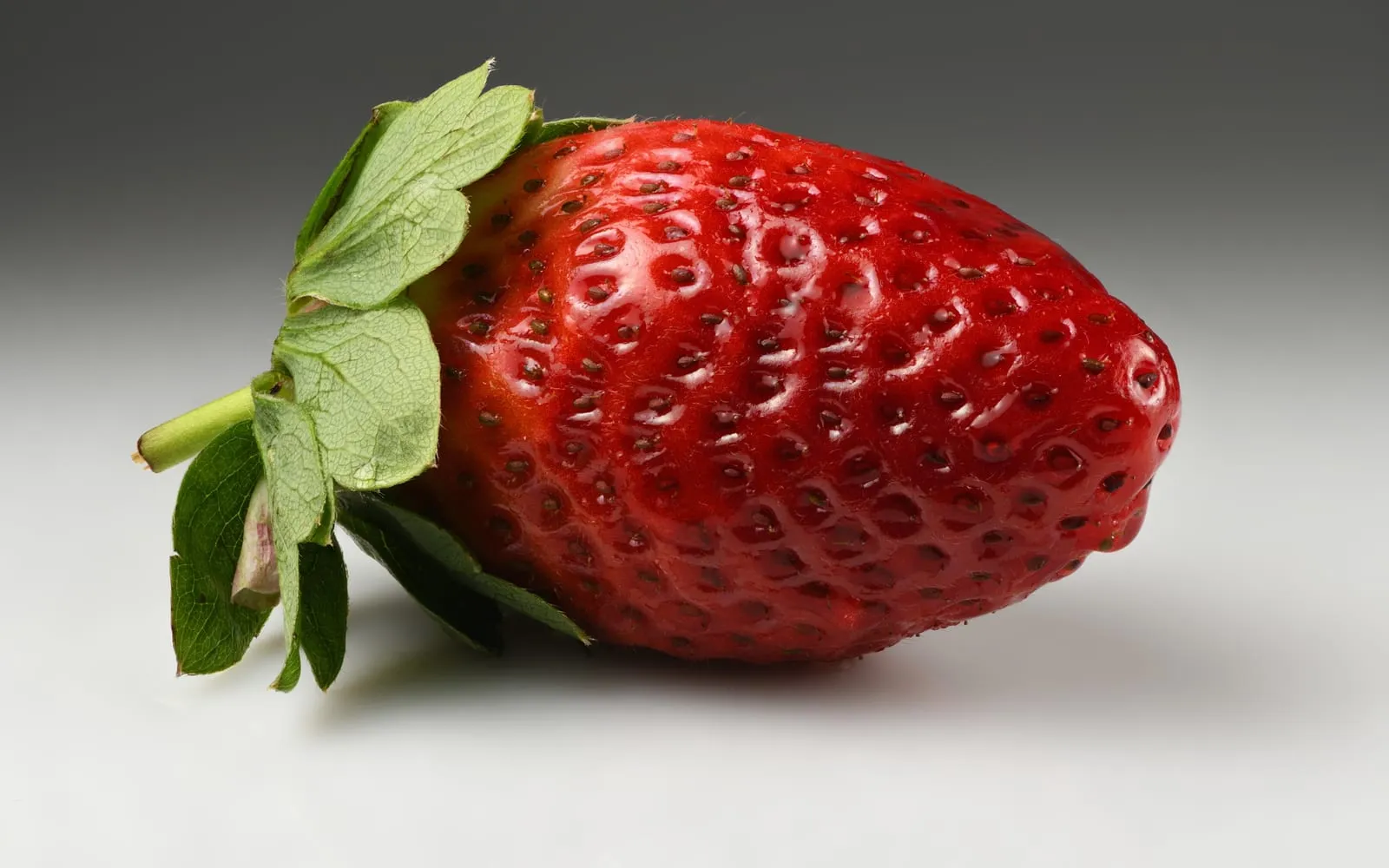
The fruit is not a berry in the botanical sense. The fleshy red part is a swollen flower base, and the true fruits are the small pips embedded in its surface, each one a separate dry fruit containing a seed. This is why a strawberry has its seeds on the outside.
Flavour depends heavily on sun in the last week of ripening. The same variety picked after a bright dry week and a dull wet one tastes like two different fruits.
Where it is from
Neither parent is European. Fragaria chiloensis comes from the Pacific coast of Chile and Argentina, where it grows on sand dunes and coastal grassland, and Fragaria virginiana comes from eastern North America.
The Chilean parent contributes size and the tolerance for coastal sand, which is why strawberries do well in free-draining soil and resent heavy wet clay. The American parent contributes flavour and hardiness.
Both are plants of open ground rather than woodland, which explains the demand for full sun.
How it grows
A perennial that behaves like a short-lived one. Each crown cropping heavily for two or three years before vigour and fruit size fall away, so the standard practice is to replace a bed every third year using rooted runners.
Two cropping habits are sold. Summer-fruiting varieties give one heavy crop over two or three weeks in June and July, and set their flower buds the previous autumn in response to shortening days. Perpetual or everbearing varieties crop in smaller flushes from June to October and are less dependent on day length.
Runners are the propagation method and cost nothing. Peg a runner into a pot of compost sunk beside the parent in July, sever it once rooted in about six weeks, and plant it out in autumn for a crop the following summer.
Planting depth decides survival. The crown must sit exactly at soil level. Buried crowns rot and exposed ones dry out.
Through the seasons
Spring brings growth and flowering. Protect open flowers from late frost with fleece, since a frosted flower shows a black centre and will never set fruit. Tuck straw under developing trusses.
Summer is cropping, then runner management. Pick every day or two in warm weather. After the last fruit, cut the old leaves off summer-fruiting plants about 8 cm above the crown and clear away the straw.
Autumn is for planting new runners and for the flower buds of next year to form. Feed after harvest rather than before.
Winter is dormancy. Plants need the cold. Container plants can be left outside, and the main risk is waterlogging rather than frost.
Care difficulty
Moderate, and the difficulty is that several separate things all want doing at the right moment.
Straw or matting has to go under the fruit before it touches soil, or grey mould and slugs take it. Netting has to go on before the fruit colours, or birds take it. Runners have to be removed from cropping plants or the crop shrinks, and kept from the plants you want to propagate.
None of these is difficult. Missing any one of them costs a noticeable share of the harvest.
Watering
Water regularly from flowering onward. This is when the crop is made, and water stress now gives small, hard, seedy fruit.
Water at the base and keep it off the fruit and leaves. Wet ripening fruit becomes grey mould within a day or two in warm weather.
Morning is better than evening, so anything splashed has the day to dry.
Containers and growbags need daily attention in summer, sometimes twice.
Ease off after the harvest, though never to the point of drought, because autumn is when next year’s flower buds form.
Warning signs, diseases and pests
Grey mould, Botrytis cinerea, is the biggest single loss. Fruit develops a soft brown patch and then a grey fuzz, and it spreads to whatever it touches. Keep fruit off the soil with straw, space plants for airflow, water at the base, and remove every mouldy fruit the moment you see it rather than leaving it.
Vine weevil is the serious pest, and worst in containers. The adults notch neat semicircles from leaf edges, which is harmless, while the grubs eat the roots and the first sign is often a plant that collapses. Biological control with nematodes in spring and again in early autumn is the effective treatment.
Birds strip ripening fruit within hours. Netting stretched over a frame works; netting draped straight on the plants lets birds peck through it and traps wildlife.
Slugs and snails hollow out fruit from underneath.
Powdery mildew curls leaf edges upward and shows a white bloom on the undersides, mostly on stressed or crowded plants.
Red or purple leaf blotching in autumn is generally normal ageing rather than disease.
Spotted wing drosophila lays eggs in fruit while it is still ripening, so berries that looked perfect can collapse into a soft, maggot-filled mess within a day. It has been established across North America and Europe since 2008 and remains a quarantine priority in Australia and New Zealand. Pick promptly and cover the crop with fine mesh where it occurs.
Growing environment
Full sun. Strawberries tolerate partial shade and give you a smaller, less sweet crop for it.
Hardy through any temperate winter. Most cultivars need a period of winter chill to crop properly, so a mild winter cuts the yield. Frost during flowering is the real danger, and fleece over the plants on clear nights in April and May saves the crop.
Soil should be fertile, free-draining and slightly acid, around pH 6 to 6.5. Dig in plenty of compost or well-rotted manure before planting. Avoid ground that grew potatoes, tomatoes or strawberries recently, because they share verticillium wilt.
Spacing at 35 to 45 cm apart in rows 75 cm apart gives the air movement that keeps mould down.
Containers, hanging baskets and towers all work and have the advantage of keeping fruit away from slugs.
Feeding
Feed with a high-potassium liquid fertiliser fortnightly from the first flowers until the last fruit. Tomato feed is exactly right.
After cropping, switch to a balanced feed to build the crown and support the flower buds forming for next year.
Avoid heavy nitrogen at any point. It gives large soft leaves, a mass of runners, and soft fruit that moulds.
Top-dress with compost in spring, keeping it clear of the crown itself.
Troubleshooting
Small, hard, seedy fruit. Water stress during fruiting, or exhausted three-year-old plants. Water more and start a new bed from runners.
Misshapen fruit with hard green patches. Poor pollination, often from cold weather or a shortage of insects during flowering. Grow flowers nearby, and ventilate anything under cover.
Fruit rotting on the plant. Grey mould. Straw underneath, water at the base, space the plants, and remove affected fruit immediately.
Flowers with black centres. Frost damage. Those flowers will not set. Fleece the plants on cold clear nights next spring.
Plant collapses suddenly, roots eaten away. Vine weevil grubs. Treat with nematodes and repot in fresh compost.
Masses of runners and little fruit. Too much nitrogen, or the variety is being allowed to spend everything on spreading. Remove runners from cropping plants.
Yields falling every year. Normal after year three. Replace the bed with rooted runners from your healthiest plants, in a different spot.
Strawberry problem guides
Not sure what is wrong? See the common vegetable pests guide.