
Edible
Cucumber
Cucumis sativus
Also known as Garden cucumber, Ridge cucumber
How to grow cucumbers, Cucumis sativus. Greenhouse and ridge types, training up strings, why fruit turns bitter, and the male flower rule that only applies to some varieties.
At a glance
- Difficulty
- Moderate
- Water
- Very frequently. Daily under glass in hot weather
- Light
- Full sun outdoors. Light shading under glass in midsummer
- Temperature
- 20-30 deg C. Growth stalls below 15, frost kills
- Hardiness
- USDA 10-11, RHS H1c, hardy to 2 C
- Type
- Tender annual
- Height
- 1-3 m
- Native to
- South Asia, most likely the foothills of the Himalaya
- Best month
- July in the Northern Hemisphere, January in the Southern Hemisphere
Soil below 15 deg C rots the seed, so a soil thermometer beats a calendar every time. The other half is pollination. Outdoor ridge cucumbers are monoecious and need insects, and the first dozen flowers are male, while all-female glasshouse cultivars set without pollen and turn bitter and club-shaped if a bee reaches them.
Hardiness zones describe winter cold alone. Summer heat, humidity, rainfall and the length of the growing season decide as much, so treat the range as the outer limit rather than as a recommendation.
Every month named in this guide is for the temperate Northern Hemisphere. If you garden in the Southern Hemisphere, shift each one by six months, so July becomes January. Closer to the equator the wet and dry seasons matter more than the calendar, and the shift stops being a useful guide.
Not known to be toxic
- Safe to eat
- The fruit
Non-toxic. The ASPCA lists Cucumis sativus as non-toxic to dogs, cats and horses, and cucumber does not appear on the RHS list of potentially harmful garden plants. The fruit is eaten raw in quantity and slices of it are a common dog treat. The one thing to know concerns bitterness rather than poisoning. Cucumbers contain cucurbitacins, bitter compounds concentrated in the skin and the stem end, and stressed plants produce more of them. A cucumber that tastes strongly bitter should be discarded rather than eaten, because very high cucurbitacin levels cause stomach upset, and there are documented cases of poisoning from bitter squashes and gourds grown from saved seed that had crossed with ornamental relatives. Shop-bought and commercially bred varieties have had the bitterness bred out. Taste the stem end of any home-grown fruit before serving it, and if it is bitter, bin it.
Sources: ASPCA (Cucumber, Cucumis sativus), RHS potentially harmful garden plants
About
Cucumbers come in two kinds that want quite different treatment, and buying the wrong one for your situation causes most of the trouble people have with them.
Greenhouse cucumbers are the long smooth ones. Modern varieties are all-female and set fruit without pollination, which is why they have no seeds worth mentioning. They need warmth and shelter and they crop heavily.
Ridge cucumbers are the shorter, rougher, often prickly outdoor types. They need insects to pollinate them, they crop without glass in a cool summer, and they taste more strongly of cucumber.
The male flower rule that circulates as universal advice applies to one of these and not the other.
Appearance and character
A vine climbing by coiled tendrils, with large triangular lobed leaves that are rough and slightly bristly. Left to itself it trails across the ground; given support it climbs to 2 or 3 m.
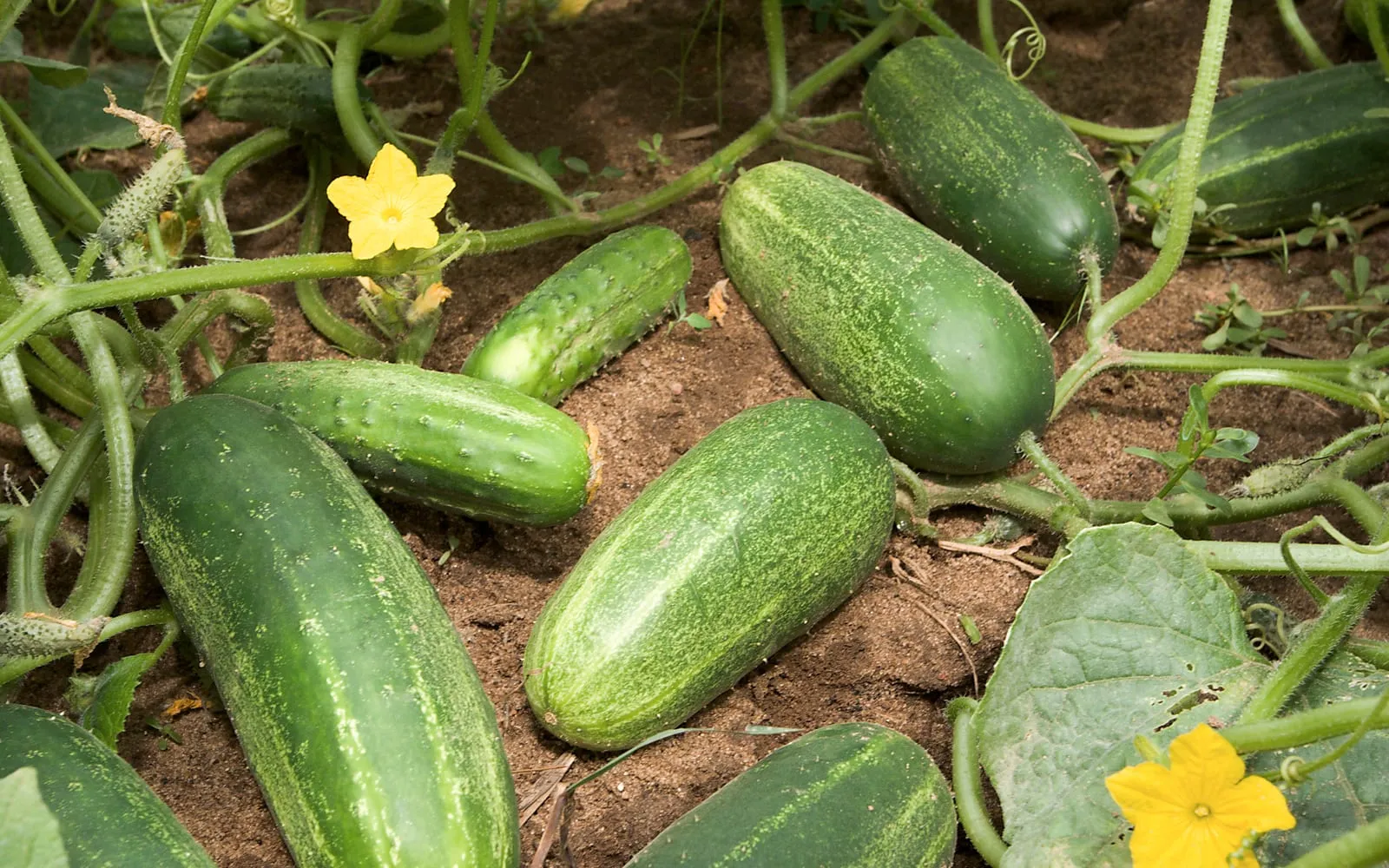
Flowers are bright yellow and five-petalled. On most varieties male and female flowers appear separately on the same plant, and the female is easy to identify by the miniature cucumber behind the flower.
Fruit ranges from 8 cm pickling gherkins to 40 cm greenhouse types, in smooth, ridged, spined and warted skins. Yellow, white and round varieties exist, including the lemon cucumber, which looks nothing like a cucumber and tastes exactly like one.
The characteristic flavour and the cool texture both come from very high water content, at around 96 per cent.
Where it is from
South Asia, most probably the Himalayan foothills of northern India, where the wild ancestor still grows and where cultivation goes back at least three thousand years.
The plant is built for warm humid monsoon conditions with abundant water and rich soil, and every requirement follows from that. It has no drought tolerance worth the name, no frost tolerance at all, and an appetite for water and nutrients that surprises people used to easier crops.
Cucumbers reached Europe via Greece and Rome, where Tiberius reportedly demanded them year round and had them grown in wheeled frames moved to follow the sun.
How it grows
A tender annual. Seed germinates in warmth at around 20 deg C in under a week, and the plant crops within twelve weeks of sowing.
Sow seed on its edge rather than flat, which reduces the chance of rot, in individual pots to avoid disturbing the roots later. Cucumbers dislike transplanting and a checked plant sulks for weeks.
Greenhouse types are trained up a single vertical string or cane, with the growing tip pinched out at the roof, and side shoots stopped two leaves beyond each developing fruit. Ridge types are left to sprawl or given netting, and the main shoot is pinched after six or seven leaves to encourage branching.
Picking drives production. A cucumber left to mature fully signals to the plant that it has reproduced, and cropping slows or stops. Cut fruit while it is firm and before it fattens.
Fruit forms fastest in warm weather, and a plant can go from flower to picking size in about ten days in July.
Through the seasons
Spring is sowing. Greenhouse varieties from March in a heated propagator, ridge varieties from late April indoors or late May outdoors. Plant out only once nights are reliably above 12 deg C.
Summer is the crop. Water daily under glass, feed weekly once fruit sets, train and pinch, and pick every two or three days. Shade the greenhouse glass lightly in midsummer, since intense direct sun scorches the leaves.
Late summer brings powdery mildew, which usually ends the season. Keep plants watered and ventilated to delay it.
Autumn finishes them. Clear the plants once cropping stops, and remove all debris from the greenhouse, since pests overwinter in it.
Care difficulty
Moderate. Cucumbers are hungry, thirsty and fussy about temperature, and none of that is difficult so much as demanding of consistency.
Water is the main thing. A cucumber plant in a greenhouse in July may need watering twice a day, and any check produces bitter, misshapen fruit.
Warmth is the second. These plants stop growing below 15 deg C, and a cold week in June sets them back further than the same week would set back a courgette.
The third is knowing your variety, since the pruning and pollination rules differ completely between greenhouse and ridge types.
Watering
Water very frequently and consistently. This is one of the thirstiest crops in the garden.
Under glass in hot weather, daily is the minimum and twice daily is common. Outdoors, water thoroughly every two or three days in dry spells.
Use tepid water rather than cold. Cucumbers are tropical and cold water at the roots checks growth, which matters most under glass where the difference is greatest.
Water at the base and keep the leaves dry, since wet foliage encourages powdery mildew.
Irregular watering is the direct cause of bitter and misshapen fruit. Steady moisture matters more than volume.
Mulch the soil to hold moisture, and damp down the greenhouse floor on hot days to raise humidity, which cucumbers like and red spider mite does not.
Warning signs, diseases and pests
Powdery mildew is close to inevitable by late summer. White powdery patches spread across the leaves and the plant declines. Water the roots well, ventilate generously, remove the worst leaves, and grow resistant varieties. A milk and water spray at one part in nine has some effect. Treat it as the natural end of the season rather than a failure.
Red spider mite is the greenhouse pest that ruins crops. Leaves become finely speckled and dull, then bronzed, with fine webbing between the stems. It thrives in hot dry air, so damping down the floor and misting suppress it. Biological control with Phytoseiulus persimilis works well.
Slugs and snails take young plants outdoors.
Whitefly cluster under the leaves and coat everything in sticky honeydew.
Cucumber mosaic virus mottles and distorts the leaves and stunts the plant. There is no cure, it is spread by aphids, and affected plants should be removed.
Bitter fruit has three causes, separated in the troubleshooting section.
Fruit that yellows and drops when small usually means the plant is short of water or has set more fruit than it can carry.
Cucumber beetle, a small yellow beetle either striped or spotted black, attacks outdoor ridge cucumbers across North and South America and matters more for what it spreads than what it eats. It can carry bacterial wilt, a disease with no cure that causes a milky ooze from a cut stem and kills the vine within weeks. Cover seedlings with row cover from planting to prevent it, since cucumber is one of the crops that rarely survives a confirmed infection. It has never established outside the Americas.
Growing environment
Full sun outdoors. Under glass, very intense midsummer sun scorches the large soft leaves, so light shading from June to August helps.
Warmth is the requirement that matters most. The productive range is 20 to 30 deg C, growth stalls below 15, and frost kills. Where summers are cool, greenhouse and polytunnel crops are earlier, longer and far more reliable than outdoor ones.
Soil should be rich, moisture-retentive and free-draining, with plenty of well-rotted manure or compost dug in. Cucumbers are gross feeders and reward preparation.
Humidity suits them, which is the opposite of most greenhouse crops and the reason cucumbers and tomatoes are an awkward pairing under the same roof. Tomatoes want dry air; cucumbers want it damp.
Supports go in at planting. Vertical strings, netting or canes all work.
Feeding
Feed weekly with a high-potassium tomato fertiliser once the first fruit starts to swell. Container and growbag plants may need it twice weekly.
Prepare the bed with plenty of organic matter before planting, since a cucumber takes far more out of the soil than most vegetables.
Do not start feeding before fruit sets. Early nitrogen produces a mass of leaf.
Magnesium deficiency, showing as yellowing between the veins on older leaves, is common on heavily fed plants. Correct it with Epsom salts.
Troubleshooting
Bitter fruit. Three possible causes. Irregular watering or temperature stress is the commonest. On all-female greenhouse varieties, pollination by a stray male flower makes seedy bitter fruit, which is why those flowers are removed. And saved seed that has crossed with an ornamental gourd can produce dangerous levels of bitterness, so bin any strongly bitter fruit.
Should I remove the male flowers? Only on all-female greenhouse varieties. Ridge cucumbers grown outdoors need their male flowers to set fruit at all.
Misshapen or curved fruit. Uneven watering or poor pollination outdoors.
White powder on the leaves in August. Powdery mildew. Water the roots, ventilate, and accept the season is ending.
Speckled bronzed leaves with fine webbing. Red spider mite. Damp down the greenhouse and introduce biological control.
Small fruit yellowing and dropping off. Water shortage, or the plant is carrying more than it can support. Water more and thin the fruit.
Plant stalled and sulking after planting out. Cold, or root disturbance. Cucumbers hate both. Fleece it and wait for warmth.
Cucumber problem guides
Not sure what is wrong? See the common vegetable pests guide.