
Houseplant
Croton
Codiaeum variegatum
Also known as Joseph's coat, Garden croton, Variegated laurel
How to care for Codiaeum variegatum. Why it drops every leaf when you move it, the light it needs for colour, treating red spider mite, and settling a new plant.
At a glance
- Difficulty
- Difficult
- Water
- When the top 2 cm of compost has dried
- Light
- The brightest position you have, including some direct sun
- Temperature
- 18-24 deg C. Never below 15 deg C
- Humidity
- High. Dry air is the main reason crotons fail indoors
- Hardiness
- USDA 10-12, RHS H1b, hardy to 15 C
- Type
- Evergreen shrub, long-lived in the right conditions
- Height
- 60-120 cm indoors
- Native to
- Indonesia, Malaysia, northern Australia and the western Pacific
- Best month
- January in the Northern Hemisphere, July in the Southern Hemisphere
Islands of the western Pacific and Malaysia. The colouring needs strong light, and a plant kept dim reverts to plain green. It drops its leaves after any sharp change in temperature or position. Outdoors year round in USDA 10 and warmer.
Hardiness zones describe winter cold alone. Summer heat, humidity, rainfall and the length of the growing season decide as much, so treat the range as the outer limit rather than as a recommendation.
Every month named in this guide is for the temperate Northern Hemisphere. If you garden in the Southern Hemisphere, shift each one by six months, so January becomes July. Closer to the equator the wet and dry seasons matter more than the calendar, and the shift stops being a useful guide.
Toxic if eaten
- Do not eat
- Every part, and the milky sap and the seeds above all
- Harm from
- Eating it and handling it
- Affects
- People, cats and dogs
Croton belongs to the spurge family, and like its relatives it bleeds a milky latex when cut. That sap contains irritant diterpene esters, and it causes redness, itching and blistering on skin and severe irritation in the eye. Wear gloves when pruning or taking cuttings, avoid rubbing your eyes, and wash your hands afterwards. Eating the leaves causes burning of the mouth, vomiting and diarrhoea in people, cats and dogs, and the ASPCA lists croton as toxic to both animals. The seeds are considerably more dangerous than the foliage, containing higher concentrations, and they are rarely produced on an indoor plant. Reports of serious poisoning are uncommon because the sap tastes foul and the leaves are tough. The risks in practice are a dog chewing a fallen leaf and a gardener getting sap in an eye after pruning without gloves. This plant is not the same as the botanical genus Croton, which is a separate group in the same family, and the confusion persists in older books. It is also unrelated to laurel despite sometimes being sold as variegated laurel.
Sources: ASPCA (Croton, Codiaeum variegatum), RHS potentially harmful garden plants
About
A croton carries more colour in its leaves than most plants manage in flower. Green, yellow, orange, scarlet and near-black appear on the same plant, often on the same leaf, and the effect in January is worth a good deal of trouble.
The trouble arrives immediately. Crotons drop their leaves in response to almost any change, and a plant bought in a warm humid garden centre and carried home through a cold car park will often be half bare within a fortnight. This is normal, it is not a sign that the plant is dying, and it stops once the plant has settled.
The two things that decide long-term success are light and humidity. A croton needs the brightest spot in the house to hold its colour, and it needs air that a centrally heated room does not provide on its own.
Appearance and character
An evergreen shrub, upright and bushy when young, becoming woody and leggy with age, reaching 60 to 120 cm indoors.
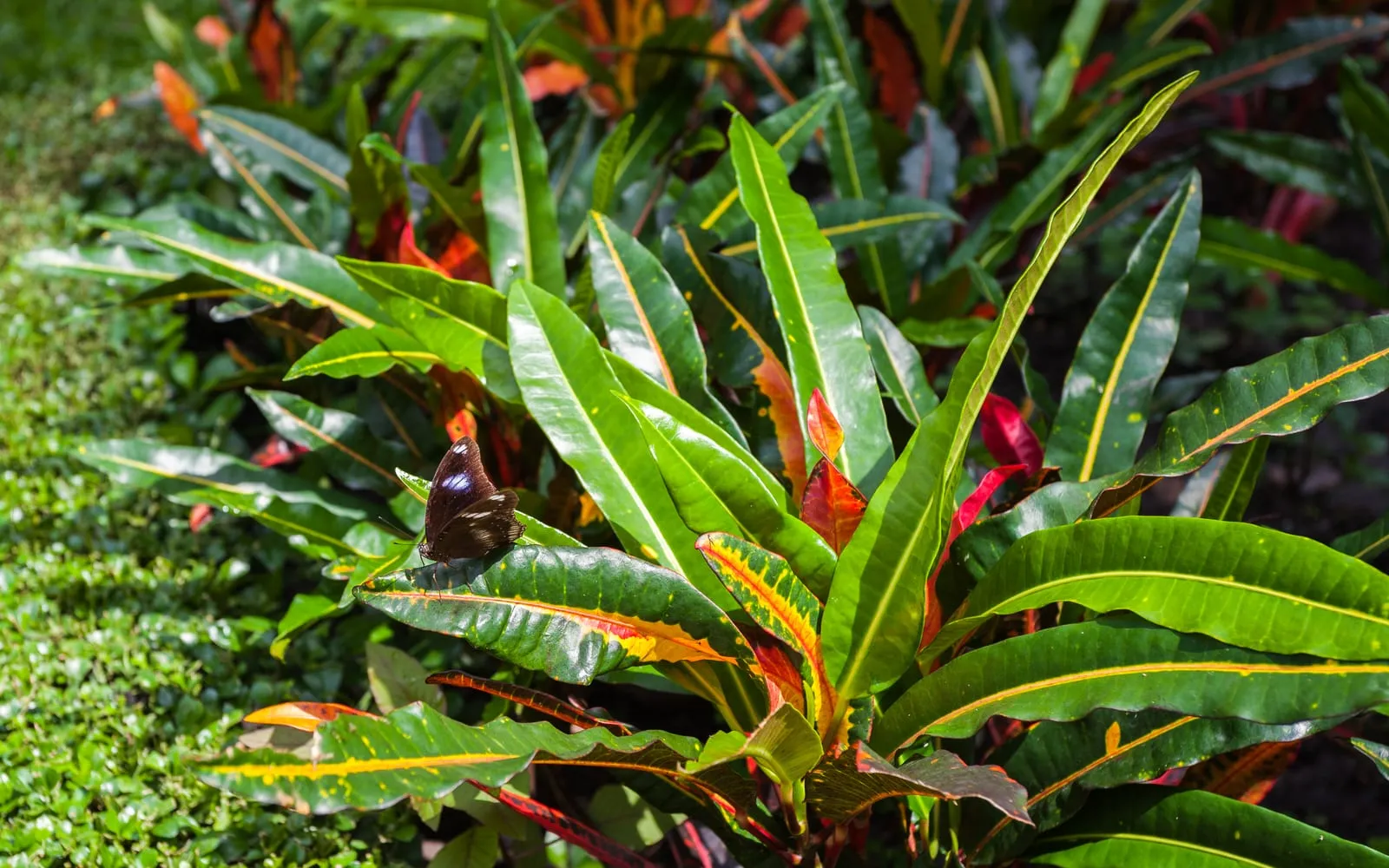
Leaves are thick, leathery and highly glossy, and their shape varies enormously between varieties. They may be broad and oval, long and strap-like, twisted into spirals, or reduced to a narrow midrib with paddle-shaped blades along it.
Colour develops with light and with age. New leaves usually emerge green or yellow and darken through orange to red and purple as they mature, so a single plant shows the whole range at once.
The veins are picked out in a contrasting colour, most often bright yellow or red, which is the plant’s most distinctive feature.
Stems bleed a milky white latex when cut.
Flowers appear rarely indoors, as insignificant small white blooms on a long stalk, and they are worth removing.
Varieties differ widely. ‘Petra’ is the common broad-leaved form with yellow and red veining, ‘Mammy’ has twisted narrow leaves, ‘Gold Dust’ is green speckled with yellow, and ‘Mrs Iceton’ turns deep red and near-black.
Where it is from
Indonesia, Malaysia, northern Australia and the islands of the western Pacific, where it grows as an understorey and forest-edge shrub in humid tropical conditions.
Forest edge is the important detail. Unlike most houseplants of tropical origin, croton grows in bright light rather than deep shade, which is why it needs so much more light indoors than people expect.
Constant warmth and high humidity year-round explain the intolerance of cold and dry air.
It is grown as a garden hedge and boundary marker across the tropics, where plants reach 3 m and colour intensely in full sun.
In parts of the Pacific it has ceremonial significance and is planted around meeting houses and burial grounds.
The name Codiaeum comes from a Malay word for the plant. The common name croton comes from an earlier misclassification and has stuck.
How it grows
Give it the brightest position in the house. A south or west-facing window with some direct morning or late afternoon sun is right, and a shaded corner produces a green plant.
Keep it warm and steady, 18 to 24 deg C, and never below 15 deg C. Sudden temperature changes cause leaf drop.
Raise the humidity. A tray of damp pebbles, a group of plants, a bathroom, or a humidifier all work, and misting alone achieves very little.
Water when the top 2 cm of compost has dried, using tepid water, and let the pot drain completely.
Feed fortnightly from April to September with a balanced houseplant fertiliser.
Expect leaf drop for two to four weeks after bringing a plant home or moving it. Choose the position first, put it there, and leave it alone.
Wipe the leaves with a damp cloth regularly. It keeps them glossy and it is the best early warning for red spider mite.
Prune in spring to keep it bushy, cutting back to just above a leaf node, and wear gloves.
Propagate from tip cuttings in spring. Dip the cut end in water to stop the latex flowing, then in rooting hormone, and root in a warm humid propagator.
Through the seasons
Winter is the testing season. Light is scarce and heating dries the air, which is exactly what a croton dislikes. Move it to the brightest window, keep the humidity up, water sparingly, and stop feeding.
Spring is recovery and pruning. Cut back leggy growth, repot if needed, take cuttings, and resume feeding.
Summer is the growing season and the best colour. Water when the surface dries, feed fortnightly, and watch closely for red spider mite in hot weather.
Autumn is the wind-down. Reduce watering and feeding and move it away from any window that gets cold at night.
Care difficulty
Difficult, and it is one of the few common houseplants that earns that rating.
Leaf drop makes it look like a failure when it is settling in. A plant that loses half its leaves after being moved is behaving normally, and it will releaf.
Light is the requirement most people underestimate. Crotons need far more than the average foliage houseplant and lose their colour without it.
Humidity is the second, and a centrally heated room in winter is persistently too dry.
Red spider mite is attracted to crotons more than to most plants and thrives in exactly the conditions that stress them.
Anyone who can supply a bright humid position will find it grows steadily and lives for years.
Watering
Water when the top 2 cm of compost has dried, which in summer often means twice a week and in winter every ten days or so.
Use tepid water rather than cold, since cold water triggers leaf drop.
Water thoroughly and drain completely. Never leave the pot standing in water.
Keep the compost lightly moist rather than either sodden or bone dry. Crotons dislike drying out and drop leaves when they do.
Raise the humidity rather than watering more. The commonest mistake is responding to dry-air symptoms by overwatering the roots.
Rainwater or filtered water suits it better than hard tap water.
Warning signs, diseases and pests
Leaf drop is the complaint that dominates. Crotons shed leaves in response to a change of position, a draught, cold water, a temperature drop, dry air, or drying out at the roots. After a move it is normal and temporary. Ongoing leaf drop in a settled plant means one of the conditions is wrong, and cold draughts and dry air are the usual causes. Choose the position carefully and stop moving the plant.
Red spider mite is the pest to expect. Fine pale stippling on the upper surface, a dull dusty look, and fine webbing between leaves and stems. It multiplies fast in hot dry air. Raise the humidity, wipe the leaves regularly, and treat promptly, since a heavy infestation is very hard to clear.
Colour fading to plain green means insufficient light. Move it somewhere brighter.
Brown crispy leaf edges and tips point to dry air or to drying out at the roots.
Bleached pale patches on the leaves are sun scorch, which happens when a plant accustomed to shade is moved abruptly into strong sun.
Mealybug and scale both attack crotons, appearing as white cottony masses and flat brown discs on the stems and leaf undersides.
A bare woody stem with leaves only at the top means the plant needs cutting back in spring.
Growing environment
The brightest position available, including a few hours of direct sun in the morning or late afternoon. This is not a low-light plant.
Steady warmth between 18 and 24 deg C, and never below 15 deg C.
High humidity. A bathroom with a bright window is close to ideal, and elsewhere a pebble tray and grouped plants help.
Away from draughts, external doors, radiators and cold glass. Draughts cause more leaf drop than anything else.
Free-draining peat-free compost with added perlite, in a pot with drainage holes.
Choose the final position before you take it out of the sleeve, and leave it there. Crotons object to being moved.
Out of reach of pets and small children, since the sap irritates and the leaves cause vomiting.
Feeding
Feed fortnightly from April to September with a balanced liquid houseplant fertiliser at the stated strength.
Stop feeding from October to March, when the plant is not growing.
Repot every two years in spring, or top-dress a large plant.
Avoid feeding a plant that has just dropped its leaves after a move. Let it settle and re-leaf first.
Flush the compost through with plain water occasionally to clear fertiliser salts.
Troubleshooting
It dropped all its leaves after I brought it home. Normal. Crotons shed leaves in response to any change of conditions. Put it in its final position, keep it warm and humid, water carefully, and it will re-leaf over several weeks.
The colours have faded to green. Not enough light. A croton needs the brightest spot in the house, including some direct sun, to hold its colour.
Fine speckling on the leaves and webbing between the stems. Red spider mite. Crotons are very prone to it in dry heated air. Raise the humidity, wipe the leaves, and treat quickly.
Brown crispy leaf edges. Dry air or the roots drying out. Raise the humidity and keep the compost lightly moist.
It keeps dropping leaves even though it has not been moved. Look for a cold draught, a radiator nearby, cold water, or a window that gets cold at night.
Can I cut it back? Yes, in spring, to just above a leaf node. Wear gloves, since the cut stems bleed irritant latex. The prunings root as cuttings in a warm humid propagator.
Why is it called a croton if it is a Codiaeum? An early misclassification that stuck. The genus Croton is a separate group in the same family.
Is it safe with a dog? No. The sap irritates skin and eyes, and eating the leaves causes vomiting and diarrhoea. Keep it out of reach.
Croton problem guides
Not sure what is wrong? See the common houseplant pests guide.