
Outdoor plant
Damask Rose
Rosa damascena
Also known as Rose of Castile, Attar rose, Bulgarian rose
How to grow the damask rose, Rosa damascena. Pruning a once-flowering old rose, the difference between summer and autumn damasks, and where rose oil comes from.
At a glance
- Difficulty
- Easy
- Water
- Weekly in dry spells, more in the first two summers
- Light
- Full sun. Six hours minimum for scent and flower count
- Temperature
- Fully hardy, to about -20 deg C
- Hardiness
- USDA 4-9, RHS H6, hardy to -25 C
- Type
- Deciduous shrub, long-lived
- Height
- 1.2-2.2 m
- Native to
- Western Asia, as an ancient garden hybrid
- Best month
- May in the Northern Hemisphere, November in the Southern Hemisphere
It flowers once, on last year wood, so pruning in winter removes the flowers and the time to cut is straight after the display. Rose oil is distilled from this species commercially in the Bulgarian Valley of Roses and around Isparta in Turkey, where hot dry summers and cold winters concentrate the oil. Blackspot is far worse in warm humid summers than in dry ones.
Hardiness zones describe winter cold alone. Summer heat, humidity, rainfall and the length of the growing season decide as much, so treat the range as the outer limit rather than as a recommendation.
Every month named in this guide is for the temperate Northern Hemisphere. If you garden in the Southern Hemisphere, shift each one by six months, so May becomes November. Closer to the equator the wet and dry seasons matter more than the calendar, and the shift stops being a useful guide.
Not known to be toxic
Non-toxic. The ASPCA lists Rosa species as non-toxic to dogs, cats and horses, and roses do not appear on the RHS list of potentially harmful garden plants. Damask rose petals are eaten, and have been for centuries, in rose water, Turkish delight, jams and the Persian spice blend advieh. Hips are edible too once the irritant hairs inside are removed. The genuine hazard here is mechanical rather than chemical: the thorns are numerous and sharp, and a deep scratch from any rose can introduce the soil bacterium that causes tetanus, or in rare cases the fungus behind sporotrichosis, so wear gloves when pruning and keep a tetanus booster current if you garden regularly.
Sources: ASPCA (Rose, Rosa species), RHS potentially harmful garden plants
About
The damask rose is grown for its scent above everything else. It is the rose behind attar of roses and rose water, and the perfume industry still turns to it rather than to any modern hybrid, because nothing bred since has matched the depth of it.
Two places dominate production. The Valley of the Roses around Kazanlak in Bulgaria and the district around Isparta in Turkey between them supply most of the world’s rose oil, with Kashan in Iran a third centre. Picking starts before dawn and stops by mid-morning, because the volatile oil evaporates once the sun is on the flowers. It takes roughly three to four tonnes of petals to make a single kilogram of oil.
In a garden it is a large, thorny, arching shrub that flowers once, gloriously, in June.
Appearance and character
An upright shrub becoming arching with age, armed with numerous hooked thorns of mixed sizes, and inclined to sucker from the base. Growth reaches 1.2 to 2.2 m in most gardens.
Leaves are divided into five or seven oval, downy, grey-green leaflets, softer and duller than the glossy foliage of modern roses.
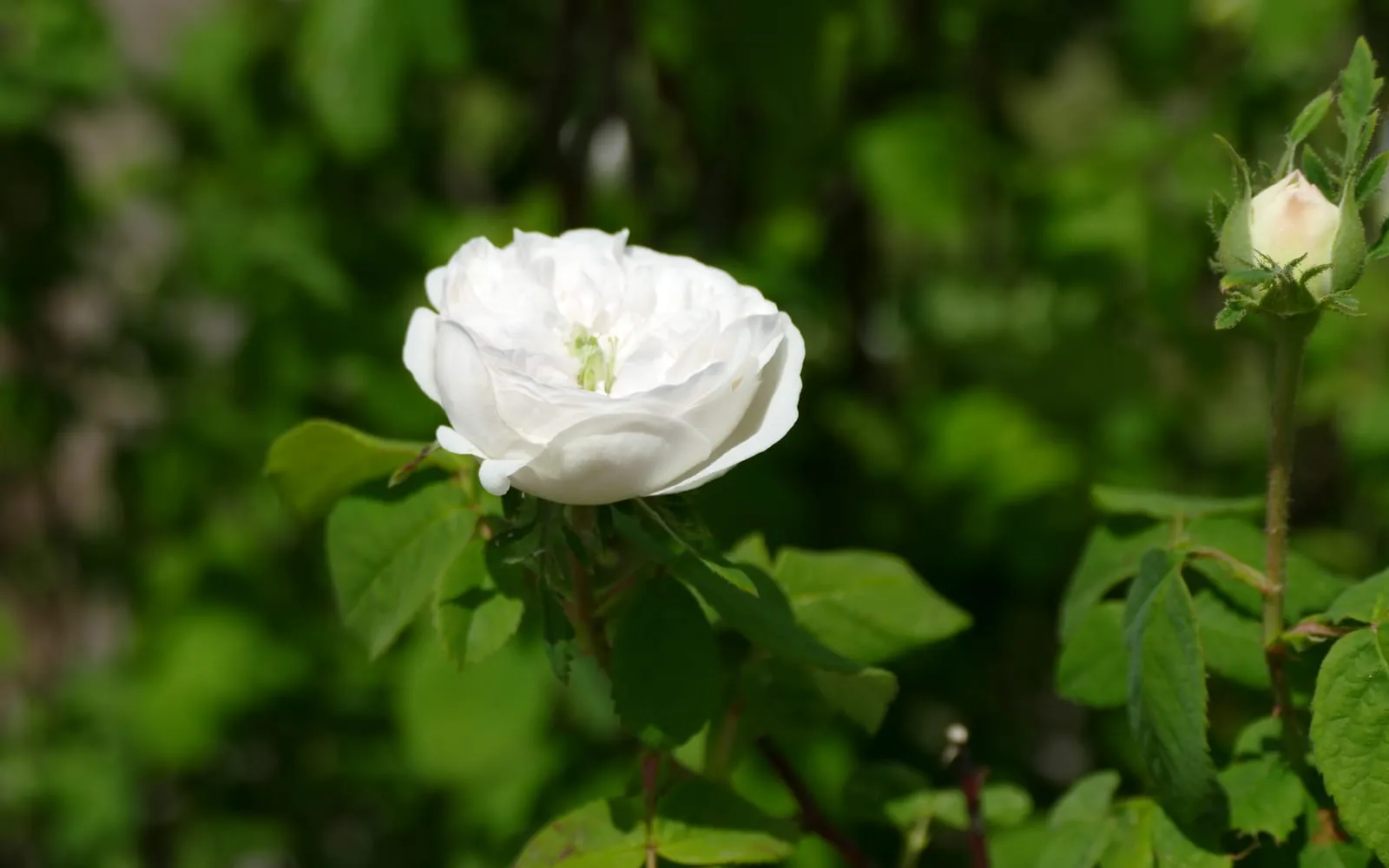
Flowers come in loose clusters of six to twelve, semi-double to double, in clear pink or white, with petals that fall cleanly rather than browning on the bush. The classic cultivar ‘Madame Hardy’, raised in 1832, is white with a small green eye at the centre.
The scent is the point. It is deeper and sweeter than a hybrid tea, with a honeyed quality, and it carries several metres on a still warm evening.
Hips are red, elongated and bristly, and they follow if the flowers are left undeadheaded.
Where it is from
The damask rose is an ancient garden hybrid rather than a wild plant. Genetic work points to a cross involving Rosa gallica, Rosa moschata and Rosa fedtschenkoana, which places its origin somewhere in western Asia, and it has been in cultivation for well over two thousand years.
It came to western Europe through the Middle East, and the name records a route through Damascus rather than a birthplace.
The parentage explains the plant’s habits. Rosa gallica contributes hardiness and suckering, Rosa moschata contributes the scent and the arching growth, and the third parent contributes the repeat-flowering that some damasks show.
How it grows
A deciduous shrub flowering on wood made the previous year. This is the fact that governs pruning, and it is where most damage is done, because the standard advice for modern roses is to prune hard in late winter, which on a damask removes the entire flowering wood.
Two groups are sold. The summer damask flowers once, over three or four weeks in June, and then makes next year’s growth. The autumn damask, sold as ‘Quatre Saisons’ or Rosa damascena var. semperflorens, gives a second lighter flush in early autumn and was for centuries the only repeat-flowering rose available in Europe.
Suckers appear around the base of plants grown on their own roots and can be detached in autumn to make new plants. On a grafted plant, suckers come from the rootstock and must be pulled off rather than cut.
Layering works well. Peg a low branch into the soil in summer, and it roots by the following spring.
Through the seasons
Winter is for the light structural work only. Remove dead, damaged and crossing wood in February, and leave the rest alone.
Spring brings growth. Feed in March with a rose fertiliser and mulch thickly with well-rotted manure, keeping it clear of the stems.
Summer is flowering, through June and into July. Prune immediately after the flowers finish, cutting back the flowered shoots by about a third and removing a couple of the oldest stems at the base. Feed again once pruning is done.
Autumn is for planting new bushes, taking hardwood cuttings, and clearing fallen leaves so blackspot spores do not overwinter under the plant.
Care difficulty
Easy, and considerably tougher than a modern hybrid tea, provided you prune at the right time.
Prune after flowering rather than in late winter. A damask cut back hard in February will make plenty of growth and produce almost no flowers that year.
The other adjustment is expectation. This is a large shrub with one spectacular flowering season rather than a plant that performs from June to October. Give it space at the back of a border, or grow it as an informal hedge, and judge it on scent.
Watering
Water weekly in dry spells, and more attentively for the first two summers while the roots go down.
Give a proper soak rather than a daily sprinkle. Roses are deep-rooted and a light watering encourages surface roots that then suffer.
Water at the base and keep it off the leaves. Wet foliage in the evening is how blackspot and mildew get established.
Established plants in reasonable soil ride out most cool summers without any watering at all.
A thick mulch does more than extra water, holding moisture and suppressing the weeds that compete at the base.
Warning signs, diseases and pests
Blackspot is the common disease of roses in any climate with warm wet summers, showing as dark blotches with fringed edges on the leaves, which then yellow and drop. Old roses vary in susceptibility and damasks are moderately resistant. Collect and bin fallen leaves rather than composting them, mulch in spring to stop spores splashing up, prune for an open centre, and feed well so the plant can outgrow it.
Powdery mildew coats young shoots and buds with a white bloom, and it is worse on dry-rooted plants against a wall. Water the roots and improve air movement.
Rose aphids cluster on flower buds and soft new growth in spring. They rarely threaten an established shrub. Squash them, wash them off with water, or leave them for the ladybirds and blue tits.
Rose rust shows as orange pustules on the leaf undersides, mostly in wet summers. Remove affected leaves.
Blind shoots, meaning strong stems that end without a flower bud, are common and need cutting back to a healthy bud lower down.
Growing environment
Full sun, with six hours a day as the minimum. Scent production falls off markedly in shade, and so does flower count.
Fully hardy to about -20 deg C. This is a considerably tougher plant than most modern roses.
Soil should be deep, fertile and moisture-retentive while still draining, and damasks do well on clay improved with organic matter. They tolerate a wider pH range than many roses, and are happy on chalk.
Give it room. A mature damask is 2 m across as well as tall, and crowding it brings mildew.
Avoid replanting a new rose where an old one has been, because rose replant disease will stunt it. Change the soil in the planting hole if you have no choice.
Feeding
Feed twice a year. A rose fertiliser in March as growth starts, and a second application immediately after the summer pruning to support the wood that carries next year’s flowers.
Mulch with well-rotted manure or garden compost in spring, laid 5 to 8 cm thick over damp soil and kept away from the stems. This does more for a damask rose than anything else in the calendar.
Stop feeding by the end of July. Late nitrogen produces soft growth that frost damages.
Troubleshooting
Plenty of growth, no flowers. Almost always pruning at the wrong time. This rose flowers on last year’s wood, so prune after flowering and never in late winter.
Black blotches on yellowing leaves. Blackspot. Clear fallen leaves, mulch, open up the centre of the bush, and feed.
White powdery coating on buds and shoots. Powdery mildew, usually from dry roots. Water deeply and mulch.
Shoots coming up a metre away from the plant. Suckers. On an own-root plant these are free new roses. On a grafted plant, trace them to the root and pull them off rather than cutting.
Flowers over in three weeks. Normal for a summer damask. For a second flush, grow the autumn damask ‘Quatre Saisons’ instead.
Scent much weaker than expected. Cool dull weather, too much shade, or picking in the afternoon. The oil is strongest on a warm morning.
New rose sulking where an old one was removed. Rose replant disease. Lift it, replace the soil in the hole with soil from elsewhere in the garden, and replant.
Damask Rose problem guides
Not sure what is wrong? See the common rose problems guide.